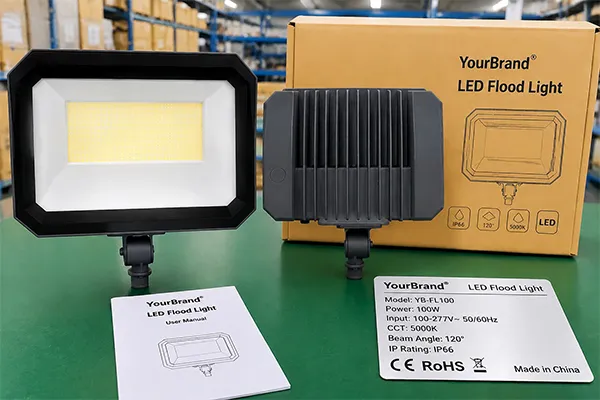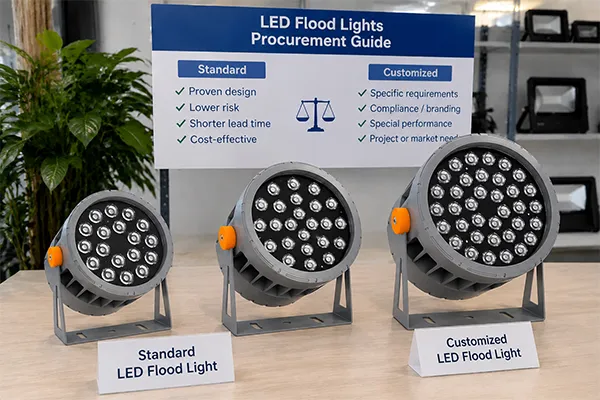
Custom LED flood light manufacturing can become confusing when brands begin with a long list of isolated requests: more watts, higher lumens, a new housing color, or a different beam angle. Those choices can conflict with cost, heat control, compliance, and delivery targets.1 I recommend starting with a complete product brief that a manufacturer can turn into a repeatable specification.
Custom LED flood light manufacturing works best when a brand defines its application, target market, price position, expected volume, and performance requirements before selecting individual product options. A qualified OEM/ODM manufacturer can then align wattage, optics, drivers, thermal design, finish, packaging, testing, and documentation into a product specification that is practical to produce at scale.
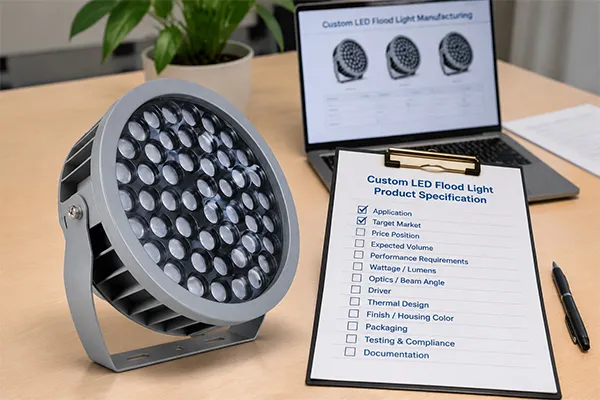
In OEM/ODM discussions, I often see brands arrive with a strong visual concept but incomplete commercial requirements. The deeper work is not simply choosing components. It is deciding how every product decision supports the intended customer, sales channel, installation environment, and long-term supply plan.
How Should Brands Start Custom LED Flood Light Manufacturing?
A brand may ask for a “custom floodlight” without first defining where it will be installed or who will buy it. That gap can lead to inappropriate performance targets, incompatible components, and quotations that cannot be compared fairly. I encourage brands to begin custom LED flood light manufacturing with a structured product brief.
Brands should start custom LED flood light manufacturing by documenting the target application, installation environment, sales market, customer segment, target price, forecast order volume, and required product features. This information gives the manufacturer a basis for recommending a commercially suitable configuration rather than simply assembling a list of unrelated options.
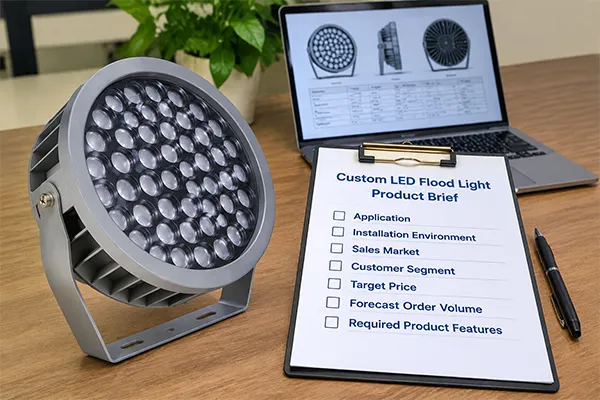
Build a Product Brief Before Requesting a Quote
I have found that the clearest OEM/ODM projects begin with questions that may seem commercial rather than technical. However, these questions often determine the technical path.
For example, a floodlight intended for a residential garden, a warehouse loading area, a sports facility perimeter, or a façade illumination project may require very different decisions.2 The same nominal wattage does not automatically serve each application well.3
A useful custom floodlight product brief should include the following information:
- Intended application: Security lighting, landscape lighting, industrial yard lighting, signage, façade lighting, parking areas, or general outdoor lighting.
- Installation environment: Wall mounting, pole mounting, ground installation, coastal environments, high-humidity areas, dusty locations, or high-ambient-temperature regions.
- Target customer: Electrical contractors, retailers, project buyers, distributors, online customers, or professional lighting installers.
- Target market: The country or region where the product will be sold and installed.
- Price position: Entry-level, mid-market, premium, or project-specific.
- Expected annual volume: Trial quantity, small-batch launch, regular container orders, or long-term program volume.
- Brand requirements: Logo treatment, housing color, label format, retail packaging, product photography needs, and instruction manual language.
- Commercial conditions: Desired MOQ, sample timing, target delivery window, and preferred shipping terms.
Why Product Position Comes Before Specifications
A product positioned as a value-oriented distribution item may need stable, readily available components and a simplified packaging approach. A premium branded floodlight may require more differentiation in finish, driver selection, labeling, or optical performance.
Neither approach is automatically better. The key is alignment.
| Product-brief factor | Why it matters in manufacturing | Example impact |
|---|---|---|
| Target market | Influences documentation, labeling, plugs, packaging language, and compliance review | A brand may need different carton markings for different markets |
| Installation environment | Affects housing, sealing approach, cable selection, and corrosion considerations | Coastal use may require additional material and finish review4 |
| Price position | Guides component selection and cosmetic expectations | Premium positioning may require tighter appearance standards |
| Order volume | Influences customization feasibility and procurement planning | A custom housing color may be more practical at planned repeat volumes |
| Sales channel | Changes packaging and accessory needs | Retail packaging differs from bulk project packaging |
In my pre-sales coordination work, I try to clarify whether a request is intended for a one-time project or a long-term branded product line. This distinction matters. A one-off project can sometimes accept a more specific configuration. A recurring SKU needs a more stable supply-chain strategy, clearer component control, and realistic replenishment planning.
A specification is not complete because it has many numbers. It is complete when the factory, brand, and purchasing team share the same understanding of what the product must achieve commercially and operationally.
Brands should also involve technical and commercial stakeholders early. A purchasing manager may focus on target cost and delivery. A product manager may focus on appearance and market differentiation. A technical lead may focus on installation and performance. I believe the strongest product brief combines these viewpoints before sampling begins.
Which Specifications Interact in a Custom LED Flood Light?
Brands sometimes treat wattage, lumen output, beam angle, CCT, driver type, and housing color as separate checkboxes. This approach can create problems because each choice can influence heat management, optical behavior, cost, product size, and production feasibility. I recommend evaluating the full custom LED flood light specification as one connected system.
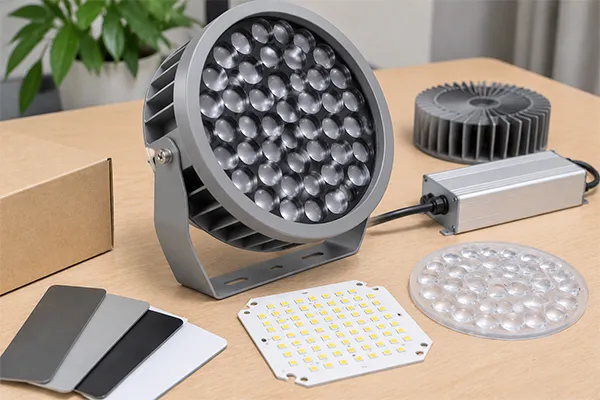
A custom LED flood light should be specified as a balanced system, not as isolated performance claims. Wattage, lumen output, LED configuration, beam angle, color temperature, driver design, thermal structure, housing finish, cable, packaging, and installation method can affect one another. Higher wattage or higher stated lumens are not automatically the best fit for every market or application.
Wattage and Lumens Need Context
Wattage is an electrical input value. Lumens describe light output.5 Neither figure alone defines product suitability.
A buyer should ask how the product will be installed, what area it is intended to illuminate, what beam pattern is required, and how the fixture will manage heat in its expected environment. A higher-wattage configuration may require a different housing size, heat-sink design, driver capacity, cable arrangement, or mounting bracket.6
In OEM/ODM discussions, brands often request the highest lumen figure available because they expect it to improve competitiveness. Yet the decision should be based on the market promise the brand can responsibly make and maintain. A product with an aggressively specified output may face greater pressure on thermal design, component selection, and consistency control.
I suggest that brands ask manufacturers to clarify:
- The LED and driver configuration proposed for the requested output.
- The thermal-management approach of the housing.
- The measurement and tolerance assumptions used in the quotation.
- The expected operating environment considered during specification discussions.
- Whether the proposed configuration is intended for long-term repeat production.
Beam Angle, CCT, and Optics Shape the Lighting Result
Beam angle is not merely a catalog option. It changes light distribution and affects how users perceive brightness and coverage.7 A wide beam may suit broad-area illumination, while a narrower distribution may suit more directional use. The right choice depends on mounting height, target area, spacing, glare expectations, and the lighting design.
Color temperature also has market and application implications. Common options include warm white, neutral white, and cool white, but a brand should define the expected CCT range and procurement consistency expectations.8 I recommend discussing color requirements early when a brand plans to sell the same SKU across multiple batches.
Housing Finish and Mechanical Details Also Matter
Housing color can be part of a brand identity, especially for premium or architectural ranges. Still, a custom surface finish should be reviewed alongside material, coating process, lead time, MOQ, and batch-to-batch color expectations.
Other details may include:
- Bracket shape and adjustment range
- Cable length and cable entry arrangement
- Connector requirements
- Brand logo position
- Product label layout
- Screws and visible hardware finish
- Retail box artwork or bulk carton markings
- Installation accessories
| Specification area | Connected considerations | Buyer question to ask |
|---|---|---|
| Wattage | Driver, LED board, heat sink, housing size | Is the housing configuration appropriate for this design? |
| Lumen target | LED selection, thermal design, measurement conditions | How is the quoted output target defined? |
| Beam angle | Lens or reflector, application, mounting height | What installation scenario is this optic intended to support? |
| CCT | LED binning, market preference, product range consistency | What CCT range should we specify for repeat orders? |
| Finish color | Coating process, MOQ, lead time, appearance control | What are the practical limits for custom color matching? |
| Packaging | Sales channel, shipping protection, labeling | Is this retail-ready or designed for project bulk supply? |
At Upward Lighting, I can coordinate customization discussions around color temperature, wattage, beam angle, CRI, and finish colors. However, I would not present any option as universally suitable. Brands should still obtain qualified professional review for application-specific lighting design, electrical installation, and local project requirements.
How Can Brands Move From a Floodlight Sample to Stable Production?
A visually acceptable sample can be an important milestone, but it does not prove that a product will remain consistent across repeat orders.9 Brands can face avoidable risk if they approve a sample without confirming the production configuration, component availability, testing scope, packaging requirements, and delivery assumptions. I recommend treating sample approval as the start of production validation, not the end.
Brands should evaluate custom LED flood light manufacturing beyond the sample stage by confirming the agreed bill of materials, production controls, component supply availability, aging-test process, packaging, MOQ, delivery conditions, and documentation. A successful sample should be assessed together with the factory’s ability to produce the same agreed configuration consistently at the planned order volume.
A Sample Answers Only Certain Questions
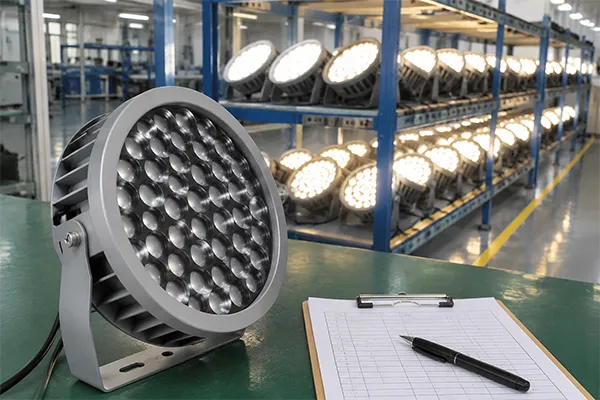
A sample can help a brand assess appearance, dimensions, mounting details, logo placement, packaging concept, and basic functional expectations. It can also reveal misunderstandings before a larger order is placed.
However, a sample may use components that need further supply confirmation. It may be hand-assembled with additional attention. It may not represent the exact packing flow used for regular production. Therefore, I advise brands to record the approved sample specification in writing.
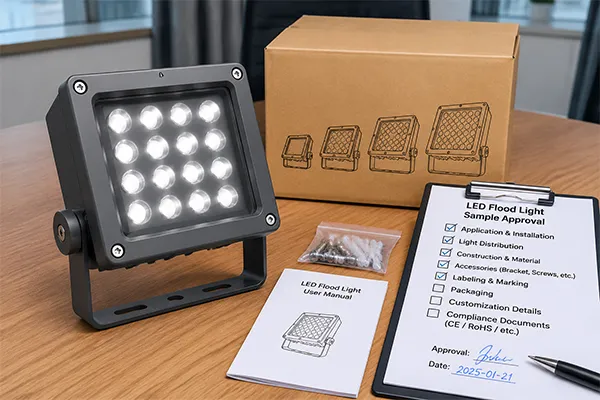
The sample approval record should identify:
- Model number and revision status
- Rated electrical parameters
- Requested CCT, CRI, and beam-angle configuration
- Housing color and finish description
- Driver and key component configuration, where commercially appropriate
- Cable, connector, and mounting-bracket details
- Label artwork and carton artwork version
- Required documents and test expectations
- Approved sample photographs
- Any tolerances or open points still requiring confirmation
Evaluate Production Consistency and Supply-Chain Readiness
During manufacturing discussions, I believe buyers should ask practical questions about how the product will be repeated. The goal is not to demand confidential factory information. The goal is to understand whether the proposal has a controlled path from sample to routine order.
At Upward Lighting, every product undergoes a 100% aging test before shipment, typically lasting 4 to 8 hours as part of our stated process.10 This process context can be relevant for buyers assessing quality-control practices. Still, I would not describe aging alone as a guarantee of field performance, application suitability, or lifetime in every environment.11
A broader production review can include:
| Production topic | What brands should clarify | Why it matters |
|---|---|---|
| Component sourcing | Whether key parts are available for repeat orders | Helps reduce unexpected configuration changes |
| Incoming inspection | How critical materials are checked | Supports consistency before assembly |
| Aging process | Duration, process scope, and records available | Helps buyers understand the factory’s stated QC workflow |
| Final inspection | Appearance, function, labeling, and packaging checks | Reduces avoidable shipment issues |
| MOQ | MOQ by model, finish, packaging, or custom feature | Prevents cost and lead-time surprises |
| Lead time | Sample, first order, and repeat order timing assumptions | Supports inventory planning |
| Change control | How component or artwork changes are communicated | Protects an approved product specification |
Compare Quotes Only After the Scope Is Equal
The lowest quote can be misleading when suppliers are quoting different configurations. One quotation may include a different driver, a different LED configuration, simpler packaging, no custom finish, or different delivery assumptions.
I have seen quotation discussions become much clearer when brands issue one agreed request-for-quotation document. Every supplier should quote against the same scope.
A comparable floodlight quotation should state:
- Product model and complete performance specification.
- Required customization details and artwork responsibilities.
- Quantity and MOQ assumptions.
- Packaging type, carton quantity, and marking requirements.
- Requested inspection or test expectations.
- Required certificates or supporting documents.
- Incoterms, port or destination assumptions, and freight treatment.
- Sample cost, tooling cost, or color-development charges, if applicable.
- Production lead time and payment assumptions.
For products intended for export, I also recommend treating compliance as an early input. Upward Lighting products may hold documents such as CE and RoHS for applicable product ranges, but buyers should verify the specific documents, product model coverage, validity, and relevance to the intended market. Country-specific certification, labeling, recycling, packaging, and electrical requirements can vary12 and should be confirmed with qualified local professionals or the relevant authority before launch.
Frequently Asked Questions
What is the typical MOQ for custom LED flood lights?
MOQ depends on the requested customization. A standard model with a label or packaging change may support a lower quantity than a custom housing color, dedicated optic, or special component configuration. I recommend asking for MOQ separately for the product, finish, packaging, and any customized accessory.
Can I customize wattage, CCT, beam angle, and housing color in one product?
A manufacturer may be able to customize several parameters together, but the combination should be reviewed as one specification. Wattage, output, optics, driver, thermal structure, finish, cost, and lead time can interact. I suggest confirming the complete configuration before approving a quote or sample.
Does an approved sample guarantee mass-production quality?
No. An approved sample helps confirm the requested design and basic configuration, but it does not guarantee long-term production consistency or field performance. Brands should also review component control, aging processes, final inspection, packaging, supply availability, and procedures for managing specification changes.
What documents should I request from an LED flood light manufacturer?
I recommend requesting a quotation with the full specification, product datasheet, drawings where needed, packing details, sample approval records, and relevant certification documents. Buyers should verify that documents apply to the exact model and intended market. Local compliance requirements should be checked independently.
Why do LED flood light quotes vary so much between suppliers?
Quotes often differ because suppliers are not quoting the same scope. Differences may include LED and driver configuration, housing weight, optics, cable, packaging, testing expectations, certifications, customization level, delivery terms, and quantity. I recommend comparing quotations only after each supplier receives the same written specification.
Conclusion
Custom LED flood light manufacturing is most reliable when brands treat it as a product-development process rather than a menu of separate options. I recommend defining the application, market, customer, price position, and volume plan first. Then, brands can align output, optics, drivers, thermal design, finish, packaging, quality controls, and compliance documentation into a practical specification. If you are developing a branded floodlight range, I invite you to share your product brief with Upward Lighting so our team can help review manufacturability, customization options, small-batch requirements, and quotation scope.
"Solid State Lighting LED Product Development and Manufacturing ...", https://www.energy.gov/documents/ledrtprdctmfg-reportoct2016pdf. LED luminaire design requires coordinated consideration of electrical, optical, thermal, mechanical, reliability, and regulatory factors; changes in one design area can impose constraints in the others. Evidence role: general_support; source type: research. Supports: Sources should describe the interdependence of thermal design, component selection, performance, reliability, and regulatory requirements in LED luminaires.. Scope note: This supports the general systems-engineering principle rather than the delivery implications of any specific OEM project. ↩
"LED Outdoor Area Lighting Fact Sheet", https://www.energy.gov/sites/prod/files/2014/05/f16/outdoor_area_lighting.pdf. Outdoor-lighting guidance treats the application, illuminated area, mounting geometry, and visual task as determinants of appropriate luminaire distribution and performance criteria. Evidence role: general_support; source type: institution. Supports: Sources should show that outdoor lighting design and luminaire selection depend on the visual task, area geometry, mounting arrangement, environmental conditions, and intended use.. Scope note: General lighting-design guidance does not prescribe a single floodlight specification for every listed application. ↩
"CALiPER Application Summary Report 20: LED PAR38 Lamps", https://www1.eere.energy.gov/buildings/publications/pdfs/ssl/caliper_20_summary.pdf. A watt measures electrical power, whereas light output and the illumination delivered to a target depend on luminaire efficacy, optical distribution, mounting geometry, and the installation conditions. Evidence role: definition; source type: government. Supports: Sources should distinguish electrical power in watts from light output and application-level lighting performance measures such as lumens, illuminance, and distribution.. Scope note: The relationship does not by itself establish the suitability of a particular floodlight model for a particular site. ↩
"Coatings for corrosion protection", https://nvlpubs.nist.gov/nistpubs/Legacy/SP/nistspecialpublication1035.pdf. Marine and coastal atmospheres can increase corrosion risk because airborne chlorides and moisture promote electrochemical degradation; protective material and coating choices are therefore relevant to equipment exposed in such environments. Evidence role: mechanism; source type: government. Supports: Sources should document that chloride-containing marine atmospheres accelerate corrosion and that material selection and protective coatings are relevant mitigation measures.. Scope note: The needed protection level depends on local salinity, exposure, maintenance, substrate, and product construction. ↩
"Realization of the lumen", https://www.nist.gov/pml/sensor-science/optical-radiation/realization-lumen. The watt is the unit of power, while the lumen is the unit of luminous flux used to quantify the amount of visible light emitted by a source. Evidence role: definition; source type: government. Supports: Sources should define the watt as a unit of power and the lumen as the SI-derived unit used for luminous flux.. ↩
"DOE Solid-State Lighting CALiPER Program 2009 Roundtable", https://www1.eere.energy.gov/buildings/publications/pdfs/ssl/2009_caliper_roundtableproceedings.pdf. Because LED systems convert part of their electrical input into heat, higher-power designs generally require thermal paths and driver ratings adequate to control operating temperature and maintain intended performance. Evidence role: mechanism; source type: research. Supports: Sources should explain that a portion of LED input power becomes heat and that junction temperature, heat sinking, driver capability, and fixture design affect LED-system reliability and performance.. Scope note: Specific requirements for housing, cable, or bracket changes depend on the detailed electrical design, enclosure, ambient temperature, and installation method. ↩
"CALiPER Application Summary Report 20: LED PAR38 Lamps", https://www1.eere.energy.gov/buildings/publications/pdfs/ssl/caliper_20_summary.pdf. A luminaire's beam angle describes the spread of its emitted intensity; changing that distribution changes the area covered and the illuminance pattern produced at a given mounting geometry. Evidence role: mechanism; source type: education. Supports: Sources should explain that beam angle and optical distribution determine how luminous intensity is spread across a target area and can affect illuminance uniformity, coverage, and glare.. Scope note: Perceived brightness also depends on background luminance, aiming, surface reflectance, adaptation, and observer position. ↩
"LED Color Characteristics", https://www.energy.gov/sites/prod/files/2016/08/f33/led-color-characteristics-factsheet.pdf. LED color can vary between devices and production bins; specifying correlated color temperature and an allowable chromaticity range is a recognized means of managing color consistency in repeated procurement. Evidence role: general_support; source type: government. Supports: Sources should document LED color variation, chromaticity binning, and the use of color-consistency specifications in LED lighting procurement.. Scope note: A CCT designation alone does not fully define color consistency, because products with similar CCT values may differ in chromaticity. ↩
"(PDF) Manufacturing Data Validation through Simulation", https://tsapps.nist.gov/publication/get_pdf.cfm?pub_id=822090. Quality-management principles require controlled production processes, documented requirements, verification, and management of changes; approval of an individual sample is not equivalent to demonstrating sustained production conformity. Evidence role: general_support; source type: institution. Supports: Sources should establish that production quality depends on controlled processes, documented requirements, verification, and change management rather than on approval of one unit alone.. Scope note: The source supports a general quality-system principle and does not assess the capability of a particular manufacturer. ↩
"LED Flood Light Factory Audit Guide for Overseas Buyers", https://iphdled.com/led-flood-light-factory-audit-guide-for-overseas-buyers/. According to the manufacturer's documented quality-control procedure, products are subjected to a pre-shipment aging test with the stated scope and duration. Evidence role: case_reference; source type: other. Supports: A first-party quality-control procedure, audit record, or independently issued inspection documentation should confirm the stated aging-test coverage and duration.. Scope note: A manufacturer process statement or audit record documents the procedure but does not by itself prove field lifetime, application suitability, or the result for every shipment. ↩
"Accelerated Degradation Test Investigation for Life-Time Performance Analysis of LED Luminaires", https://ui.adsabs.harvard.edu/abs/2020ITCPM..10..551P/abstract. Burn-in and short-duration aging tests may identify some early-life failures, but long-term reliability and service life also depend on operating temperature, duty cycle, environmental exposure, component degradation, and installation conditions. Evidence role: general_support; source type: paper. Supports: Sources should explain that burn-in or aging tests can screen early failures but cannot alone predict all long-term failure mechanisms or field reliability under variable environments.. Scope note: The predictive value of a particular aging test depends on its duration, load, temperature, sample coverage, and documented failure criteria. ↩
"EU - Labeling/Marking Requirements", https://www.trade.gov/country-commercial-guides/eu-labelingmarking-requirements. Requirements for placing electrical products on the market can differ by jurisdiction and may encompass conformity assessment, labeling, electrical safety, packaging, and end-of-life or recycling obligations. Evidence role: general_support; source type: government. Supports: Sources should show that market-access rules for electrical equipment may include jurisdiction-specific conformity assessment, labeling, waste/recycling, packaging, and safety obligations.. Scope note: Applicable obligations depend on the destination market, product classification, importer role, and current local law. ↩