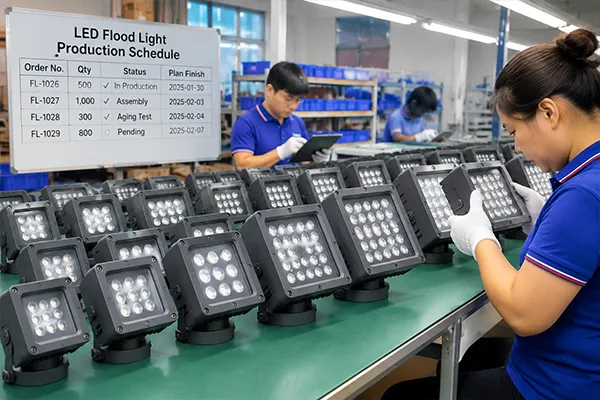

An LED flood light factory audit matters because a polished sample or impressive workshop can hide inconsistent controls behind the scenes1. I have seen buyers face costly complaints when later batches differ from the approved unit. I use audits to move beyond appearances and check whether a supplier can repeatedly build, test, document, and ship the agreed product.
I recommend treating an LED flood light factory audit as a verification of repeatability, not a tour of facilities. Buyers should trace the approved specification through the bill of materials, incoming inspection, assembly, aging, final inspection, packaging, and shipment records2. I also recommend verifying certificates, customization controls, and corrective-action processes against the exact model and target market before approving long-term cooperation.
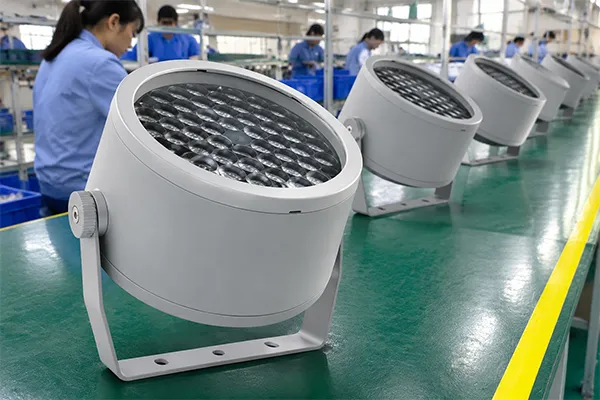
I have worked with customers who initially asked about workshop size, machinery, and certificates. Those questions are understandable, but the stronger questions focus on process evidence. A supplier’s real value becomes clearer when I can show how the approved product is protected from material changes, production variation, and shipment mistakes.3
What Should an LED Flood Light Factory Audit Actually Verify?
I often see buyers start an audit by looking at factory scale, staff numbers, or a showroom. Those observations can be useful, but they can create false confidence when records are missing. I believe the real risk is not whether a supplier can make one good floodlight, but whether it can make the same approved floodlight repeatedly.
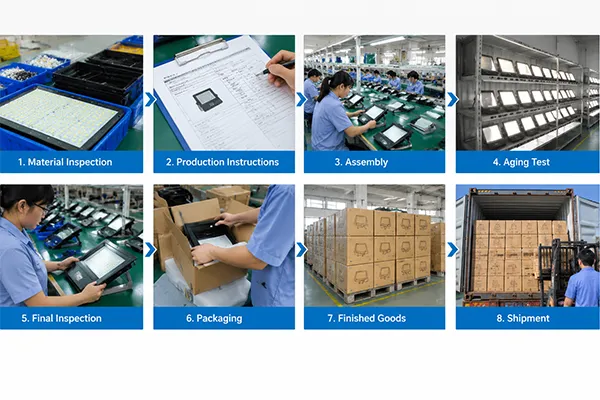
An LED flood light factory audit should verify whether the supplier controls critical requirements from written specifications to finished-goods shipment. I look for traceable records covering materials, production instructions, testing, aging, inspection, packaging, and quality exceptions. A clean facility can support confidence, but documented execution provides stronger procurement evidence.
Start With the Approved Product Definition
I recommend that buyers begin with the product specification rather than the production floor. If the required product is not clearly defined, even a disciplined factory cannot reliably judge conformance4.
For a commercial LED floodlight, I would expect the approved specification to address items such as:
- Model number and housing size
- Rated wattage and permitted tolerance
- Input voltage and frequency
- Color temperature, such as 3000K, 4000K, 5000K, or 6500K
- Luminous output target and measurement conditions
- Beam angle
- CRI requirement
- IP rating requirement
- Surge-protection requirement, where applicable
- Driver type and dimming method
- LED brand or approved LED performance range
- Housing finish and color
- Cable type, length, plug, and label language
- Packaging requirements and carton markings
- Target-market documentation requirements
At Upward Lighting, I find that OEM and ODM projects become easier to manage when each approved requirement is placed into a written confirmation before mass production. A verbal request such as “make the light brighter” or “use a better driver” is not enough for procurement control.
Follow the Product Through the Process
During an LED flood light factory audit, I encourage buyers to follow one model through each stage. I do not consider a presentation alone sufficient. I prefer to see actual documents, labels, work instructions, inspection records, and, where practical, the product itself.
| Production stage | What I would ask to inspect | Why it matters |
|---|---|---|
| Specification review | Approved drawing, quotation, sample confirmation | Confirms the factory knows what to produce |
| Incoming materials | LED, driver, housing, cable, glass, gasket records | Reduces the risk of unapproved component substitution |
| Assembly | Work instructions and in-process checks | Shows whether operators have defined standards |
| Electrical testing | Test method, test equipment, records | Supports consistency and product safety evaluation |
| Aging | Aging time, loading arrangement, failure records | Identifies early failures before shipment |
| Final inspection | Sampling plan, appearance and functional checks | Verifies finished product quality |
| Packaging | Carton labels, inner protection, drop-risk controls | Helps prevent shipping and identification errors |
| Shipment | Batch records, inspection release, photos | Improves traceability after delivery |
I have learned from customer audit requests that the best audit questions are usually simple: “Can you show me the record?” A supplier may say that every unit is tested, but buyers should ask what test is performed, where the result is recorded, who releases the batch, and how the supplier handles a failed unit.
How Can Buyers Audit LED Flood Light Quality Control?
I understand why buyers worry about quality control. A floodlight can look acceptable when powered on for a few minutes, yet still create downstream problems through water ingress, driver failure, color inconsistency, incorrect labeling, damaged cables, or inconsistent mounting accessories5. I therefore look beyond a single sample when evaluating production readiness.
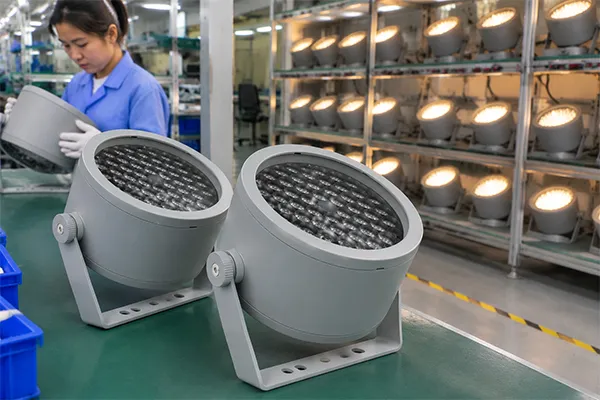
Buyers can audit LED flood light quality control by checking how a supplier inspects incoming components, controls assembly, conducts electrical and aging tests, separates nonconforming goods, and records final inspection results. I consider the handling of failures and rework especially important because it reveals whether quality controls work under real production pressure.
Evaluate Incoming-Material Control
Many quality outcomes are determined before final assembly begins. I recommend that buyers ask how the factory identifies and checks critical components, including LED modules, drivers, housings, seals, cables, reflectors, tempered glass, screws, and brackets.
For example, a buyer can ask:
- Does the supplier maintain an approved supplier list for critical components?
- Does the supplier check incoming driver labels against the approved BOM?
- Does the supplier inspect housings for finish defects, damage, or dimensional mismatch?
- Does the supplier identify incoming material by batch or delivery date?
- Does the supplier quarantine materials that fail inspection?
- Does the supplier document decisions when a component is changed?
I do not suggest that every buyer must inspect every incoming component in a technical laboratory. Instead, I suggest that buyers verify whether the supplier has a practical, repeatable method for controlling the components that affect the agreed product.
Review Assembly and Work Instructions
Assembly quality depends on more than operator experience. I look for work instructions that define key steps, especially for wiring, sealing, torque-sensitive fasteners, gasket placement, driver installation, cable entry, and label application.
A supplier does not need excessive paperwork to be reliable. However, I believe the factory should be able to show operators what they are expected to build and how supervisors check the result. If instructions exist only in someone’s memory, consistency can become harder to maintain when staffing, order volume, or product configurations change.
I have seen customers ask to compare the approved sample with units taken directly from the production line. I consider this a practical audit step because it helps reveal whether the approved standard has reached the actual assembly process.
Verify Aging and Final Inspection in Context
At Upward Lighting, we conduct a 100% aging test before shipment, typically lasting 4 to 8 hours depending on product and order requirements. I describe this as one internal production control, not as a universal guarantee of field performance. Buyers should ask each supplier to explain its own aging process, acceptance criteria, and failure handling.
During an LED flood light factory audit, I recommend checking:
- Whether aging racks are active during the visit or video review
- Whether each unit is powered during aging
- How failed products are identified and removed
- Whether repair and retest records exist
- Whether aging results can be linked to production batches
- Whether final inspection occurs after aging and before packing
Aging can help identify some early failures6, but it does not replace application-specific validation, independent testing where needed, or ongoing supplier performance monitoring.
How Should Buyers Verify Certificates and Compliance Claims?
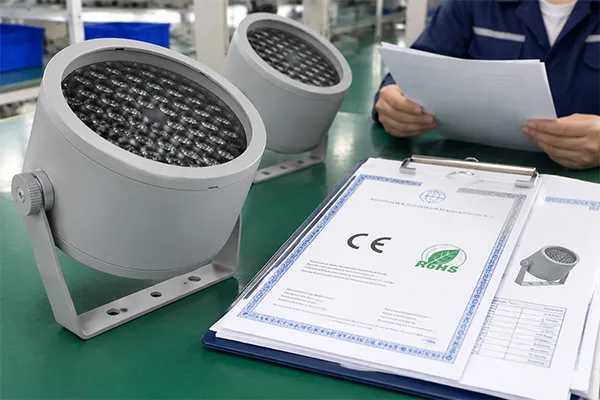
I know that CE, RoHS, IP ratings, and test reports often influence supplier selection7. Buyers need these documents for market access planning and customer confidence. However, I do not treat any certificate as blanket proof that every product, configuration, destination, or future batch meets every applicable requirement.
Buyers should verify certificates and compliance documents against the exact LED floodlight model, electrical configuration, component set, destination market, and intended application. I recommend reviewing document scope, issuing body, report number, dates, product photos, and technical parameters, then confirming market-specific obligations with qualified local professionals.
Check Whether the Document Matches the Product
I encourage buyers to compare the documents with the purchase specification line by line. A report that covers a 50W non-dimmable floodlight may not automatically support a 100W dimmable version with a different driver, cable, housing, plug, or surge protector8.
I would ask a supplier to help clarify the following points:
| Document-review question | Evidence I would request |
|---|---|
| Does the report identify the exact product model? | Model number, product photo, technical description |
| Does the input rating match the order? | Voltage, frequency, wattage, current data |
| Does the document reflect the intended configuration? | Driver, cable, plug, dimming, sensor, surge protector details |
| Is the document still relevant? | Issue date, revision status, supporting files |
| Does the product label align with the records? | Label artwork and physical sample |
| Does the target market require additional steps? | Guidance from qualified compliance or legal advisers |
At Upward Lighting, our products hold CE and RoHS documentation for applicable product configurations. I would still encourage each buyer to verify the documents relevant to the exact model and destination market. Local regulatory requirements can vary, and buyers should seek qualified professional evaluation for application-specific or market-specific decisions.
Look Beyond Certificates
A certificate can be one part of supplier qualification, but it does not demonstrate that production controls remain unchanged. I would also ask whether the supplier has a process for managing modifications after documentation is issued.
For example, I consider these questions valuable:
- Who approves a driver change?
- Does the factory inform the buyer before changing a critical component?
- Is a revised BOM issued after approval?
- Does the supplier retain old and new samples for comparison?
- Does the supplier review whether a change affects existing test reports or declarations?
- Can the supplier trace which customer orders used which configuration?
I believe this change-control discussion is often more useful than simply collecting a folder of certificates. It tells me whether a supplier understands that compliance and product consistency are connected9.
How Can an LED Flood Light Factory Audit Test OEM and ODM Readiness?
I have seen OEM projects fail when both sides assume they share the same definition of “customized.” A buyer may mean a specific 4000K output, logo label, cable length, and carton design. A supplier may hear only “custom floodlight” and begin production with incomplete instructions. That gap can lead to delays, rework, and avoidable disputes.
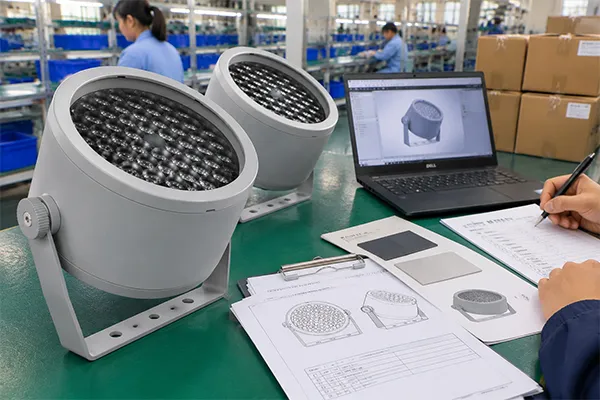
An LED flood light factory audit can test OEM and ODM readiness by reviewing the supplier’s change-control workflow from inquiry to mass production. I look for written specifications, approved samples, BOM confirmation, artwork approval, revision tracking, and clear responsibilities when a customer requests changes.
Ask for the Customization Workflow
At Upward Lighting, we provide OEM and ODM options for parameters such as color temperature, wattage, beam angle, CRI, and surface finish color. I find that customization is most manageable when both sides use a controlled sequence.
I recommend a workflow like this:
- Written inquiry: The buyer provides target specifications, annual volume expectations, market, and application.
- Technical review: The supplier checks whether the requested parameters are practical for the proposed platform.
- Quotation confirmation: Both parties confirm commercial terms, product scope, lead time assumptions, and tooling needs where applicable.
- Specification sheet: The supplier issues a clear product specification and draft BOM.
- Sample approval: The buyer evaluates the sample against agreed criteria.
- Artwork approval: The buyer approves labels, logo placement, manuals, cartons, and shipping marks.
- Mass-production release: The supplier receives written approval for the final version.
- Change control: Both parties document later changes before implementation.
I do not suggest that every project needs a complex engineering system. I do believe that every project needs a written reference point. Without one, buyers may receive a product that is technically usable but commercially different from what their sales team or end customer expected.
Test How the Supplier Handles Changes and Problems
The strongest OEM discussion often starts with an uncomfortable question: “What happens when something goes wrong?” I recommend that buyers ask for a bounded, anonymized example of a quality issue or a specification misunderstanding and how the supplier addressed it.
A useful supplier response should explain:
- How the issue was identified
- How affected goods were contained
- Whether production was paused or segregated
- How the root cause was investigated
- What corrective action was taken
- How the buyer was informed
- What record was created to prevent recurrence
I have participated in investigations where a customer noticed a packaging detail that did not match the approved artwork. The issue was not technically complex, but it mattered because incorrect carton information can create warehouse and channel confusion10. I learned that a final packaging check against approved artwork is as important as checking electrical performance.
A factory does not need to claim perfection. I trust a supplier more when it can show a disciplined response to exceptions.
How Should Buyers Score an LED Flood Light Factory Audit?
I know that audits can produce many notes, photos, and documents, yet still leave the buyer unsure whether to approve the supplier. I recommend using a weighted scorecard that focuses on risks that can affect repeat orders. I would not approve or reject a supplier based on a single score alone11, but a scorecard can structure the discussion.
Buyers should score an LED flood light factory audit against specification control, material traceability, production testing, document accuracy, change management, corrective action, delivery capability, and communication quality. I recommend identifying critical gaps that require closure before mass production, even when the overall score appears acceptable.
Use a Practical Audit Scorecard
I suggest using a 1-to-5 rating for each category, where 1 means unacceptable evidence, 3 means adequate but needing improvement, and 5 means strong documented control. Buyers can adapt the weighting to their product risk, destination market, and order volume.
| Audit category | Suggested weight | What I would evaluate |
|---|---|---|
| Specification and BOM control | 20% | Revision control, approved sample linkage, clear product definition |
| Incoming-material control | 15% | Supplier management, component checks, traceability |
| Assembly and in-process control | 15% | Work instructions, operator checks, defect prevention |
| Testing and aging | 15% | Test execution, failure handling, record availability |
| Final inspection and packaging | 10% | Inspection criteria, labeling, packing protection |
| Certificates and documents | 10% | Exact-model relevance, document accuracy, controlled files |
| OEM/ODM change management | 10% | Written approvals, revision records, customer communication |
| Corrective action and service | 5% | Complaint response, containment, preventive action |
Separate Critical Gaps From Improvement Opportunities
I recommend that buyers classify findings into three groups:
- Critical gaps: Issues that could directly affect safety, legal obligations, product identity, or major commercial risk. I would require closure before shipment or supplier approval.
- Major gaps: Issues that could cause recurring inconsistency, delayed delivery, or customer complaints. I would request a corrective-action plan with deadlines.
- Improvement opportunities: Issues that do not immediately threaten the order but could strengthen long-term cooperation.
I would also avoid treating one visit, video audit, or sample test as the final decision. Supplier qualification should continue through first-order inspection, batch documentation, shipment review, field feedback, and periodic performance evaluation. Stable cooperation is built through repeated evidence, not a single positive impression.
Frequently Asked Questions
What is the purpose of an LED flood light factory audit?
I use an LED flood light factory audit to evaluate whether a supplier can consistently produce the approved product at scale. I review specification control, component management, testing, aging, packing, documentation, and corrective-action processes rather than relying only on a sample or factory appearance.
Can I audit a Chinese LED floodlight supplier remotely?
I believe a remote audit can provide useful evidence through live video, document review, production photos, and interviews12. However, I would not treat a remote audit as equal to continuous oversight. I recommend combining it with sample evaluation, third-party inspection where appropriate, and batch-level documentation.
Are CE and RoHS certificates enough to approve a floodlight supplier?
I do not consider CE and RoHS documents alone enough for supplier approval. Buyers should verify whether documents apply to the exact model, configuration, and target market. I also recommend reviewing change-control practices and seeking qualified local advice on market-specific compliance requirements.
How long should LED floodlights undergo aging tests?
I cannot set one universal aging duration because requirements vary by product, application, and supplier process. At Upward Lighting, we conduct 100% aging tests for 4 to 8 hours before shipment. I recommend that buyers ask suppliers to document their actual aging process and failure-handling method.
What should I do if a supplier changes a floodlight component after sample approval?
I recommend requiring written notification and approval before any critical component change. Buyers should request an updated BOM, revised specification where needed, and confirmation of any effect on performance, documentation, packaging, or target-market requirements before mass production continues.
Conclusion
An LED flood light factory audit should help overseas buyers judge process discipline rather than factory appearance alone. I recommend tracing the approved floodlight from written specifications and materials through assembly, aging, inspection, packaging, and shipment records. I also encourage buyers to verify certificates for the exact product configuration and to require written change control for OEM or ODM work. At Upward Lighting, we welcome structured supplier evaluations because clear requirements, documented controls, and fast communication create more stable long-term lighting partnerships.
"Quality and Consistency of Machined Components and ...", https://www.nist.gov/system/files/documents/oles/2-Donmez-Alkan-Manufacturing-2012-07-10-MSSFFA.pdf. ISO quality-management guidance explains that consistent conformity is supported by controlled and repeatable processes, rather than by isolated inspection outcomes alone. Evidence role: general_support; source type: institution. Supports: Quality-management guidance explaining that consistent conformity depends on controlled, repeatable processes rather than inspection or appearance alone.. Scope note: This supports the general quality-management principle and does not establish conditions at any particular factory. ↩
"FSMA Final Rule on Requirements for Additional ...", https://www.fda.gov/food/food-safety-modernization-act-fsma/fsma-final-rule-requirements-additional-traceability-records-certain-foods. Quality-system regulations describe production controls, acceptance activities, and device-history records as mechanisms for demonstrating that manufactured products conform to specified requirements. Evidence role: general_support; source type: government. Supports: Quality-system requirements and guidance addressing production controls, acceptance activities, records, and traceability.. Scope note: The cited regulatory framework may be sector-specific; it provides a transferable control principle rather than a floodlight-specific audit protocol. ↩
"Manufacturing", https://www.nist.gov/manufacturing. Quality-management standards require organizations to control planned and unintended changes in production so that continuing conformity of products and services is maintained. Evidence role: mechanism; source type: institution. Supports: The relationship between controlled changes, process variation, and reliable product conformity.. Scope note: This establishes a management-system mechanism, not a quantitative measure of an individual supplier's value. ↩
"Conformity assessment", https://www.nist.gov/conformity-assessment. ISO terminology defines conformity as fulfillment of a requirement, making a defined requirement necessary before conformity can be objectively assessed. Evidence role: definition; source type: institution. Supports: The definition of conformity as fulfillment of specified requirements.. ↩
"LED Luminaire Reliability: Impact of Color Shift", https://www.energy.gov/sites/prod/files/2017/04/f34/lsrc_colorshift_apr2017.pdf. LED-luminaire reliability research identifies component reliability, thermal and environmental exposure, and color maintenance as factors that can affect performance beyond initial operation. Evidence role: general_support; source type: research. Supports: LED-luminaire reliability literature identifying drivers, color maintenance, environmental exposure, and electrical components as relevant performance factors.. Scope note: The evidence supports the plausibility of these risk categories but does not show that every listed issue occurs in every floodlight design. ↩
"Broadband RF Monitoring of Atomistic Changes in Materials", https://www.nist.gov/publications/towards-understanding-early-failures-behavior-during-device-burn-broadband-rf. Reliability engineering describes burn-in as controlled operation used to screen some early-life failures before products enter service. Evidence role: mechanism; source type: education. Supports: Reliability-engineering explanations of burn-in as operation intended to screen certain early-life failures.. Scope note: Burn-in does not demonstrate long-term field reliability and its effectiveness depends on the test conditions and failure mechanisms involved. ↩
"EU WEEE_RoHS", https://www.trade.gov/eu-weeerohs. European Commission guidance explains that CE marking indicates compliance with applicable EU requirements, while RoHS restricts specified hazardous substances in electrical and electronic equipment. Evidence role: historical_context; source type: government. Supports: The role of CE marking and RoHS obligations in European Union product compliance, while distinguishing them from IP classifications.. Scope note: CE marking and RoHS compliance do not by themselves verify all product attributes, and IP ratings are a separate enclosure-protection classification. ↩
"A guide to EU standards and conformity assessment", https://www.govinfo.gov/content/pkg/GOVPUB-C13-07a06d81c863b5241d6249891a51fb90/pdf/GOVPUB-C13-07a06d81c863b5241d6249891a51fb90.pdf. European Commission guidance states that manufacturers must ensure that products remain compliant when design or characteristic changes may affect conformity with applicable requirements. Evidence role: general_support; source type: government. Supports: Guidance that manufacturers must assess whether product changes affect compliance with applicable requirements.. Scope note: Whether a particular wattage, driver, cable, or enclosure change requires renewed testing depends on the applicable legislation, standards, and technical assessment. ↩
"Compliance FAQs: CE Marking", https://www.nist.gov/standardsgov/compliance-faqs-ce-marking. Quality-management requirements link the control of production changes and externally provided components to the continuing conformity of outputs with specified requirements. Evidence role: mechanism; source type: institution. Supports: How change control helps maintain conformity of produced goods to defined requirements.. Scope note: The relationship is procedural: documented change control reduces risk but cannot alone prove legal compliance for a specific product. ↩
"Guidance for Industry: Food Labeling Guide", https://www.fda.gov/regulatory-information/search-fda-guidance-documents/guidance-industry-food-labeling-guide. Supply-chain identification guidance explains that accurate logistics labels support product identification, handling, and traceability across warehousing and distribution activities. Evidence role: mechanism; source type: institution. Supports: The role of standardized, accurate logistics labeling in identifying and handling products through supply chains.. Scope note: This supports the operational importance of carton accuracy but does not quantify the likelihood of confusion in a particular channel. ↩
"Best Practices in Cyber Supply Chain Risk Management", https://csrc.nist.gov/CSRC/media/Projects/Supply-Chain-Risk-Management/documents/briefings/Workshop-Brief-on-Cyber-SCRM-Vendor-Selection-and-Management.pdf. Quality-management guidance calls for evaluation, selection, monitoring, and re-evaluation of external providers using their ability to meet requirements, supporting assessment beyond a single audit score. Evidence role: expert_consensus; source type: institution. Supports: Risk-based supplier evaluation and monitoring principles that consider multiple criteria and ongoing performance.. Scope note: The guidance does not prescribe a universal supplier-scorecard model or approval threshold. ↩
"ISO 9001 Auditing Practices Group Guidance on: REMOTE ...", https://committee.iso.org/files/live/sites/tc176/files/documents/ISO%209001%20Auditing%20Practices%20Group%20docs/Auditing%20General/APG-Remote_Audits.pdf. Auditing guidance recognizes information and communication technologies, including remote document review and video-based interaction, as tools that can support the collection of audit evidence. Evidence role: general_support; source type: institution. Supports: Audit guidance permitting the use of information and communication technologies to collect and evaluate audit evidence.. Scope note: Remote methods may restrict direct observation and verification; their adequacy depends on audit objectives, risks, and access to reliable evidence. ↩