
LED flood light production can become a planning problem when a project deadline, seasonal restocking plan, or product launch is already fixed. A buyer may receive a quick quotation but still lack a dependable delivery date. I help solve this issue by mapping each order to its actual production path before we commit to a lead time.
The time required for LED flood light production in China depends on whether the order uses available stock, standard specifications, or customized components and packaging.1 A reliable lead-time commitment should follow confirmation of quantity, wattage, color temperature, beam angle, finish, packaging, quality requirements, and shipment terms.2 Buyers should also allow time for aging tests, inspection, documentation, and shipment arrangements after factory assembly is complete.3
A lead time is not simply a number printed on a quotation. In my experience coordinating flood light orders, the more useful question is: What must happen before this specific order can be released for shipment? The answer helps procurement teams plan with fewer surprises.
Which LED Flood Light Production Path Does Your Order Follow?
LED flood light production often appears straightforward until a buyer compares a stocked item with a made-to-order product. The wrong assumption can create a gap between an expected delivery date and the actual factory schedule. I recommend identifying the order path first, because each path has different material, assembly, and approval requirements.
Most LED flood light orders follow one of three paths: available stock, standard production, or customized production.4 Stock orders may move fastest if the exact model and quantity are ready. Standard orders require scheduled assembly and testing. Customized orders usually need additional confirmation, material preparation, and sample or packaging review before production can begin.
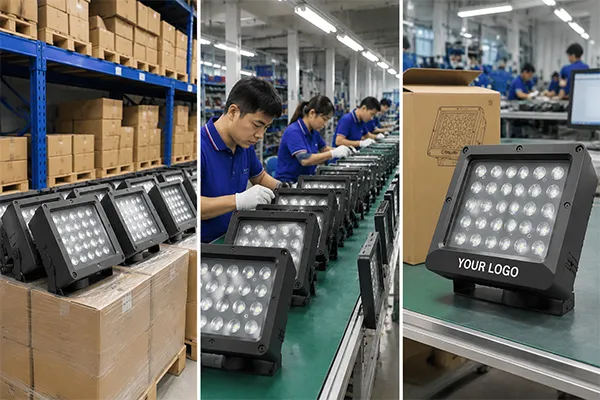
Available Stock: The Fastest Path, With Important Limits
Available stock can be a suitable option when a buyer accepts the exact product configuration already prepared by the supplier. This may include a fixed wattage, body color, input voltage, color temperature, beam angle, and retail or export carton arrangement.
However, “in stock” should never mean “assumed available.” I would encourage buyers to ask for confirmation of:
- The exact model number and technical configuration
- The quantity physically available for allocation
- The production date or stock condition where relevant
- The applicable labeling, carton marks, and instruction documents
- The required certifications or declarations for the destination market
- Whether the stock is already aging-tested and inspection-ready
- Whether the product can meet the buyer’s requested shipping date
A supplier may have similar flood lights in stock but not the precise version required for a tender, distributor program, or private-label launch. For example, the same housing design may be available in one color temperature but not another. It may have a standard bracket but not the requested cable length or plug type.
Standard Production: A Common Route for Repeatable Specifications
Standard production usually applies when the product uses regular factory configurations, but the required quantity is not immediately available as finished stock. The factory must coordinate materials, assembly capacity, driver preparation, LED source selection, aging, final checks, and packing.
This path can be easier to schedule than a highly customized order because the supplier may already use approved bills of materials and established assembly processes. Still, a buyer should not treat “standard” as “instant.” Production slots, component availability, order volume, and seasonal demand can all affect the release date.5
Customized Production: More Decisions Before the Clock Starts
Customized LED flood lights can involve changes to:
| Customization area | Typical buyer requirement | Possible planning effect |
|---|---|---|
| Wattage | Specific power range for a project | May require a different driver or thermal configuration |
| Color temperature | 3000K, 4000K, 5700K, or another target | May require LED source allocation |
| Beam angle | Narrow, medium, or wide distribution | May affect optical components |
| Surface finish | Black, gray, white, or project-specific color | May require coating or housing preparation |
| CRI | Standard or higher CRI requirement | May require different LED selection |
| Packaging | Private-label carton, barcode, manual | Requires artwork approval and packaging preparation |
| Cable and plug | Regional cable, connector, or plug | Requires component confirmation and assembly planning |
I have found that a customized order is most predictable when the buyer locks every relevant specification before the supplier begins material preparation. A late change can affect more than one component.6 It may also require the supplier to reassess the schedule rather than simply “edit” the order.
A dependable lead time starts after the order specification is clear enough for the factory to reserve materials and production capacity.
What Must Be Confirmed Before LED Flood Light Production Can Be Scheduled?
LED flood light production cannot be scheduled accurately when key requirements remain open. Buyers sometimes ask for a delivery date before deciding wattage, color temperature, packaging, or order quantity. That approach creates uncertainty because each unresolved detail can affect material preparation and factory coordination.
Before a supplier can provide a credible LED flood light production schedule, the buyer should confirm the product specification, quantity, customization scope, packaging, testing expectations, documentation needs, and delivery terms. The supplier can then assess stock, components, capacity, and quality-control steps for that specific order.
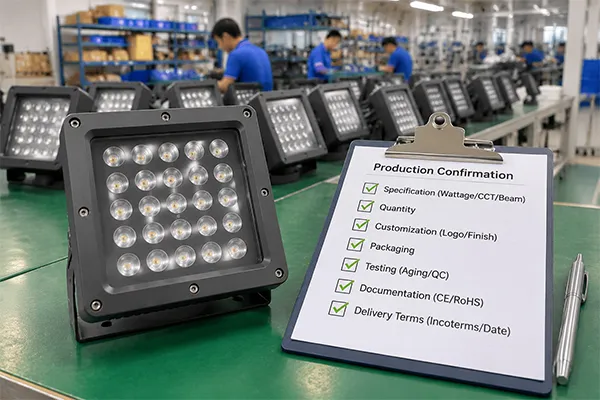
Use a Written Specification Checklist
A written specification sheet protects both the buyer and the supplier.7 It gives purchasing, technical, quality, and sales teams one shared reference. It also reduces the chance that a quotation describes one configuration while the production team receives another.
For flood light procurement, I suggest confirming the following items in writing:
-
Product model and application
State whether the product is intended for building facades, yards, sports areas, signage, industrial sites, or general outdoor illumination. -
Electrical requirements
Confirm wattage, input voltage, frequency, surge protection expectation, driver brand requirement if applicable, cable length, and plug type. -
Optical requirements
Confirm color temperature, CRI, beam angle, lumen target where relevant, and any glare-control or distribution requirement. -
Mechanical requirements
Confirm housing finish, bracket style, mounting method, IP rating expectation, corrosion-resistance requirement, and branding marks. -
Commercial requirements
Confirm quantity by model, target delivery date, carton format, pallet requirements, shipping destination, and Incoterms. -
Compliance documents
Identify which certification documents, declarations, test reports, labels, or market-specific requirements the buyer needs. Buyers should verify that all documents are current, applicable to the ordered model, and accepted in the intended market.
Why Quantity Matters More Than Buyers May Expect
Quantity is not only a commercial number. It affects material demand, line loading, aging-test capacity, inspection planning, carton availability, and loading arrangements.8 A small trial order may be easier to place into an existing schedule, but it may still need custom packaging or special parts. A large volume order may require phased production or multiple material arrivals.
At Upward Lighting, we support both small-batch and OEM/ODM orders, but I would still avoid promising a schedule before our team checks the full order requirement. A buyer benefits from the same discipline with every supplier.
Fast Communication Is Not the Same as Fast Completion
A supplier can respond to an inquiry, issue a quotation, or revise a product drawing quickly. Those are positive service indicators. Yet they do not prove that a finished product can be shipped quickly.
I separate these milestones:
| Milestone | What it means | What it does not mean |
|---|---|---|
| Quotation issued | Commercial pricing and initial terms are available | Materials and production capacity are reserved |
| Specification confirmed | The order requirement is clear | Finished goods are available |
| Order released | Materials and scheduling can be coordinated | Quality checks are complete |
| Factory completion | Assembly and packing may be finished | Shipment documents and pickup are finalized |
| Shipment readiness | Goods, inspection, documents, and handover arrangements are aligned | Transit time is included |
This distinction is useful for importers and project contractors. It prevents a common planning error: treating a fast sales response as evidence of a short manufacturing cycle.9
What Happens Between Assembly and Shipment Readiness?
A flood light may look complete on the assembly line, but LED flood light production is not truly finished from a procurement perspective until required quality checks, packing, documentation, and pre-shipment arrangements are complete. Ignoring these stages can leave buyers with a factory completion date that does not support their actual installation or launch deadline.
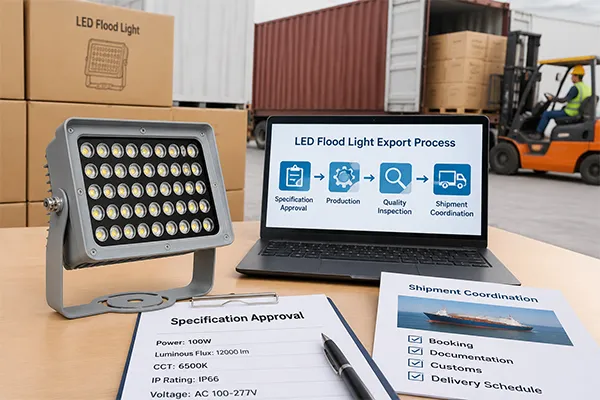
Factory completion and shipment readiness are different milestones.10 After assembly, LED flood lights may need aging tests, visual and functional inspection, packing verification, document preparation, buyer inspection, and cargo handover coordination. Procurement schedules should include these steps rather than relying only on the date when assembly ends.
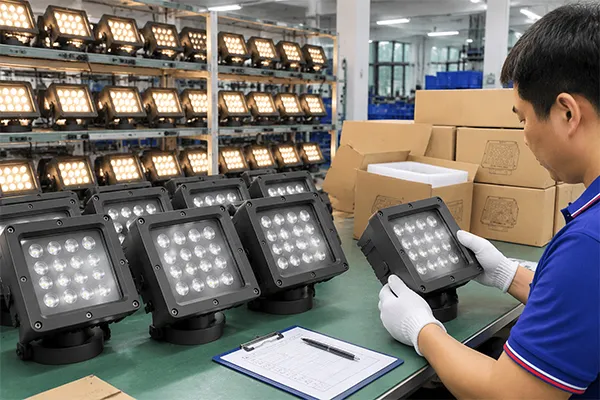
Aging Tests Support Process Control
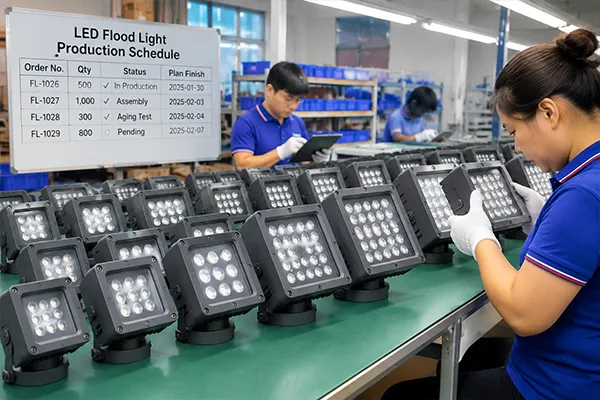
At Upward Lighting, every product undergoes a 100% aging test lasting 4 to 8 hours before shipment. This is part of our internal quality process for checking operation before goods are released. The exact test arrangement and acceptance criteria should always be discussed in relation to the product and order requirement.
An aging test is not merely a box to tick. It requires physical space, testing equipment, handling time, and records within the factory workflow.11 A buyer who requests faster completion should understand that removing or compressing essential checks can create unnecessary quality risk.
Inspection and Packing Checks
After aging, the order may require final inspection. The scope varies by buyer and may include:
- Appearance and finish checks
- Wattage and functional verification
- Label and carton-mark confirmation
- Quantity verification
- Accessory checks, including brackets, screws, cables, and manuals
- Random sampling under an agreed inspection plan
- Buyer-appointed third-party inspection, where required
I recommend agreeing on inspection expectations before production begins. If a buyer plans a pre-shipment inspection, the supplier needs time to prepare the goods, provide product records, coordinate access, and address any confirmed findings. This is especially important for branded or project-specific flood lights.
Documentation and Export Preparation
Export orders may also need commercial invoices, packing lists, carton data, product labels, declarations, or other buyer-requested documents. The exact documentation depends on the destination, product classification, transaction terms, and buyer requirements.
Our products carry CE and RoHS documentation for applicable market-entry needs, but buyers should independently verify the relevance and validity of documentation for their ordered product and target market. Certification requirements can differ by country, project, customer channel, and product configuration.
Allow Time for Cargo Handover
Shipment readiness includes more than factory work. A booking, container-loading plan, courier collection, or freight forwarder handover may depend on external schedules. I can coordinate factory-side preparation, but freight transit and carrier operations are separate from production control.
For planning purposes, I suggest buyers build a timeline with at least these checkpoints:
- Specification lock
- Deposit or order release, as agreed
- Material readiness
- Assembly and aging
- Final inspection
- Packing and document completion
- Cargo handover
- International transit and destination clearance
This approach gives project managers a more realistic basis for installation scheduling.
Can Rush Orders Shorten LED Flood Light Production?
LED flood light production can sometimes be prioritized, but rush requests often create unrealistic expectations. A buyer may assume that a higher payment automatically makes every component available and every process immediate. In reality, materials, production capacity, testing stations, and inspection resources still need coordination.
A rush order may shorten LED flood light production only when the exact materials, approved specifications, and production capacity are available.12 It cannot reliably bypass component lead times, technical confirmation, aging tests, inspection, or shipment coordination. Buyers should ask suppliers which steps can be prioritized and which constraints remain fixed.
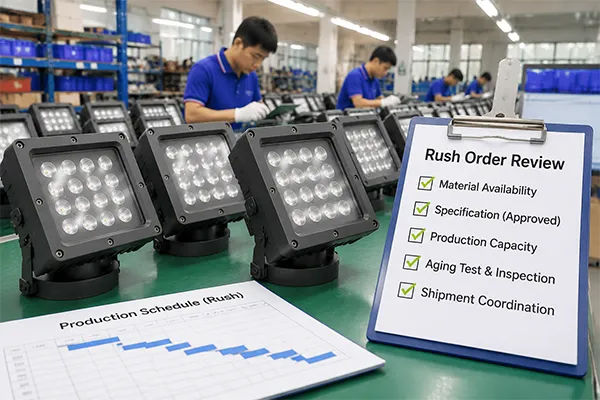
Ask for a Constraint-Based Answer
When a deadline is urgent, I encourage buyers to avoid asking only, “Can you do it faster?” Instead, ask the supplier to identify the actual constraints.
A useful rush-order discussion should cover:
- Is the requested model available as finished stock?
- Are all required LED chips, drivers, housings, brackets, cables, and cartons available?
- Is the requested color temperature or beam angle standard for the supplier?
- Does the order need custom printing, labels, manuals, or packaging?
- Can the factory allocate an earlier assembly slot?
- Is aging-test capacity available within the requested period?
- Does the buyer require third-party inspection?
- Is the requested shipping handover date compatible with the forwarder’s schedule?
This type of conversation produces a better answer than a simple yes or no. It also allows the buyer to consider alternatives, such as using a standard finish, selecting a stocked color temperature, splitting a delivery, or separating urgent project units from later replenishment quantities.
Post-Confirmation Changes Can Reset the Schedule
A production schedule is based on the information available when the order is confirmed. If the buyer later changes the wattage, finish, quantity, packaging artwork, cable, or color temperature, the supplier may need to check materials and capacity again.
Even a seemingly small adjustment can have wider effects. A new carton size may affect packaging material. A different plug may require a new cable assembly. A quantity increase may exceed the components reserved for the first order release.
I have seen that clear internal buyer approval is one of the most effective ways to protect a target date. Procurement teams should align their technical, branding, finance, and project stakeholders before asking the factory to begin.
Build Buffer Into Project Procurement
For site projects, tenders, seasonal sales, and new product launches, a buyer should not place an order based only on the earliest possible factory date. A practical procurement plan includes buffer for approval, quality checks, cargo handover, transit variation, customs processes, and local delivery.
The right buffer varies by destination and shipping method, so it requires supplier- and forwarder-specific confirmation. Still, the principle is consistent: the earlier a buyer locks the specification, the more options the supplier has to protect the schedule.
Frequently Asked Questions
How long does standard LED flood light production usually take in China?
Standard LED flood light production does not have one universal duration. The timeline depends on material availability, order quantity, factory capacity, required testing, packaging, and inspection needs. Buyers should request a written supplier-specific schedule after confirming the complete product specification and commercial requirements.
Are LED flood lights ready to ship immediately if a supplier says they are in stock?
Not always. Buyers should confirm that the supplier has the exact model, wattage, color temperature, finish, quantity, cable configuration, packaging, and required documents available. Similar stock may not meet a project’s technical specification or destination-market requirements.
Does a fast quotation mean a supplier can produce LED flood lights quickly?
No. A fast quotation shows that a supplier can respond efficiently, but it does not confirm material availability, reserved production capacity, testing completion, or shipment readiness. Buyers should treat quotation speed and manufacturing lead time as separate supplier evaluation factors.
Can I change the flood light specification after I place an order?
You can request a change, but the supplier may need to reassess the lead time and price. Changes to wattage, color temperature, beam angle, finish, packaging, quantity, cables, or labels can affect materials, production scheduling, testing, and carton preparation.
Can rush production skip LED flood light aging tests?
A responsible supplier should not treat aging tests and agreed inspection steps as optional shortcuts. At Upward Lighting, we conduct a 100% aging test for 4 to 8 hours before shipment. Buyers should confirm the supplier’s quality process and agree on any application-specific testing requirements in advance.
Conclusion
The best answer to “How long does LED flood light production take in China?” is not a fixed number of days. The correct answer depends on the order path: available stock, standard production, or customized production. Buyers should finalize specifications early, distinguish factory completion from shipment readiness, and allow time for aging, inspection, documentation, and cargo handover. If you are sourcing flood lights for a project, distribution program, or private-label range, contact Upward Lighting with your specifications so we can review the most realistic production path and lead-time commitment for your order.
"How to Think About Planned Lead Times", https://lgoreview.mit.edu/how-to-think-about-planned-lead-times/. Manufacturing research distinguishes make-to-stock fulfillment from make-to-order production, with the latter generally requiring order-specific planning and production activity before delivery. Evidence role: general_support; source type: education. Supports: The distinction between make-to-stock and make-to-order production and its implications for inventory availability and lead time.. Scope note: This evidence supports the general production-planning distinction rather than lead times for a particular Chinese LED flood-light factory. ↩
"design specifications of a generic supply chain simulator", https://tsapps.nist.gov/publication/get_pdf.cfm?pub_id=822193. Production planning depends on defined product requirements, material needs, process steps, and capacity assumptions; unresolved requirements therefore limit the reliability of schedule estimates. Evidence role: mechanism; source type: institution. Supports: Defined product requirements and production inputs are necessary for planning work, materials, and delivery schedules.. Scope note: The source should establish the general planning mechanism, not validate a specific supplier's quoted lead time. ↩
"Common Export Documents", https://www.trade.gov/common-export-documents. Export transactions commonly require commercial and shipping documentation and coordination with transport providers after goods have been manufactured and packed. Evidence role: general_support; source type: government. Supports: Export fulfillment commonly involves inspection, commercial documentation, packing information, and transport handover in addition to manufacturing.. Scope note: Documentation and handover requirements vary by destination, product, contract terms, and transport mode. ↩
"The Customization-Responsiveness Squeeze", https://sloanreview.mit.edu/article/the-customizationresponsiveness-squeeze/. Operations-management literature describes a continuum of fulfillment modes, including stocked products, standard make-to-order products, and customized or engineer-to-order products. Evidence role: general_support; source type: research. Supports: Manufacturers commonly use stocked, standard configurable, and custom or engineer-to-order fulfillment modes.. Scope note: This classification is a general manufacturing framework and does not demonstrate that a quantified majority of LED flood-light orders follows these exact categories. ↩
"Supply chain resilience: A review from the inventory management ... - PMC", https://pmc.ncbi.nlm.nih.gov/articles/PMC11997565/. Manufacturing lead time and delivery performance are influenced by material availability, capacity constraints, production loading, and variability in demand. Evidence role: mechanism; source type: research. Supports: Material availability, finite capacity, demand variation, and order loading are recognized determinants of manufacturing lead time and delivery performance.. Scope note: The relative importance of these factors differs across factories, products, and supply conditions. ↩
"Engineering Change Management Concepts for Systems Modeling", https://tsapps.nist.gov/publication/get_pdf.cfm?pub_id=913323. Research on engineering change management finds that changes to product requirements can propagate across interdependent components, documentation, and manufacturing processes. Evidence role: mechanism; source type: research. Supports: Engineering changes can propagate through product structures, bills of materials, processes, and supply requirements.. Scope note: The evidence supports the general risk of change propagation; the actual impact of a particular change depends on the product design and supplier controls. ↩
"Software quality assurance: documentation and reviews", https://nvlpubs.nist.gov/nistpubs/Legacy/IR/nistir4909.pdf. Documented specifications establish a common basis for communicating technical and quality requirements between purchasers and suppliers. Evidence role: general_support; source type: government. Supports: Clear, documented technical requirements support consistent procurement, quality control, and supplier communication.. Scope note: A written specification improves clarity but does not by itself ensure supplier performance or contract compliance. ↩
"Production Planning and Control Systems-State of the Art and New ...", https://ecommons.udayton.edu/cgi/viewcontent.cgi?article=1003&context=mis_fac_pub. Material-requirements planning and capacity planning use order quantities to determine component demand, production loading, and the resources required to fulfill an order. Evidence role: mechanism; source type: education. Supports: Order quantities drive material-requirements planning, capacity loading, and associated production and fulfillment activities.. Scope note: The source may not address every listed activity, such as aging-test stations or carton availability, for a specific lighting manufacturer. ↩
"Valuing Time in Supply Chains: Establishing Limits of Time-based ...", https://cdn.vanderbilt.edu/vu-web/owen/files/publications/ValueofTimeFinalabstract.pdf. Supply-chain performance measures distinguish administrative response and order-processing time from the manufacturing and fulfillment lead times required to produce and deliver goods. Evidence role: definition; source type: research. Supports: Order-response or quotation time is operationally distinct from manufacturing lead time and order-fulfillment time.. Scope note: The distinction does not establish that any individual supplier's quick quotation is unrelated to its actual manufacturing capability. ↩
"Common Export Documents", https://www.trade.gov/common-export-documents. In export logistics, the completion of manufacturing is distinct from shipment readiness, which may additionally require packing confirmation, documentation, carrier booking, and cargo handover. Evidence role: definition; source type: institution. Supports: Finished goods may require packing, export documentation, customs or carrier procedures, and freight handover before shipment can occur.. Scope note: The exact sequence and duration of these activities depend on Incoterms, destination rules, and the selected transport arrangement. ↩
"Burn-In - Integration and Test > Thermal Testing - S3VI - NASA", https://s3vi.ndc.nasa.gov/ssri-kb/topics/47/. Reliability practice describes burn-in and operational testing as controlled test activities requiring appropriate equipment, test duration, handling, and documented procedures. Evidence role: mechanism; source type: research. Supports: Burn-in or operational testing exposes electronic products to controlled operation and requires test infrastructure and recorded procedures.. Scope note: Such sources support the general resource requirements of testing but do not prove the adequacy of any supplier's particular aging-test duration or acceptance criteria. ↩
"7 Capacity Management Supply Chain Strategies for Manufacturers ...", https://blogs.bu.edu/kongta/capacity-management-supply-chain-strategies/. Operations-management research treats expediting as a change in order priority that remains constrained by material availability, process dependencies, and finite capacity. Evidence role: mechanism; source type: research. Supports: Expediting can alter order priority but remains constrained by material availability, process dependencies, and finite production capacity.. Scope note: Expediting effects are factory-specific and may involve cost, disruption, or quality trade-offs not addressed by the general principle. ↩