
The LED flood light export process can become expensive when an order moves forward with unclear specifications, unapproved branding files, or undocumented inspection expectations. We have seen small gaps between a sample and a purchase order create avoidable delays. We help importers manage this process by treating product definition, production control, and shipping coordination as one connected workflow.
The LED flood light export process starts before production, not after cartons are packed. Importers should define the product version, destination-market requirements, OEM materials, quality acceptance criteria, and shipment responsibilities before placing an order. A controlled sample, aligned documents, scheduled testing, complete export paperwork, and coordinated freight handover reduce the risk of sample-to-batch differences and shipment-stage surprises.
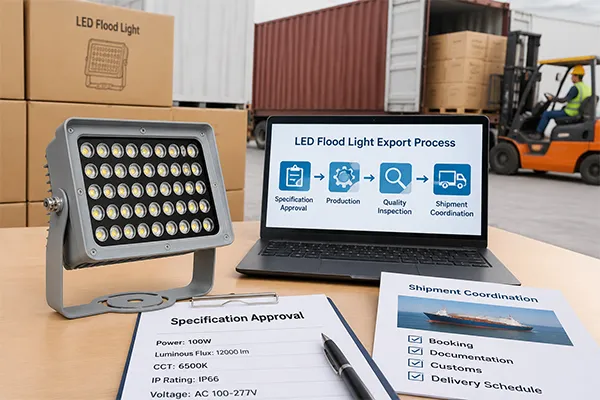
For us, export coordination begins with the questions we ask before quotation. A floodlight’s wattage and unit price are important, but they do not define a shippable product. The details that buyers confirm early often determine whether production, documentation, booking, and customs handover can proceed smoothly later.
Why Does the LED Flood Light Export Process Start With a Detailed RFQ?
A vague RFQ creates uncertainty at the earliest stage of the LED flood light export process. If an importer asks only for a “100W floodlight price,” we may not know the required voltage, beam pattern, cable type, branding, or market standard. That uncertainty can lead to mismatched quotations, unsuitable samples, and revised schedules.
A detailed RFQ gives the supplier and importer a shared starting point for the LED flood light export process. It should define electrical requirements, light performance, appearance, branding, packaging, target market, and project-specific expectations. We use these details to quote the correct configuration, assess material needs, and identify issues that require confirmation before scheduling production.
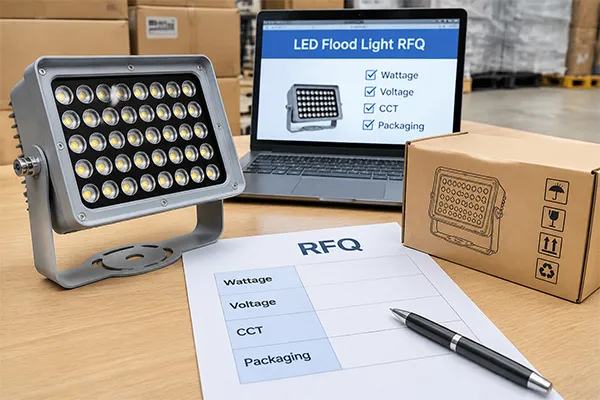
A Floodlight Is More Than Its Wattage
In our pre-sales work, we regularly receive inquiries that specify wattage but leave out the factors that determine the actual product version. A 100W LED floodlight for a warehouse in the UAE may need a different input voltage, plug, cable length, color temperature, mounting arrangement, or label information than a 100W product intended for a distributor in the UK.1
We encourage buyers to treat the RFQ as a procurement-control document, not merely a request for price. The more complete the request is, the more meaningful the quotation becomes.2
A practical RFQ for customized floodlights should include the following:
- Model or housing style: slim floodlight, modular floodlight, sensor floodlight, or another agreed design
- Rated wattage: such as 30W, 50W, 100W, 150W, or 200W
- Input voltage and frequency: for example, AC 100–277V or another project-specific range
- Color temperature: 3000K, 4000K, 5000K, 5700K, or 6500K
- Beam angle: based on mounting height, area coverage, glare control, and project design
- CRI requirement: especially where color visibility matters
- Ingress-protection and environmental expectations: subject to the product design and application
- Housing finish: standard black, gray, white, or a custom surface color
- Cable, connector, and plug requirements: cable length, regional plug, connector type, or open-wire termination
- Branding requirements: logo method, label language, carton artwork, manuals, and barcode needs
- Packaging requirements: inner boxes, master carton quantity, drop-test expectations, palletization, or retailer-ready packaging
- Destination market and project use: distribution stock, tender, commercial project, or private-label retail
- Required documents: buyers should specify which documents are needed for their market, project, or customer review
We have learned that the target country alone does not always define the requirement. A tender, electrical consultant, retailer, or end customer may impose additional technical and document requirements.
Questions We Ask Before We Quote
Before we issue a formal quotation, we normally clarify the questions that can affect feasibility, cost, materials, and lead time. We do not ask these questions to slow down the order. We ask them because a quick quotation based on incomplete inputs can create a slow and costly correction later.
| RFQ area | Questions we clarify | Why it matters |
|---|---|---|
| Electrical configuration | What voltage range, frequency, cable, and plug are required? | These details affect driver selection and assembly materials. |
| Optical performance | What CCT, beam angle, lumen expectation, and CRI are needed? | These factors influence LED selection and performance evaluation. |
| Installation | How will the fixture be mounted and wired? | Brackets, cables, connectors, and aiming requirements may differ. |
| OEM program | Is there a logo, label, carton, manual, or barcode requirement? | Artwork and packaging materials need approval before production. |
| Market access | What market, project, or tender documents are requested? | Buyers must verify applicability, while we can provide available documents for review. |
| Inspection | What are the agreed acceptance criteria and inspection timing? | Quality checks work best when expectations are documented in advance. |
At Upward Lighting, we support OEM and ODM inquiries for parameters such as color temperature, wattage, beam angle, CRI, and surface finish. However, we recommend that importers make the commercial decision only after they confirm that the proposed specification matches their market, installation environment, and customer promise.
How Should Importers Control Samples and Mass-Production Versions?
Sample approval can create false confidence when the approved unit is not formally linked to the production documents. A sample may have one cable, label, driver, carton, or LED configuration, while a later purchase order may describe the order differently. We see version control as a central part of the LED flood light export process.
Importers should approve a controlled product version rather than approving a sample in isolation.3 The approved sample, proforma invoice, specification sheet, artwork files, packaging details, and quality requirements should reference the same confirmed configuration. We recommend freezing these documents before mass production begins and recording any change through written revision approval.4
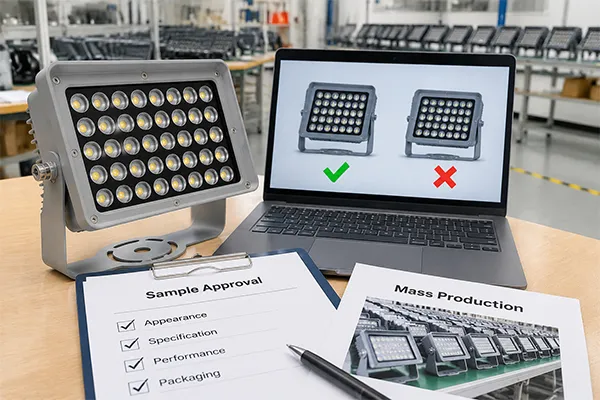
What a Controlled Approval Package Includes
When we coordinate a custom order, we aim to make sure that the documents tell the same story. A sample may demonstrate the physical product, but it cannot always show every production input. For example, the sample may use a plain carton while the final order needs a branded retail carton. The sample may also use a temporary label while mass production requires a private-label rating label and a specific barcode.
A useful approval package usually includes:
-
Approved product sample or sample photos
These should show the housing, finish, bracket, cable exit, connector, and other visible details. -
Product specification sheet
This should state the agreed model, wattage, voltage, CCT, beam angle, CRI, dimensions, and other relevant performance or mechanical requirements. -
Proforma invoice (PI)
The PI should match the approved commercial configuration, quantities, unit prices, trade terms, payment terms, and packaging assumptions. -
Artwork approval sheet
This should cover logo placement, rating labels, outer cartons, inner boxes, manuals, warning labels, and barcode information where applicable. -
Packaging specification
This should identify carton dimensions, units per carton, gross weight, net weight, protective materials, and pallet requirements when needed. -
Quality and inspection requirements
This should state what will be checked, what documents or photos will be shared, and whether the buyer will appoint a third-party inspection provider.
Why Revision Control Matters
We recommend that buyers assign a simple version reference to each approved document. A reference such as “FL-100W-5000K-V3” can prevent confusion when a project has several wattages or packaging versions.
| Document | Example control point | Common risk without control |
|---|---|---|
| Specification sheet | Revision number and approval date | Wrong CCT, voltage, or beam angle enters production |
| PI | Model code and configuration | Price and order description do not match |
| Logo artwork | File name and print approval | Incorrect logo size, color, or placement |
| Carton artwork | Carton dimensions and marks | Packaging does not meet customer or shipping needs |
| Rating label | Required electrical and brand data | Labels do not match the intended market or buyer format |
| Inspection checklist | Critical visual and functional criteria | Supplier and inspector apply different standards |
We once worked through a request where the buyer approved the fixture sample quickly but continued revising the carton artwork. The fixture itself was ready for production planning, but the customized carton materials could not be finalized until the artwork was signed off. That situation reinforced a simple lesson: a custom order is only ready when all production inputs are ready.
Why Are OEM Logos, Labels, and Cartons Part of the LED Flood Light Export Process?
Many buyers treat OEM branding as a final packaging step. In reality, logos, labels, manuals, and cartons are material inputs that can affect production readiness. If artwork arrives late or changes after printing starts, the LED flood light export process may need revision even when the floodlight itself is technically complete.
OEM materials should be confirmed before mass production because they influence printing, label preparation, carton manufacturing, packing instructions, and final inspection. We recommend that importers approve artwork early, provide editable files where needed, and confirm language, marks, product data, and packaging information before materials are ordered.
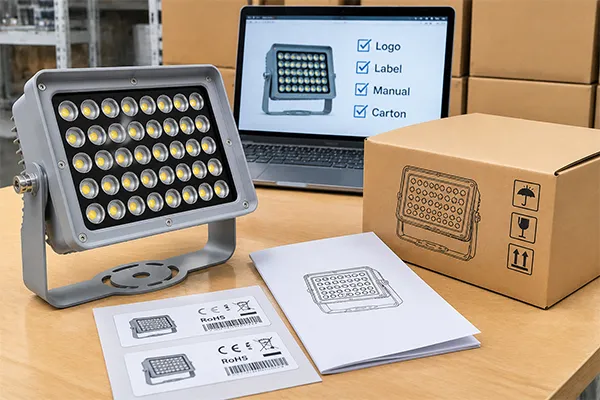
OEM Requirements That Need Early Attention
A private-label LED floodlight involves more than adding a logo to the front glass or housing.5 Each branded element should match the agreed product version and the buyer’s market approach.
We normally ask buyers to confirm the following before we prepare OEM materials:
- Brand name and logo files: preferably high-resolution or vector artwork
- Logo location and method: laser marking, printing, label, embossing, or another agreed method
- Rating-label content: model, electrical data, importer details where required, production code, and other buyer-requested information
- Manual language: English only, bilingual, or market-specific language versions
- Carton artwork: product image, brand name, item code, quantity, gross weight, dimensions, handling marks, and barcode
- Barcode format: EAN, UPC, or customer-defined code, if applicable
- Color standards: Pantone or other controlled color references for packaging and logo printing
- Inner packaging: foam, molded protection, polybag, gift box, or neutral box requirements
Packaging Is Also a Quality-Control Issue
Packaging protects the product during domestic handling, container loading, ocean or air transit, unloading, and local delivery.6 It also shapes how distributors, contractors, and retailers receive the product.
For project-oriented orders, buyers may prioritize carton strength, clear model identification, and installation information. For retail distribution, the buyer may need shelf-ready graphics, barcode placement, multilingual warnings, and consistent brand presentation.
We recommend that importers review packaging from three angles:
| Review angle | What to check | Buyer benefit |
|---|---|---|
| Product protection | Internal supports, carton strength, packing quantity, stacking approach | Helps reduce transit damage risk |
| Operational handling | Model marks, carton quantity, weights, dimensions, pallet details | Helps warehouse and distribution planning |
| Brand compliance | Logos, barcodes, manuals, label content, language | Supports a consistent private-label program |
Our team can coordinate custom packaging and labeling based on confirmed files. However, the importer should verify any mandatory labeling, language, recycling, importer-identification, or product-marking obligations with qualified local advisers. Supplier-provided documents and artwork support the process, but they do not replace destination-market compliance review.
What Happens During Production, Aging Tests, and Pre-Shipment Inspection?
Importers often focus on the shipment date, but quality evidence is built during production. The LED flood light export process should include agreed checkpoints for materials, assembly, aging, inspection, packing, and document preparation. When these activities are sequenced clearly, buyers can make payment and booking decisions with better information.
During production, we coordinate the confirmed specification with material preparation, assembly, 100% aging tests7, visual checks, functional verification, packing, and pre-shipment review. At Upward Lighting, each product undergoes a 100% aging test lasting approximately 4 to 8 hours before shipment. Importers should still define their own acceptance criteria and consider independent inspection when appropriate.
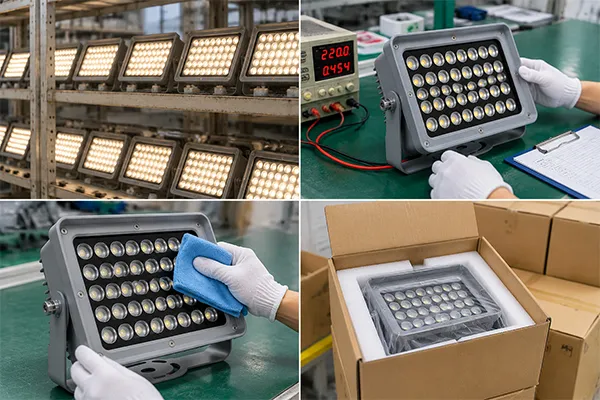
Our Typical Quality Sequence
The exact process depends on the product configuration and order requirements, but the sequence below reflects how we approach coordination for LED floodlight orders.
-
Specification and material confirmation
We review the approved version before purchasing or allocating relevant materials. This step is especially important for custom drivers, cables, connectors, finishes, labels, and cartons. -
Production scheduling
We align assembly planning with material readiness. A product may be technically simple, but a custom carton, label, or plug can still affect shipment readiness. -
Assembly and in-process checks
We monitor visible workmanship, component fit, wiring, mounting hardware, labeling, and other agreed production points. -
Aging test
Upward Lighting performs a 100% aging test for approximately 4 to 8 hours before shipment. The purpose is to identify early functional issues and support our internal quality-control process. -
Final inspection and packing review
We check the final product against the confirmed version, then verify quantity, labels, carton marks, and packing condition. -
Buyer or third-party inspection, if arranged
Importers may appoint their own quality-control agency or representative. We recommend agreeing on inspection timing, sampling approach, checklist, and release procedure before production is complete.
What Buyers Should Define as Acceptance Criteria
A supplier’s standard checks may not fully cover a distributor’s internal requirements or a project’s tender requirements.8 Buyers should identify the characteristics that matter most to their business.
Examples include:
- Rated wattage and input-voltage marking
- CCT and visual color consistency expectations
- Housing color and surface appearance
- Cable length, plug type, and connector configuration
- Bracket angle, mounting holes, and included accessories
- Product dimensions and carton dimensions
- Logo, label, manual, and barcode correctness
- Quantity per carton and carton markings
- Functional operation and agreed test records
- Any project-specific photometric, electrical, or document review requirements
We use controlled order information to reduce avoidable errors, but we do not suggest that one general inspection list is enough for every market. A stadium project, construction site, warehouse, retail program, and municipal application can have very different acceptance standards. Buyers should obtain qualified technical evaluation for application-specific performance, safety, and regulatory decisions.
Which Documents and Logistics Milestones Matter Before Shipment?
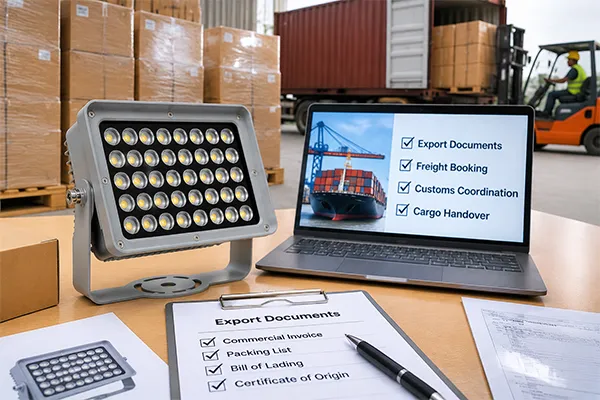
Shipment delays often begin with activities that were not included in the original order plan. The LED flood light export process involves more than finished goods; it also involves balance-payment timing, document preparation, freight booking, customs coordination, and handover to the selected logistics party.
Before shipment, importers should confirm the commercial terms, document list, payment-release procedure, freight booking responsibility, cargo handover point, and customs coordination steps. We can prepare available export documents and coordinate with the nominated forwarder, while the importer, freight forwarder, customs broker, and local advisers remain responsible for verifying import compliance, taxes, clearance rules, and destination requirements.
Build Milestones Into the Purchase Order
We recommend that buyers map the commercial and logistics sequence before mass production starts. This approach reduces last-minute disputes about who must book the vessel, when the balance is due, or which document format is needed.
| Milestone | Typical coordination point | Main parties involved |
|---|---|---|
| PI confirmation | Product version, quantity, price, payment, Incoterms | Importer and supplier |
| Artwork freeze | Labels, manuals, cartons, OEM branding | Importer and supplier |
| Production release | Approved specifications and materials | Supplier |
| Inspection window | Buyer inspection or third-party inspection timing | Importer, inspector, supplier |
| Balance-payment step | Agreed payment condition and release process | Importer and supplier |
| Freight booking | Container, LCL, air, courier, or buyer-nominated forwarder | Importer, forwarder, supplier |
| Export declaration | China-side customs and cargo information | Supplier and export/logistics parties |
| Shipping handover | Cargo release to forwarder or carrier | Supplier, forwarder, importer |
| Destination clearance | Duties, taxes, permits, local compliance | Importer, broker, local advisers |
Documents Buyers Commonly Request
The document list depends on the sales terms, shipping method, destination, customer, and product category.9 We can provide available order and export documents as agreed, but buyers should confirm their required list before production finishes.
Common documents may include:
- Commercial invoice
- Packing list
- Bill of lading, sea waybill, air waybill, or courier transport record
- Proforma invoice
- Product specification sheet
- Test or inspection records where agreed
- Certificate of origin where applicable and available
- Product documents related to CE or RoHS where available
- Insurance documents if insurance is arranged under the agreed trade term
- Pallet, carton, or shipping-mark information
Certifications Require Market-Specific Verification
CE and RoHS are frequently requested for LED lighting products, especially in European-oriented sourcing discussions.10 However, we encourage buyers to avoid treating any certificate or declaration as universal clearance. The relevant question is whether the documents, product version, markings, technical file expectations, and project requirements are appropriate for the intended market and use.
At Upward Lighting, our products hold certifications such as CE and RoHS. We can provide available product documents for buyer review. Still, the importer should verify:
- Whether the specific product model and configuration are covered
- Whether the destination market accepts the relevant documentation
- Whether a project owner, retailer, or tender requires additional reports
- Whether labeling and importer obligations apply
- Whether local electrical rules impose additional requirements
- Whether customs, tax, environmental, or recycling obligations apply
This verification should involve the importer’s freight forwarder, customs broker, compliance team, and qualified local advisers where needed.
Frequently Asked Questions
What is the first step in the LED flood light export process?
The first step is to define the exact product version and commercial requirements. We recommend confirming wattage, voltage, CCT, beam angle, finish, cable, plug, branding, packaging, destination market, and inspection expectations before requesting a final quotation or approving production.
Is an approved LED floodlight sample enough to start mass production?
No. An approved sample is useful, but it should be linked to a controlled specification sheet, PI, artwork approval, packaging details, and inspection requirements. We recommend that buyers freeze these documents before production so the mass-produced version matches the approved configuration.
Can a manufacturer guarantee customs clearance in my country?
No supplier can responsibly guarantee destination customs clearance without market-specific verification.11 We can coordinate export-side documents and cargo handover, but the importer, customs broker, freight forwarder, and qualified local advisers should verify duties, taxes, import rules, and local compliance obligations.
Do CE and RoHS documents automatically allow LED floodlights to be sold everywhere?
No. CE and RoHS documents do not automatically satisfy every country, tender, retailer, or project requirement.12 Buyers should verify that the relevant product configuration, documentation, marking, and application meet the rules and customer expectations in the destination market.
When should I book freight for a customized floodlight order?
We recommend discussing freight responsibility and booking timing when the order is confirmed. The final booking should align with production status, inspection plans, payment terms, cargo readiness, and the forwarder’s cut-off dates. Your nominated forwarder can advise on route-specific timing and document requirements.
Conclusion
The LED flood light export process works best when importers treat it as a controlled procurement workflow rather than a final shipping task. We recommend starting with a complete RFQ, linking the approved sample to the production documents, freezing OEM materials early, defining inspection expectations, and planning export milestones before goods are ready. At Upward Lighting, we support importers with customized LED floodlight specifications, OEM/ODM coordination, 100% aging tests, export-document preparation, and shipping handover. Contact us to discuss your required product version and sourcing plan.
"Mains electricity by country", https://en.wikipedia.org/wiki/Mains_electricity_by_country. National electrical-supply and plug references document that the United Kingdom and the United Arab Emirates use different nominal voltage and plug arrangements, supporting the need to specify market-appropriate electrical configurations. Evidence role: general_support; source type: institution. Supports: Authoritative electrical-system references showing that the United Kingdom and the United Arab Emirates use different nominal supply voltages and plug systems.. Scope note: Voltage and plug differences do not by themselves establish every labeling, cable, mounting, or product-certification requirement. ↩
"Competitive Selection - Procurement Services - Iowa State ...", https://www.procurement.iastate.edu/competitive-selection. Public-procurement guidance generally identifies clear and complete specifications as necessary for suppliers to prepare responsive, comparable quotations. Evidence role: general_support; source type: government. Supports: Public-procurement guidance explaining that clear, complete specifications enable suppliers to prepare responsive and comparable offers.. Scope note: Such guidance concerns procurement practice broadly and does not measure quotation quality for LED floodlights specifically. ↩
"Configuration Management Concepts Document", https://www.nist.gov/publications/configuration-management-concepts-document. Quality-management guidance emphasizes control of documented product requirements and changes so that operational outputs remain consistent with approved specifications. Evidence role: general_support; source type: institution. Supports: Quality-management principles concerning controlled documented information, production requirements, and management of changes.. Scope note: This supports the control principle rather than prescribing a particular sample-approval package. ↩
"Guidance for Industry", https://www.fda.gov/media/71023/download. Quality-system guidance describes documented review and control of changes as a means of maintaining consistency between approved requirements and manufacturing execution. Evidence role: mechanism; source type: government. Supports: Quality-system guidance requiring planned, reviewed, and documented changes to controlled manufacturing processes or specifications.. Scope note: Requirements and terminology vary by industry and jurisdiction; this does not establish a universal legal duty for every lighting order. ↩
"EU - Labeling/Marking Requirements", https://www.trade.gov/country-commercial-guides/eu-labelingmarking-requirements. The European Commission's product-compliance guidance describes traceability, economic-operator identification, and user-information obligations that may apply in addition to a product's visible branding. Evidence role: general_support; source type: government. Supports: EU product-compliance guidance on manufacturer and importer identification, traceability, instructions, and safety information for regulated products.. Scope note: The precise obligations depend on the applicable legislation, product category, and destination market. ↩
"Getting Started with Design & Testing", https://www.ista.org/getting_started_with_design.php. Transport-packaging standards address the ability of complete packages to withstand distribution hazards associated with handling, loading, transport, and delivery. Evidence role: mechanism; source type: institution. Supports: Packaging-test standards and guidance describing how distribution packaging is evaluated against handling and transport hazards.. Scope note: Conformance with a packaging test method does not guarantee that every shipment will be damage-free. ↩
"Burn-in", https://hep.uchicago.edu/atlas/tilecal/prr/Burn-in.html. Reliability literature describes burn-in testing as an approach for exposing certain early-life electronic failures before field use. Evidence role: mechanism; source type: research. Supports: Reliability literature explaining that burn-in or aging can screen some early-life failures in electronic components and assemblies.. Scope note: Burn-in effectiveness depends on the test conditions and failure mechanisms and cannot demonstrate long-term reliability or compliance by itself. ↩
"6.2.1. What is Acceptance Sampling?", https://www.itl.nist.gov/div898/handbook/pmc/section2/pmc21.htm. Acceptance-sampling guidance treats inspection as an assessment against defined acceptance criteria, which may be established by contractual or customer requirements rather than by a supplier's routine checks alone. Evidence role: general_support; source type: institution. Supports: Inspection and acceptance-sampling guidance showing that acceptance criteria and sampling plans are defined in relation to specified requirements.. Scope note: The guidance does not determine which criteria are appropriate for a particular floodlight project. ↩
"Know Your Incoterms", https://www.trade.gov/know-your-incoterms. Official export guidance notes that the documents needed for an international shipment can vary with the goods, destination-country requirements, transaction terms, and transport method. Evidence role: general_support; source type: government. Supports: Official export guidance explaining that documentation requirements vary by destination, commodity, transaction, and mode of transport.. Scope note: Export guidance is jurisdiction-specific and should not be treated as a complete list of documents for every import transaction. ↩
"RoHS", https://en.wikipedia.org/wiki/RoHS. European Union guidance identifies CE marking under applicable harmonised legislation and RoHS substance restrictions as relevant regulatory frameworks for electrical and electronic equipment placed on the EU market. Evidence role: historical_context; source type: government. Supports: European Commission and EU legal materials establishing CE-marking obligations under applicable harmonised legislation and RoHS restrictions for electrical and electronic equipment.. Scope note: Applicability depends on the product, its intended use, and the specific EU legislation in force; CE marking is not a single product certificate. ↩
"EU - Import Requirements and Documentation", https://www.trade.gov/country-commercial-guides/eu-import-requirements-and-documentation. Customs authorities require import declarations and supporting information such as classification, value, origin, and compliance data, so clearance is determined under destination-country procedures rather than by a supplier's assurance alone. Evidence role: general_support; source type: institution. Supports: Customs guidance showing that import clearance depends on accurate declarations, tariff classification, valuation, origin, and destination-country procedures.. Scope note: Specific declaration requirements, liability allocation, and clearance outcomes vary by jurisdiction and transaction. ↩
"EU - EU Legislation and CE Marking", https://www.trade.gov/country-commercial-guides/eu-eu-legislation-and-ce-marking. European Commission guidance characterizes CE marking and RoHS as compliance frameworks tied to defined EU legislation and market scope, not as universal evidence that a product meets all foreign-market or purchaser-specific conditions. Evidence role: definition; source type: government. Supports: European Commission guidance defining CE marking and RoHS as EU legal frameworks with defined scope rather than universal approvals.. Scope note: A particular tender or retailer may accept such documentation as part of its requirements, but that acceptance must be verified against its own terms. ↩