Importing LED flood lights from China can look simple when suppliers offer similar photos, wattages, and prices. The real risk appears later, when an approved sample does not match the bulk order, project requirements are unclear, or a shipment arrives with avoidable defects. I reduce these risks by helping buyers define, document, and verify requirements before production begins.
The safest way to reduce risk when importing LED flood lights from China is to confirm the real application, approve a fully documented sample, lock measurable specifications and tolerances, and use inspection checkpoints before final payment. Buyers should compare total procurement scope—not only unit price—and verify production, aging-test, packaging, and compliance evidence relevant to the target market.
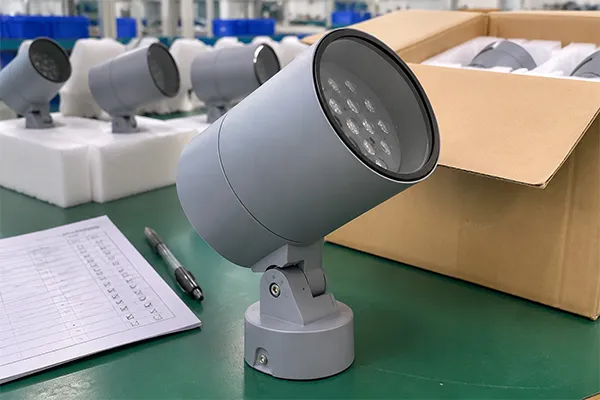
In my experience as a China-based LED lighting manufacturer, most serious disputes do not begin with obvious bad intentions. They begin with assumptions. A buyer assumes that “100W,” “IP66,” or “warm white” means one fixed standard.1 A factory may interpret those terms differently unless the order documents remove uncertainty.
Why Is Application Definition Essential When Importing LED Flood Lights from China?
When buyers start importing LED flood lights from China, they often focus on wattage, price, and appearance first. Those factors matter, but they do not explain where or how the fixture will operate. If the application is vague, the supplier may select a configuration that meets a basic quotation but not the real project need.
Buyers should define the installation environment, operating schedule, mounting method, beam requirement, cable arrangement, and local market expectations before ordering LED flood lights. A clear application brief helps suppliers recommend suitable materials, drivers, optics, sealing structures, and packaging instead of relying on generic catalog specifications.
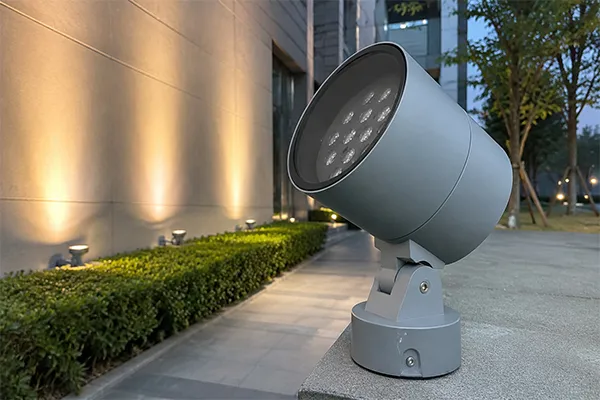
Start With the Real Operating Conditions
I recommend that buyers describe the operating task in practical language. For example, “100W outdoor floodlight” is not enough information for a reliable quotation. A warehouse loading yard, sports area, building façade, billboard, and coastal walkway may all use floodlights, but each application places different demands on the product.
A useful application brief should cover the following points:
- Installation location: Is the fixture installed outdoors, under a canopy, indoors, near water, or in a dusty industrial area?
- Operating hours: Will it run 2 hours per night, 10 hours per night, or continuously?
- Ambient temperature: Will the product operate in hot climates, enclosed spaces, cold regions, or areas with limited airflow?
- Mounting position: Will it be wall-mounted, pole-mounted, bracket-mounted, or installed at an angle?
- Target beam pattern: Does the project require wide-area illumination, a narrow façade beam, asymmetric distribution, or glare control?
- Electrical requirements: What are the required input voltage, frequency, surge protection expectations, plug type, and cable length?
- Appearance requirements: Does the buyer need a black, gray, white, or custom-finish housing?
- Maintenance access: Can installers easily replace failed units, or will replacement require lifts, shutdowns, or costly labor?
Do Not Treat IP Rating as the Full Outdoor Answer
An IP rating can be important, but I do not advise buyers to treat a high IP rating as a complete guarantee of outdoor reliability. Outdoor performance also depends on housing design, gasket quality, cable gland selection, assembly consistency, thermal management, mounting angle, drainage, and the actual environment.2
For example, a floodlight near a coastal area may face humidity and salt exposure that require more attention to housing finish, fasteners, and sealing details3 than a standard inland installation. A fixture in a hot climate may require careful heat management and driver selection, especially when it operates for long periods.
I have seen buyers save time by sending photos of the installation site, a simple lighting layout, and the expected daily operating hours. Those three items often reveal risks that a short product description cannot show.
When importing LED flood lights from China, I encourage buyers to ask the supplier what assumptions sit behind the quotation. This creates a more useful discussion than simply asking, “Is this your best price?”
How Should Buyers Compare LED Flood Light Quotes Beyond Unit Price?
A low quote can be attractive, especially for wholesalers, distributors, and competitive project bids. However, a lower LED flood light price may reflect a different scope of materials, testing, packaging, warranty support, delivery terms, or documentation. I believe buyers should compare the full procurement package before deciding which offer is truly economical.
Buyers should compare LED flood light quotations line by line, including LED source, driver, housing, surge protection, cable, packaging, testing, lead time, Incoterms, and after-sales terms. The lowest unit price can be suitable only when the product scope and risk controls match the buyer’s intended market and application.
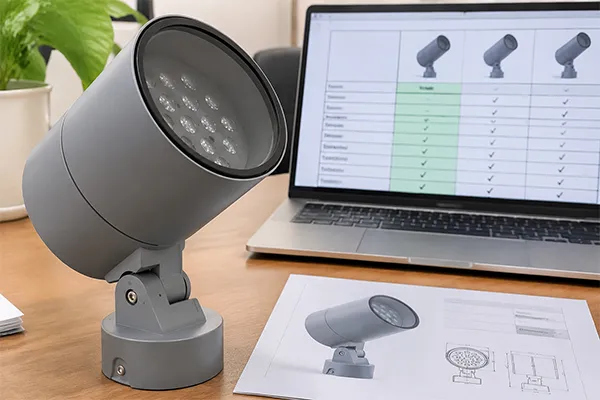
Compare Like for Like
Two suppliers may both quote a “100W LED floodlight,” but they may not be offering the same product configuration. One quote may include a longer cable, better driver specification, thicker housing, stronger surge protection, individual inner boxes, and a more complete aging-test process. Another may offer a basic configuration that is suitable for less demanding use.
I recommend building a comparison table before negotiating price.
| Comparison Point | Questions Buyers Should Ask | Why It Matters |
|---|---|---|
| LED source | What LED package or brand is used? Is binning or color consistency defined? | LED selection can affect color consistency, efficacy, and long-term output.4 |
| Driver | What driver model, input range, power factor, and protection features apply? | Drivers are a major reliability consideration in many LED fixtures.5 |
| Housing | What material, finish, and heat-sink structure are included? | Housing affects heat dissipation, corrosion resistance, and physical durability.6 |
| Optics | What beam angle or lens design is supplied? | Beam distribution affects lighting results more than wattage alone.7 |
| Surge protection | Is surge protection included? What is the rated scope? | Electrical conditions vary by project and region. |
| Cable and connector | What cable length, wire specification, plug, and gland are provided? | Installation compatibility can create unexpected rework costs. |
| Packaging | How many pieces per carton? Is drop protection defined? | Weak packaging can turn a good product into a damaged shipment.8 |
| Testing | What is inspected, and what aging-test duration is applied? | Testing evidence helps buyers assess shipment controls. |
| Delivery | What lead time applies after deposit and artwork approval? | Delays can affect project schedules and inventory planning. |
Calculate Total Procurement Risk
I use the phrase total procurement risk because unit price is only one part of the cost. Buyers should also consider the likely cost of delays, claims, replacements, customs issues, reputational damage, and lost customers.
A simple internal comparison can look like this:
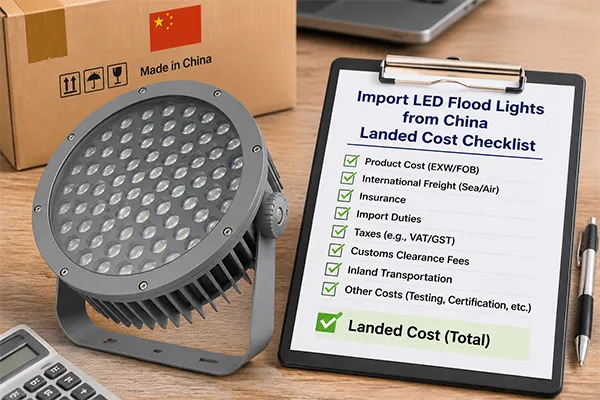
- Calculate the landed unit cost, including freight, insurance, duties, local delivery, and inspection.
- Estimate the cost of a batch issue, such as replacement stock, labor, reverse logistics, and customer credits.
- Review the supplier’s response speed and ability to provide clear written answers.
- Consider whether the supplier can support repeat orders with the same documented configuration.
- Compare payment terms and the evidence available before the final balance is paid.
When importing LED flood lights from China, I do not suggest assuming that the cheapest offer is poor quality. Some suppliers may have efficient supply chains or simpler product scopes. However, buyers need to understand exactly what is included and what is excluded. A price is only meaningful when the specification is comparable.
How Can an Approved LED Flood Light Sample Protect the Bulk Order?
A sample is one of the most valuable controls in LED flood light sourcing.9 Yet a good sample alone does not prove that every unit in mass production will match it.10 The risk increases when the buyer approves a sample informally through photos, chat messages, or verbal confirmation without recording the final configuration.
An approved LED flood light sample protects the bulk order only when buyers document the sample’s specifications, components, labeling, packaging, test requirements, and allowed deviations. The sample approval record should become a reference for production and pre-shipment inspection, not simply a one-time visual check.
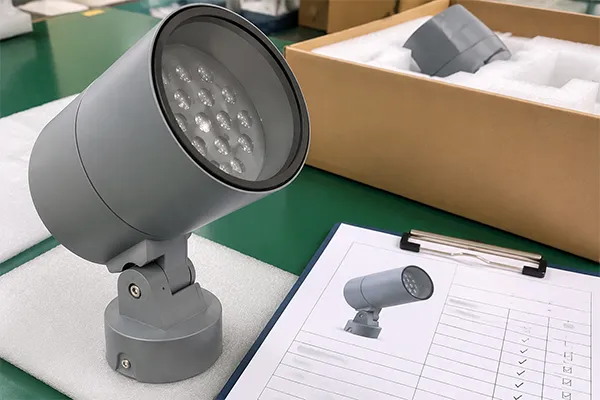
Turn the Sample Into a Controlled Reference
At our facility, I have learned that inconsistency can enter an order at several stages: specification interpretation, component purchasing, production assembly, labeling, packaging, and shipment preparation. A detailed sample approval process gives both buyer and supplier a common reference point.
I recommend that buyers create a sample approval record with the supplier. This document does not need to be overly complicated, but it should be specific enough to prevent avoidable disagreement.
The record can include:
- Product model number and revision number
- Product photos from multiple angles
- Rated wattage and acceptable tolerance
- Input voltage and frequency
- Color temperature and acceptable range
- CRI requirement, if relevant
- Beam angle or optical configuration
- LED source and driver model, where practical
- Housing color and surface finish
- Cable length, wire type, plug, and connector details
- Bracket dimensions and mounting-hole spacing
- Product label artwork and carton marking
- Required accessories, screws, and instruction documents
- Individual box and master-carton configuration
- Required test records or inspection checkpoints
- Defined allowable substitutions, if any
Define What Cannot Change
A buyer should clearly identify the critical-to-quality features. These are the items that cannot change without written approval. For one customer, the critical issue may be the beam angle because the product is used for a façade project. For another, it may be carton size because the customer needs to maximize container loading. For a distributor, consistent color temperature and branding may be the priority.
I once worked through a sample review where the buyer liked the floodlight body but later realized that the supplied cable was too short for the installation method. The product itself was not defective, but the project required additional junction boxes and labor. A clearer sample approval sheet would have prevented that issue before the deposit stage.
When importing LED flood lights from China, I recommend retaining a physical approved sample whenever possible. Both parties should identify the sample by date, model, and configuration. Photos are helpful, but physical samples and written specifications provide stronger references if a quality question arises later.
What Quality Control Evidence Should Buyers Request Before Shipment?
Buyers cannot inspect every production step themselves, especially when they source from another country. However, they can request practical evidence at defined checkpoints. This approach gives buyers more visibility into the order and helps them identify issues before final payment or shipment.
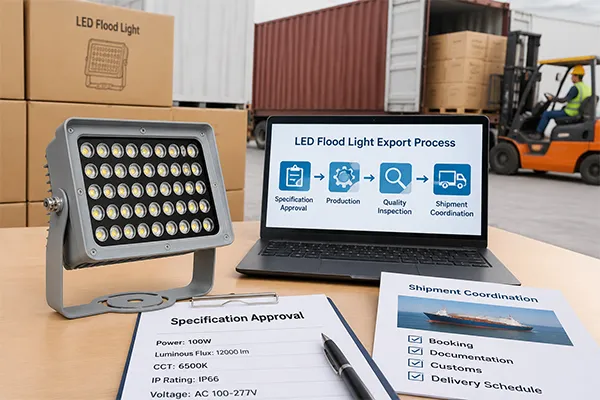
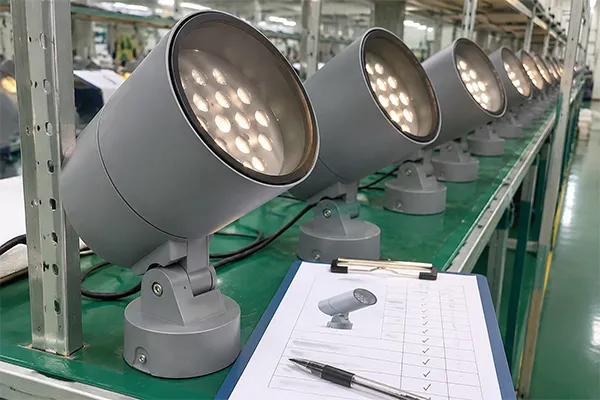
Buyers should request a written production and inspection plan, aging-test scope, pre-shipment photos or videos, packing information, and inspection records for LED flood lights. For higher-value or project-critical orders, buyers may also consider a qualified independent inspection before paying the balance.
Use Checkpoints Instead of Waiting for the Container
A practical quality-control plan can be divided into stages. The exact depth of control should reflect order value, product complexity, project consequences, and the buyer’s tolerance for risk.
| Control Stage | Buyer Verification Focus | Typical Evidence to Request |
|---|---|---|
| Before deposit | Final specification and sample approval | Signed specification sheet, approved sample record, quotation revision |
| Before mass production | Material and artwork confirmation | Label artwork, carton artwork, component list confirmation |
| During production | Assembly consistency and workmanship | Production photos, in-process inspection information |
| Before packing | Functional checks and appearance review | Test records, product photos, labeling confirmation |
| Before shipment | Quantity, packaging, and shipment condition | Packing list, carton photos, aging-test evidence, final inspection report |
| Before balance payment | Overall conformity with agreed order | Supplier report and, if needed, independent inspection results |
Understand What Aging Tests Can and Cannot Show
At Upward Lighting, we conduct a 100% aging test for 4 to 8 hours before shipment as part of our shipment-control process. I view aging as a useful screening step because it can help identify some early functional issues before products leave the factory.
However, I do not present aging tests as a guarantee against every future field failure. A 4- to 8-hour aging test cannot fully reproduce years of outdoor exposure, installation quality, voltage fluctuation, heat accumulation, corrosion, or unexpected operating conditions.11 Buyers should ask suppliers what their aging procedure covers, how records are kept, and whether the test conditions align with the product type.
Consider Independent Inspection for Higher-Risk Orders
Independent inspection can be useful for:
- First orders with a new supplier
- Large purchase values
- Project-specific products
- Orders with custom labels or packaging
- Time-sensitive deliveries
- Products that will be difficult or costly to replace
An independent inspector should work from a clear inspection checklist. Otherwise, the inspection may only confirm general appearance and quantity rather than the buyer’s specific requirements.
For importing LED flood lights from China, evidence should be connected to the approved specification. A generic factory photo is less useful than a photo showing the correct label, carton mark, cable, mounting bracket, and product configuration.
How Should Buyers Verify Certifications and Supplier Reliability?
Certificates and supplier claims can support a sourcing decision, but neither should be treated as automatic proof that a product meets every legal, technical, or project requirement. Markets, applications, installation conditions, and buyer responsibilities differ. I recommend a verification process that connects documents to the actual product being purchased.
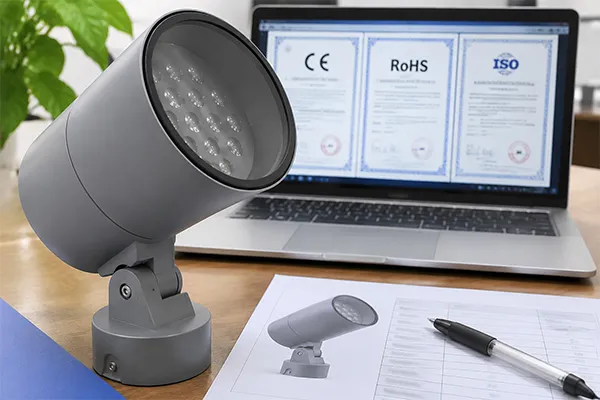
Buyers should verify that certification documents relate to the correct LED flood light model, revision, and target-market requirements. They should also assess supplier reliability through communication quality, document control, production capability, response speed, references, and willingness to support reasonable verification steps.12
Verify Documents Against the Actual Order
At Upward Lighting, our products hold certifications such as CE and RoHS. These documents can be relevant to market-entry, safety, and environmental expectations in applicable contexts. Still, buyers should verify the documents for the specific model and target market rather than assuming that one certificate covers every product, country, or project.
Buyers can ask the following questions:
- Does the certificate or test report identify the same model number?
- Does the product configuration match the tested version?
- Is the document current and issued by an identifiable organization?
- Does the document apply to the target country and intended application?
- Are there additional local requirements for electrical installation, energy performance, EMC, safety, or project approval?
- Does the product labeling match the required market information?
For application-specific compliance decisions, I recommend that buyers consult qualified local professionals, testing organizations, or regulatory advisers. This is especially important for public projects, commercial buildings, hazardous environments, or markets with specific national requirements.
Evaluate the Supplier’s Operating Discipline
Supplier reliability is not only about factory size or the number of certificates displayed online. I look for operating discipline. A reliable supplier should be able to explain the product configuration, identify unclear points, provide written revisions, and respond consistently.
Useful supplier-selection questions include:
- Can the supplier provide a detailed specification sheet?
- Can the supplier support OEM or ODM changes such as wattage, CCT, beam angle, CRI, and finish color?
- Can the supplier handle small-batch orders without losing specification control?
- How does the supplier manage artwork, labels, packaging, and revision changes?
- What is the normal response time for quotations and technical questions?
- What evidence can the supplier provide before shipment?
- How does the supplier address nonconforming goods or documented claims?
When I work with importers and lighting brands, I find that clear communication is often an early indicator of future order management. If a supplier cannot answer basic specification questions before the order, the risk rarely becomes smaller after the deposit is paid.
Frequently Asked Questions
What is the biggest risk when importing LED flood lights from China?
The biggest risk is usually an unclear agreement between the approved sample and the bulk-order specification. Buyers should document critical components, performance requirements, labels, packaging, testing scope, and allowable tolerances before production begins.
Should I choose the lowest-priced LED flood light supplier?
I recommend comparing the lowest quote carefully rather than rejecting it automatically. Buyers should confirm the product configuration, materials, driver, packaging, testing, lead time, payment terms, and after-sales scope. A lower price may reflect a different procurement scope.
Is an IP66 LED flood light always suitable for outdoor use?
No. An IP rating is one important factor, but outdoor suitability also depends on housing construction, gasket quality, cable glands, thermal design, mounting position, corrosion exposure, installation quality, and actual environmental conditions.
Does a 100% aging test guarantee LED flood light reliability?
No. A 100% aging test can help identify some early functional issues before shipment. It does not eliminate risks associated with long-term use, installation conditions, electrical supply quality, weather exposure, heat, or maintenance practices.
Should I use a third-party inspection before paying the balance?
A third-party inspection can be worthwhile for first orders, large orders, customized products, and project-critical deliveries. The inspection should follow a buyer-approved checklist that reflects the sample approval record and final purchase specification.
Conclusion
Reducing risk when importing LED flood lights from China requires more than comparing prices or reviewing a certificate. I recommend that buyers begin with the actual application, convert requirements into measurable specifications, approve a documented sample, and request evidence throughout production and before shipment. A structured approach makes supplier comparisons fairer and quality disputes easier to manage. If you are sourcing LED flood lights for a wholesale, distribution, brand, or project application, contact Upward Lighting for a clear specification review, OEM/ODM quotation, and practical production-control discussion.
"Color temperature", https://en.wikipedia.org/wiki/Color_temperature. IEC 60529 defines IP66 in terms of protection against dust ingress and powerful water jets; it does not, by itself, specify corrosion resistance, thermal performance, light distribution, or service life. Evidence role: definition; source type: institution. Supports: IP codes describe ingress protection, while colour appearance and electrical ratings require additional specifications to characterize a luminaire fully.. Scope note: The standard addresses ingress protection rather than all aspects of floodlight performance. ↩
"Purchasing Energy-Efficient Exterior Lighting", https://www.energy.gov/cmei/femp/purchasing-energy-efficient-exterior-lighting. U.S. Department of Energy guidance on LED luminaires identifies thermal management, environmental exposure, and component design as important factors affecting luminaire performance and reliability beyond enclosure ratings. Evidence role: general_support; source type: government. Supports: Outdoor LED luminaire performance is influenced by thermal design, moisture control, corrosion exposure, component selection, and installation conditions.. Scope note: General LED-luminaire guidance may not evaluate every floodlight construction or installation orientation. ↩
"CORROSION PROTECTION FOR SPACE FLIGHT ...", https://standards.nasa.gov/sites/default/files/standards/NASA/A/2022-01-11-NASA-STD-6012A-Approved.pdf. ISO 9223 characterizes atmospheric corrosivity using factors including time of wetness and sulfur dioxide and chloride deposition, which are especially relevant in marine and coastal environments. Evidence role: mechanism; source type: institution. Supports: Chloride deposition and time of wetness in marine atmospheres accelerate atmospheric corrosion and affect material-selection decisions.. Scope note: Atmospheric-corrosivity classifications indicate exposure risk and do not predict the service life of a particular floodlight. ↩
"LED Color Characteristics", https://www1.eere.energy.gov/buildings/publications/pdfs/ssl/led-color-characteristics-factsheet.pdf. U.S. Department of Energy solid-state-lighting materials explain that LED binning is used to control colour consistency and that LED performance metrics include efficacy and light-output maintenance. Evidence role: mechanism; source type: government. Supports: LED chromaticity binning affects colour consistency, and LED operating conditions and component characteristics influence efficacy and light-output maintenance.. Scope note: Component-level performance does not alone determine the performance of the completed luminaire. ↩
"LED Systems Reliability Consortium", https://www.energy.gov/cmei/ssl/led-systems-reliability-consortium. Research on LED lighting-system reliability identifies driver electronics, particularly temperature-sensitive components, as an important potential constraint on luminaire lifetime. Evidence role: general_support; source type: research. Supports: Electronic drivers are a significant reliability component in LED lighting systems and can limit system lifetime under demanding operating conditions.. Scope note: Failure contributions vary with driver design, thermal environment, electrical conditions, and product quality. ↩
"Impact of Thermal Dissipation on the Lighting Performance ...", https://pmc.ncbi.nlm.nih.gov/articles/PMC8776062/. LED thermal-management research shows that enclosure and heat-sink design influence heat transfer and operating temperature, which in turn affect lighting-system performance and lifetime. Evidence role: mechanism; source type: research. Supports: Housing and heat-sink design affect LED junction temperature, while material and coating choices affect resistance to environmental degradation.. Scope note: Thermal studies may not directly assess corrosion resistance or mechanical durability for every housing material and finish. ↩
"Purchasing Energy-Efficient Exterior Lighting", https://www.energy.gov/cmei/femp/purchasing-energy-efficient-exterior-lighting. Illuminating Engineering Society guidance treats luminaire intensity distribution as a fundamental input to calculations of illuminance, uniformity, and glare; electrical wattage alone does not describe those outcomes. Evidence role: mechanism; source type: institution. Supports: Luminaire photometric distribution determines how light is delivered to a task or area, whereas wattage measures electrical input rather than lighting layout performance.. Scope note: The appropriate distribution still depends on mounting geometry, surface conditions, and the visual task. ↩
"Checking the Net Contents of Packaged Goods", https://www.nist.gov/system/files/documents/2023/02/10/2023%20NIST%20Handbook%20133.pdf. ISTA distribution-test procedures are designed to evaluate whether packaged products can withstand transport hazards such as handling shocks, vibration, and compression. Evidence role: general_support; source type: institution. Supports: Distribution packaging must protect products against handling, vibration, impact, and compression hazards encountered in shipment.. Scope note: Passing a laboratory distribution test reduces but does not eliminate the possibility of freight damage in actual logistics conditions. ↩
"PART 46 – QUALITY ASSURANCE", https://www.acquisition.gov/dlad/part-46-%E2%80%93-quality-assurance. First-article inspection practices verify that an initial item conforms to specified design and production requirements before or at the start of production. Evidence role: general_support; source type: institution. Supports: First-article or pre-production verification is used to confirm that an initial production item meets documented requirements before broader production proceeds.. Scope note: Sample or first-article approval does not by itself demonstrate that all subsequent units will remain conforming. ↩
"ISO 2859-1", https://chemistry.unt.edu/~tgolden/courses/iso2859-1.pdf. Acceptance-sampling guidance explains that inspection of a sample supports a decision about a lot at a stated sampling risk; it does not establish that every item in the lot conforms. Evidence role: general_support; source type: government. Supports: Sampling inspection provides evidence about a lot under a defined sampling plan but cannot prove the conformity of every individual unit.. Scope note: The degree of assurance depends on the sampling plan, lot size, acceptance criteria, and process controls. ↩
"Integration and Test > Accelerated Life Testing - S3VI - NASA", https://s3vi.ndc.nasa.gov/ssri-kb/topics/38/. LED reliability literature distinguishes short burn-in screening from long-duration or accelerated testing used to estimate degradation and failure behavior under defined stresses. Evidence role: general_support; source type: research. Supports: Long-term LED reliability and lumen maintenance require testing approaches that extend beyond short functional burn-in periods and account for operating stresses.. Scope note: Accelerated and laboratory tests also cannot reproduce every field installation, weather pattern, or electrical disturbance. ↩
"Supply Chain Management", https://www.nist.gov/mep/supply-chain. ISO 9001 procurement controls require organizations to evaluate and select external providers based on their ability to supply processes, products, and services that conform to requirements. Evidence role: expert_consensus; source type: institution. Supports: Supplier evaluation commonly considers the supplier's ability to meet requirements consistently, including quality-management processes, documentation, capacity, and verification arrangements.. Scope note: ISO 9001 provides a management-system framework and does not prescribe a single scoring method for supplier reliability. ↩