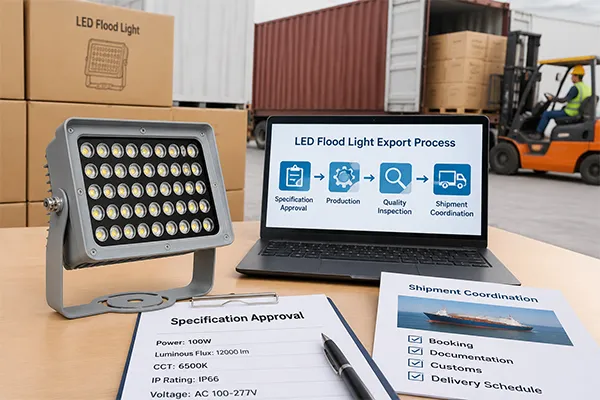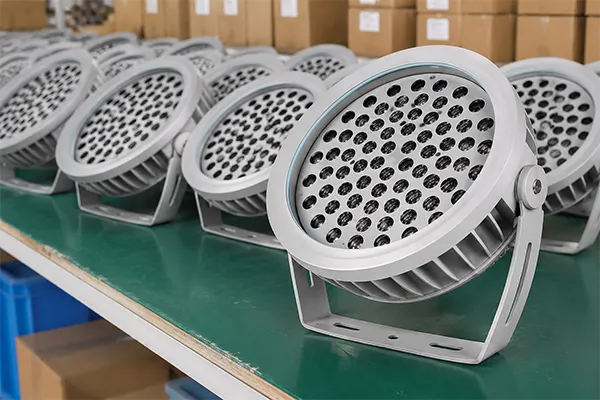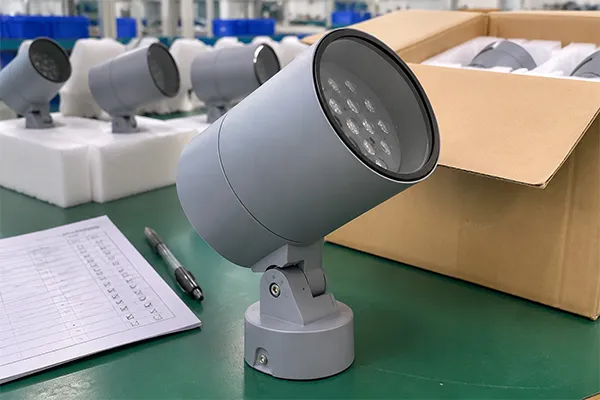

Importing LED flood lights from China can look simple when a supplier provides a low unit price, but that figure rarely reflects the full procurement budget. Freight, compliance documents, order quantity, packaging, customs charges, and local delivery can all affect your margin.1 We recommend building a landed-cost plan before comparing suppliers or placing an order.
The cost to import LED flood lights from China depends on the product specification, order volume, Incoterm, shipping method, destination requirements, and destination-side charges. A realistic budget includes the factory price, customization and testing, export handling, freight, insurance where applicable, import duty, VAT or sales tax, customs clearance, and final delivery. Buyers should verify destination charges with a qualified forwarder, customs broker, or local tax adviser.
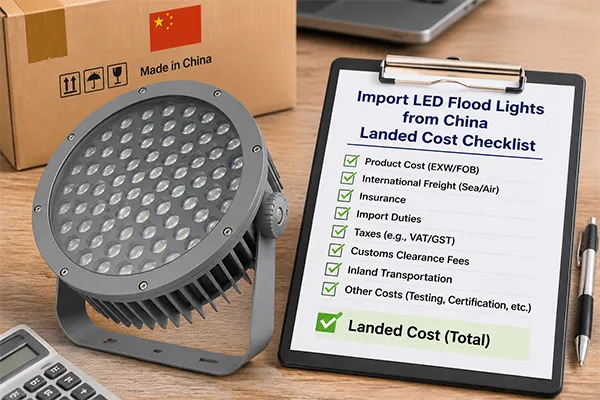
A low supplier quote can be useful, but it is only the starting point. In our export quoting experience at Upward Lighting, the best purchasing decisions come from comparing equivalent specifications and calculating the total cost per usable, compliant unit—not simply selecting the lowest quoted factory price.
What Costs Should You Include When You Import LED Flood Lights from China?
Many first-time buyers focus on the product price because it is the most visible number. That approach can create a problem later, especially when freight invoices, customs charges, or local transport costs arrive after production is complete. We encourage buyers to use a full landed-cost checklist from the first quotation stage.
When you import LED flood lights from China, you should include factory pricing, product customization, testing, export-side charges, freight, insurance if required, import duty, taxes, customs clearance, and delivery to your warehouse or project location. The exact responsibility for each cost depends on the agreed Incoterm and destination-market rules.2
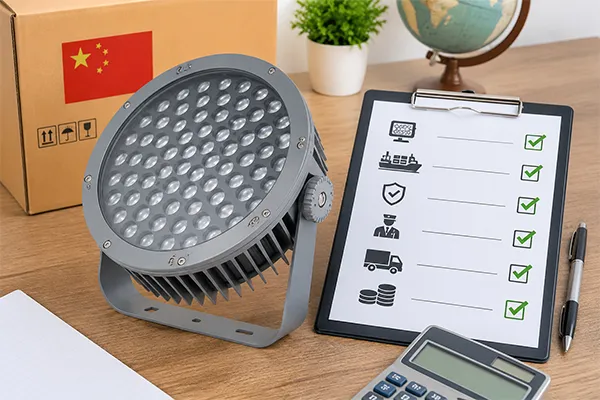
Build a Complete Landed-Cost Checklist
We usually recommend separating procurement costs into three groups:
- Factory-side costs
- International shipping costs
- Destination-side costs
This structure helps purchasing teams compare quotations clearly. It also prevents an EXW quote from being compared directly with an FOB, CIF, or DDP quote without adjustment.
| Cost Category | Typical Items to Review | Who Should Confirm It? |
|---|---|---|
| Product cost | Unit price, wattage, driver, housing, optics, packaging | Factory and buyer |
| Customization | Logo, color box, private label, special cable, beam angle | Factory and buyer |
| Quality control | Aging test, inspection standard, third-party inspection | Factory, buyer, inspection provider |
| Export preparation | Export carton marks, palletizing, documents, port handling | Factory and forwarder |
| Freight | Sea freight, air freight, courier charges, fuel and peak-season surcharges | Freight forwarder |
| Insurance | Cargo insurance, coverage terms, claim conditions | Insurer or forwarder |
| Import charges | Duty, VAT, sales tax, customs-related fees | Customs broker or local adviser |
| Local delivery | Port-to-warehouse transport, unloading, storage, appointments | Local forwarder or carrier |
Why “Landed Cost” Is More Useful Than Unit Price
A $10 floodlight with expensive freight, weak packaging, delayed certification documents, or high failure risk may cost more than a $13 product that is easier to ship, install, and resell.3
We have seen buyers request a very low ex-factory price and later discover that their carton size reduced container efficiency. In another anonymized quotation, a customer reduced the individual product cost slightly by choosing a heavier die-cast body and larger retail box. The customer then needed to reconsider the freight impact because the shipment occupied more cubic volume.
Procurement lesson: The cheapest LED floodlight at the factory gate is not automatically the lowest-cost product at the destination warehouse.
We can explain the controllable factory-side elements of a quote. However, buyers should not rely on a manufacturer to determine customs classification, duty, VAT, import licensing, or local clearance requirements. Those items require confirmation from qualified destination-country professionals.
Why Do LED Flood Lights from China Have Different Factory Prices?
Two LED flood lights may both be labelled “100W,” yet their construction, performance, and long-term operating value can differ significantly. This can confuse buyers who compare product photos or wattage labels without reviewing detailed specifications. We believe a fair supplier comparison begins with a shared technical requirement sheet.
LED flood lights from China vary in price because wattage alone does not define product quality or project suitability. Lumen output, LED chips, driver design, heat dissipation, IP rating, beam angle, surge protection, housing material, certification needs, and packaging all influence the factory cost and downstream risk.4
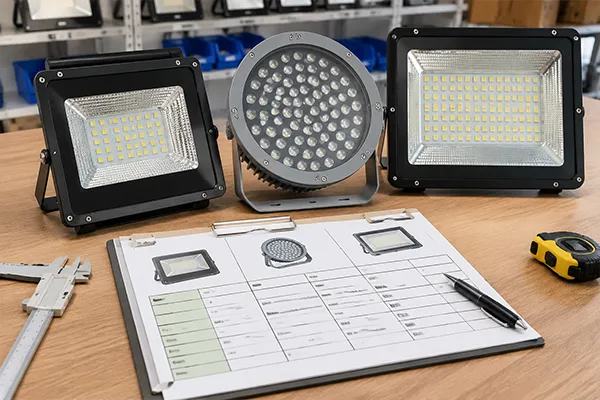
Compare Performance, Not Just Wattage
A floodlight should be evaluated by what it delivers over time.5 Buyers should ask for the actual performance data that supports a quotation.
Key areas to compare include:
- Luminous efficacy: How many lumens does the fixture deliver per watt?
- LED source: Which LED package or chip type is used, and is the supply stable?
- Driver quality: Does the driver suit the input-voltage range and operating environment?
- Heat management: Is the aluminum housing designed to dissipate heat effectively?
- Ingress protection: Is the stated IP rating suitable for the installation environment?
- Surge protection: Does the product need additional protection for unstable-grid or outdoor applications?
- Beam angle: Does the optic suit area lighting, façade lighting, sports areas, signage, or security use?
- Color quality: Does the buyer need 3000K, 4000K, 5000K, 6500K, or a specified CRI level?
Product Variables That Affect the True Cost
| Specification Variable | Lower-Cost Approach | Higher-Control Approach | Procurement Impact |
|---|---|---|---|
| Driver | Basic driver selection | Branded or project-matched driver | Can affect reliability and warranty exposure |
| Housing | Lighter construction | More robust die-cast aluminum design | Can affect cooling and durability |
| IP protection | Basic gasket and sealing | More controlled sealing design and testing | Can affect outdoor performance |
| Cable | Standard cable length | Customized cable, plug, or connector | Changes material and assembly cost |
| Surge protection | Standard configuration | Added surge protection device | Can be relevant in unstable power areas |
| Packaging | Bulk carton | Retail box, color box, foam protection, pallet | Changes damage risk and freight volume |
At Upward Lighting, we support OEM and ODM discussions around color temperature, wattage, beam angle, CRI, and surface finish. However, we always encourage buyers to connect each requested feature to the final application. A floodlight for a wholesale stock program may need a different balance of cost and specification than a floodlight for a coastal project, stadium perimeter, warehouse yard, or construction site.
Buyers should also request and verify applicable compliance documents for their target market. We can provide product documentation associated with our CE and RoHS offerings, but buyers should confirm that each document, product configuration, label, and certification scope matches the destination market and intended application.
How Do Quantity and Packaging Affect the Cost to Import LED Flood Lights from China?
Small orders often appear safer because they reduce the initial cash commitment. However, smaller shipments can carry higher per-unit handling and freight costs. This is especially true for samples, mixed-SKU trial orders, courier shipments, and less-than-container-load freight.
The cost to import LED flood lights from China usually falls per unit as order quantity and shipping efficiency improve, but the best quantity depends on demand planning, storage capacity, and working capital. Carton dimensions, pallet requirements, mixed models, and shipping mode can matter as much as gross weight.
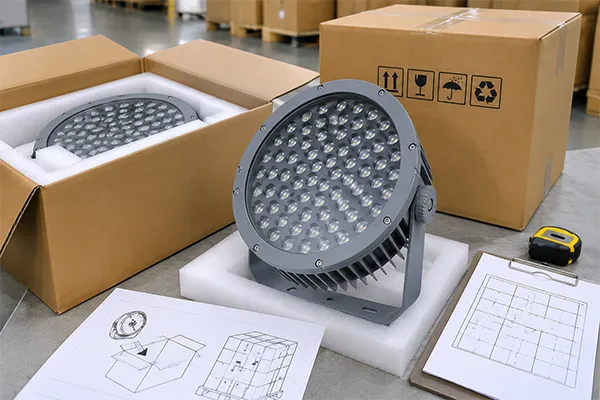
Understand the Difference Between Weight and Volume
Lighting buyers sometimes focus only on kilograms. Freight providers may also calculate charges based on cargo volume, particularly for air shipments and LCL sea freight.6 A shipment with oversized cartons, retail packaging, or loose pallet arrangement may cost more even if the products are relatively light.
We recommend asking suppliers for:
- Carton dimensions
- Units per carton
- Net weight and gross weight
- Total carton quantity
- Total cubic meters (CBM)
- Pallet dimensions, if pallets are required
- Whether cartons are stackable
- Whether packaging is suitable for long-distance transport
Common Order Structures and Their Cost Implications
| Order Structure | Potential Advantage | Cost Risk to Review |
|---|---|---|
| Samples by courier | Fast evaluation | High freight cost per unit |
| Small mixed-SKU order | Tests several models | More complex packing and lower volume efficiency |
| LCL sea shipment | Avoids full-container commitment | Consolidation and destination handling may be significant |
| Full container order | Better volume efficiency | Requires stronger sales forecast and inventory capacity |
| Repeat stock order | More stable planning | Requires supplier consistency and demand discipline |
In one anonymized case, we prepared a mixed floodlight order for a distributor evaluating several wattages and finishes. The order was useful for market testing, but it required more carton types, more item labels, and more detailed packing-list control than a single-model order. The buyer accepted the higher per-unit logistics cost because the commercial goal was product validation rather than lowest freight cost.
That distinction matters. A trial order should be judged by the information it provides. A regular replenishment order should be judged more heavily by supply stability, carton efficiency, product consistency, and unit economics.
Packaging Is a Quality-Control Decision
Packaging is not only a logistics issue. It also affects product condition at arrival.7 Floodlights include glass, brackets, cables, drivers, and coated housings that can be damaged if internal protection is insufficient.
We encourage buyers to define:
- Drop-protection expectations
- Inner-box requirements
- Master-carton strength
- Carton marking requirements
- Barcode and label placement
- Pallet wrapping needs
- Photo records before shipment
Our team performs 100% aging tests for 4 to 8 hours before shipment, depending on the product requirement and production arrangement. Aging tests support factory quality control, but they do not replace a buyer’s broader incoming inspection plan, field evaluation, or application-specific professional assessment.
Which Incoterm Should You Use for LED Flood Lights from China?
Incoterms can make quotations easier to understand, but only if both parties define them correctly. A buyer may receive one EXW offer, one FOB offer, and one CIF offer and assume the numbers are directly comparable. They are not, because each term assigns different responsibilities and cost components.8
The best Incoterm for LED flood lights from China depends on your logistics capability and risk preference. EXW, FOB, CIF, DDP, and delivered warehouse quotations include different services, transfer points, and exclusions. Buyers should request a written cost breakdown and confirm destination responsibilities with their freight forwarder or customs broker.
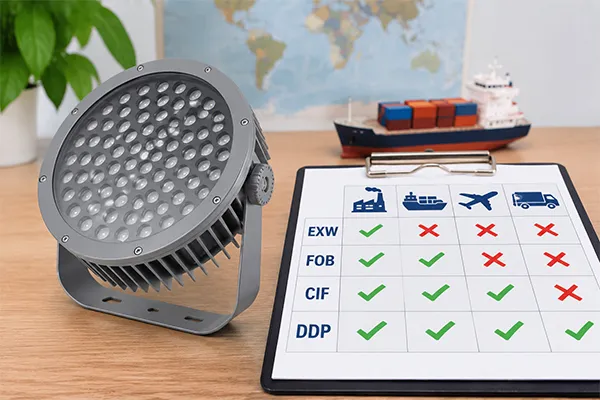
A Practical Incoterm Comparison
| Incoterm or Quote Type | Factory Typically Handles | Buyer Typically Handles | Best Suited For |
|---|---|---|---|
| EXW | Makes goods available at factory | Pickup, export handling, freight, import, delivery | Buyers with strong China logistics support |
| FOB | Export preparation and delivery to named port, subject to agreed terms | Main freight, insurance, import, delivery | Experienced importers with a forwarder |
| CIF | Product, export handling, and freight to named destination port | Import clearance, duty, taxes, port charges, delivery | Buyers who want freight arranged to port |
| DDP | Terms vary by provider and must be documented carefully | May include limited buyer obligations, depending on agreement | Buyers needing a managed delivered arrangement |
| Delivered warehouse quote | Scope must be listed line by line | Depends on written inclusions and exclusions | Buyers seeking budget visibility |
Do Not Treat CIF and DDP as the Same
CIF normally relates to cost, insurance, and freight to a named port. It does not automatically mean that customs clearance, duty, VAT, port handling, and delivery to your warehouse are included.9
DDP is often used loosely in commercial discussions.10 Buyers should be particularly careful here. A “DDP price” may sound simple, but the buyer should ask:
- Which address is covered?
- Is customs clearance included?
- Are duty and taxes included?
- Is cargo insurance included?
- Are port storage, inspections, remote-area fees, and delivery appointments included?
- Who is the importer of record where required?
- What happens if customs requests additional documents or inspection?
We can coordinate export preparation and shipment discussions based on the agreed trade term. However, we do not present ourselves as a destination-country customs broker or tax adviser. Buyers should confirm every destination-side obligation with their appointed forwarder, customs broker, and local professional adviser.
How Can You Compare LED Flood Light Supplier Quotes Fairly?
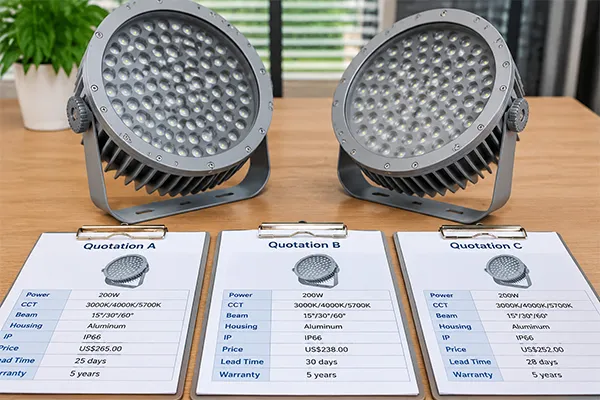
Supplier quotations can differ because the products differ, not necessarily because one supplier is overcharging. A fair comparison requires a controlled request-for-quotation process. Without one, buyers can accidentally compare a high-output, better-protected floodlight against a lower-performance alternative that only appears similar.
To compare LED flood lights from China fairly, buyers should send every supplier the same specification sheet, order quantity, packaging requirement, Incoterm, destination port, and document requirement. They should then compare the total commercial package, including product consistency, quality controls, lead time, responsiveness, and after-sales support.
Use a Standard RFQ Template
We suggest including the following information in every RFQ:
- Required wattage and target lumen output
- Input voltage and frequency
- Color temperature and CRI
- Beam angle
- IP rating and IK requirement, if relevant
- Housing finish and bracket style
- Surge protection requirement
- Cable type, cable length, plug, or connector
- Product label, carton label, barcode, and logo requirements
- Required certificates or test reports
- Quantity by SKU
- Sample requirement
- Target Incoterm
- Destination port or delivery location
- Required shipment date
Evaluate Supplier Capability Beyond Price
For commercial buyers, supplier selection should also include manufacturing control and communication quality. We recommend reviewing:
| Evaluation Area | Questions to Ask |
|---|---|
| Quotation speed | Does the supplier clarify unclear specifications before quoting? |
| Product consistency | Can the supplier maintain the same driver, LED source, housing, and packaging standard? |
| Quality process | What inspection and aging procedures are used before shipment? |
| Documentation | Can the supplier provide relevant documents for buyer verification? |
| Customization | Can the supplier support branding, wattage, optics, color, and packaging needs? |
| Order flexibility | Can the supplier support small batches or mixed-SKU orders? |
| Communication | Does the supplier answer technical and commercial questions clearly? |
| Delivery planning | Does the supplier provide realistic production and shipment preparation timelines? |
At Upward Lighting, we have worked with contractors, importers, distributors, traders, and local lighting brands that need quick quotations but also need practical detail. We have found that the best long-term buyers ask precise questions early. They request product photos, packaging details, aging-test information, samples, and document copies before they commit to a larger order.
A lower quote may still be suitable, but buyers should understand exactly what they are receiving. The goal is not to pay more without reason. The goal is to buy the right level of performance, documentation, protection, and service for the target market.
How Can You Reduce Risk When You Import LED Flood Lights from China?
Importing creates risk when expectations are not written down. The buyer may expect one driver brand, one carton format, or one finish standard, while the supplier may interpret the request differently. Clear specifications, sample approval, and inspection planning reduce avoidable disputes.11
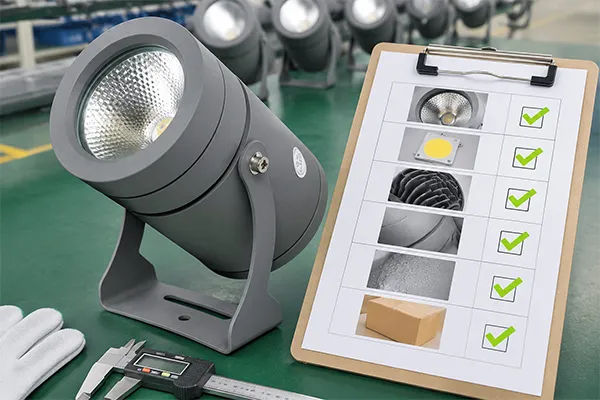
Buyers can reduce risk when importing LED flood lights from China by approving samples, confirming specifications in writing, reviewing packaging details, verifying documents, using clear Incoterms, and arranging qualified inspection or logistics support when needed. These steps protect product quality, delivery planning, and project margins.
Create a Pre-Shipment Control Plan
A practical control plan may include:
- Approved sample: Keep a confirmed sample or approved sample record.
- Written specification sheet: List the agreed technical and cosmetic requirements.
- Bill of materials confirmation: Clarify critical components, where appropriate.
- Packaging approval: Confirm carton design, inner protection, labels, and pallet method.
- Pre-shipment inspection: Use internal checks, third-party inspection, or both.
- Photo and video records: Request production and packing photos before release.
- Document review: Check invoice, packing list, product labels, and requested compliance documents.
- Shipment booking confirmation: Confirm cut-off dates, cargo-ready date, and handover requirements.
Match Inspection to the Commercial Risk
A small sample order may not justify the same inspection budget as a container order for a major project. However, a large order with tight installation dates can justify more formal controls.
In our manufacturing process, we conduct a 100% aging test lasting between 4 and 8 hours before shipment. This process helps us identify certain early failures before packing. We also support buyer-specific packaging and product requirements when they are confirmed before production.
Still, no factory process should be treated as a substitute for independent verification where the application carries high safety, commercial, or contractual risk.12 Project buyers should seek qualified technical evaluation for installation-specific requirements, electrical compatibility, photometric planning, and local regulatory obligations.
A clear specification protects both the buyer and the supplier. It reduces rework, shipment delays, claim disputes, and unexpected landed-cost pressure.
Frequently Asked Questions
Is the factory price the total cost to import LED flood lights from China?
No. The factory price usually covers only the product under the agreed commercial term. Buyers should also consider export handling, freight, insurance where applicable, import duty, taxes, customs clearance, local charges, and final delivery. A forwarder or customs broker should confirm destination-side costs.
Is FOB better than EXW for buying LED flood lights?
FOB can be easier for many overseas buyers because the supplier handles export preparation and delivery to the named port under the agreed terms. EXW may suit buyers with a reliable China-based forwarder. The best option depends on your logistics capability and quote comparison method.
How can I lower freight costs for LED flood light orders?
Buyers can improve freight efficiency by optimizing carton dimensions, increasing units per carton where product protection allows, consolidating SKUs, reducing unnecessary retail packaging, and selecting a suitable shipping mode. Buyers should compare volume, weight, handling charges, and delivery timing with their forwarder.
Should I buy the cheapest LED floodlight available?
Not without confirming the specification. The lowest-priced product may use different drivers, LED sources, housings, seals, cables, packaging, or quality-control processes. Buyers should compare equivalent products based on performance, reliability expectations, documentation, packaging, and total landed cost.
Can a manufacturer confirm import duties and VAT?
A manufacturer can explain its own quotation, export preparation, packing details, and available product documents. However, duty, VAT, HS classification, customs procedures, and local delivery charges should be verified with a qualified customs broker, freight forwarder, or local adviser in the destination market.
Conclusion
The cost to import LED flood lights from China is a landed-cost decision, not a single factory-price decision. We recommend evaluating product specifications, packaging, order quantity, Incoterms, freight planning, quality controls, and destination-side charges together. A well-documented quotation can protect your margin more effectively than a low unit price alone. If you are sourcing floodlights for distribution, wholesale, or a project, contact Upward Lighting for a detailed OEM/ODM quotation with clear product, packaging, and export-preparation information.
"Determine Total Export Price", https://www.trade.gov/determine-total-export-price. Official trade guidance identifies transport, insurance, customs duties, taxes, and clearance-related charges as costs that may contribute to the total cost of importing goods. Evidence role: general_support; source type: government. Supports: Official import guidance describing freight, insurance, customs duties, taxes, and related charges as components of import cost.. Scope note: The specific charges and their effect on margin vary by shipment, Incoterm, and destination. ↩
"Know Your Incoterms", https://www.trade.gov/know-your-incoterms. The International Chamber of Commerce states that Incoterms allocate delivery tasks, costs, and risk between seller and buyer; import requirements remain subject to the rules of the destination jurisdiction. Evidence role: definition; source type: institution. Supports: The International Chamber of Commerce explains that Incoterms define parties' delivery obligations, allocation of costs, and transfer of risk under sales contracts.. Scope note: Incoterms do not themselves determine customs classification, tax liability, or all contractual charges. ↩
"Part 31 - Contract Cost Principles and Procedures", https://www.acquisition.gov/far/part-31. Total-cost-of-ownership approaches assess purchasing decisions beyond initial price by considering acquisition, logistics, quality, operating, and failure-related costs. Evidence role: general_support; source type: government. Supports: Procurement guidance recognizes that acquisition price alone may omit logistics, quality, operation, maintenance, and failure-related costs.. Scope note: This framework supports the principle, not the article's hypothetical USD 10 and USD 13 comparison. ↩
"Lifetime and Reliability", https://www1.eere.energy.gov/buildings/publications/pdfs/ssl/life-reliability_fact-sheet.pdf. LED-luminaire research identifies driver performance, thermal management, optical design, and environmental protection as material factors in fixture performance and reliability. Evidence role: mechanism; source type: government. Supports: Lighting research explains that LED luminaire performance and reliability depend on system elements such as the driver, thermal management, optical design, and environmental protection.. Scope note: The source may not directly quantify the factory-cost effect of every listed feature. ↩
"Lifetime and Reliability", https://www1.eere.energy.gov/buildings/publications/pdfs/ssl/life-reliability_fact-sheet.pdf. LED performance guidance evaluates luminaires using maintained light output and expected service performance, rather than initial wattage or initial output alone. Evidence role: expert_consensus; source type: government. Supports: Authoritative LED guidance treats lumen maintenance, lifetime, and in-service performance as relevant measures of lighting quality.. Scope note: Application-specific evaluation can also require photometry, controls, environmental, and installation data. ↩
"Air Cargo Tariffs and Rules: What You Need to Know", https://www.iata.org/en/publications/newsletters/iata-knowledge-hub/air-cargo-tariffs-and-rules-what-you-need-to-know/. Air-cargo rating uses chargeable weight, and LCL ocean freight is commonly assessed by cargo weight or volume under the carrier's or forwarder's applicable tariff. Evidence role: mechanism; source type: institution. Supports: Air-cargo rules use chargeable weight, while LCL freight is commonly rated by cargo measurement or weight according to the applicable tariff.. Scope note: Actual formulas, conversion factors, minimums, and destination fees differ by carrier, route, and contract. ↩
"June 2005 Proper Packaging Required to Maintain Traceability", https://www.nist.gov/document/h-005pdf. Transport-packaging standards are designed to evaluate whether a package protects its contents against distribution hazards such as handling shocks, vibration, and compression. Evidence role: mechanism; source type: institution. Supports: Distribution-packaging standards assess whether packaging protects products from handling, vibration, compression, and other transport hazards.. Scope note: Passing a packaging test does not guarantee that every shipment will arrive undamaged. ↩
"Know Your Incoterms", https://www.trade.gov/know-your-incoterms. Under ICC Incoterms, EXW, FOB, and CIF assign different delivery points and allocate different transport, cost, and risk responsibilities to the seller and buyer. Evidence role: definition; source type: institution. Supports: ICC Incoterms distinguish the seller's and buyer's delivery, carriage, cost, and risk obligations under EXW, FOB, and CIF.. Scope note: The sales contract and any separately agreed services can add obligations beyond the baseline Incoterm. ↩
"Know Your Incoterms", https://www.trade.gov/know-your-incoterms. CIF requires the seller to arrange carriage and insurance to the named port of destination, while import clearance and associated import charges are ordinarily the buyer's responsibility. Evidence role: definition; source type: institution. Supports: ICC guidance defines CIF as carriage and insurance to a named destination port while allocating import formalities to the buyer.. Scope note: Port handling, delivery, and other charges can depend on the carriage contract and the parties' separate agreement. ↩
"What Is DDP Shipping? Full Explanation, Costs & Responsibilities", https://www.bsifreight.com/knowledge/guides-resources/what-is-ddp-shipping. Under the ICC definition, DDP places delivery at the named destination on the seller and generally requires the seller to handle export and import formalities and pay the applicable duties and taxes. Evidence role: definition; source type: institution. Supports: The formal DDP rule places maximum delivery obligations on the seller, including import clearance where applicable.. Scope note: This establishes the formal meaning of DDP; it does not measure how consistently businesses use the term in informal quotations. ↩
"Trade Guide: WTO PSI", https://www.trade.gov/trade-guide-wto-psi. Quality-management guidance emphasizes documented requirements, verification activities, and control of externally supplied products as measures for preventing nonconformity and misunderstanding. Evidence role: general_support; source type: institution. Supports: Quality-management principles emphasize documented requirements, verification, and control of externally provided products to reduce nonconformity.. Scope note: Such controls reduce risk but cannot eliminate disputes arising from contract interpretation, transport damage, or changing regulatory requirements. ↩
"Key considerations - CASCO toolbox - ISO", https://casco.iso.org/key-considerations.html. Conformity-assessment frameworks recognize independent testing, inspection, and certification as additional means of establishing confidence that products meet specified requirements. Evidence role: expert_consensus; source type: institution. Supports: Conformity-assessment frameworks distinguish supplier declarations from independent testing, inspection, and certification used to provide confidence in compliance.. Scope note: The appropriate level of independent verification depends on applicable law, contract terms, product risk, and the intended installation. ↩