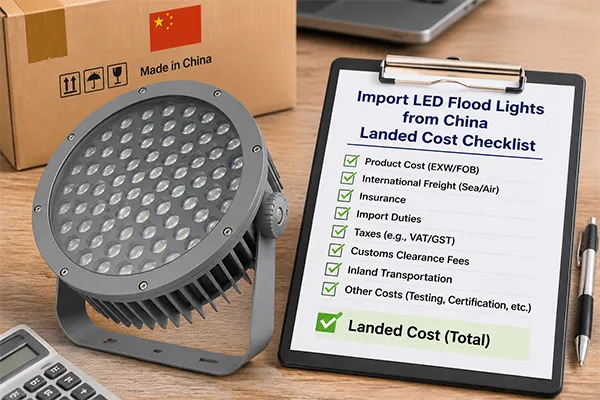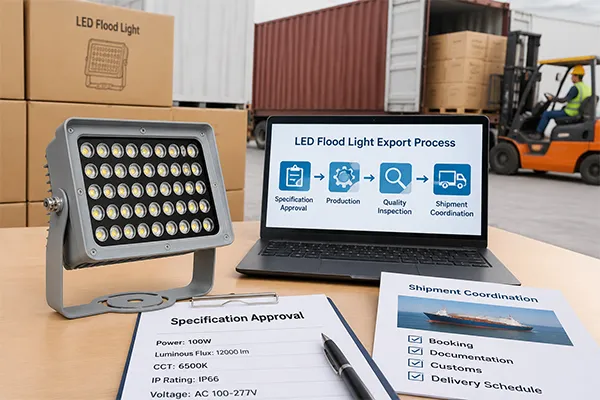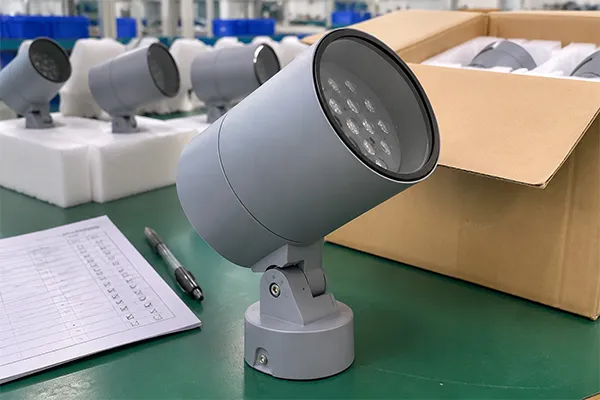

Buying LED flood lights in bulk can become difficult when a quotation looks simple but the project requirements are not. A low unit price, high wattage claim, or familiar-looking housing may hide important differences in light distribution, documentation, packaging, delivery, and batch consistency. I help buyers turn those unknowns into clear, purchasable specifications.
I recommend buying LED flood lights in bulk only after the buyer confirms the application, installation conditions, target market, required documentation, quantity, and repeat-order plan. The best bulk purchase is not automatically the cheapest or highest-wattage option. It is the product specification that can be verified, produced consistently, delivered on schedule, and used appropriately for the intended lighting task.
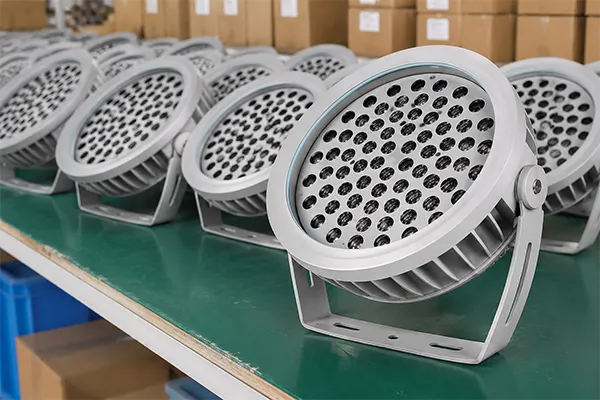
When I receive a flood light RFQ, I rarely start by asking only for wattage and quantity. I first need to understand where the lights will be installed, what the buyer needs to illuminate, and which market the goods will enter. Those details make a quote comparable and help reduce costly mismatches after delivery.
How Should I Define the Application Before Buying LED Flood Lights in Bulk?
When buyers purchase LED flood lights in bulk without confirming the actual lighting task, they may receive products that are technically acceptable but poorly suited to the site. The result can be insufficient coverage, unwanted glare, difficult installation, or replacement costs that were not included in the original budget.
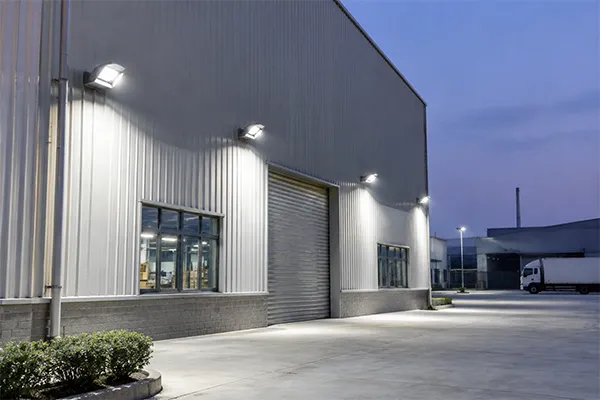
I define the application by confirming the illuminated target, mounting height, distance from the target, operating environment, installation method, and local requirements. These factors guide the selection of lumen output, beam angle, wattage, color temperature, glare control, mounting accessories, and ingress-protection expectations.1
Start With the Illuminated Target
A flood light does not perform in isolation. I always ask what the customer wants to light:
- A building façade
- A warehouse loading area
- A parking lot
- A sports practice area
- A construction site
- A billboard
- A garden or landscape feature
- A security perimeter
- An industrial yard
Each target requires a different approach. For example, a wide beam may help cover a broad loading area, while a narrower beam may be more suitable when the fixture is mounted farther away from a façade or sign. A buyer should not assume that two flood lights with the same stated wattage will create the same useful coverage.2
Confirm Installation Geometry
The installation position often changes the buying decision. I recommend that purchasing teams gather the following information before requesting a final offer:
| Information to confirm | Why it matters |
|---|---|
| Mounting height | Affects light spread, intensity, and glare risk |
| Distance to target | Helps determine beam angle and aiming needs |
| Mounting surface | Determines bracket, pole, wall, or trunnion requirements |
| Number of fixtures | Supports an initial layout discussion and budget planning |
| Existing fixture type | Helps identify retrofit constraints |
| Cable route and voltage | Affects electrical compatibility and installation work |
| Nearby traffic or residences | Makes glare control more important |
I have seen inquiries where a buyer requested 200 W flood lights because that wattage was used on a previous project. After discussing the mounting height and target distance, the buyer discovered that the previous specification did not match the new site. The final decision should involve a qualified lighting or electrical professional when a project requires photometric calculations, safety review, or site-specific compliance.
Consider Environmental Exposure
Outdoor flood lights may face rain, dust, salt air, heat, vibration, insects, and frequent switching.3 An IP rating can be useful, but I do not treat it as a complete answer.4 Buyers should also evaluate the housing design, cable entry, gasket arrangement, mounting bracket, coating, screw material, and intended operating environment.
For coastal, industrial, or high-humidity applications, I suggest that buyers explain the site conditions in writing. This gives the supplier a clearer basis for recommending appropriate materials or finishes. It also creates a better record when the buyer compares several offers for LED flood lights in bulk.
Why Are Wattage and Lumens Not Enough for LED Flood Lights in Bulk?
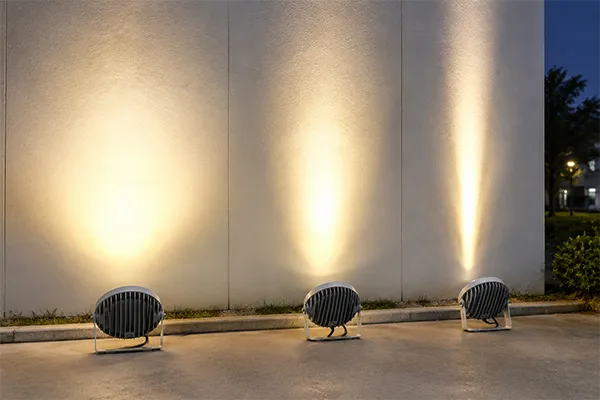
Many procurement teams begin with wattage because it is easy to compare. However, wattage describes power consumption, not the complete lighting result.5 Claimed lumens are also useful, but they do not show how light is distributed, whether glare is controlled, or how the fixture will perform in one specific installation.6
I compare LED flood lights in bulk using the complete product specification rather than wattage or lumen claims alone. Buyers should review beam angle, luminous distribution, color temperature, CRI, driver configuration, thermal design, protection level, mounting method, and documentation relevant to the destination market.
Wattage Is an Input, Not a Site Result
A 100 W flood light consumes approximately 100 watts of electrical power under its rated operating conditions.7 That figure does not independently confirm how much useful light reaches the working plane, wall, roadway edge, or storage area.
Several factors can affect practical results:
- LED package selection and efficiency
- Driver performance
- Optical lens or reflector design
- Beam angle
- Fixture orientation
- Mounting height
- Ambient temperature
- Spacing between fixtures
- Surface reflectance around the installation area
I advise buyers to treat stated lumens as one part of the review. If a project needs predictable illumination levels, the buyer should request relevant photometric information where available and have a qualified professional assess the site layout.8
Compare the Full Specification Sheet
A clear product specification helps both the buyer and supplier avoid assumptions. I usually encourage buyers to compare a table like this before placing a bulk order:
| Specification item | Questions to ask |
|---|---|
| Wattage | What power range is required for the application? |
| Input voltage | Is the fixture compatible with the destination electrical system? |
| Lumen output | Is the stated output supported by product documentation or test information? |
| Beam angle | Does the beam suit the mounting distance and target width? |
| CCT | Is 3000 K, 4000 K, 5000 K, or 6500 K preferred for the project? |
| CRI | Is color appearance important for the location or product display? |
| IP rating | Is the stated protection level appropriate for exposure conditions? |
| Housing finish | Does the buyer need black, gray, white, or a customized finish? |
| Bracket and cable | Are mounting and cable details suitable for installation? |
| Driver | Is a specific driver configuration or brand requested? |
| Dimming | Is non-dimming, 0–10 V, DALI, or another control method needed? |
Avoid “Equivalent” Assumptions
I do not assume that a product is equivalent simply because its housing looks similar or its wattage is the same. Two models can differ in component selection, optical structure, cable length, finish, packaging, and production controls.9 These differences may matter more when a buyer is supplying a contractor, retail channel, or local lighting brand.
This does not mean one specification is always better than another. It means the buyer should decide which requirements are essential for the intended market and application. That is the practical way to compare LED flood lights in bulk without relying on a single headline number.
How Can I Compare Suppliers for LED Flood Lights in Bulk?
Supplier selection becomes challenging when quotations use different assumptions. One supplier may quote a bare fixture, while another includes a longer cable, different packaging, a mounting accessory, or additional documents. If those details remain unclear, the lowest quoted price may not represent the lowest total procurement cost.
I compare suppliers for LED flood lights in bulk by reviewing specification clarity, production capability, quality-control records, quotation completeness, packaging, delivery communication, documentation, and repeat-order support. A useful supplier should make assumptions visible before production begins.
Make Quotations Truly Comparable
I recommend sending the same RFQ information to each supplier. This simple step makes price differences easier to understand. A complete RFQ normally includes:
- Product model or reference image
- Required wattage and quantity
- Color temperature and CRI
- Beam angle or lighting purpose
- Input voltage
- Housing color or surface finish
- Required documents for the target market
- Packaging expectations
- Trade term and destination port
- Required delivery date or shipment schedule
- Sample requirement, if applicable
- Expected repeat-order volume
When I prepare a quotation, I find that unclear requirements create the most avoidable revisions. A buyer may initially ask for “100 pieces of 150 W flood lights,” then later add 4000 K, a specific plug type, customized cartons, and a deadline for a project shipment. Those additions can change the price, lead time, and production arrangement.
Evaluate Quality Controls as Risk Reduction
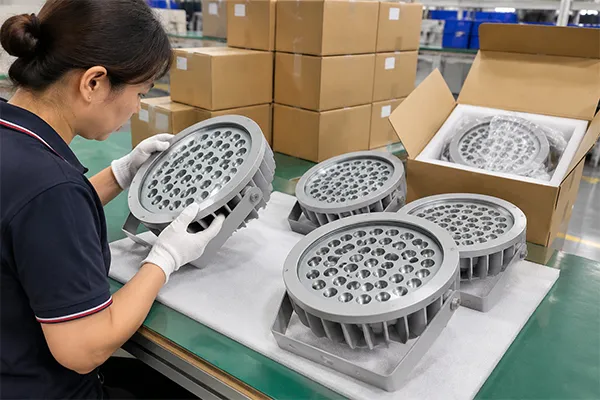
At Upward Lighting, we carry out a 100% aging test for approximately 4 to 8 hours before shipment. I view this process as a practical batch-level risk-reduction measure. It can help identify certain early issues before products leave the factory, but it does not prove that no failures will occur later or guarantee performance in every installation environment.
Buyers should ask suppliers how they manage:
- Incoming component checks
- Assembly controls
- Aging or burn-in procedures
- Electrical and functional checks
- Appearance inspection
- Label verification
- Packaging inspection
- Pre-shipment quantity checks
- Complaint handling and corrective-action communication
I believe that a supplier’s response to a detailed quality question is often as informative as the answer itself. Clear records, realistic explanations, and consistent communication usually support better procurement decisions.
Review Delivery and Replenishment Capability
For distributors and project contractors, replenishment can be as important as the first order. I recommend asking whether the supplier can maintain the same key configuration for later orders. This includes the housing, optics, driver arrangement, CCT, label format, carton design, and finish color.
A supplier should not promise indefinite availability without qualification because components and market conditions can change. However, the supplier should explain how they manage specification records, approved samples, and change communication. That process helps protect buyers who need LED flood lights in bulk for phased projects or ongoing sales channels.
What Documentation Should I Verify When Buying LED Flood Lights in Bulk?
Documentation requirements vary by product model, destination market, customer type, and project contract. Buyers can face delays or rejected goods when they assume that a general certificate applies to every configuration, every shipment, or every market without checking the details.
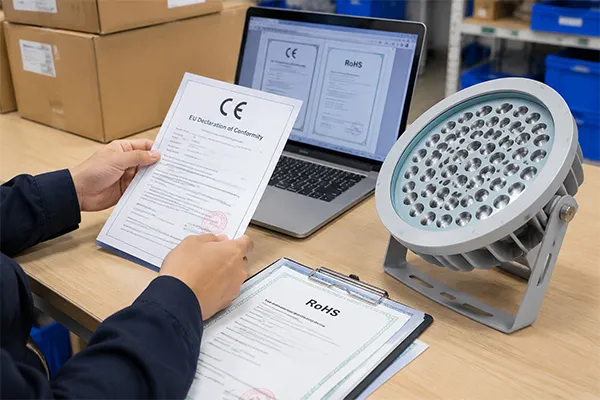
I recommend that buyers verify documentation for the specific LED flood light model, configuration, destination market, and project requirement. CE, RoHS, test reports, declarations, labels, and other documents should be reviewed as part of procurement due diligence, not treated as universal proof of market acceptance.10
Verify the Correct Product and Market
Upward Lighting provides products associated with documents such as CE and RoHS for applicable market-entry and environmental requirements. However, I always encourage buyers to verify the exact scope of any document before ordering. A document should match the product family or model being purchased and should be appropriate for the destination market and the buyer’s contractual obligations.
Buyers should confirm:
- The product model shown on the document
- The document issue date and validity status, where applicable
- The issuing body or laboratory details
- The standards referenced
- Whether the document covers the ordered configuration
- Labeling and marking requirements
- Importer or local representative responsibilities
- Project-specific documentation requested by the client
Build Documentation Into the Purchase Order
I suggest listing required documents in the purchase order or approved specification sheet. This avoids confusion near shipment. For example, a buyer can specify whether they need a commercial invoice, packing list, product label artwork, carton marks, declaration, test documentation, or inspection photos.
| Procurement stage | Documentation action |
|---|---|
| RFQ stage | State target market and required documentation |
| Sample stage | Check label, specification, finish, and core configuration |
| Pre-production stage | Approve artwork, packaging, and final product parameters |
| Pre-shipment stage | Confirm quantity, photos, packaging marks, and agreed documents |
| Post-delivery stage | Retain records for traceability and future replenishment |
Use Samples Carefully
A sample can help a buyer evaluate appearance, construction, mounting, cable details, finish, and basic function. However, I do not treat a single sample as complete proof of future site performance or full batch behavior.11 Buyers should compare the sample with the approved specification and clarify which features must remain consistent in production.
For larger projects, a buyer may also need a third-party inspection, incoming inspection plan, or installation trial. The right method depends on the application risk, contract terms, and local requirements. Professional electrical and lighting advice remains important for application-specific decisions.
How Can I Reduce Total Cost When Ordering LED Flood Lights in Bulk?
The purchase price matters, especially for wholesalers, importers, and competitive project bids. Still, the unit price is only one part of the commercial decision. A bulk purchase can become expensive if it creates excess replacements, installation delays, repacking work, customer complaints, or difficulty obtaining matching products later.
I reduce total cost by balancing unit price with specification fit, quality-control visibility, packaging suitability, delivery reliability, documentation readiness, and repeat-order consistency. The goal is to avoid preventable costs that are not visible in the first quotation.
Look Beyond the Unit Price
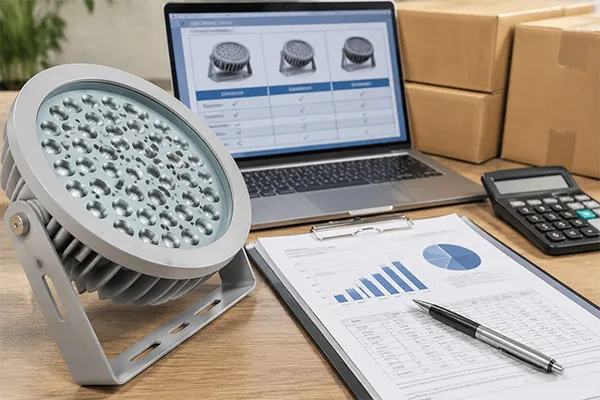
A useful internal comparison should include more than the ex-factory price. I encourage procurement teams to assess the following cost areas:
- Product price
- Freight and insurance
- Duties and local handling costs
- Packaging and relabeling work
- Installation labor
- Inspection costs
- Replacement stock requirements
- Customer-service exposure
- Cost of delayed delivery
- Future replenishment risk
For example, a lower-priced product may be the right choice when the application is simple, the specification is clear, and the buyer accepts the commercial terms. In another case, a buyer may choose a different configuration because customized packaging, a specific CCT, or more detailed production records better support their distribution model. I do not believe every lower-priced offer is inferior. I believe buyers need to understand what is included and what risks remain unaddressed.
Plan Quantities and Delivery Schedules
Large orders may require phased delivery, especially for project contractors with limited site storage. I recommend confirming:
- Required shipment date
- Production lead time
- Container loading plan
- Pallet or carton requirements
- Port and trade term
- Spare quantity expectations
- Whether partial shipments are acceptable
- Forecast for follow-up orders
At our factory, I often see that a fast quotation is valuable only when the details are stable enough to produce. We support OEM/ODM requirements such as wattage, CCT, beam angle, CRI, and surface finish colors, including small-batch orders where feasible. Still, each customization should be confirmed early because it can affect materials, production scheduling, and packaging.
A structured purchase plan gives the buyer more control over LED flood lights in bulk and gives the supplier a clearer basis for meeting delivery expectations.
Frequently Asked Questions
What is the best wattage for LED flood lights in bulk?
I do not recommend one universal wattage. The appropriate wattage depends on the target area, mounting height, beam angle, required illumination, site conditions, and local project requirements. Buyers should assess wattage together with lumen output, optical distribution, and installation geometry.
Should I order a sample before placing a bulk flood light order?
I generally recommend a sample when the buyer is evaluating a new supplier, customized configuration, finish color, packaging format, or mounting detail. A sample helps confirm the agreed product features, but buyers should still establish production specifications and inspection requirements for the full order.
Are CE and RoHS documents enough for every market?
I do not treat CE and RoHS documents as automatically sufficient for every market or project. Buyers should verify the specific model, destination country, applicable standards, customer contract requirements, labeling obligations, and any local certification or importer responsibilities.
How long should LED flood light aging tests last?
Aging-test duration can vary by manufacturer and product process. At Upward Lighting, we conduct 100% aging tests for approximately 4 to 8 hours before shipment. This process can help identify certain early issues, but it is not a guarantee of zero failures or a substitute for site-specific evaluation.
What details should I include in a bulk LED flood light RFQ?
I recommend including quantity, wattage, voltage, CCT, CRI, beam angle, IP requirement, finish color, mounting requirements, packaging needs, target market, required documents, destination port, trade term, and delivery deadline. Clear RFQs lead to more comparable quotations.
Conclusion
Buying LED flood lights in bulk is a specification and supplier-management process, not only a price comparison. I recommend starting with the lighting application, then confirming technical parameters, target-market documentation, packaging, delivery timing, and repeat-order requirements. Wattage, lumens, IP ratings, and certificates all matter, but none should be reviewed in isolation. If you are sourcing flood lights for a project, distribution channel, or private-label range, I invite you to send us your RFQ and target specifications. Our team at Upward Lighting can help convert your requirements into a clear, producible quotation.
"LED Outdoor Area Lighting Fact Sheet", https://www.energy.gov/sites/prod/files/2014/05/f16/outdoor_area_lighting.pdf. Professional lighting-design guidance treats photometric distribution, mounting geometry, glare, environmental conditions, and installation details as interrelated criteria for luminaire selection. Evidence role: general_support; source type: institution. Supports: That lighting design requires matching luminaire photometry, mounting conditions, environmental exposure, and glare considerations to the intended task and location.. Scope note: Specific specification choices remain dependent on the project’s lighting calculations, applicable codes, and local environmental conditions. ↩
"CALiPER Application Summary Report 20: LED PAR38 Lamps", https://www1.eere.energy.gov/buildings/publications/pdfs/ssl/caliper_20_summary.pdf. Lighting guidance distinguishes input power from photometric output and distribution; luminaires of equal wattage may therefore provide different illumination patterns and useful light at a target. Evidence role: mechanism; source type: government. Supports: That electrical wattage is an input-power measure and does not by itself specify lumen output or the spatial distribution of light from a luminaire.. Scope note: Actual coverage also depends on the specific luminaire, aiming, mounting height, spacing, and site reflectances. ↩
"LED Luminaire Lifetime: Recommendations for Testing and ...", https://www.energy.gov/sites/default/files/2015/01/f19/led_luminaire_lifetime_guide_sept2014.pdf. Outdoor-luminaire standards and technical guidance recognize exposure to moisture, dust, temperature, corrosion, and mechanical stresses as relevant environmental conditions for equipment selection. Evidence role: general_support; source type: institution. Supports: That outdoor luminaires are subject to environmental stresses such as water, dust, temperature variation, corrosion, and mechanical effects that can affect product selection and durability.. Scope note: Not every installation experiences every listed exposure, and the severity of each condition must be assessed for the individual site. ↩
"IP code", https://en.wikipedia.org/wiki/IP_code. IEC 60529 defines IP codes as classifications of protection against access and ingress of solids and water under specified conditions, rather than as comprehensive evidence of corrosion resistance, UV durability, or overall service life. Evidence role: definition; source type: institution. Supports: That IEC IP codes classify protection against access to hazardous parts and ingress of solid objects and water under defined test conditions.. Scope note: The precise applicability of an IP rating depends on the tested enclosure configuration and the conditions specified by the standard. ↩
"Purchasing Energy-Efficient Light Bulbs", https://www.energy.gov/cmei/femp/purchasing-energy-efficient-light-bulbs. Energy-efficiency guidance distinguishes watts, which measure electrical power, from lumens, which measure emitted visible light; wattage alone therefore does not characterize a luminaire’s photometric result. Evidence role: definition; source type: government. Supports: That watts measure electrical power while lumens measure luminous flux, making wattage insufficient as a standalone measure of delivered lighting performance.. Scope note: Lumen output itself does not fully determine illumination at a task plane because optical distribution and installation geometry also matter. ↩
"CALiPER Application Summary Report 20: LED PAR38 Lamps", https://www1.eere.energy.gov/buildings/publications/pdfs/ssl/caliper_20_summary.pdf. Photometric practice distinguishes total luminous flux from angular intensity distribution and installed illuminance; consequently, a lumen value alone cannot establish glare performance or lighting results at a particular site. Evidence role: mechanism; source type: research. Supports: That total luminous flux does not describe the angular distribution of light, glare characteristics, or illuminance produced after installation.. Scope note: Site-specific performance requires luminaire photometry together with mounting, aiming, spacing, surface, and environmental information. ↩
"Purchasing Energy-Efficient Light Bulbs", https://www.energy.gov/cmei/femp/purchasing-energy-efficient-light-bulbs. Electrical product ratings use watts to indicate rated input power under stated operating conditions, so a 100 W luminaire is nominally designed to draw about 100 W when operated as rated. Evidence role: definition; source type: institution. Supports: That a luminaire wattage rating refers to its rated electrical input power under specified operating conditions.. Scope note: Actual power draw can vary with supply voltage, dimming state, driver characteristics, temperature, and measurement tolerance. ↩
"Guide to FEMP-Designated Parking Lot Lighting", https://energy.gov/sites/prod/files/2014/02/f7/parking_lots_guide.pdf. Lighting-design methods calculate expected illuminance from luminaire photometry, position, orientation, mounting height, and surrounding geometry, supporting the use of photometric information for projects with defined illumination targets. Evidence role: general_support; source type: education. Supports: That lighting calculations use luminaire photometric data and installation geometry to estimate illuminance and uniformity for a planned layout.. Scope note: Calculated values are estimates and may differ from field measurements because of installation tolerances, maintenance, reflectance, and environmental conditions. ↩
"THE ABC's OF THE U.S. CONFORMITY ASSESSMENT ...", https://nvlpubs.nist.gov/nistpubs/Legacy/IR/nistir6014.pdf. Technical guidance on LED luminaires identifies optics, drivers, thermal design, materials, and manufacturing control as distinct factors affecting product characteristics, so matching wattage or external appearance does not establish full equivalence. Evidence role: general_support; source type: institution. Supports: That LED luminaire performance and conformity depend on multiple design and manufacturing elements, including optics, drivers, thermal construction, and component control.. Scope note: The material significance of any difference must be evaluated against the buyer’s application, contractual specification, and applicable standards. ↩
"CE marking – obtaining the certificate, EU requirements", https://europa.eu/youreurope/business/product-rules-compliance/general-product-compliance/ce-marking/index_en.htm. European Commission guidance states that CE marking is required only for products covered by applicable EU harmonisation legislation and signifies the manufacturer’s declared conformity with the relevant requirements; it is not a universal certificate of acceptance for every market or configuration. Evidence role: general_support; source type: government. Supports: That CE marking applies only where relevant EU harmonisation legislation requires it and is based on the manufacturer’s conformity assessment and declaration for the applicable product.. Scope note: Additional national rules, importer obligations, sector-specific requirements, and contractual documentation may apply depending on the destination and product. ↩
"6.2.2.2. Choosing a Sampling Plan with a given OC Curve", https://www.itl.nist.gov/div898/handbook/pmc/section2/pmc222.htm. Sampling and conformity-assessment principles recognize that evaluation of one or a limited number of units can verify observed sample attributes but cannot guarantee full-lot consistency or future in-service performance. Evidence role: general_support; source type: institution. Supports: That inspection of a sample provides evidence about inspected units or a sampled lot but does not guarantee the conformity or long-term performance of every production unit.. Scope note: The confidence provided by sampling depends on the sampling plan, lot definition, test method, acceptance criteria, and production controls. ↩