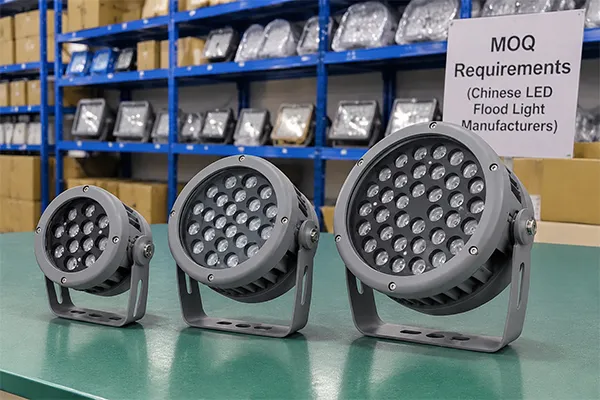
MOQ requirements from Chinese LED flood light manufacturers can feel unclear when we are comparing suppliers, planning a trial order, or responding to a project inquiry. A low minimum may look attractive, but it can also affect price, material availability, lead time, and customization options. We need to assess MOQ as part of a complete sourcing plan.
Chinese LED flood light manufacturers do not usually apply one universal MOQ to every order. MOQ depends on the floodlight model, requested specifications, customization level, certification needs, packaging, production scheduling, and expected reorder plan.1 We recommend that buyers provide complete technical and commercial requirements first, then compare quote-specific MOQ, price, lead time, and feasibility before committing.
In our daily quotation and OEM/ODM discussions, we see that the better question is not simply, “What is your MOQ?” Instead, we encourage buyers to ask: What production and sourcing conditions does this requirement create? That approach helps us reduce inventory risk, avoid unrealistic delivery promises, and build a workable purchase plan.
Why Do Chinese LED Flood Light Manufacturers Set Different MOQ Requirements?
When we source from Chinese LED flood light manufacturers, we may expect a simple minimum order quantity for every product. However, floodlight sourcing becomes more complex when a buyer needs a specific wattage, optics, finish, label, or market document. A general MOQ answer can create confusion rather than clarity.
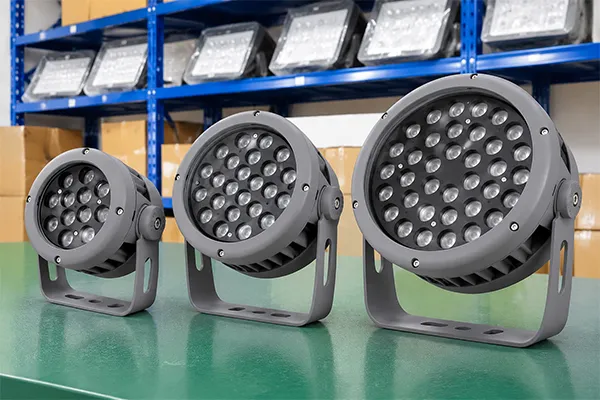
Chinese LED flood light manufacturers normally set MOQ requirements according to the production conditions behind a specific product request. Standard models or available configurations may support smaller trial quantities, while customized housing colors, branded packaging, special beam angles, or non-standard electrical parameters may require a higher MOQ or different commercial terms.2
Standard configurations versus customized requirements
We usually separate floodlight inquiries into two broad categories:
- Standard or available configurations
- Customized OEM/ODM configurations
A standard configuration may use existing components, established production instructions, regular packaging, and available LED driver options. For example, a buyer may request an existing 50W, 100W, or 200W LED floodlight in a standard color temperature and housing finish. In that situation, a supplier may be able to discuss a smaller initial quantity, subject to stock, production schedule, and destination-market requirements.
A customized product creates a different sourcing condition. Customization can include:
- A specific wattage or electrical input range
- A requested color temperature, such as 3000K, 4000K, or 6500K
- A special beam angle or optical distribution
- A higher CRI requirement
- A specified driver brand or surge-protection requirement
- A custom powder-coating color
- Laser marking, private labels, or branded cartons
- Project-specific cable length, connectors, or mounting brackets
- Market-specific documents or packaging marks
Each change can affect component purchasing, assembly planning, artwork setup, quality control instructions, and final inspection arrangements.
In our quotation and OEM/ODM discussions, we normally confirm whether the requested floodlight can use an existing bill of materials or whether it requires new sourcing, new packaging, or a dedicated production setup.
This distinction matters because MOQ is not only a factory-cost issue. It also affects our cash flow, warehouse planning, and ability to serve our own customers. A distributor may need a small first order to test demand. A contractor may only need enough fixtures for one project phase. A lighting brand may need custom packaging but wants to avoid holding large inventory before the product gains market acceptance.
The production factors behind a quote-specific MOQ
We recommend that buyers ask suppliers which specific factors influence their MOQ. A transparent answer can reveal whether the supplier understands the product and has a structured production process.
| MOQ factor | Why it can affect the order | What buyers should confirm |
|---|---|---|
| Housing and heat sink | Different wattages may use different die-casting bodies3 | Is the housing a regular model or a special requirement? |
| LED chips and driver | Electrical performance depends on component selection4 | Are the requested components available for small quantities? |
| Optics | Beam angle changes may require different lenses or reflectors5 | Is the optic standard for this floodlight series? |
| Surface finish | Special paint colors may require a separate coating arrangement | Does the finish require a color minimum? |
| Packaging | Branded cartons often require printing minimums6 | Can neutral cartons be used for a trial order? |
| Labels and manuals | Market-specific markings may need separate artwork | What label, language, and packaging requirements apply? |
| Certification documents | Applicability can vary by model and target market | Can the supplier provide relevant documents for review? |
| Production schedule | Small orders may need to join an existing production run | What is the confirmed lead time for this configuration? |
At Upward Lighting, we treat these points as quote-dependent. We do not assume that one MOQ applies to every LED floodlight or every buyer requirement.
How Does Customization Change LED Flood Light MOQ?
Customization can make a floodlight order more competitive in a target market, but it can also increase the MOQ or change the commercial terms. We often see buyers focus on unit price first, then discover that their branding, packaging, or technical requests create a separate production arrangement.
For Chinese LED flood light manufacturers, customization may change MOQ because it can introduce new material purchases, artwork approvals, production instructions, or quality-control checkpoints. Buyers can often reduce initial-order risk by prioritizing the custom elements that create the most market value and keeping other specifications within an available product platform.
Not every customization has the same impact
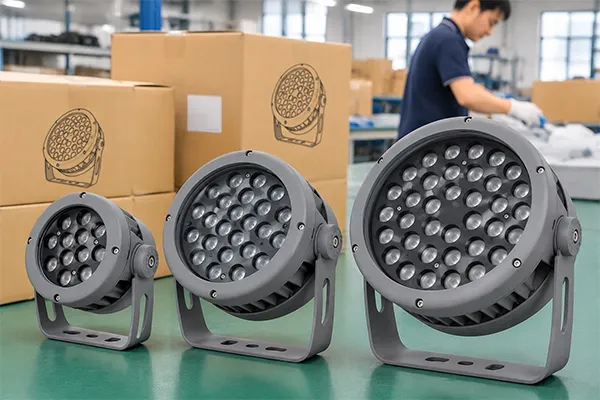
We find that some customization requests are easier to evaluate than others. A buyer who requests a standard floodlight with a custom label may face a different MOQ discussion than a buyer who requests a new housing color, a specialized optical design, and a unique retail carton.
The table below shows how we would typically approach customization planning. It is not a universal rule for all factories. Each supplier should provide a written quotation based on the actual request.
| Customization type | Typical procurement effect | Buyer planning approach |
|---|---|---|
| Standard wattage selection | May be available within an existing range | Confirm exact model and performance parameters |
| Color temperature selection | May be easier if regular LED materials are available | Ask whether the CCT is standard for that model |
| Private label | May require label artwork and approval | Provide logo files and label dimensions early |
| Custom retail packaging | Can involve carton-printing minimums | Consider neutral cartons for initial market testing |
| Special housing color | May require a separate finishing arrangement | Confirm color code, sample approval, and order conditions |
| Driver brand requirement | May affect sourcing and lead time | Specify electrical and reliability requirements clearly |
| Beam angle adjustment | Can require alternative optics or mechanical changes | Request photometric information where relevant |
| Higher CRI or special LED bin | May affect component availability and cost | Confirm performance target and tolerance expectations |
A practical way to prioritize customization
We recommend that buyers rank every requirement as either essential, preferred, or optional. This simple exercise helps us build a realistic proposal.
For example, a buyer launching a new outdoor lighting brand may decide that these are essential:
- Their logo on the product label
- A consistent 4000K color temperature
- A suitable IP rating for the intended application
- Product documents relevant to their destination market7
- A delivery date that supports the launch plan
The same buyer may consider these items preferred rather than essential:
- A custom housing color
- A fully printed retail carton
- A dedicated beam angle
- A unique mounting accessory
This prioritization allows us to discuss a phased sourcing strategy. The buyer might begin with an available floodlight platform, neutral packaging, and a brand label. After sales volume becomes more predictable, the buyer can consider deeper OEM/ODM changes.
I have seen this approach help buyers avoid spending too much on a first order that has not yet proven demand. It also gives both sides clearer information for replenishment planning.
Can Mixed LED Floodlight Models Be Combined to Meet MOQ?
Mixed LED floodlight models can help buyers test a wider product range, but we should not assume that all SKUs can automatically be combined to meet one MOQ. Different wattages, housings, drivers, packaging formats, and test requirements may require separate production and sourcing arrangements.
Chinese LED flood light manufacturers may support mixed-model orders under certain conditions, but the feasibility must be confirmed model by model. Buyers should ask whether quantities can be combined by product family, housing platform, component configuration, packaging type, or production batch rather than relying on a verbal assumption.
Why mixed SKUs are not always interchangeable
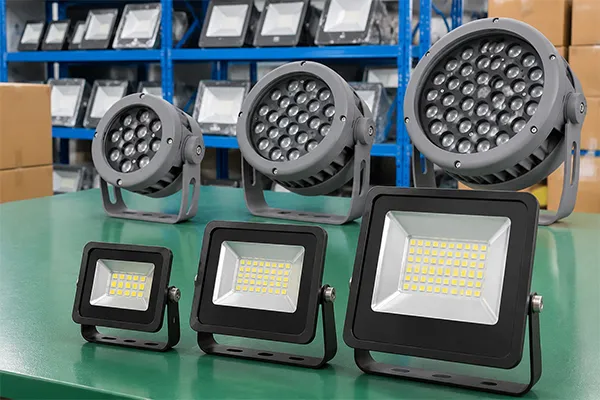
A 30W floodlight and a 200W floodlight may both belong to one supplier’s product range, but they may use very different materials.8 They can have different die-cast housings, LED boards, drivers, cables, brackets, cartons, and assembly procedures.
Even products with similar outward appearances can create different internal requirements. For example:
- A 100W 3000K floodlight may use different LED material from a 100W 6500K version.
- A narrow-beam floodlight may use different optical parts from a wide-beam version.
- A branded carton may have a separate printing requirement from a neutral export carton.
- A floodlight for one destination market may need specific markings, documents, or plug and cable arrangements.
- A model with additional surge protection may require a different driver or protection device.
We therefore recommend that buyers provide a complete SKU list rather than only a total quantity. A clear inquiry might state:
| SKU | Wattage | CCT | Beam angle | Quantity | Packaging | Destination |
|---|---|---|---|---|---|---|
| FL-A | 50W | 4000K | Standard | 300 pcs | Neutral carton | UAE |
| FL-A | 100W | 4000K | Standard | 200 pcs | Neutral carton | UAE |
| FL-B | 150W | 6500K | Wide beam | 100 pcs | Private label | UAE |
With this information, we can evaluate which quantities may share materials or production processes and which ones need separate MOQ consideration.
Trial orders need commercial discipline
A mixed trial order is often sensible for importers, wholesalers, and local lighting brands. However, we should evaluate the total commercial risk, not only the quantity per SKU.
A lower-volume trial order may result in:9
- A higher unit price
- Fewer configuration choices
- Longer waiting time for certain materials
- Neutral packaging instead of custom cartons
- Limited access to special finishes or optics
- A need to follow a planned production schedule
- Separate MOQ treatment for some items
These trade-offs do not necessarily make a small order unattractive. They simply need to be visible before we promise a price or delivery date to our own customers.
At Upward Lighting, we support small-batch discussions where feasible, but we confirm product-specific conditions before we commit. This protects both the buyer’s project timeline and our production planning.
What Should Buyers Ask Chinese LED Flood Light Manufacturers Before Requesting MOQ?
A short message asking only for “your MOQ” rarely produces a reliable answer. We understand that buyers want a quick starting point, but a structured inquiry helps Chinese LED flood light manufacturers provide a more accurate price, timeline, and feasibility assessment.
Buyers should send product specifications, customization needs, order quantities, destination market, and requested delivery timing when requesting MOQ. This information allows the supplier to identify whether the floodlight uses an existing configuration, requires new materials, needs special documents, or can fit into an upcoming production schedule.
Our practical MOQ inquiry checklist
We recommend that every importer, contractor, distributor, or lighting brand include the following points in an initial floodlight inquiry:
-
Exact product model or reference image
We need to know whether the buyer is asking about an existing model or a new design requirement. -
Technical specifications
Buyers should specify wattage, voltage, color temperature, CRI, beam angle, IP rating expectation, mounting method, cable requirements, and other relevant parameters. -
Customization requirements
Buyers should list logo placement, labels, packaging, housing color, driver preferences, accessories, and any project-specific needs. -
Quantity by SKU
We need quantities for each wattage and configuration, not only a total order quantity. -
Initial order and replenishment expectations
A buyer should tell us whether the first order is a trial order, a project order, or the beginning of a regular purchasing program. -
Destination market
The market affects labeling, documentation, electrical requirements, and product compliance review.10 -
Certification and documentation needs
Buyers should state which documents they need. We recommend that buyers verify certificate scope, model coverage, validity, and market applicability with qualified professionals or relevant authorities.11 -
Target delivery date
A required arrival date helps us assess production, shipping, and material risks. -
Commercial target
If appropriate, buyers can share their target price range, quality level, and intended market position. This helps us avoid proposing a configuration that does not fit the project.
Questions that produce better supplier comparisons
When comparing Chinese LED flood light manufacturers, we recommend asking the same questions to each supplier:
- Is this MOQ based on an available configuration or a customized configuration?
- Which specifications can change the MOQ?
- Can the requested SKUs be mixed, and which ones must be treated separately?
- What packaging is included in the quoted MOQ?
- What is the lead time after sample and artwork approval?
- Which product documents are available for this specific model?
- Does the supplier conduct aging tests, final inspection, or other quality-control procedures?
- What happens if a required component is not available at the time of order?
At Upward Lighting, every product undergoes a 100% aging test before shipment, generally lasting 4 to 8 hours.12 However, buyers should still define their own acceptance criteria, inspection method, and application requirements. A qualified technical evaluation remains important for application-specific purchasing decisions.
Frequently Asked Questions
What is the standard MOQ for LED floodlights from China?
There is no single standard MOQ for all LED floodlights from China. We assess MOQ case by case based on the model, wattage, configuration, customization, packaging, material availability, order volume, and production schedule. Buyers should request a written quotation for their exact SKU list.
Can I place a small trial order with Chinese LED flood light manufacturers?
We may support small trial orders for selected available configurations, depending on product availability and production conditions. However, a small batch may have a higher unit price, fewer customization choices, neutral packaging, or a longer lead time. Buyers should confirm all terms before ordering.
Can I mix different wattages to meet the MOQ?
Different wattages cannot automatically be combined to meet one MOQ. Each wattage may use different housings, LED boards, drivers, optics, packaging, and testing arrangements. We recommend submitting quantities by SKU so the supplier can confirm which models, if any, can be grouped.
Does custom logo packaging increase LED floodlight MOQ?
Custom logo packaging can increase MOQ because printed cartons, labels, manuals, and artwork setup may have separate minimums. Buyers can sometimes reduce initial exposure by using neutral export cartons with customized labels, but this option depends on the supplier and project requirements.
Should I request CE or RoHS documents before ordering?
Yes, buyers should request relevant documentation before ordering when it applies to their destination market. However, buyers should verify document validity, product-model coverage, and regulatory suitability independently. Certification availability is product-specific and should be confirmed in the formal quotation.
Conclusion
MOQ requirements from Chinese LED flood light manufacturers should be treated as a sourcing decision, not as a single number. We need to consider the floodlight model, technical specifications, customization scope, mixed-SKU plan, market documentation, delivery timing, and future replenishment expectations. A smaller order may be feasible, but it can involve trade-offs in price, lead time, or configuration flexibility. If you are sourcing LED floodlights for a project, distribution program, or private-label launch, we invite you to send us your detailed SKU list and requirements for a quote-specific MOQ and production assessment.
"Material requirements planning with a novel lot sizing method and a new ...", https://pmc.ncbi.nlm.nih.gov/articles/PMC12307884/. Manufacturing and inventory-management research explains that minimum order quantities are commonly shaped by setup costs, material constraints, and production-planning considerations; the precise MOQ remains supplier- and product-specific. Evidence role: mechanism; source type: research. Supports: Research on minimum-order-quantity policies and manufacturing setup costs supports the general principle that order minimums can vary with product configuration, setup requirements, inventory, and production planning.. Scope note: This support explains the general mechanism and does not establish the MOQ of any particular Chinese floodlight manufacturer. ↩
"Raw Material Minimum Order Quantity Optimization", https://dspace.mit.edu/bitstream/handle/1721.1/121302/1240293813-MIT.pdf?sequence=1. Operations-management literature finds that product customization can introduce setup, changeover, and material-procurement costs that make larger production lots economically relevant; the resulting MOQ is a negotiated commercial term rather than a universal rule. Evidence role: mechanism; source type: paper. Supports: Operations-management literature should document how customization can require additional setup, procurement, or changeover activity that affects order-size economics.. Scope note: The evidence is general to customized manufacturing and may not quantify effects for particular floodlight features. ↩
"Impact of Thermal Dissipation on the Lighting Performance and Useful ...", https://pmc.ncbi.nlm.nih.gov/articles/PMC8776062/. LED thermal-management research shows that luminaire housing and heat-sink design must dissipate heat generated by the LED system, so higher-power designs may require different mechanical thermal solutions. Evidence role: mechanism; source type: research. Supports: Technical research should support the relationship between LED power dissipation, thermal management, and heat-sink or housing design.. Scope note: Thermal-design principles do not prove that every wattage variant uses a distinct die-cast housing. ↩
"The Role of LED Drivers in Modern Energy-Efficient Lighting Systems", https://my.jalc.edu/ICS/icsfs/mm/energy-efficient-lighting-systems.html?target=0527eb2f-81ff-4671-ac6d-b562438a98b5. Technical literature on LED systems explains that the LED driver regulates operating current and that component characteristics affect luminaire efficiency, light output, and reliability. Evidence role: mechanism; source type: research. Supports: LED-lighting research should explain that driver characteristics and LED component selection affect current regulation, efficiency, light output, and reliability.. Scope note: Actual performance also depends on thermal design, optics, operating conditions, and the specific components used. ↩
"Focusing LED Light | Physics Van - University of Illinois", https://van.physics.illinois.edu/ask/listing/1980. LED optical-design references describe secondary lenses and reflectors as components used to control a luminaire's light distribution and beam angle. Evidence role: mechanism; source type: education. Supports: Optical-engineering materials should show that secondary lenses and reflectors are used to shape the angular distribution of LED light.. Scope note: A different beam angle can sometimes be achieved within an existing optical platform, so a component change is not inevitable. ↩
"MOQ (Minimum Order Quantity) in Corrugated Packaging Explained", https://www.presidentcontainergroup.com/moq-minimum-order-quantity/. Packaging-production economics recognizes that artwork preparation and press or converting setup costs can make short runs of custom printed cartons comparatively inefficient, which may lead suppliers to impose production minimums. Evidence role: mechanism; source type: research. Supports: Packaging-production sources should explain that artwork setup, plates, machine setup, and run efficiency can create minimum-run considerations for printed cartons.. Scope note: Minimums differ by printing method, carton specification, and packaging supplier. ↩
"LED Lighting Facts", https://www.energy.gov/cmei/ssl/led-lighting-facts. Regulatory guidance for electrical products indicates that conformity assessment, technical documentation, and marking obligations are determined by the destination jurisdiction and the applicable product rules. Evidence role: general_support; source type: government. Supports: Government regulatory guidance should show that electrical-product conformity documentation and marking obligations depend on the jurisdiction in which a product is placed on the market.. Scope note: The specific documents required for a floodlight depend on its design, intended use, and the laws of the destination market. ↩
"Impact of Thermal Dissipation on the Lighting Performance and Useful ...", https://pmc.ncbi.nlm.nih.gov/articles/PMC8776062/. LED-luminaire engineering literature shows that electrical loading and thermal dissipation requirements influence driver, LED-array, heat-sink, and mechanical design choices, making component commonality across power ratings conditional rather than automatic. Evidence role: mechanism; source type: paper. Supports: Technical literature should support that LED luminaires at different power levels can require different thermal, electrical, and mechanical design choices.. Scope note: This does not establish the bill of materials for any specific 30 W or 200 W floodlight. ↩
"Economies of Scale in Manufacturing: Examples and Limits - Fabrico CMMS", https://www.fabrico.io/blog/economies-of-scale-manufacturing/. Manufacturing economics literature shows that fixed setup, procurement, and handling costs are spread over fewer units in small batches, which can increase unit cost and reduce the practicality of specialized options. Evidence role: mechanism; source type: paper. Supports: Manufacturing and supply-chain research should support that fixed setup and transaction costs can raise per-unit costs and constrain flexibility for small production batches.. Scope note: Lead time, packaging availability, and configuration options depend on the supplier's inventory and schedule and cannot be inferred from order volume alone. ↩
"Electrical and Electronic Equipment Compliance Requirements", https://www.nist.gov/system/files/documents/2017/05/05/01-18-2017-8118r1-guide_to_us_electrical_and_electronic_products.pdf. International electrical-safety standards and market regulations establish requirements for luminaire safety, marking, and conformity documentation that may vary according to the jurisdiction where the product is supplied. Evidence role: general_support; source type: institution. Supports: International standards and regulatory guidance should establish that luminaire safety, marking, documentation, and conformity assessment are governed by applicable market rules.. Scope note: Standards and regulations must be checked for the relevant product version, installation context, and destination market. ↩
"ENERGY STAR Test Procedures and Verification", https://www.energy.gov/cmei/buildings/energy-star-test-procedures-and-verification. Conformity-assessment guidance emphasizes that certificates and test reports should be reviewed for the issuing body's competence, stated scope, product identification, and applicability to the relevant regulatory requirement. Evidence role: general_support; source type: institution. Supports: Accreditation and conformity-assessment guidance should support checking whether a certificate was issued by a competent body and applies to the relevant product and regulatory purpose.. Scope note: Independent verification reduces the risk of relying on inapplicable documentation but does not itself determine legal compliance. ↩
"Comparison of online and offline tests in LED accelerated reliability ...", https://pubmed.ncbi.nlm.nih.gov/26836556/. Reliability research describes burn-in or aging tests as methods intended to screen for certain early-life failures in electronic systems; verification of a stated 100% test rate and 4–8-hour duration requires supplier-specific quality records or independent audit evidence. Evidence role: mechanism; source type: research. Supports: Reliability literature should explain the purpose and limitations of burn-in or aging tests for detecting early-life failures in electronic and LED systems.. Scope note: General research on burn-in testing does not verify Upward Lighting's claimed testing practice or demonstrate performance in a particular application. ↩