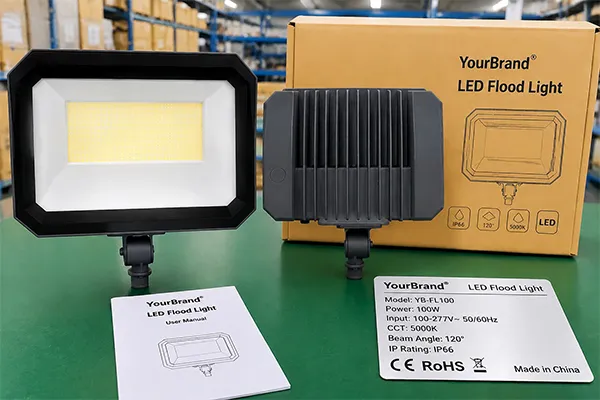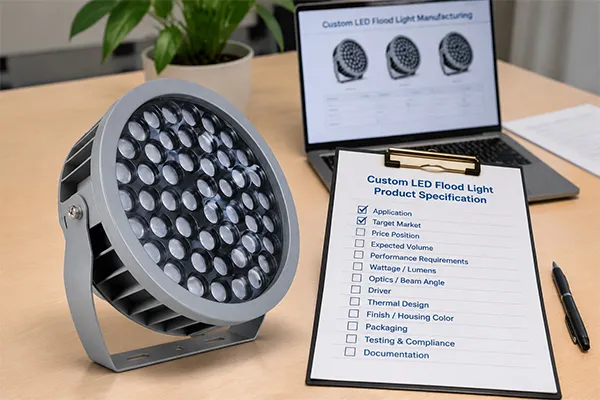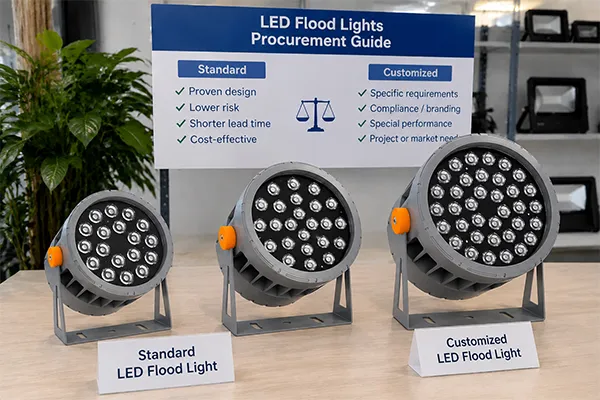

The LED flood light sample approval process can become risky when buyers judge a product only by whether it turns on and appears bright. That approach can leave important installation, accessory, packaging, and documentation questions unanswered. I recommend using sample approval to create a clear production baseline before a full order begins.
The LED flood light sample approval process should confirm that a floodlight suits the intended installation and that the supplier can reproduce the approved version in volume. Buyers should assess the application context, light distribution, physical construction, accessories, labeling, packaging, customization details, and relevant compliance documents. A written approval record helps both parties reduce ambiguity before mass production.
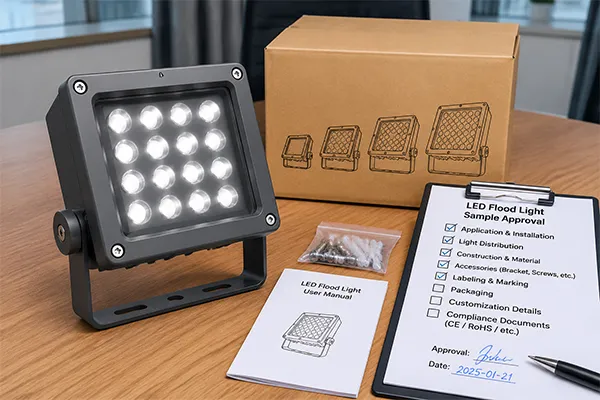
In our pre-sales and project communications at Upward Lighting, I have seen that the most useful sample approvals are not simply “approved” or “not approved.” They become a shared reference for the product that will be manufactured, inspected, packed, and delivered. The sections below explain how I would structure that process for contractors, importers, distributors, and OEM/ODM lighting brands.
Why Should the LED Flood Light Sample Approval Process Start With Installation Context?
A floodlight can look acceptable on a workbench yet perform poorly after installation. Buyers often face pressure to approve samples quickly, especially when a tender, seasonal purchase plan, or project schedule is moving forward. However, approving without installation details can create uncertainty around beam coverage, glare, mounting, and usable output.
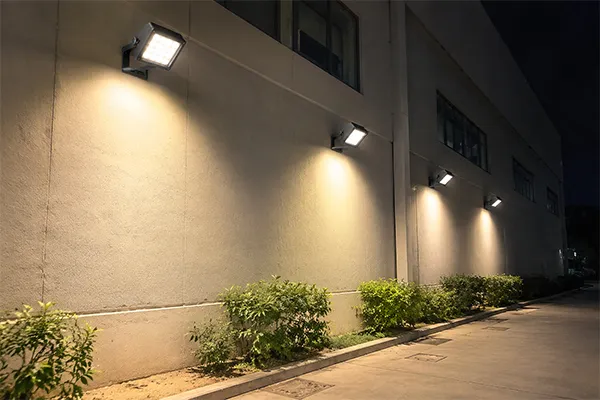
The LED flood light sample approval process should begin with the real lighting task: mounting height, target distance, coverage dimensions, surrounding brightness, glare limits, operating hours, and environmental exposure1. These factors help buyers and suppliers assess whether the selected wattage, beam angle, color temperature, and mounting arrangement are appropriate for the intended application.
Define the Area That Needs Light
I encourage buyers to describe what the floodlight must illuminate before focusing on the product datasheet. “Outdoor area” is too broad for a meaningful approval. A loading yard, sports perimeter, façade, parking area, warehouse entrance, construction site, and billboard each create different lighting requirements.
A practical application brief can include:
- Installation height: For example, 3 meters on a building wall is very different from 10 meters on a pole.
- Distance to the target: Buyers should identify how far the light must throw.
- Coverage width and length: This helps determine whether a narrow, medium, or wide beam is needed.
- Orientation: The mounting angle can affect useful coverage and glare.
- Ambient lighting: A dark rural area and an urban retail frontage need different visual results.
- Operating schedule: Dusk-to-dawn use, motion-sensor operation, or several hours per night can affect product selection.
- Environmental conditions: Rain, dust, salt air, high temperatures, vibration, and wind exposure should be discussed early.
A sample is most valuable when it is evaluated in conditions that resemble the final installation, rather than only inside a showroom or warehouse.
Consider Beam Angle and Glare Together
Buyers sometimes request higher wattage when the actual issue is beam distribution. A narrow beam may provide stronger apparent intensity at a distant target but leave adjacent areas darker. A wide beam may spread light more evenly but reduce intensity over a long distance.2
In our buyer communications, I often ask for installation photos, mounting drawings, and approximate dimensions. These materials help us discuss suitable options without presenting the supplier as the final authority on site lighting design. For complex, regulated, or safety-critical projects, buyers should involve a qualified lighting designer, electrical engineer, or local project professional.
| Installation factor | Why it matters during sample approval | Evidence to record |
|---|---|---|
| Mounting height | Influences beam spread and aiming | Site photo, drawing, or stated height |
| Target distance | Affects perceived reach and coverage | Approximate distance in meters |
| Beam angle | Changes the illuminated footprint | Approved beam-angle specification |
| Color temperature | Affects visual appearance and project consistency | CCT selection, such as 3000K, 4000K, or 6500K |
| Mounting direction | Can affect glare, drainage, and aiming | Bracket position or marked installation photo |
| Environment | Influences material and protection requirements | Indoor/outdoor, coastal, dusty, wet, or hot conditions |
Use Site Feedback Carefully
A buyer may test a sample at the intended site and report that it is too bright, too dim, too narrow, or uncomfortable to look toward. That feedback is valuable, but I recommend documenting the conditions in which it was observed. The same product can appear different when installed at another height or angle.3
A useful feedback record could state:
- The sample model and specification tested.
- The mounting height and aiming angle.
- The distance to the illuminated object or area.
- The time of test and surrounding ambient light.
- The requested adjustment, such as a different beam angle, wattage, CCT, or surface finish.
This context turns a subjective comment into an actionable pre-production discussion.
How Can We Create a Traceable LED Flood Light Sample Approval Process Before Mass Production?
A working sample does not automatically define the mass-production version.4 This is where many B2B approvals become unclear. A buyer may approve one physical unit while later expecting a certain cable, label, carton, color, or accessory that was discussed separately but never placed into a final confirmation record.5
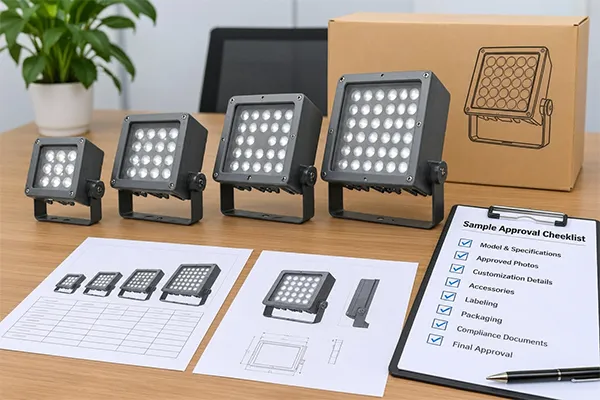
A traceable LED flood light sample approval process should convert the approved sample into a written production reference. The record should identify the model, key specifications, approved photos, customization details, accessories, labels, packaging, and document requirements. Both buyer and supplier should use the same reference before production starts.
Build an Approval File, Not Just an Email Reply
I have found that a simple “sample approved” email leaves too much room for interpretation. A stronger approach is to create a sample approval file or pre-production confirmation sheet. This does not need to be complicated. Its main purpose is to ensure that the commercial version is visible and traceable.
The approval file can include:
- Buyer name, project reference, and purchase order reference
- Supplier model number and sample identification
- Product photographs from several angles
- Agreed wattage, voltage, CCT, CRI, and beam angle
- Housing color and finish
- IP rating or other agreed product marking, where applicable
- Cable length, cable type, plug, connector, or terminal requirement
- Bracket type and installation accessories
- Label artwork or required label content
- Inner box and master-carton requirements
- Required certifications or test-document review items
- Approved sample date and confirmation contact
At Upward Lighting, we can support OEM/ODM adjustments such as color temperature, wattage, beam angle, CRI, and surface finish color. However, every requested customization should be written into the approval reference. A verbal confirmation can be useful during early communication, but it should not be the only record before a production order.
Separate Standard Models From Customized Versions
Buyers should clearly distinguish between a standard catalog product and a customized version. This distinction affects production planning, materials, lead time, labeling, minimum order expectations, and final inspection criteria.
| Approval item | Standard model example | Customized model example |
|---|---|---|
| CCT | Standard 6500K option | Project-specific 4000K |
| Beam angle | Existing lens configuration | Specified narrow or asymmetric distribution |
| Housing finish | Standard black housing | RAL-matched coating color |
| Cable | Standard cable length | Extended cable or specific connector |
| Label | Factory standard label | Buyer brand, SKU, barcode, or local language |
| Packaging | Standard export carton | Custom color box, inserts, or carton marks |
When a buyer requires an OEM label or branded package, I recommend approving artwork separately from the physical sample. A lighting sample may be electrically correct while its final printed label or packaging is still under review.
Confirm What “Same as Sample” Means
The phrase “same as sample” is common in B2B purchasing, but it can be vague. Does it mean the same appearance? The same driver configuration? The same cable? The same carton? The same mounting bracket? A robust LED flood light sample approval process defines the relevant characteristics instead of relying on a broad phrase.
A practical approval step is to attach annotated photos. A buyer can mark the cable exit, screw position, logo location, bracket shape, color finish, or connector. This visual record is especially useful when several teams are involved, such as procurement, engineering, branding, quality control, and logistics.
Which Non-Optical Details Belong in the LED Flood Light Sample Approval Process?
A buyer may approve the light output but still receive a product that is difficult to install, poorly matched to local wiring practices, or unsuitable for retail and distribution requirements. Small physical details can cause real delays on site or create rework in a warehouse. These items deserve the same attention as visible brightness.
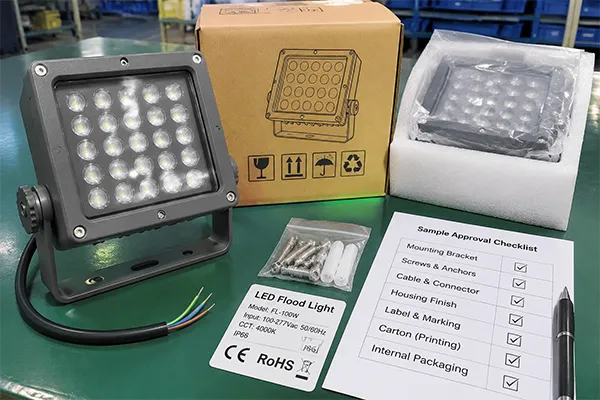
The LED flood light sample approval process should cover non-optical details, including the mounting bracket, screws, cable, connector, housing finish, label, carton, and internal packaging. These features influence installation efficiency, product presentation, damage prevention, and whether the delivered batch matches the buyer’s approved commercial version.
Evaluate the Mounting Bracket and Installation Hardware
The bracket is not merely a supporting part. It affects aiming range, installation speed, corrosion expectations, and the installer’s ability to secure the light to the intended surface.6
During sample review, I suggest that buyers inspect:
- Bracket thickness and overall rigidity
- Adjustment range and locking method
- Hole spacing and mounting-hole diameter
- Included screws, washers, and fasteners
- Accessibility of screws after mounting
- Alignment between cable exit and mounting orientation
- Sharp edges, paint coverage, and visible finish quality
A buyer should also consider whether the supplied hardware fits the actual installation substrate. Hardware suitable for a steel structure may not be appropriate for concrete, masonry, or timber.7 The final selection of anchors and site installation method should remain with qualified project personnel.
Confirm Cable, Connector, and Electrical Interface Details
Cable specifications are easy to overlook when a sample is tested close to a power source. However, cable length and termination method can matter greatly in a real installation. A cable that is too short can create extra junction-box work. A connector that is unfamiliar to local installers can slow down deployment.
The approval record should identify:
| Component | Questions for the buyer and supplier |
|---|---|
| Cable length | Is the standard length sufficient for the installation route? |
| Cable type | Is the sheath suitable for the stated environment and project requirement? |
| Wire configuration | Does it match the intended electrical connection method? |
| Plug or connector | Is it required, and is the selected type suitable for the destination market? |
| Cable entry | Is the cable exit direction compatible with mounting and water management? |
| Junction arrangement | Does the project require a separate junction box or terminal solution? |
In our communications, I prefer to ask for photos of the expected installation connection where possible. This reduces the risk of approving a product that is technically functional but inconvenient for the installer.
Approve Labels and Packaging as Commercial Components
For importers, distributors, and private-label brands, labels and cartons are part of the product. They may support warehouse management, brand presentation, traceability, and local sales-channel requirements.
Buyers should approve:
- Product label position and content
- Brand name, model number, barcode, and SKU
- Input information and required warnings
- Country-of-origin marking where applicable
- Inner-box artwork and master-carton printing
- Carton dimensions, gross weight, and quantity per carton
- Protective materials that prevent surface damage in transit8
At our factory, products undergo a 100% aging test of approximately 4 to 8 hours before shipment9 as part of our standard quality-control process. Buyers can still request that the agreed inspection and packing requirements are documented for their order. Aging-test practice is one quality-control element; it does not replace buyer-defined acceptance criteria or application-specific verification.
How Should Buyers Review Certifications and Test Documents During Sample Approval?
Certification logos and document files can create false confidence when they are not matched to the destination market or project specification. Buyers may assume that a CE or RoHS document automatically resolves every approval requirement. In practice, document relevance depends on the exact product, destination, application, customer requirement, and current regulatory framework.
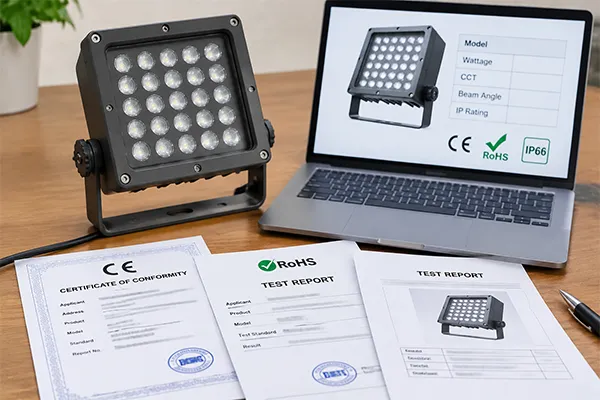
Buyers should review certifications and test documents as part of the LED flood light sample approval process by matching them to the product model, destination market, and project requirements. CE, RoHS, and other documents should be verified for relevance, scope, validity, and consistency with the supplied product rather than treated as automatic project approval.10
Match the Document to the Actual Product
A document is most useful when the buyer can connect it clearly to the product under consideration. Buyers should compare the model number, product description, electrical ratings, and issuing organization details against the approved product specification.
I recommend keeping a document-check record that notes:
- The document name and reference number.
- The product model or model family named in the document.
- The issue date and any stated validity information.
- The destination market or customer requirement it relates to.
- Any gaps requiring further clarification.
Upward Lighting products hold certifications such as CE and RoHS11, which can support market-entry and environmental compliance discussions for relevant markets. However, buyers should verify the documents that apply to their specific order and should not assume that a document automatically satisfies every country, tender, installation, or client requirement.
Ask the Right Procurement Questions
A useful document review is not about collecting the largest number of certificates. It is about asking whether the available evidence aligns with the buyer’s actual obligation.
Consider these questions:
- Does the document identify the same model, series, or relevant configuration?
- Does the destination market require additional documentation, registration, or labeling?
- Does the project specification require a particular test standard or independent report?
- Is the required voltage, frequency, plug type, or marking consistent with the order?
- Does the buyer’s customer require factory inspection, batch testing, or third-party verification?
- Are there special conditions for public projects, outdoor infrastructure, or hazardous environments?
For a major tender or technically demanding installation, I recommend that buyers consult qualified local compliance, engineering, or legal professionals. A supplier can provide available product information and documents, but local obligations and final project acceptance can depend on factors beyond the sample itself.
Link Document Review to Pre-Production Confirmation
The best time to identify a document gap is before materials are committed and production begins. If a buyer needs a specific marking, report, or packaging statement, that requirement should appear in the same pre-production confirmation package as the approved sample details.
This gives procurement teams a clearer basis for supplier comparison. Instead of asking only, “Do you have certification?” they can ask, “Can you provide the relevant documentation for this model, configuration, destination, and customer requirement?” That question is more precise and more useful for risk reduction.
Frequently Asked Questions
What should be included in an LED flood light sample approval record?
An approval record should include the product model, wattage, voltage, CCT, CRI, beam angle, approved photos, housing finish, bracket, cable, connector, label, packaging, and required documents. Buyers should also record any project-specific customization and identify the final approved commercial version.
Can I approve an LED floodlight based only on visual brightness?
No. Visual brightness alone does not predict site performance. Mounting height, aiming angle, beam angle, target distance, ambient conditions, glare tolerance, and surface reflectance can all affect results. I recommend testing in a representative installation context whenever practical.
Does CE or RoHS approval guarantee acceptance in every market?
No. CE, RoHS, and related documents should be reviewed against the destination market, product model, customer requirements, and project specifications. They may support relevant compliance needs, but buyers should verify whether additional documents, markings, tests, or local requirements apply.
Why should floodlight packaging be approved before production?
Packaging affects product protection, warehouse handling, shipping efficiency, retail presentation, and traceability. A carton can also contain important model, barcode, quantity, and handling information. Approving packaging before production helps prevent avoidable corrections after products are already packed.
Should buyers keep the physical approved sample?
Yes, where practical. The buyer and supplier should retain identified reference samples or detailed approved photos and specifications. A physical sample can help resolve questions about appearance, bracket design, finish, accessories, and other visible details during pre-shipment inspection or later reorder discussions.
Conclusion
The LED flood light sample approval process is a practical risk-reduction step, not a quick judgment of whether a product looks bright enough. I recommend starting with the installation task, then documenting the approved model, optical configuration, bracket, cable, labeling, packaging, and relevant document checks. This approach helps buyers create a clearer production baseline before placing a volume order. If you are sourcing floodlights for a project, distribution program, or private-label range, contact Upward Lighting to discuss samples, OEM/ODM options, and pre-production confirmation requirements.
"LED Outdoor Area Lighting Fact Sheet", https://www.energy.gov/sites/prod/files/2014/05/f16/outdoor_area_lighting.pdf. Exterior-lighting guidance identifies mounting geometry, target-area dimensions, ambient conditions, glare control, operating conditions, and environmental exposure as relevant inputs to lighting design and product selection. Evidence role: general_support; source type: institution. Supports: Lighting-design guidance should support that mounting geometry, target area, ambient conditions, glare, operating conditions, and environment affect exterior-lighting design and evaluation.. Scope note: Such guidance supports the relevance of these factors generally; it does not determine the correct floodlight specification for a particular site. ↩
"Understanding LM-79 Reports", https://betterbuildingssolutioncenter.energy.gov/sites/default/files/attachments/understanding_lm79_reports.pdf. Photometric principles show that a luminaire’s beam distribution concentrates or spreads luminous flux, affecting illuminance at distance and uniformity across the illuminated area. Evidence role: mechanism; source type: education. Supports: A photometry source should explain how beam distribution and distance affect luminous intensity and illuminance across a target area.. Scope note: Actual results also depend on mounting height, aiming, optics, obstructions, and surface reflectance. ↩
"EXTERIOR LIGHTING GUIDE", https://cltc.ucdavis.edu/sites/g/files/dgvnsk12206/files/media/documents/2010_DOE_FEMP_Exterior_Lighting_Guide.pdf. Lighting-design guidance indicates that changes in mounting height and luminaire aiming alter the distribution of light on a target and can change glare and perceived brightness. Evidence role: mechanism; source type: institution. Supports: Technical guidance should support that luminaire mounting height and aiming alter the distribution of light, illuminance, and glare.. Scope note: Perceived appearance is also influenced by background luminance, observer position, and adaptation conditions. ↩
"VOTING MACHINES: QUALITY AND CONFIGURATION MANAGEMENT ...", https://www.nist.gov/document/qualityconfigmgtreqs-20061120pdf. Quality-management practice uses documented specifications and configuration control to establish the characteristics that production units must meet, rather than relying on an informal approval of a single unit. Evidence role: general_support; source type: institution. Supports: Quality-management sources should support the need for documented specifications, configuration control, and verification when moving from samples or prototypes to serial production.. Scope note: The specific documentation required depends on the contract, product risk, and applicable quality system. ↩
"What is Supplier Quality Management? Supplier Selection Criteria", https://asq.org/quality-resources/supplier-quality?srsltid=AYCX9vLHxgETpZKJq5cd23ybxF3Ykvmtj-GupY2eYqznKABcUKI4uLCi. Supplier-quality guidance emphasizes documenting product requirements and controlled changes so that delivered goods can be verified against the agreed configuration. Evidence role: general_support; source type: institution. Supports: Supplier-quality and configuration-management guidance should support documenting product, accessory, labeling, and packaging requirements to reduce ambiguity.. Scope note: Documentation reduces ambiguity but does not by itself guarantee supplier conformance. ↩
"CT053378.0001 26 50 00-1 SECTION 26 50 00 LIGHTING PART 1", https://www.paulding.gov/DocumentView.aspx?DID=1332. Luminaire installation and safety guidance treats mounting arrangements as relevant to secure attachment, adjustment, and suitability for the environmental conditions of use. Evidence role: general_support; source type: institution. Supports: Luminaire safety or installation guidance should support that mounting means must provide secure attachment and that outdoor hardware requires consideration of environmental durability.. Scope note: The adequacy of a specific bracket or fastener depends on load, substrate, wind exposure, corrosion environment, and local installation requirements. ↩
"Foundation And Anchor Design Guide For Metal Building Systems", https://institutional-partnerships.unm.edu/index.jsp/libweb/Foundation%20And%20Anchor%20Design%20Guide%20For%20Metal%20Building%20Systems/T15DB4445190. Construction fastening guidance distinguishes between steel, concrete, masonry, and timber substrates because anchor type, installation method, and load performance depend on the base material. Evidence role: general_support; source type: education. Supports: Construction or engineering guidance should support that anchors and fasteners are selected according to the base material and loading conditions.. Scope note: A substrate category alone is insufficient for final selection; loads, edge distances, condition of the material, and applicable codes must also be evaluated. ↩
"June 2005 Proper Packaging Required to Maintain Traceability", https://www.nist.gov/document/h-005pdf. Transport-packaging guidance describes cushioning, restraint, and protective materials as methods for reducing product damage caused by handling, vibration, and impact during distribution. Evidence role: general_support; source type: institution. Supports: Packaging guidance should support that protective packaging is designed to reduce damage caused by transport handling and distribution hazards.. Scope note: Protection performance must be validated for the product’s weight, fragility, package design, and distribution environment. ↩
"Lighting for Aging Eyes: Home Safety Tips - Bellevue", https://www.rightathome.net/bellevue/blog/lighting-for-aging-eyes. A factory quality-control procedure and associated inspection records should document whether each relevant unit undergoes an aging or burn-in test, the test duration, and the point in the production process at which testing occurs. Evidence role: case_reference; source type: other. Supports: Primary quality-control records or an auditable factory procedure should substantiate the stated test coverage, duration, and pre-shipment timing for the relevant products.. Scope note: A stated aging-test procedure is evidence of a process control and does not by itself prove long-term field reliability or conformance with buyer-specific acceptance criteria. ↩
"Manufacturers - Internal Market, Industry, Entrepreneurship and SMEs", https://single-market-economy.ec.europa.eu/single-market/goods/ce-marking/manufacturers_en. European Commission guidance explains that CE marking is a manufacturer declaration of conformity with applicable EU requirements, while RoHS compliance concerns restrictions on specified hazardous substances; neither label alone establishes acceptance under every project or non-EU market requirement. Evidence role: definition; source type: government. Supports: European Commission sources should explain the legal meaning of CE marking, the scope of RoHS obligations, and the responsibility to demonstrate conformity with applicable requirements.. Scope note: The applicable obligations depend on the product, market, applicable legislation, and any purchaser or project-specific requirements. ↩
"Modern Design 10W CE RoHS Led Flood Light Outdoor Lighting Tower Rotating Led Flood Light", https://www.alibaba.com/product-detail/Modern-Design-10W-CE-RoHS-Led_1600888285300.html. Product-specific compliance documentation should identify the relevant Upward Lighting model or model family and substantiate the stated CE-marking and RoHS-compliance status. Evidence role: case_reference; source type: other. Supports: Primary product-specific declarations, test reports, or certificates should identify the relevant Upward Lighting model or model family and the applicable CE or RoHS compliance basis.. Scope note: The scope and applicability of such documentation must be checked against the exact ordered configuration and destination-market requirements. ↩