
Private label LED flood lights can create costly problems when buyers treat them as simple logo-printing products. A mismatched beam angle, unclear label, weak packaging choice, or unapproved specification can lead to returns, rework, and slow inventory. I recommend starting with the selling application and building a controlled product specification before comparing supplier quotations.
Private label LED flood lights from China are best sourced through a documented OEM/ODM process that connects the target application, product specification, branding, sample approval, packaging, and production controls. Buyers should evaluate suppliers on communication, specification management, sample consistency, and change control—not only unit price or headline wattage.
In my experience as a China-based LED lighting manufacturer, the most useful private-label discussions begin with practical questions: Where will the light be installed? Who will buy it? What level of performance and presentation does the market expect? Those answers shape a more reliable sourcing decision than a logo file alone.
What Should Buyers Define Before Ordering Private Label LED Flood Lights?
Buyers often request a quote for private label LED flood lights with only a wattage, quantity, and logo. That approach can create uncertainty because two products with the same wattage can serve very different applications1. I encourage buyers to define the selling task first so the product, price point, and customer expectation align.
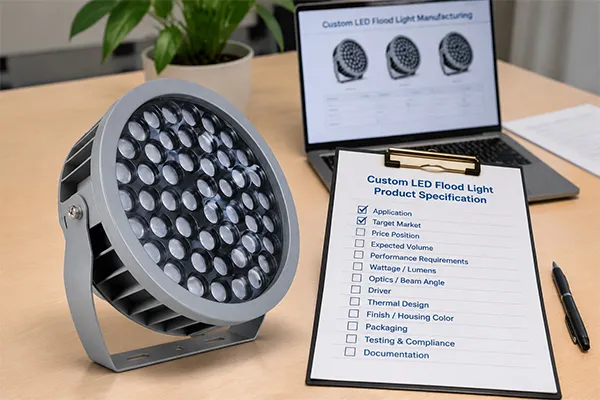
Before ordering private label LED flood lights, buyers should define the target application, installation environment, required light distribution, wattage range, color temperature, brand position, expected price level, labeling needs, and destination market requirements. A complete brief helps suppliers recommend a suitable configuration and reduces specification gaps before sampling.
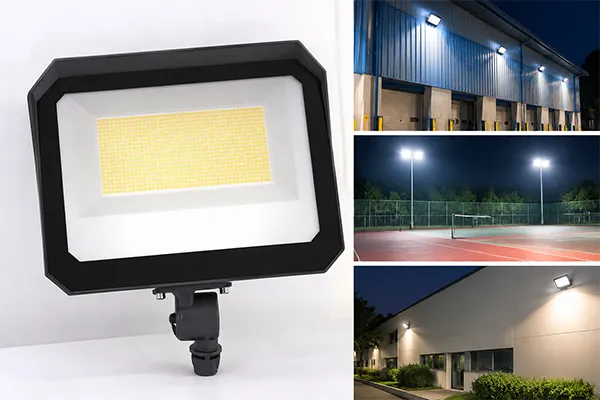
Start with the application, not the advertised wattage
Wattage is important, but it does not explain the full selling task. A 50 W outdoor floodlight for a residential backyard is not necessarily the right product for a loading yard, warehouse façade, parking area, or construction project. Each use case may require a different optical distribution, mounting method, color temperature, durability expectation, and product presentation.
When I review private-label inquiries, I see recurring gaps in the first request. Buyers may specify “high brightness” without identifying mounting height. They may ask for “waterproof” without describing rain exposure, coastal conditions, or cable-entry expectations. These gaps do not mean the buyer is unprepared; they simply need to be clarified before the supplier locks a production proposal.
I suggest building an internal sourcing brief around the following questions:
- Where will the floodlight be used? Residential, commercial, industrial, security, sports, façade, or temporary construction use.
- What is the installation height? Mounting height affects the desired beam angle and light coverage.2
- What is the environment? Consider rainfall, dust, heat, humidity, vibration, corrosion risk, and access for maintenance.
- Who is the final customer? Contractors, retailers, wholesalers, installers, or end users may prioritize different features.
- What market position do you want? Entry-level, mid-market, or premium private-label LED flood lights require different cost and presentation decisions.
- What is the expected order pattern? A small test order, ongoing container program, project-based purchase, or mixed-SKU distribution plan can affect packaging and supply planning.
Turn commercial goals into a specification matrix
A useful specification combines technical and commercial choices. I do not view customization items as isolated checkboxes. For example, a black housing finish, 4000 K light color, branded carton, and premium warranty message should fit the same market position. If the product is positioned as an economical wholesale item, highly customized retail packaging may add cost without improving sell-through.
| Decision area | Questions to define | Why it matters for procurement |
|---|---|---|
| Application | What area is being illuminated? | Guides output, optics, mounting, and protection expectations |
| Wattage and output | What performance level does the market expect? | Avoids comparing products by wattage alone |
| Color temperature3 | Is 3000 K, 4000 K, 5000 K, or 6500 K preferred? | Affects customer preference and application suitability |
| Beam angle | Is broad area lighting or focused illumination needed? | Influences coverage and installation results |
| CRI | Is color appearance important for the application? | Helps align product selection with the use case |
| Housing finish | What color and surface treatment fit the brand? | Supports visual consistency and corrosion considerations |
| Branding | What logo, labels, manuals, and packaging are required? | Reduces artwork and market-entry disputes |
| Market documents | Which documents does the destination market require? | Supports compliance verification before purchase |
I recommend that buyers ask a qualified electrical or lighting professional to review application-specific choices, especially when the installation involves safety, regulated projects, or unusual environmental conditions.
This early work takes time, but it reduces a common problem: buying a technically acceptable floodlight that is commercially wrong for the intended market.
How Can Buyers Customize Private Label LED Flood Lights Effectively?
Private-label projects can become difficult when each customization request is handled separately. A logo may be approved, while the label layout, carton artwork, color temperature, and instruction manual remain unclear. I find that buyers get better results when they treat private label LED flood lights as one coordinated product package.
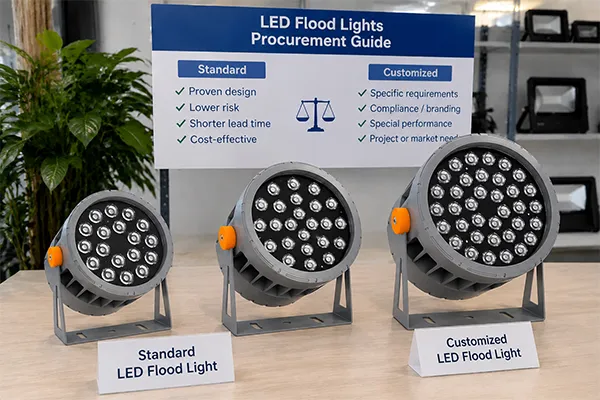
Effective private-label LED flood light customization combines product performance, physical appearance, branding, labels, packaging, and documentation into one approved configuration. Buyers should confirm which items are standard, which are customizable, the applicable minimum order quantity, artwork format, lead time, and any cost impact before production begins.
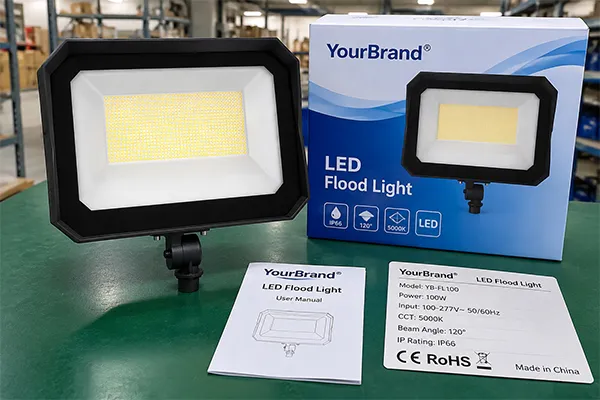
Common private-label floodlight customization options
At Upward Lighting, we discuss OEM/ODM choices in relation to the buyer’s target application and brand positioning. The available options depend on the product platform, material choices, order quantity, and production schedule. Buyers should avoid assuming that every option is possible at the same quantity or price.
Common customization areas include:
-
Electrical and lighting parameters
- Wattage
- Input voltage range
- Color temperature
- Beam angle
- Color Rendering Index (CRI)
- Driver selection or requested component requirements
-
Product appearance
- Housing color and surface finish
- Bracket finish
- Cable length or cable specification
- Product markings
- Logo placement
-
Brand identity
- Laser marking, printing, or branded labels
- Rating label design
- Instruction manual artwork
- Outer-carton artwork
- Retail box design
- Barcode, SKU, and country-of-origin markings where applicable
-
Commercial packaging
- Individual retail carton
- Neutral box with label
- Master-carton print
- Protective inserts
- Palletization requirements
- Spare-part or accessory packing
Match branding choices to the sales channel
I often recommend that buyers consider how the product will be sold before investing in packaging. A distributor selling to electrical contractors may need durable transit packaging, clear carton identification, and accurate technical labels. A retail or e-commerce brand may need stronger visual presentation, barcode planning, product inserts, and product photography consistency.
| Sales channel | Typical private-label priority | Procurement consideration |
|---|---|---|
| Wholesale distribution | Clear SKU control and economical cartons | Keep packaging cost proportional to selling price |
| Retail stores | Branded shelf presentation | Confirm retail-box durability and artwork approval |
| E-commerce | Product identity, barcode, inserts | Plan carton dimensions, labels, and fulfillment handling |
| Project supply | Specification and installation clarity | Confirm configuration consistency across project quantities |
| Local brand program | Brand consistency across SKUs | Standardize logo size, finishes, and document templates |
Do not overlook labels and instructions
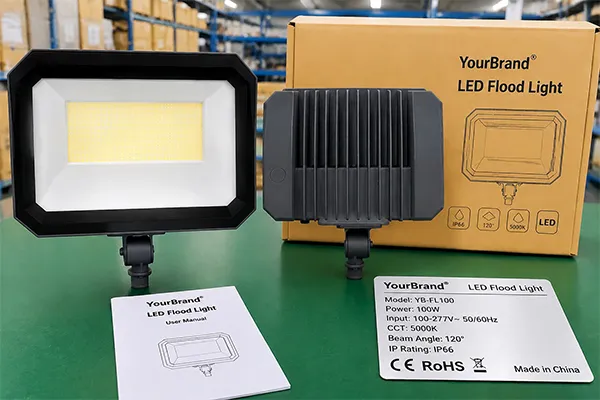
A floodlight label is not merely a branding surface.4 It can contain product identification, electrical information, model references, and other details that may be relevant to buyers, installers, and market documentation. Requirements differ by destination market and product type. I recommend that the buyer verify required markings and documentation with an appropriately qualified compliance professional or local authority before final approval.
Our products can be supplied with documents such as CE and RoHS-related materials when applicable. However, I advise buyers to verify the current document scope, model coverage, revision status, test basis, and destination-market relevance. A certificate name alone does not automatically confirm that a particular private-label configuration meets every requirement in every market.5
How Should Buyers Compare Private Label LED Flood Light Suppliers in China?
A low quotation can be attractive, especially for a new private-label program. However, the lowest unit price may not account for unclear specifications, limited technical communication, packaging changes, or production variation. I believe buyers should compare private label LED flood light suppliers by how well they convert requirements into controlled, reviewable production details.
Buyers should compare private-label LED flood light suppliers using a balanced scorecard that covers product-fit questions, quotation clarity, manufacturing controls, sample handling, documentation, communication speed, customization capability, and delivery planning. A supplier’s process discipline is often as important as its quoted unit price.6
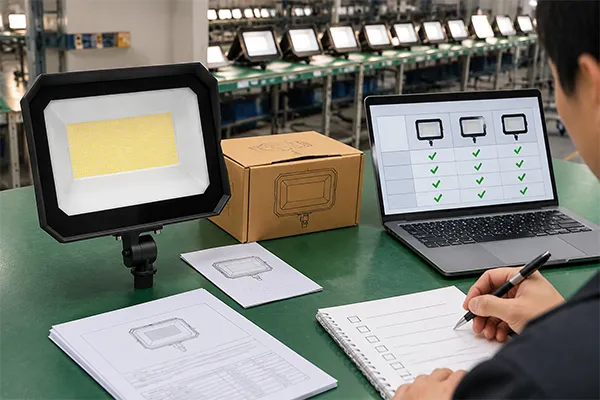
Look for clarifying questions, not just fast prices
A responsive quote is valuable, but a quote based on incomplete information may create later disputes. In my OEM/ODM work, I consider certain supplier questions to be positive signs. A capable supplier should ask about the application, requested configuration, brand artwork, packaging, market destination, and quantity plan.
For example, a supplier should be willing to clarify:
- Whether the buyer needs a standard product or a customized configuration
- Whether the requested wattage and optical pattern fit the intended installation
- Whether the logo applies to the housing, label, carton, manual, or all items
- Whether branded packaging is needed for every unit
- Whether the order requires a sample before mass production
- Whether a certificate or test document covers the specific proposed model
- Whether the buyer has a target delivery date and port requirements
I have found that clear questions at the inquiry stage prevent more expensive questions after a deposit is paid.
Use a supplier evaluation scorecard
Buyers can make supplier comparison less subjective by scoring each candidate against the same criteria.
| Evaluation criterion | What to review | Why it reduces risk |
|---|---|---|
| Specification communication | Does the supplier restate the requested configuration? | Reveals whether requirements are understood |
| Quote transparency | Are product, branding, packing, and shipping terms clear? | Makes price comparisons more meaningful |
| Sample process | Can the supplier document and confirm the sample configuration? | Reduces mismatch between sample and order |
| Quality-control process | What inspection and aging process is described? | Supports assessment of manufacturing consistency |
| Customization support | Can artwork, labels, and cartons be managed systematically? | Helps protect brand presentation |
| Documentation support | Can documents be identified by model and revision? | Helps buyers perform market verification |
| MOQ flexibility | Is small-batch support available where needed? | Helps brands test demand with controlled exposure |
| Communication | Are answers timely, specific, and traceable? | Reduces handoff and change-order confusion |
At Upward Lighting, we carry out a 100% aging test before shipment, generally lasting 4 to 8 hours, as part of our standard process. Buyers should still ask what this process covers for the selected model and how it is recorded. An aging test is one manufacturing control, not a substitute for defining the correct product, verifying market requirements, or conducting buyer-side inspection where needed.7
Verify production readiness
Before placing a larger order, I recommend that procurement teams request clarity on:
- Approved model number and revision
- Bill of materials or controlled component description where appropriate
- Product artwork files and approval status
- Packaging specification
- Inspection standard
- Production lead time and capacity discussion
- Defect-handling or claim communication process
- Change-control procedure for materials, components, labels, or packaging
Not every supplier will manage these records in the same format. The key is that the buyer can identify what was approved and how changes will be communicated. This matters for repeat orders, especially when a brand sells the same private-label LED flood lights through multiple channels.
Why Is Sample Approval So Important for Private Label LED Flood Lights?
Some buyers treat a sample as a quick formality before a volume order. That can be risky. A sample proves that a particular unit was made in a particular configuration at a particular time.8 It does not automatically prove that every production unit, label, carton, and accessory will match unless the approved details are documented and controlled.
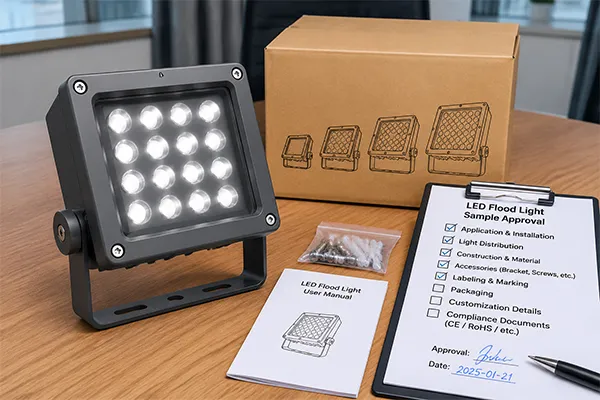
Sample approval for private label LED flood lights should confirm the exact product configuration, visual branding, label information, packaging, accessories, and acceptance criteria before mass production.9 Buyers should convert the approved sample into a signed reference point and agree on how any production change will be communicated.
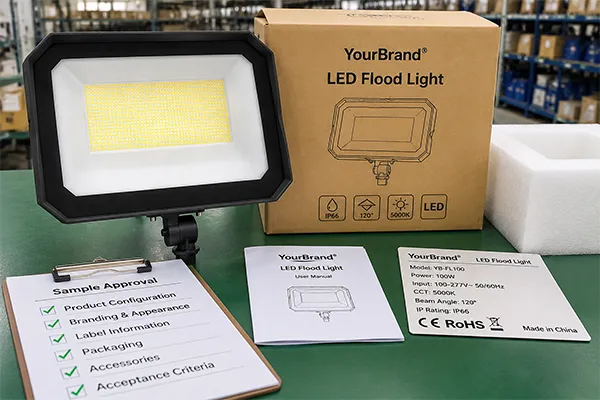
Review the sample as a commercial and technical checkpoint
I suggest reviewing a floodlight sample in the same way the final customer will experience it. The review should begin when the carton arrives, not only when the product is switched on.
A structured sample checklist can include:
- Is the model number correct?
- Is the requested wattage shown accurately?
- Does the color temperature match the approved request?
- Does the housing finish match the agreed appearance?
- Is the logo position, size, and color correct?
- Does the rating label contain approved wording and layout?
- Does the carton show the correct brand, SKU, barcode, and quantity?
- Are instructions, mounting brackets, screws, and accessories correct?
- Is the cable type and length consistent with the request?
- Does the beam distribution appear suitable for the intended application?
- Are any destination-market documents available for review?
The final point needs care. Buyers should not rely on visual sample review alone to determine regulatory suitability. Market-specific compliance assessment may require document review, local testing, installation evaluation, or professional advice.10
Lock the approved configuration before mass production
The most important output from sample approval is not simply an email saying “sample approved.” I recommend that the buyer and supplier create an approval record that identifies the exact reference sample and production requirements.
A practical approval package may include:
| Approval item | What should be recorded |
|---|---|
| Product identity | Model number, wattage, input range, CCT, beam angle, CRI, finish |
| Branding | Logo artwork version, print location, label layout |
| Packaging | Box artwork, carton marks, inserts, barcode, packing quantity |
| Accessories | Bracket, screws, cable, manual, connectors where applicable |
| Visual standard | Photos or physical reference sample |
| Documentation | Document list, applicable model references, revision dates |
| Inspection | Agreed cosmetic and functional checks |
| Change control | How the supplier must communicate proposed changes |
Plan for repeat orders, not only the first shipment
A private-label program becomes more complex when orders repeat. Artwork files may change. A buyer may introduce a new wattage, request another color temperature, or change packaging for a different country. Without clear SKU controls, these variations can become confused.
I have seen that a simple SKU naming system helps buyers manage this process. For example, each combination of wattage, color temperature, finish, and packaging version should have a distinct internal reference11. This gives purchasing, warehouse, marketing, and supplier teams the same point of reference.
At our factory, we support OEM/ODM discussions from specification confirmation through sampling and production shipment. I encourage buyers to use that access for detailed review rather than assuming that a standard floodlight listing covers every private-label requirement. The more clearly the approved configuration is documented, the easier it is to manage repeat production and reduce avoidable disputes.
Frequently Asked Questions
What is the minimum order quantity for private label LED flood lights from China?
Minimum order quantity depends on the product model, customization level, logo method, packaging requirements, and material availability. A simple label or standard carton may require less volume than a fully customized retail box. I recommend asking suppliers to separate MOQ requirements for the product, logo, and packaging.
Can I add my logo to a standard LED floodlight model?
Yes, many suppliers can add a logo through printing, laser marking, labels, or packaging artwork. However, buyers should confirm logo placement, artwork format, durability expectations, cost, and minimum quantity. A logo alone does not make the complete product specification suitable for the target market.
How do I verify certificates for private label LED flood lights?
Buyers should request the relevant documents, verify that the model and product configuration are covered, check document dates and issuing details, and confirm destination-market requirements. I recommend working with a qualified compliance professional when requirements are unclear, especially for regulated markets or major projects.
Should I order a sample before placing a bulk floodlight order?
Yes, I recommend ordering and reviewing a sample before bulk production whenever the order includes a new configuration, new branding, custom packaging, or a new supplier relationship. Buyers should approve the physical product, labels, packaging, accessories, and documented specifications—not only the light output or housing appearance.
Is a higher wattage LED floodlight always better?
No. Higher wattage does not automatically mean better lighting value or application suitability.12 Buyers should consider mounting height, coverage area, beam angle, expected illumination, energy use, thermal design, and local customer expectations. The best choice is the configuration that fits the selling task and installation context.
Conclusion
Private label LED flood lights require more than a logo and a low quotation. I believe the strongest sourcing decisions begin with the intended application, market position, and customer expectation. Buyers should then build a complete specification, compare suppliers by process capability, review samples carefully, and document approved details before mass production. At Upward Lighting, we support buyers through OEM/ODM specification discussions, customized sampling, and controlled production planning. Contact our team to discuss a private-label floodlight configuration that fits your target market and purchasing plan.
"LED Outdoor Area Lighting Fact Sheet", https://www.energy.gov/sites/prod/files/2014/05/f16/outdoor_area_lighting.pdf. Lighting guidance distinguishes electrical power (watts) from delivered light and distribution; fixture suitability depends on photometric characteristics and installation conditions rather than wattage alone. Evidence role: mechanism; source type: government. Supports: That wattage measures electrical power consumption, while light output, distribution, and installation conditions determine whether a luminaire is suitable for an application.. ↩
"Chapter 11 - Street Lighting", https://www.intrans.iastate.edu/wp-content/uploads/sites/15/2020/03/Chapter_11.pdf. Photometric design principles show that mounting height and beam distribution affect both the footprint and illuminance of a lighting installation. Evidence role: mechanism; source type: education. Supports: That mounting height and luminaire beam distribution jointly affect the area covered and illuminance produced on the target plane.. ↩
"LEDS - National Institute of Standards and Technology", https://tsapps.nist.gov/publication/get_pdf.cfm?pub_id=842492. Correlated color temperature (CCT), expressed in kelvins, characterizes the apparent warm-to-cool appearance of white light and is distinct from luminous output or color-rendering quality. Evidence role: definition; source type: government. Supports: That correlated color temperature describes the apparent warm-to-cool character of white light and is commonly specified in kelvins.. Scope note: CCT describes perceived white-light appearance; it does not by itself establish the best CCT for every market or installation. ↩
"Luminaires V2.2 Final Specification", https://www.energystar.gov/sites/default/files/Luminaires%20V2.2%20Final%20Specification.pdf. Luminaire safety standards require specified product markings, which commonly include manufacturer or model identification and relevant rated electrical characteristics. Evidence role: definition; source type: institution. Supports: That luminaire marking requirements commonly include identification and rated electrical information.. Scope note: The exact mandatory markings depend on the applicable standard, product category, and destination-market law. ↩
"Requirements Pertaining to Third Party Conformity Assessment Bodies", https://www.federalregister.gov/documents/2012/05/24/2012-10923/requirements-pertaining-to-third-party-conformity-assessment-bodies. Official conformity-assessment guidance explains that compliance is assessed against applicable legal requirements for the specific product and its technical documentation; a certificate or test report must therefore be evaluated for its scope and relevance. Evidence role: expert_consensus; source type: government. Supports: That conformity assessment depends on applicable legislation, the specific product placed on the market, and supporting technical documentation rather than on a certificate title alone.. Scope note: The applicable assessment route and evidentiary requirements vary by jurisdiction and product legislation. ↩
"Supplier selection and order allocation: a literature review - PMC", https://pmc.ncbi.nlm.nih.gov/articles/PMC8127846/. Supplier-selection research generally treats cost as one criterion among quality, delivery performance, service, and technical or process capability. Evidence role: general_support; source type: paper. Supports: That supplier-selection research commonly evaluates quality, delivery, service, technical capability, and cost as multiple criteria.. Scope note: Multi-criteria supplier-selection frameworks do not prescribe the relative importance of each factor for a particular private-label lighting purchase. ↩
"A methodology for testing life-cycle performance of consumer products", https://nvlpubs.nist.gov/nistpubs/Legacy/IR/nbsir76-1157.pdf. Reliability literature describes burn-in as a screening method for certain early-life failures; it does not replace verification of design requirements, regulatory conformity, or all manufacturing attributes. Evidence role: mechanism; source type: research. Supports: That burn-in or aging is a reliability-screening method intended to expose some early-life defects and is not a complete verification of all product requirements.. Scope note: The defects detectable through burn-in depend on the test duration, stress conditions, product design, and failure mechanisms. ↩
"Acceptance sampling by variables, with special reference to the case in ...", https://nvlpubs.nist.gov/nistpubs/jres/39/jresv39n3p271_A1b.pdf. Acceptance-sampling principles recognize that conclusions drawn from inspected samples are probabilistic and do not guarantee the conformity of every unit in a production lot or subsequent run. Evidence role: mechanism; source type: government. Supports: That inspection or approval of a sample provides evidence about sampled units or a defined lot but does not guarantee conformity of every unit in future production.. Scope note: The degree of assurance depends on the sampling plan, acceptance criteria, lot definition, and process controls. ↩
"Use of quality assurance systems in the fastener industry", https://nvlpubs.nist.gov/nistpubs/Legacy/IR/nistir6001.pdf. Quality-management principles call for controlled documented requirements, verification before release, and management of changes so that production remains aligned with approved specifications. Evidence role: general_support; source type: institution. Supports: That quality-management systems use documented requirements, controlled production information, verification, and change management to maintain conformity.. Scope note: A quality-management standard provides a general control framework and does not prescribe a specific private-label sample-approval form. ↩
"Conformity Assessment of Medical Devices: An Overview from a ... - PMC", https://pmc.ncbi.nlm.nih.gov/articles/PMC12821529/. Electrical-product compliance is determined under applicable market legislation and may involve technical documentation, conformity assessment, and testing appropriate to the product and jurisdiction. Evidence role: expert_consensus; source type: government. Supports: That electrical-product market access is governed by applicable jurisdiction-specific rules and may require technical documentation, conformity assessment, and testing.. Scope note: This general principle does not identify the exact obligations for a particular floodlight model or destination country. ↩
"Research Results and Recommendations for Universally Unique Identifiers in Product Data Standards", https://nvlpubs.nist.gov/nistpubs/ams/NIST.AMS.300-12.pdf. Product-identification and traceability guidance supports assigning distinct identifiers to distinguish product variants and maintain consistent information across supply-chain processes. Evidence role: general_support; source type: institution. Supports: That unique product identification supports accurate item management and traceability when products differ by relevant attributes or packaging configurations.. Scope note: The precise internal SKU structure is a business-system decision and need not follow any single identification scheme. ↩
"Purchasing Energy-Efficient Light Bulbs", https://www.energy.gov/cmei/femp/purchasing-energy-efficient-light-bulbs. Energy-efficiency guidance distinguishes watts, a measure of electrical power, from lumens, a measure of light output; appropriate lighting selection also depends on distribution and the intended task or space. Evidence role: definition; source type: government. Supports: That watts measure electrical power, whereas lumens measure light output, and lighting selection should consider additional performance characteristics.. Scope note: Lumens and efficacy alone likewise do not determine installation suitability without photometric and environmental context. ↩