
LED flood lights can look similar on a quotation while creating very different risks for a project or product line. I often see buyers start with a long customization list, then discover that the site conditions, budget, deadline, or replenishment plan point to a proven standard configuration instead.
To choose between standard and customized LED flood lights, buyers should first define the application, installation conditions, performance targets, market requirements, budget, and delivery deadline. Standard models are usually the lower-risk option when proven specifications already fit the job. Customization makes sense when a non-negotiable technical, compliance, branding, or commercial requirement cannot be met by an existing model.
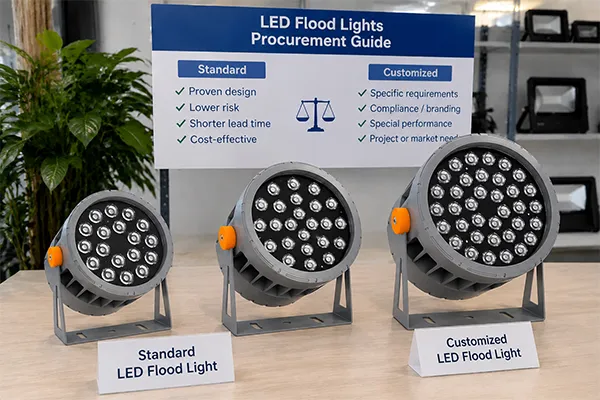
The decision is not about whether customization is automatically better. In my pre-sales work, I find that the best choice usually becomes clear when we move beyond product preferences and examine the actual lighting task, approval process, supply plan, and cost of making changes.
What Application Requirements Should Define LED Flood Lights?
A buyer may request customized LED flood lights because a project has unique expectations. However, an undefined application can turn a reasonable request into unnecessary development work, delayed sampling, and a difficult approval process.
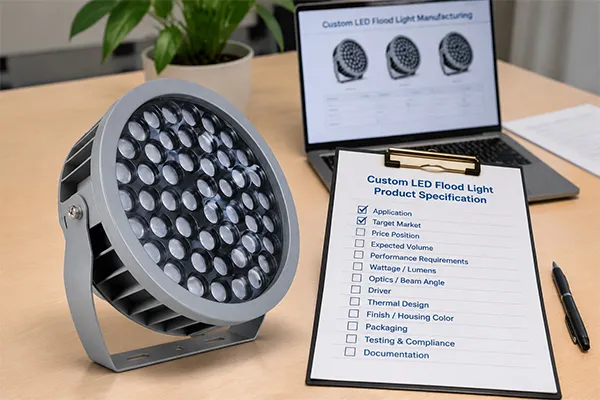
The first step is to define what the LED flood lights must do at the installation site. Buyers should confirm the target area, mounting height, beam distribution, wattage, color temperature, control needs, environmental exposure, and installation method before deciding whether a standard configuration is insufficient.
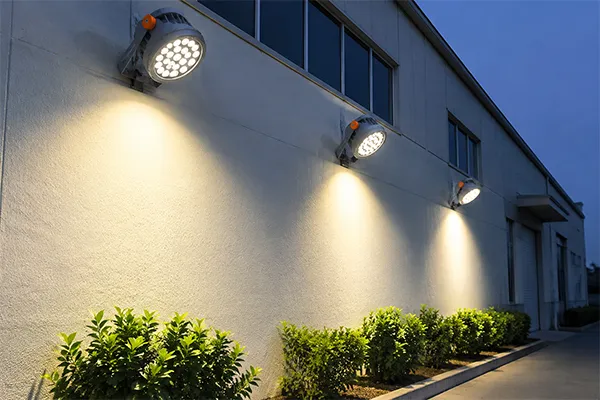
Begin With the Lighting Task
I encourage buyers to describe the lighting task before asking which specifications can be customized. A flood light for a building façade, loading area, parking zone, sports perimeter, billboard, warehouse yard, or construction site may need a different optical distribution and installation approach.1
A product specification is only useful when it connects to a real operating condition. For example, a higher wattage may seem like a simple upgrade, but it can affect2:
- Heat management and driver selection
- Fixture dimensions and weight
- Bracket strength and mounting suitability
- Input current and circuit planning
- Delivery cost and packaging size
- Project budget and energy-use assumptions
Similarly, a narrower beam angle is not automatically more precise. It may create stronger brightness at a distant target while leaving wider areas underlit. A wider beam may improve coverage but reduce intensity on the intended surface. A qualified lighting professional should evaluate the layout, illuminance expectations, glare risk, and local requirements for an application-specific decision.3
Build a Practical Requirement Brief
Before I prepare a quote, I find that the following information helps avoid revisions later:
| Requirement area | Questions buyers should answer | Why it matters |
|---|---|---|
| Installation site | Is the location indoor, outdoor, coastal, dusty, wet, or high-temperature? | The environment affects housing, sealing, corrosion resistance, and component choices.4 |
| Mounting | What is the mounting height, angle, and bracket or pole arrangement? | Mounting affects beam selection, cable length, aiming, and mechanical compatibility. |
| Lighting objective | Is the goal area lighting, façade washing, security lighting, or sign illumination? | The objective guides wattage, optics, color temperature, and control requirements. |
| Electrical conditions | What input voltage and wiring method are available? | Electrical compatibility must be confirmed before purchase. |
| Market destination | Where will the products be sold or installed? | Documentation and regulatory expectations vary by market and application.5 |
| Commercial plan | Is this a one-time project, repeat order, or branded product line? | The answer affects MOQ, packaging, inventory, and customization value. |
Avoid “More Features” as a Decision Rule
In my experience, buyers often revise early requests after they assess the full installation context. A requested special color temperature may not be necessary once the project team considers visual consistency with nearby fixtures. A special bracket may become unnecessary if a standard adjustable bracket already works with the mounting structure.
That process is normal. It does not mean the original request was wrong. It means the buyer is moving from a preference-based inquiry to a procurement specification that can be evaluated properly.
I treat the application brief as the foundation of supplier comparison. Without it, pricing comparisons can be misleading because different suppliers may be quoting different performance levels or commercial terms.
When Are Standard LED Flood Lights the Smarter Procurement Choice?
A standard product can be overlooked because it appears less tailored to the project. Yet buyers can create more risk when they customize a model that already meets the essential application and market requirements.
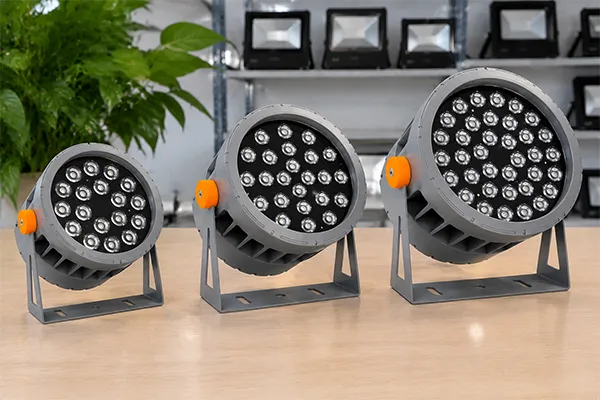
Standard LED flood lights are usually the smarter choice when their proven wattage, optical options, color temperature, housing, and documentation align with the project. They can support faster quotation, simpler sample approval, more predictable lead times, easier replenishment, and greater inventory flexibility than a new custom configuration.
Why Standard Configurations Reduce Execution Risk
A standard configuration is not a low-quality compromise. It is often a model with established materials, assembly processes, packaging, and production planning. For contractors, distributors, and importers, that maturity can be valuable.
When buyers use standard LED flood lights, they may benefit from:
- Faster quotation cycles. The supplier can often confirm specifications and pricing more quickly when components and production methods are already defined.
- Simpler approvals. A buyer can focus on verifying the existing sample, dimensions, electrical data, documentation, and visual appearance.
- More predictable supply planning. Common configurations may have more stable component sourcing than highly specific combinations.6
- Easier future replenishment. Repeat orders are less likely to require a new engineering discussion when the original model remains suitable.
- Lower inventory complexity. Distributors can avoid carrying multiple near-identical SKUs that are difficult to forecast.
Standard Does Not Mean “No Choice”
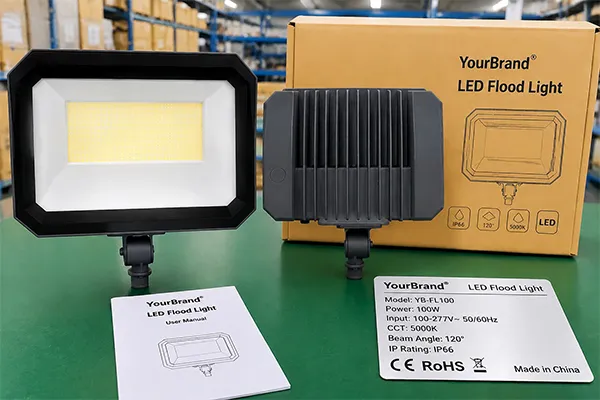
Many suppliers offer a useful range of standard options. A buyer may be able to select from common wattages, color temperatures, housing colors, beam angles, voltage versions, cable lengths, or sensor-ready arrangements without launching a full OEM or ODM process.
The important question is whether the option is truly standard within the supplier’s product system or whether it requires a special purchasing, engineering, or production arrangement. I recommend asking this directly because the commercial implications can differ.
| Buyer priority | Standard LED flood lights may fit when… | Customization may be needed when… |
|---|---|---|
| Delivery deadline | The existing configuration meets the site requirements. | A critical requirement is unavailable in the standard range. |
| Budget control | The buyer wants to minimize development and low-volume costs. | The added value of a unique feature supports the higher cost. |
| Repeat procurement | The buyer needs predictable replenishment across projects. | The buyer is developing a differentiated branded range. |
| Technical fit | Standard optics and electrical versions suit the installation. | The installation has a non-negotiable special requirement. |
| Brand strategy | The product will be sold as a general-purpose item. | Packaging, finish, labeling, or appearance must match a brand system. |
Questions I Suggest Asking a Supplier
When a buyer wants a standard model, I still recommend a disciplined review:
- Is the quoted model a current production item?
- Which parameters are fixed, and which are selectable?
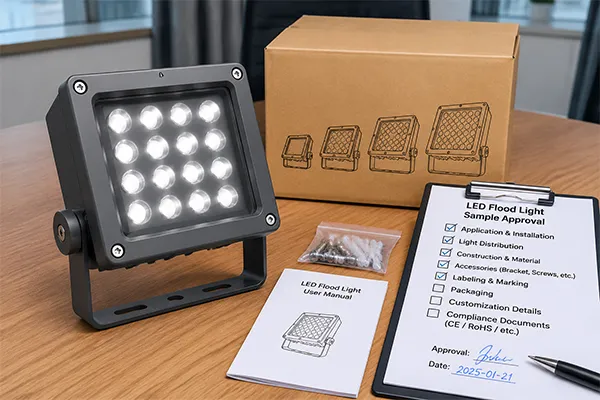
- What sample is being approved?
- What are the confirmed dimensions, weight, and mounting details?
- What documents can the supplier provide for the specific model and target market?
- What is the expected production lead time after order confirmation?
- What happens if the buyer needs replacement units or repeat orders later?
At Upward Lighting, we can discuss standard configurations first and then identify whether a limited adjustment is feasible. I find that this approach helps buyers avoid paying for customization that provides little operational value.
When Do Customized LED Flood Lights Create Enough Value?
Customization can help a buyer solve a real project or product-line problem. However, it should be treated as a controlled commercial process, not as a default feature list added to an inquiry.
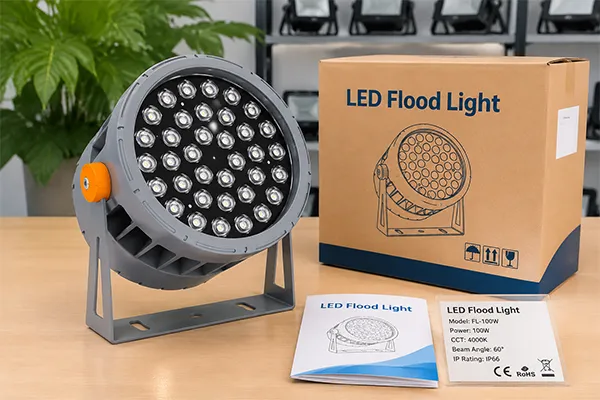
Customized LED flood lights are justified when a standard product cannot meet a non-negotiable requirement, such as a specific optical need, electrical configuration, market documentation requirement, brand appearance, packaging system, or differentiated product strategy. Buyers should confirm that the value of the change exceeds its MOQ, validation, cost, and lead-time impact.
Customization Should Solve a Defined Problem
Inquiries that I handle often begin with requests for custom wattage, color temperature, beam angle, CRI, finish color, label, or packaging. These can all be legitimate requests. Still, each change should have a clear reason connected to the application or business model.
For example:
- A specific color temperature may support visual consistency across a site or a brand’s catalog.
- A custom beam angle may be necessary where the mounting height and target geometry cannot be served by standard optics.
- A different input voltage or cable arrangement may be required for the electrical conditions of a destination market.
- A custom housing color or finish may support architectural integration or private-label consistency.
- A branded carton, label, and instruction set may be valuable for distributors and local lighting brands building a recognizable retail or trade identity.
- A higher CRI requirement may be relevant where color appearance is important, but buyers should define the performance expectation rather than assume that a higher number suits every outdoor application.
Understand the Commercial Effects Before Approval
A parameter change can affect more than the product itself. It can change component sourcing, assembly instructions, quality-control checkpoints, packaging, labeling, sample timing, and order quantity requirements.
I recommend that buyers ask for written confirmation of these points before issuing a purchase order:
| Customization topic | Commercial question to confirm |
|---|---|
| MOQ | What minimum quantity applies to the final approved version? |
| Sample process | Is a sample available, and what exactly does it represent? |
| Tooling or artwork | Are there setup, printing plate, mold, or artwork costs? |
| Unit pricing | How does the change affect pricing at different order volumes? |
| Lead time | Does the change require special components or longer validation? |
| Specification control | Which drawing, datasheet, artwork, and bill of requirements will govern production? |
| Repeat orders | Can the same materials and branding be maintained for future batches? |
| Change management | What happens if the buyer changes the specification after sample approval? |
Certification and Compliance Need Careful Verification
Buyers sometimes request a customized version and assume that documents for a standard version automatically apply. That assumption can create avoidable risk. Product certification, declarations, test reports, labeling, and market-entry obligations must be reviewed according to the actual product configuration, destination market, and installation context.7
Upward Lighting can provide relevant product documentation, including CE and RoHS-related materials for applicable products. However, I always recommend that buyers verify document scope, product-model alignment, and market acceptance with qualified compliance professionals or their local authority, importer, consultant, or certification partner.
Customization is worthwhile when it protects a critical requirement or supports a repeatable commercial strategy. It is not worthwhile when it only adds complexity without improving application fit, customer value, or market readiness.
How Should Buyers Compare Cost, MOQ, and Lead Time for LED Flood Lights?
The lowest unit price does not always produce the lowest procurement cost.8 A standard model may cost less to buy and manage, while a custom version may create stronger long-term brand value for the right buyer.
Buyers should compare LED flood lights using total procurement impact rather than unit price alone. They should review sample cost, MOQ, artwork or development charges, production lead time, approval steps, shipment planning, inventory risk, and the cost of specification changes for both standard and customized options.
Use Total Cost Instead of Unit Price Alone
A supplier quotation should be evaluated in context. A lower-priced customized flood light can become expensive if the order quantity is too low, the packaging must be reworked, or the approval process delays a tender or delivery schedule.
I suggest separating costs into four categories:
-
Product cost
This includes the fixture, driver, LED components, bracket, cable, packaging, and agreed accessories. -
Customization cost
This can include special materials, non-standard components, artwork preparation, color matching, printing, packaging changes, sample development, or setup charges. -
Execution cost
This includes time spent on specification confirmation, sampling, approval, revisions, communication, inspections, and logistics coordination. -
Inventory and replenishment cost
This includes the risk of holding slow-moving custom stock, minimum-order commitments, and challenges in buying small replacement quantities later.
Compare the Two Paths Side by Side
| Evaluation point | Standard option | Customized option |
|---|---|---|
| Initial quotation | Usually simpler when the configuration is already defined | May require review of every requested change |
| MOQ | Often more flexible, subject to supplier policy | May be higher due to special materials or packaging |
| Sample approval | Usually faster when a regular sample is available | May require a pre-production sample or revised sample |
| Production planning | Often easier to schedule | May depend on special-component availability |
| Branding | Limited to existing product and packaging options | Can support labels, cartons, finish colors, and identity systems |
| Repeat ordering | Usually straightforward if the model remains active | Requires specification control and repeated material availability |
| Change risk | Lower when the buyer accepts a proven configuration | Higher if requirements change after development begins |
Establish a Decision Gate Before Ordering
I use a simple decision gate in discussions with buyers:
If the standard model meets the technical requirement, the expected market requirement, and the commercial deadline, I usually recommend starting with the standard model. If it fails one non-negotiable requirement, I then evaluate whether customization has a defined business case.
A buyer should be cautious when the project deadline is tight but the requested changes are still evolving. In that situation, the buyer may choose a standard configuration for the immediate project and develop a custom version for later orders. This two-track approach is not always necessary, but it can help separate urgent delivery needs from longer-term product development.
At Upward Lighting, our team can provide rapid quotations and discuss OEM/ODM possibilities, including adjustments to color temperature, wattage, beam angle, CRI, and finish colors. We also support small-batch discussions where feasible. Still, I believe buyers should confirm the final scope early because clear specifications support better pricing, production planning, and quality control.
Frequently Asked Questions
Are standard LED flood lights lower quality than customized models?
No. Standard LED flood lights are not inherently lower quality. A standard model can be a proven configuration with established materials, assembly methods, and inspection procedures. Buyers should evaluate the actual product specification, manufacturing controls, documentation, and supplier capability rather than assume that customization indicates better quality.
What is the most important factor when choosing customized LED flood lights?
The most important factor is whether the customization solves a non-negotiable application, market, or branding requirement. Buyers should connect each requested change to a clear benefit, then compare that benefit against MOQ, cost, sample approval needs, lead time, and repeat-order implications.
Can I customize the wattage and beam angle of LED flood lights?
Many manufacturers can discuss wattage and beam-angle adjustments, but feasibility depends on the fixture platform, thermal design, optical components, driver arrangement, order quantity, and intended application. Buyers should provide mounting height, target area, environment, and performance expectations before requesting changes.
Do CE and RoHS documents guarantee market acceptance?9
No. CE and RoHS-related documents can be relevant to certain markets and products, but buyers should verify that documents apply to the exact model, configuration, destination, and intended use. Importers and project teams should seek qualified compliance guidance for application-specific decisions.
How can I make repeat orders easier for a customized flood light?
Buyers should retain approved datasheets, drawings, samples, packaging artwork, labels, color references, and purchase-order specifications. They should also confirm component consistency, MOQ, expected lead time, and change-notification practices with the supplier before launching a custom product range.
Conclusion
Choosing between standard and customized LED flood lights starts with the installation and commercial objective, not a wish list of optional features. I recommend standard configurations when they meet the required performance, documentation, budget, and delivery plan with lower execution risk. I recommend customization when it resolves a clearly defined technical, compliance, or branding gap that a standard model cannot address. If you are comparing flood light options for a project or product line, contact Upward Lighting for a specification-focused quotation and OEM/ODM discussion.
"San Antonio Urban Lighting Masterplan", https://www.sanantonio.gov/Portals/0/Files/TCI/ULMP-Urban-Lighting-Master-Plan.pdf. Lighting-design guidance describes selection of luminaire distribution and mounting arrangement as application-dependent, because the illuminated area, target orientation, mounting height, and visual task differ among outdoor installations. Evidence role: general_support; source type: institution. Supports: Lighting applications such as area, façade, and sports lighting require optical distributions and mounting arrangements suited to their particular task geometry.. Scope note: The guidance supports the general design principle; final optical selection requires a site-specific photometric calculation. ↩
"Energy Efficiency of LEDs", https://www1.eere.energy.gov/buildings/publications/pdfs/ssl/led_energy_efficiency.pdf. Technical guidance on LED systems explains that electrical input power determines current demand and contributes to thermal load, making driver capability and heat dissipation important design considerations. Evidence role: mechanism; source type: government. Supports: LED luminaire electrical power affects input current and heat generation, while thermal management and driver selection are material to LED system performance and reliability.. Scope note: The magnitude of effects on dimensions, mass, and packaging varies by luminaire architecture and is not determined by wattage alone. ↩
"DIVISION 14. LIGHTING REQUIREMENTS", https://www.greenwichct.gov/DocumentCenter/View/41370/Revised-Proposed-Amendments-to-BZR-Division-14---Lighting-Revisions-31824. Professional exterior-lighting guidance evaluates proposed installations using photometric layout, target illuminance, glare control, and applicable jurisdictional requirements rather than fixture output alone. Evidence role: expert_consensus; source type: institution. Supports: Recognized exterior-lighting guidance treats illuminance, glare control, layout, and local rules as relevant design considerations.. Scope note: Specific legal requirements and recommended lighting levels vary by jurisdiction and application. ↩
"Corrosion Protection for Metal Connectors and Fasteners in ...", https://www.brunswickcountync.gov/DocumentCenter/View/990/FEMA-TB-08---Corrosion-Protection-for-Metal-Connectors-in-Coastal-Areas-PDF. Standards and technical guidance on electrical enclosures distinguish protection against dust and water ingress and recognize environmental exposure, including corrosive conditions, as relevant to equipment design and material selection. Evidence role: mechanism; source type: institution. Supports: Dust and water ingress protection, corrosive exposure, and ambient conditions are relevant to enclosure and material selection for outdoor electrical equipment.. Scope note: An ingress-protection rating does not by itself establish corrosion resistance or suitability for every coastal, chemical, or high-temperature environment. ↩
"2-CE Marking | BETA - International Trade Administration", https://beta.trade.gov/article?id=CE-Marking. Official market-access guidance explains that electrical products may be subject to different conformity, technical-documentation, labeling, and safety obligations depending on the destination market and applicable product rules. Evidence role: general_support; source type: government. Supports: Market-access obligations for electrical products are determined by the jurisdiction, product category, and applicable legislation or standards.. Scope note: This general principle does not identify the complete compliance obligations for a particular flood-light model or installation. ↩
"Managing Product Variety: Supply Chain Segementation for Food and ...", https://scm.mit.edu/news-and-events/managing-product-variety-supply-chain-segementation-for-food-and-beverage-retailers/. Operations-management research finds that product variety and customization can increase supply-chain complexity and inventory-management difficulty, which may make sourcing less predictable than for established common configurations. Evidence role: general_support; source type: research. Supports: Greater product variety and customization can increase supply-chain complexity, forecasting difficulty, and dependence on less commonly used components.. Scope note: The effect on availability depends on the supplier's sourcing strategy, inventory policy, and the particular components involved. ↩
"EU - Import Requirements and Documentation", https://www.trade.gov/country-commercial-guides/eu-import-requirements-and-documentation. Official conformity-assessment guidance states that manufacturers must identify applicable requirements and prepare supporting documentation for the product placed on the market, including the relevant conformity assessment and declarations where required. Evidence role: general_support; source type: government. Supports: Conformity assessment and supporting technical documentation must correspond to the product and applicable regulatory requirements in the market where it is placed.. Scope note: Whether a modified product requires new or updated assessment depends on the applicable legal framework and the nature of the modification. ↩
"Total Cost of Ownership Modeling for Electronics", https://www.epa.gov/sites/default/files/documents/costofown.pdf. Public-procurement guidance on total cost of ownership treats acquisition price as only one cost element and may include operation, maintenance, logistics, risk, and end-of-life costs in an economic evaluation. Evidence role: general_support; source type: government. Supports: Procurement evaluation can consider lifecycle and transaction-related costs in addition to initial purchase price.. Scope note: The relevant cost categories and their weighting depend on the buyer's contract structure, use case, and purchasing policy. ↩
"CE marking – obtaining the certificate, EU requirements - Your Europe", https://europa.eu/youreurope/business/product-rules-compliance/general-product-compliance/ce-marking/index_en.htm. European Commission guidance explains that CE marking is the manufacturer's declaration of conformity with applicable EU requirements, and RoHS establishes substance restrictions for covered electrical and electronic equipment; these documents do not independently resolve every product-specific, national, contractual, or installation requirement. Evidence role: definition; source type: government. Supports: CE marking is a manufacturer's declaration that applicable EU requirements have been met, while RoHS concerns restrictions on certain hazardous substances in applicable electrical and electronic equipment.. Scope note: The exact obligations depend on product scope, applicable EU legislation, destination country implementation, and the intended use of the equipment. ↩