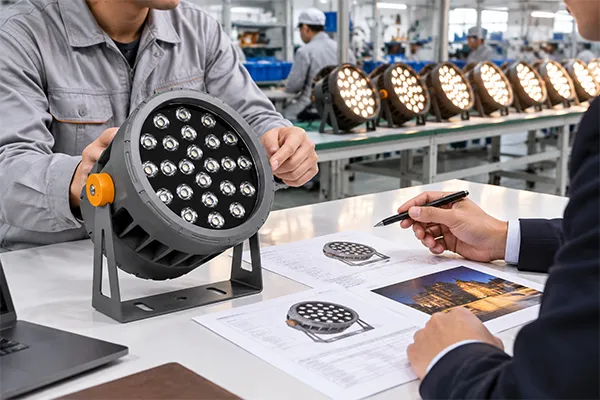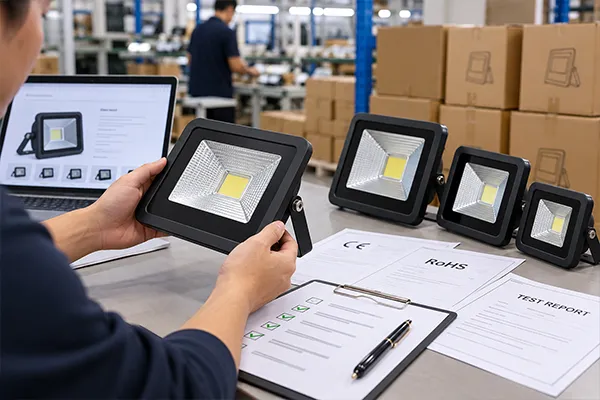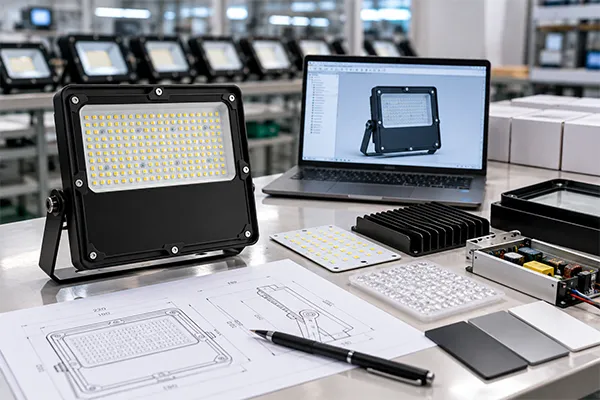

China LED Flood Light Factories attract importers because buying decisions can become difficult when a low quoted price hides differences in materials, drivers, thermal design, and quality control. A poor supplier choice can create costly claims, delayed projects, and inconsistent repeat orders. The right factory helps importers define a workable product specification and manage production risk.
China LED Flood Light Factories are often chosen for their ability to combine configurable products, scalable supply, OEM/ODM support, and competitive manufacturing costs. However, importers should compare factories by the agreed product configuration, batch-level quality controls, documentation, customization process, MOQ, and delivery reliability—not by unit price alone.
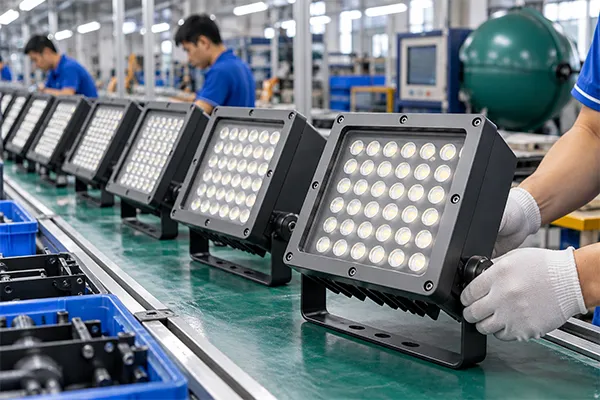
In my experience as a China-based lighting manufacturer, the best importer-factory relationships start with clear questions rather than quick assumptions. A buyer who defines the target market, application, expected service life, and required product features can compare suppliers more accurately and reduce avoidable procurement risk.
What Do China LED Flood Light Factories Offer Beyond Unit Price?
Importers often face pressure to find a lower purchase price, especially in competitive wholesale and project markets. However, a cheap floodlight can become expensive if it produces lower output than expected, overheats in service, or creates warranty claims1. The better solution is to evaluate the total product offer behind the quotation.
China LED Flood Light Factories can offer value beyond price by helping buyers balance configuration, production scale, customization, and supply-chain flexibility. The buyer should assess whether the factory can deliver the required materials, electrical components, quality process, and lead time at a stable repeat-order cost.
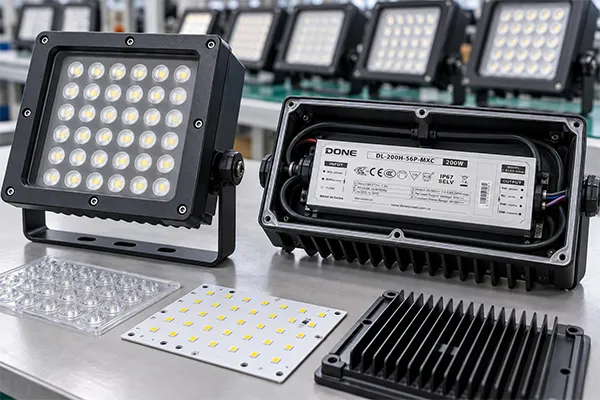
A floodlight quote is a configuration, not just a number
When I receive an inquiry for an LED floodlight, I cannot evaluate the request properly from wattage alone. Two products may both be described as “100W LED floodlights,” but their real construction can differ significantly.
The quoted price may change according to:
- Housing material and thickness
- Heat-sink design and total thermal mass
- LED chip brand, binning approach, and lumen target
- Driver brand, input voltage range, power factor, and surge protection
- Lens material and beam angle
- Ingress protection design and gasket quality
- Cable specification and connector requirements
- Surface treatment, bracket design, and finish color
- Packaging method and drop-protection requirements
- Target operating environment, such as coastal, hot-climate, or industrial use
A lower-cost version may suit a short-term, price-sensitive retail program. A heavier-duty version may be more appropriate for a contractor that must protect its reputation on outdoor projects. Neither option is automatically “right.” The key is whether the product matches the buyer’s intended market and warranty position.
| Buyer question | Why it matters | What to request from the supplier |
|---|---|---|
| What is the installation environment? | Outdoor heat, rain, dust, and corrosion affect product selection.2 | Application description and proposed configuration |
| What output is required? | Wattage alone does not confirm useful light output.3 | Lumen target, CCT, beam angle, and test basis |
| What service expectation does the market have? | Warranty expectations affect driver and thermal-design decisions. | Component list and warranty terms |
| What is the target retail or project price? | The target price defines realistic component choices. | Costed configuration options |
| Is the product for repeat purchasing? | Repeat programs require stronger batch consistency. | QC plan and production capacity discussion |
I have seen buyers spend a great deal of time comparing five quotations that were not comparable in the first place. The practical approach is to issue one written specification sheet and ask every factory to quote against it. If a factory suggests a cost-saving alternative, that alternative should be clearly separated from the original requested configuration.
A useful quote should explain what the buyer is receiving, not merely state a price per unit.
How Should Importers Compare China LED Flood Light Factory Quotations?
A quotation can look simple, but it often combines technical, commercial, and logistics assumptions. If importers compare only the final unit price, they may miss changes in driver selection, packaging, cable length, LED performance, or delivery terms. A structured comparison makes supplier selection more defensible.
Importers should compare China LED Flood Light Factory quotations line by line using the same product specification, Incoterms, order quantity, packaging standard, and quality expectations4. The lowest quoted price is meaningful only when the supplier has confirmed the same technical and commercial scope.
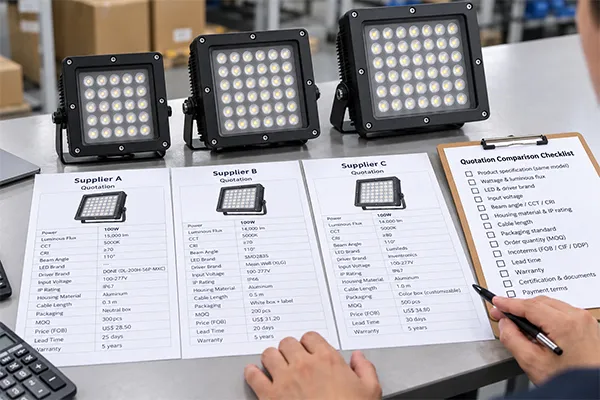
Build a comparison sheet before negotiating
I recommend that buyers create a simple quotation comparison sheet. This does not need to be complicated. It only needs to make hidden differences visible.
A useful comparison sheet includes the following areas:
| Comparison area | Example questions |
|---|---|
| Product model | Is the housing shape, size, bracket, and mounting method the same? |
| Electrical specification | What are the voltage range, driver type, surge-protection level, and cable requirements? |
| Optical specification | What are the lumen target, color temperature, CRI, beam angle, and lens type? |
| Material specification | What aluminum, glass, gasket, screws, and coating are included? |
| Quality process | Is there an aging test? What is inspected before packing? |
| Packaging | Is the inner box, master carton, label, and pallet requirement identical? |
| Commercial terms | Does the price use EXW, FOB, CIF, or another agreed Incoterm? |
| Lead time | Does lead time begin after deposit, artwork approval, or sample confirmation? |
| Documentation | Which test reports, product files, and certification documents can be supplied? |
Ask what changes the price
A responsive factory should be able to explain the major cost drivers. In our work, common price variables include order quantity, driver choice, LED configuration, housing size, surface finish, packaging complexity, and required customization.
For example, a buyer may request a logo on the product, a custom color box, a different cable length, or a special beam angle. Each request can affect material procurement, production setup, MOQ, and lead time. These are not reasons to avoid OEM work. They are reasons to define it accurately.
I also suggest that importers ask factories to identify assumptions in writing. These questions are useful:
- Does the price include the requested driver and cable specification?
- Does the quotation assume a standard carton or custom packaging?
- What is the stated production lead time for the quoted quantity?
- Does the price include labels, manuals, barcode stickers, or logo printing?
- What happens if the buyer changes artwork after approval?
- Which inspection standard will apply before shipment?
This process creates a clearer negotiation. It also helps buyers separate a supplier that understands the product from one that simply reacts with a fast number.
Can China LED Flood Light Factories Maintain Quality in Volume Production?
A successful sample can create confidence, but a sample does not prove that every unit in a production batch will be identical5. Importers may encounter problems when sample components are not controlled in volume production or when inspection standards are vague. Batch-level process control is therefore more important than sample approval alone.
China LED Flood Light Factories can maintain more consistent volume quality when they use documented specifications, incoming-material checks, production inspections, aging tests, and final inspection criteria. Importers should confirm these controls before placing a repeat order and should define acceptance expectations for each batch.
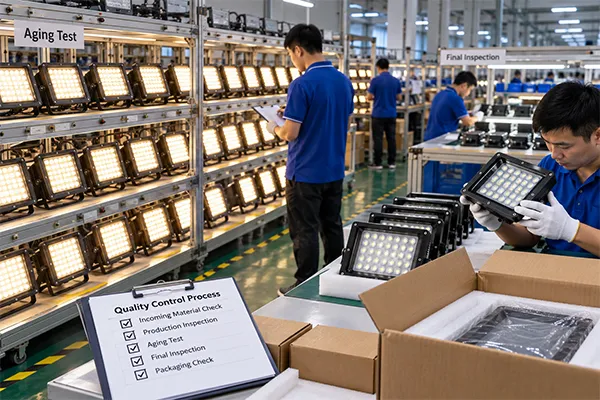
Why sample approval is only the first checkpoint
A sample usually answers basic questions:
- Does the floodlight appearance match the buyer’s expectations?
- Does the beam pattern suit the intended installation?
- Does the mounting bracket fit the application?
- Does the packaging concept look acceptable?
- Does the buyer approve the requested color temperature and branding?
These are important questions. However, a sample is often made with extra attention because it is a single unit or a small trial quantity. Volume production introduces different risks, including component substitutions, inconsistent assembly, missed soldering defects, driver variation, incorrect labels, and packing errors6.
At Upward Lighting, we use a 100% aging test lasting approximately 4 to 8 hours before shipment7 as part of our internal process for applicable products. This type of process can help identify early electrical or assembly issues before packing. Still, buyers should ask each factory what its actual process includes rather than assuming all factories use the same controls.
Evaluate the factory’s batch-control process
A buyer can request a practical explanation of the quality workflow:
| Production stage | Buyer evaluation question |
|---|---|
| Incoming materials | How are LEDs, drivers, housings, cables, and packaging checked? |
| Assembly | Are key process points defined for wiring, sealing, and screw fastening? |
| In-process inspection | Which defects trigger rework or rejection? |
| Aging test | What duration, voltage condition, and pass/fail method are used? |
| Final inspection | Are appearance, function, labeling, and packing checked? |
| Shipment release | Who approves the batch for shipment? |
I believe the most useful question is not, “Do you have QC?” Almost every supplier will say yes. A better question is, “What does your QC team inspect at each stage, and how will you record non-conforming units?”
For larger orders, importers may also consider independent pre-shipment inspection or an agreed AQL-based inspection plan8. The exact inspection method should suit the product, order value, destination market, and buyer’s risk tolerance. A factory’s internal controls and a buyer’s external inspection can work together; neither one should be treated as a universal guarantee.
When Does OEM/ODM With China LED Flood Light Factories Reduce Risk?
OEM and ODM can help importers build a differentiated product line, but customization can also create confusion if requirements remain verbal or incomplete. Buyers may expect instant changes, while factories need time to confirm engineering feasibility, materials, artwork, MOQ, and production scheduling. Clear documentation turns customization into a controlled process.
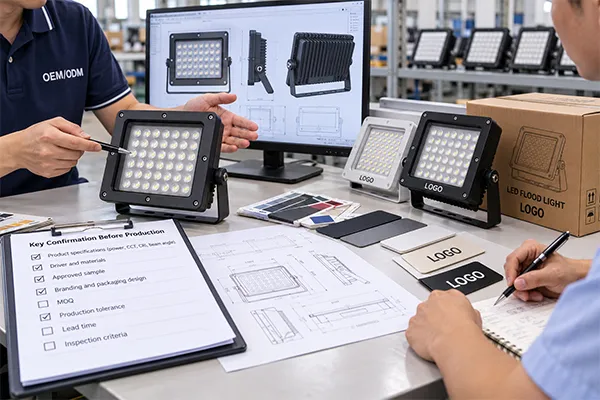
OEM/ODM with China LED Flood Light Factories reduces risk when the buyer and factory confirm measurable product parameters, approved samples, branding scope, MOQ, production tolerance, lead time, and inspection criteria before mass production begins.
Define what “custom” actually means
In LED floodlight sourcing, customization can range from simple to complex. A logo label or carton design may require a relatively straightforward approval process. A new housing, special mounting structure, unique optical distribution, or non-standard electrical arrangement may require tooling, engineering review, extra testing, and a higher MOQ.9
Common OEM/ODM options may include:
- Color temperature selection, such as warm white, neutral white, or cool white
- Wattage and output positioning
- Beam angle or lens selection
- CRI requirement
- Housing finish color
- Brand logo, rating label, and instruction manual
- Retail box or project-carton artwork
- Cable length and plug type
- Bracket adaptation for a defined installation method
- Private-label product naming and packaging
The buyer should not assume that every requested combination is available immediately. The factory needs enough information to confirm whether the request uses existing components or requires new development.
Use an OEM/ODM confirmation checklist
Before I would recommend starting mass production, I would want both sides to confirm the following points:
- Approved product specification: model, wattage, voltage, CCT, CRI, beam angle, IP rating target, cable, and driver requirements.
- Approved visual sample: housing finish, logo position, label wording, bracket design, and packaging appearance.
- Performance expectations: agreed lumen target and any required test conditions.
- Commercial terms: MOQ, unit price, tooling cost if applicable, deposit, and payment terms.
- Production tolerances: acceptable variation in finish, dimensions, output, and packaging.
- Quality acceptance criteria: defect definitions, inspection method, and claim-handling procedure.
- Lead-time milestones: sample completion, artwork approval, material preparation, production, and shipment date.
- Documentation needs: requested product files, test reports, declarations, or certification copies.
This level of detail may feel slow at the beginning. In reality, it usually saves time later because it reduces conflicting assumptions. A small-batch trial order can also be useful before a buyer commits to a larger program. It gives both the importer and the manufacturer a chance to verify packaging, market response, and order-handling procedures.
Factories may provide relevant documentation and certification files, including CE or RoHS-related documents where applicable. However, I always recommend that buyers verify destination-market rules and project-specific requirements independently. A document that is relevant for one market or product configuration may not automatically satisfy every regulatory, tender, or installation requirement.
How Can Importers Reduce Delivery and Communication Risks?
Delivery delays often begin long before the planned shipment date. Unconfirmed artwork, unclear specifications, late component approval, changing package requirements, and incomplete payment arrangements can all affect production scheduling. Importers need a supplier that communicates clearly, but they also need an internal process that prevents late changes.
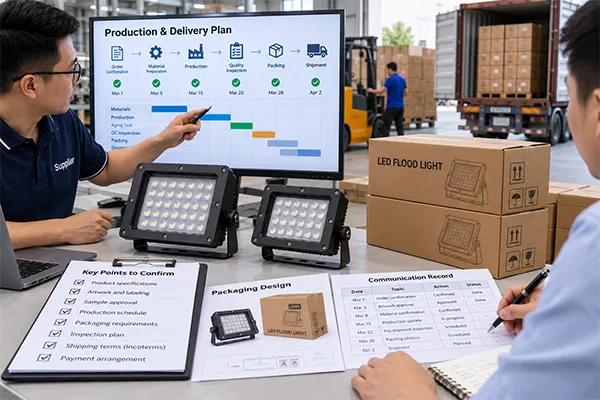
Importers can reduce risk with China LED Flood Light Factories by confirming specifications early, setting approval deadlines, tracking production milestones, and documenting every change. Clear communication is especially important for custom orders, small-batch trials, and repeat programs with seasonal delivery windows.
Treat lead time as a sequence of milestones
A quoted lead time is useful only if both sides understand when the clock starts. For example, production may begin after a deposit is received, artwork is approved, a pre-production sample is confirmed, or special components arrive.
I find that importers can avoid many delays by using a simple milestone schedule:
| Milestone | Buyer responsibility | Factory responsibility |
|---|---|---|
| Specification approval | Confirm final requirements | Review feasibility and issue final quote |
| Artwork approval | Approve labels and packaging files | Check print layout and production suitability |
| Sample approval | Give written approval or revisions | Produce and record approved version |
| Deposit/payment step | Complete agreed payment on time | Reserve materials and production slot |
| Production update | Review updates promptly | Report progress and exceptions |
| Inspection and shipment | Confirm inspection plan and balance payment | Complete QC, packing, and shipping documents |
One small anecdote from our daily operations stands out. A customer once requested a fast shipment, but the final carton artwork was still changing several days before production. The product itself was ready, yet the packaging approval delayed the schedule. The lesson was simple: artwork is not a minor detail when the importer needs a finished retail-ready product.
Look for process clarity, not broad promises
A supplier may claim to have a large capacity or very fast delivery. These claims are less useful than a clear answer to practical questions:
- Which components are normally stocked, and which require procurement?
- What is the standard MOQ for the selected configuration?
- What lead time applies to repeat orders versus first orders?
- Can the factory support mixed models or small-batch trial orders?
- Who handles technical questions after the sales quotation?
- How are design changes controlled after sample approval?
- What shipping documents can the factory prepare?
For many importers, the strongest supplier is not necessarily the biggest factory or the lowest-priced option. It is the supplier whose process fits the buyer’s actual program. A distributor may need reliable repeat supply. A lighting brand may need private-label flexibility. A contractor may need project documentation and a confirmed delivery window. These are different procurement needs, and the supplier should understand them before promising a solution.
Frequently Asked Questions
Are China LED floodlights always cheaper than products from other countries?
China LED floodlights are not automatically the cheapest option after freight, duty, compliance work, inspection, and warranty risk10 are considered. China-based sourcing can be competitive because of supply-chain depth and configuration flexibility11, but importers should compare total landed cost and the exact product specification.
What should I ask before requesting an LED floodlight quotation?
You should provide the application, target market, wattage or output target, voltage, color temperature, beam angle, IP requirement, branding needs, order quantity, packaging preference, and delivery destination. This information helps the factory quote a more accurate configuration and lead time.
Does an approved sample guarantee mass-production quality?
No. An approved sample confirms the agreed reference product, but it does not guarantee identical results across a full production batch. Importers should also confirm component control, aging tests, final inspection standards, packaging checks, and batch-level acceptance criteria.
Can I order a small quantity from a China LED flood light factory?
Many factories can support small-batch trials, although MOQ, unit price, packaging requirements, and customization options may differ from large-volume orders. Buyers should ask whether the requested configuration uses standard materials or requires special components, tooling, or custom packaging.
Do CE and RoHS documents guarantee compliance in every market?
No. CE and RoHS-related documents may be relevant for certain products and markets, but buyers must verify that the documents apply to the exact product configuration, destination country, project requirements, and current regulations. Qualified compliance professionals can help with application-specific decisions.
Conclusion
Importers choose China LED Flood Light Factories for more than a low unit price. The right partner can help turn a market requirement into a controlled product configuration with defined components, practical customization, repeatable QC, and manageable delivery planning. I recommend that buyers compare quotes against one written specification, approve samples carefully, define batch-level inspection criteria, and verify destination-market compliance requirements. If you are sourcing a floodlight program, we can help you review your required configuration and prepare a clear OEM/ODM quotation.
"LED Luminaire Reliability: Impact of Color Shift", https://www.energy.gov/sites/prod/files/2017/04/f34/lsrc_colorshift_apr2017.pdf. LED performance and lifetime are sensitive to junction temperature; inadequate thermal management can reduce light output over time and accelerate component degradation, which may increase maintenance and warranty exposure. Evidence role: mechanism; source type: government. Supports: Thermal conditions and component design affect LED light output, lumen maintenance, and product reliability.. Scope note: This evidence explains the technical mechanism but does not establish the cost outcome for every floodlight purchase. ↩
"IP code", https://en.wikipedia.org/wiki/IP_code. IEC 60529 classifies enclosure protection against ingress of solids and water, supporting the need to match outdoor luminaires to expected dust and moisture exposure. Evidence role: general_support; source type: institution. Supports: Ingress protection ratings classify enclosure protection against solid objects and water, while outdoor environments can impose additional corrosion and temperature stresses.. Scope note: An IP rating addresses ingress protection and does not by itself demonstrate corrosion resistance, thermal suitability, or overall product durability. ↩
"LED Basics", https://www.energy.gov/cmei/ssl/led-basics. Luminous flux is measured in lumens, whereas watts measure electrical power; products with the same wattage can therefore provide different light output and efficacy. Evidence role: definition; source type: government. Supports: Lumens measure luminous flux, while watts measure electrical power consumption; efficacy relates the two measures.. ↩
"Know Your Incoterms", https://www.trade.gov/know-your-incoterms. Incoterms are standardized trade terms that define specified responsibilities for delivery, costs, and risk transfer, so quotations using different terms are not directly equivalent. Evidence role: definition; source type: government. Supports: Incoterms allocate specified delivery, cost, and risk responsibilities between buyers and sellers in international trade.. Scope note: The applicable obligations depend on the particular Incoterms rule, named place, contract language, and version adopted by the parties. ↩
"In-process monitoring and non-destructive evaluation for ...", https://nvlpubs.nist.gov/nistpubs/ir/2024/NIST.IR.8538.pdf. Because production processes are subject to variation, evaluation of an initial sample is not sufficient evidence that all subsequently manufactured units will conform without effective process control and inspection. Evidence role: general_support; source type: government. Supports: Manufacturing processes exhibit variation, and quality assurance requires process controls in addition to evaluation of individual samples.. Scope note: The degree of batch-to-batch variation depends on the specific manufacturing process, components, and control methods. ↩
"ISO 9001 Clause 8.5: Production and Service Provision", https://www.ecesis.net/ISO-9001/Production-and-Service-Provision.aspx. ISO 9001 quality-management principles include controlled production, management of externally provided products and services, identification and traceability, and control of nonconforming outputs—controls relevant to component, assembly, labeling, and packing errors. Evidence role: general_support; source type: institution. Supports: Quality-management systems require control of production, externally supplied components, identification, traceability, and nonconforming outputs.. Scope note: Conformity with a quality-management standard does not itself prove that a specific production batch is defect-free. ↩
"Maximizing Electronics Reliability Through Burn-in Testing", https://www.istgroup.com/en/burn-in-testing/. Reliability literature describes burn-in as an environmental or operating screen intended to expose certain early-life electronic failures before field use. Evidence role: mechanism; source type: paper. Supports: Burn-in or aging tests are used to screen some early-life failures in electronic products.. Scope note: A four-to-eight-hour aging test may detect only some failure modes; its effectiveness depends on test conditions, product design, and the specific defects present. ↩
"ISO 2859-1", https://chemistry.unt.edu/~tgolden/courses/iso2859-1.pdf. ISO 2859-1 specifies acceptance-sampling schemes for inspection by attributes using an acceptance quality limit (AQL), providing a structured basis for defining lot inspection plans. Evidence role: definition; source type: institution. Supports: ISO 2859-1 provides sampling schemes indexed by acceptance quality limit for inspection by attributes.. Scope note: Acceptance sampling estimates conformance for a lot and does not guarantee that every unit in a shipment is free of defects. ↩
"Photometric Study Guide | What It Is & When You Need One", https://www.ledlightexpert.com/photometric_study_guide?srsltid=AU7gw4XUzLc42DR-oeNXImTswfQhItNq0QU29_7il2QZZ5X4A3_nuDaF. Product-development research recognizes that design changes may require engineering validation and tooling, and that setup costs are commonly spread across production volume, affecting the economics of customized orders. Evidence role: general_support; source type: research. Supports: Design changes can require engineering validation and tooling investment, while customized production commonly changes setup and unit-cost economics.. Scope note: The need for retesting, tooling, or a higher minimum order quantity depends on the exact design change, applicable regulations, and the factory's existing tooling. ↩
"Determine Total Export Price", https://www.trade.gov/determine-total-export-price. Importing entails costs and responsibilities beyond the ex-factory product price, including transportation and customs charges and compliance with applicable import and product requirements. Evidence role: definition; source type: government. Supports: Import transactions involve costs and obligations beyond the supplier's unit price, including transportation, customs duties, and regulatory compliance responsibilities.. Scope note: Warranty, inspection, and downstream service costs vary by contract, destination, product category, and the buyer's operating model. ↩
"2020 LED Manufacturing Supply Chain", https://www.energy.gov/cmei/ssl/articles/2020-led-manufacturing-supply-chain. Research on industrial clusters and global value chains documents the concentration of manufacturing suppliers and specialized capabilities in parts of China, providing context for claims of supply-chain depth in lighting-related sourcing. Evidence role: general_support; source type: research. Supports: Industrial clustering and supplier networks in China have supported concentrated electronics and lighting manufacturing capabilities.. Scope note: Cluster-level evidence does not establish that every Chinese supplier is competitive, flexible, or suitable for a particular order. ↩