
Chinese LED flood light manufacturers can be difficult to evaluate when product listings emphasize watts, lumens, and unit prices without explaining real application fit. That gap can lead to returns, complaints, and costly rework after distribution. We believe stronger supplier collaboration starts with confirming specifications, customization needs, and quality-control steps before production begins.
Chinese LED flood light manufacturers support global distributors best by helping them match floodlight specifications to local applications, confirm OEM/ODM details before production, and use documented pre-shipment quality processes to reduce avoidable product inconsistency. The most useful supplier is not simply the one offering the brightest or cheapest floodlight, but the one that helps distributors make clear, sellable, and repeatable product decisions.
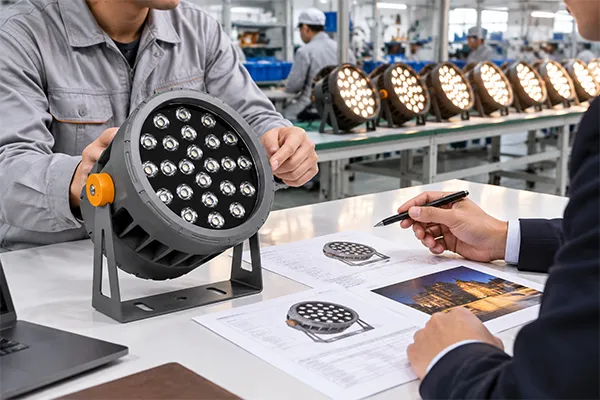
In our discussions with overseas distributors, we often find that the initial inquiry is only the starting point. A request for a “100W floodlight” may actually involve questions about mounting height, beam coverage, color temperature, local preferences, housing finish, package requirements, and applicable documentation. Those details can shape whether a product line performs as expected in the market.
Why Should Distributors Look Beyond Wattage and Lumen Claims When Sourcing Floodlights?
Distributors can face complaints when they source floodlights based mainly on a wattage label or a high lumen figure. A product may appear attractive on paper but create glare, uneven coverage, or unsuitable light color in use.1 The solution is to evaluate the lighting task and installation conditions before comparing products.
Distributors should assess LED floodlights according to the intended lighting task, mounting height, coverage area, beam angle, glare expectations, and environmental conditions—not wattage or lumen output alone.2 Lumen output matters, but it is only one part of whether a floodlight meets end-user expectations.
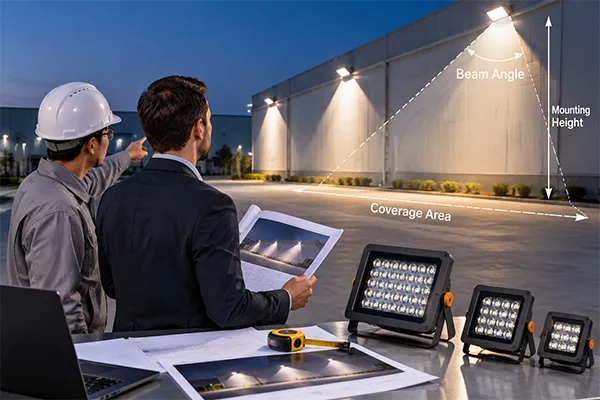
The lighting task should lead the specification
A floodlight for a warehouse loading area has different priorities from a floodlight used for residential façades, retail signage, sports facilities, security entrances, or construction yards. When distributors build a general-purpose product range without separating these uses, sales teams may struggle to recommend the right model.
In our daily quotation discussions, we usually ask what the customer wants to illuminate before we focus on the quoted wattage. This helps us translate a broad inquiry into more confirmable parameters.
For example, a buyer may need to clarify:
- Installation height: A floodlight mounted at 3 meters behaves differently from one mounted at 10 meters.
- Coverage shape: Is the target area wide, narrow, rectangular, or irregular?
- Mounting direction: Will the luminaire point downward, outward, upward, or across a walkway?
- Ambient lighting: Is the area already illuminated by street lighting, storefront lighting, or neighboring properties?
- Visual comfort: Will people look directly toward the fixture or pass near it?
- Operating environment: Will the fitting face rain, dust, salt-laden air, heat, vibration, or frequent switching?
Why brighter is not always better
Higher lumen output can be useful when an installation needs more light over a larger area. However, more lumens do not automatically mean a better result. An overly powerful fixture at a low mounting position can cause discomfort glare.3 It can also create bright spots close to the fixture while leaving distant areas underlit.
A useful sourcing conversation should distinguish between light quantity and light distribution. The beam angle, optical design, mounting position, and aiming direction can all affect perceived performance.4
| Evaluation factor | What it affects | Distributor risk if overlooked |
|---|---|---|
| Lumen output | Overall light quantity | Underlighting or excessive brightness |
| Beam angle | Width and concentration of light | Uneven coverage or missed areas |
| Mounting height | Spread and intensity at the target surface | Poor real-world results despite acceptable specifications |
| CCT | Visual appearance and local preference | Customer dissatisfaction with light color |
| Glare control | Visual comfort and safety | Complaints from residents, drivers, or workers |
| IP rating and construction | Suitability for exposure conditions | Early failure concerns in unsuitable environments |
We recommend that distributors present floodlights as application-led choices, rather than as a simple ladder of 50W, 100W, 150W, and 200W options. This approach can make sales discussions more practical and can help reduce avoidable mismatches between product expectations and installation outcomes.
How Do Chinese LED Flood Light Manufacturers Help Confirm Application-Led Specifications?
Many distributors receive incomplete requests from dealers, contractors, or end users. The pressure to quote quickly can make it tempting to select a standard model immediately. Yet unclear specifications can become expensive later. Chinese LED flood light manufacturers can add value by turning basic requests into a confirmed product configuration.
Chinese LED flood light manufacturers can support distributors by clarifying the use case, installation conditions, optical preferences, and customization requirements before confirming a quotation or order. This process helps transform a general floodlight inquiry into a product specification that is easier to purchase, market, and inspect.
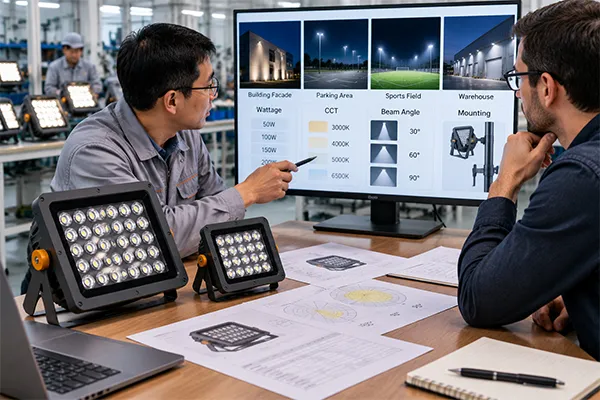
We start with questions that can be confirmed
At Upward Lighting, we work with importers, local lighting brands, wholesalers, distributors, and project-oriented customers in many markets. Before confirming an order, we typically clarify the parts of the request that can directly affect product selection and production details.
A clear request may include:
-
Target application
Examples include façade lighting, parking areas, shop exteriors, industrial yards, billboards, loading zones, and general security lighting. -
Required power range
Buyers may request a specific wattage, but we also encourage them to connect that request to the intended mounting and coverage conditions. -
Color temperature preference
Common requirements may include warm white, neutral white, or cool white. The correct selection often depends on local market habits and the intended visual effect. -
Beam angle and light distribution
Buyers should confirm whether they need broad area coverage, a more focused beam, or another distribution suitable for the installation. -
Color Rendering Index (CRI)
CRI may be more relevant for retail displays, architectural applications, and areas where color recognition matters.5 It may be less central for some basic security-lighting uses. -
Housing and finish color
A standard black or gray finish may suit many projects, while local brands may need a different surface color for product-line consistency. -
Packaging and labeling
Distributors may require their own branding, barcode labels, instruction materials, carton markings, or market-specific product information.
A quotation should be more than a price list
A useful quotation can act as an early control document. It should help the buyer see what is included and what still needs to be confirmed. We find that this is especially important for OEM/ODM floodlight orders, where assumptions can easily create confusion.
A low unit price does not reduce sourcing risk if the product configuration is still unclear.
Distributors can ask suppliers to identify the following in writing:
- Model number and product image
- Wattage and input requirements
- CCT and CRI options
- Beam angle or optical configuration
- Housing material and finish
- IP rating stated for the product
- Cable, mounting bracket, and connector details
- Branding, label, and packaging requirements
- Sampling or small-batch order conditions
- Documents available for review
This does not create a universal guarantee of field suitability. Installation design and local conditions still matter. However, it gives both parties a more reliable reference point before production begins.
How Can OEM/ODM Floodlight Customization Help Distributors Build a Local Product Line?
Distributors may lose sales when every supplier offers the same generic catalogue product without reflecting local preferences. At the same time, excessive customization can add complexity and purchasing risk. The best OEM/ODM process focuses on controlled options that make commercial sense for the distributor’s market.
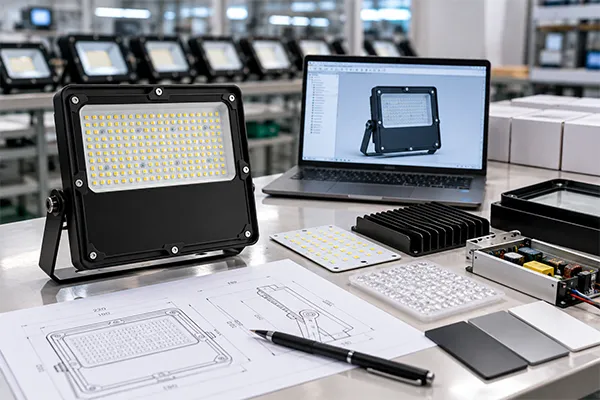
OEM/ODM support helps distributors build a more locally relevant LED floodlight line by confirming practical options such as wattage, color temperature, beam angle, CRI, housing finish, branding, and packaging. Controlled customization can improve product-line consistency without requiring distributors to develop every item from scratch.
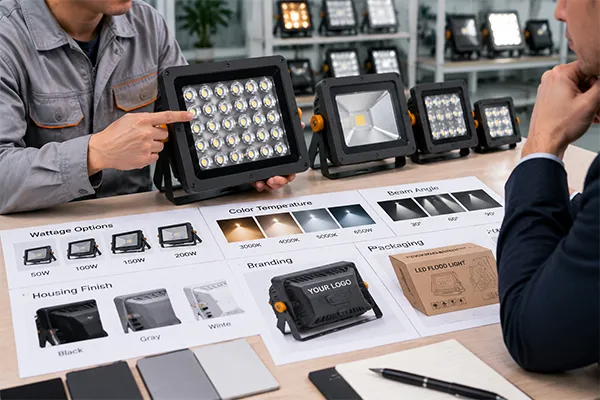
Customization should solve a market need
We do not see customization as an automatic benefit. It should have a clear purpose. A distributor may need a private-label floodlight range to establish its own brand identity. Another buyer may need a particular CCT because local customers strongly prefer a certain appearance. A project supplier may need a finish color that blends with building materials or exterior architecture.
The most practical floodlight customization requests often involve manageable product parameters:
| Customization area | Potential distributor value | Questions to confirm |
|---|---|---|
| Wattage | Creates a product ladder for different applications | Which power levels will be stocked? |
| CCT | Aligns with local customer preferences | Which CCTs will be standard versus special order? |
| Beam angle | Supports different coverage needs | Is the choice based on an installation plan? |
| CRI | Supports applications where color appearance matters | Is higher CRI commercially necessary? |
| Finish color | Supports local brand or project appearance | Is a color reference available? |
| Logo and label | Builds private-label visibility | What artwork and label information are required? |
| Retail packaging | Helps channel presentation and compliance communication | What language, barcode, and carton format are needed? |
Small-batch orders can support better decisions
For distributors entering a new segment, a small-batch trial order may be more useful than immediately placing a large mixed-container order. A trial batch gives the distributor an opportunity to review the actual product, packaging, labeling, mounting arrangement, and customer response within its own channel.
This is not a replacement for qualified technical evaluation where an application is demanding. It is a commercial risk-control step. We believe it can be especially useful when a buyer is introducing a new private-label series or moving from a basic floodlight range to more differentiated options.
I have seen how a short specification discussion can prevent a long series of later revisions. For example, a customer may initially request only a logo on the product. After reviewing the target sales channel, the buyer may also decide that carton design, installation instructions, CCT labeling, and barcode placement need alignment. It is usually easier to identify these requirements before production than after goods have been packed.
Keep the product range manageable
Distributors should avoid creating too many variations too early. A range with numerous wattages, CCTs, colors, and packaging types can increase inventory complexity.6 Instead, buyers can begin with a focused set of high-demand configurations and expand after reviewing sales patterns.
A disciplined approach may look like this:
- Start with a core range for the most common applications.
- Add private-label packaging for items with stable demand.
- Use special configurations for confirmed projects or repeat customers.
- Review return reasons and sales feedback before adding more variants.
- Maintain a written specification file for each stocked SKU.
What Quality-Control Steps Should Distributors Ask Chinese LED Flood Light Manufacturers to Explain?
Product quality claims can sound similar across many supplier websites, so distributors need specific, reviewable questions. Without a clear quality process, a buyer may not know how product consistency is checked before shipment. The solution is to ask about inspection points, order confirmation, and available documentation.
Distributors should ask Chinese LED flood light manufacturers to explain how orders are confirmed, how products are checked before shipment, what aging process is used internally, and which documents can be provided for review. These steps help buyers assess process transparency, but they do not replace application-specific testing or local compliance verification.
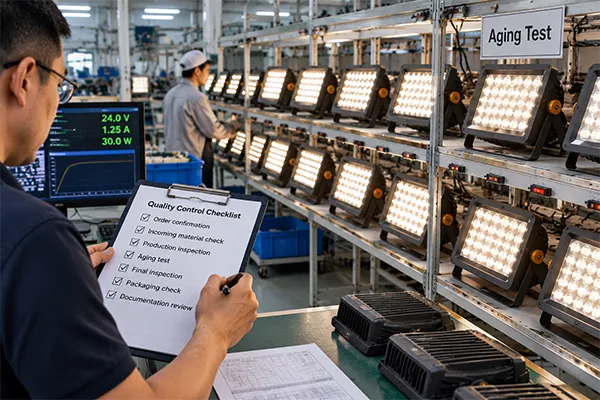
Our internal aging process is one part of pre-shipment control
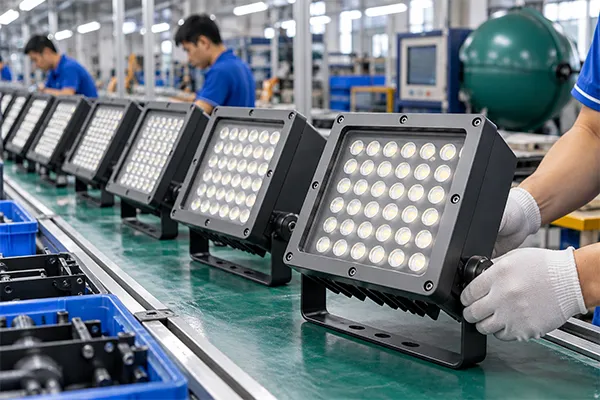
At Upward Lighting, every product undergoes a 100% aging test before shipment, generally lasting between 4 and 8 hours. We use this as an internal pre-shipment process to identify obvious operational issues before products are packed and dispatched.
We describe this carefully because an aging test is not a universal guarantee of real-world lifetime.7 It cannot fully reproduce every field condition, including abnormal voltage conditions, installation errors, coastal corrosion, extreme heat, poor ventilation, or physical damage. However, it is a practical quality-control step that buyers can ask suppliers to explain.
A distributor should ask:
- Is aging performed on all units or on a sample basis?
- How long is the internal aging period?
- At what stage does the test occur?
- What happens if a unit does not pass the internal process?
- Are appearance, labeling, assembly, and packaging checked as separate steps?
- Can the supplier provide photos, inspection records, or agreed order documentation where appropriate?
Documentation should be checked market by market
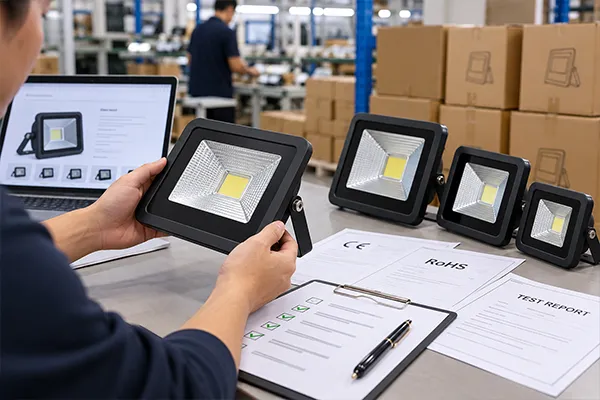
Many LED floodlight buyers ask about CE and RoHS documents.8 These documents may be relevant to market-entry expectations in certain regions, but distributors should not assume that one document package applies identically to every country, project, installation, or tender.9
Buyers should verify the latest requirements for their target market with qualified compliance professionals, local authorities, testing organizations, or project consultants where necessary. They should also confirm that the document information matches the relevant product model and configuration.
| Supplier evaluation area | Useful buyer question | Why it matters |
|---|---|---|
| Order confirmation | “Can you confirm the final specifications before production?” | Reduces interpretation errors |
| Aging process | “Is each unit aged before shipment?” | Clarifies internal pre-shipment controls |
| Inspection | “What checks are completed for appearance and assembly?” | Supports consistency review |
| Certifications | “Which documents apply to this specific model?” | Helps avoid document mismatch |
| Packaging | “Can carton and label details be approved before packing?” | Reduces channel and handling issues |
| Communication | “Who will answer technical and order questions?” | Helps manage revisions efficiently |
Responsive communication is a sourcing control
Fast replies are useful, but speed alone is not the goal. The more important issue is whether the supplier’s response turns questions into clear next steps. In export orders, details may involve drawings, label files, payment terms, packaging artwork, shipping marks, and production confirmation.
We aim to respond quickly because delays can affect a distributor’s planning. Still, a careful answer is better than a rushed assumption. When an inquiry lacks important details, we prefer to ask targeted questions rather than present an overly broad promise.
How Can Global Distributors Select the Right Chinese LED Flood Light Manufacturers?
Choosing among Chinese LED flood light manufacturers can feel overwhelming because many suppliers offer similar-looking products. The real challenge is identifying which supplier can support repeatable procurement and transparent communication. Distributors need a structured evaluation method rather than relying only on catalogue images or the lowest quotation.
Global distributors should select Chinese LED flood light manufacturers by evaluating application understanding, specification control, customization capability, pre-shipment process transparency, document relevance, communication quality, and willingness to support suitable trial orders. A supplier should make procurement clearer, not merely cheaper.

Use a supplier evaluation checklist
A comparison table can help purchasing managers move beyond general sales claims.
| Evaluation criterion | What good evidence may look like | Warning sign |
|---|---|---|
| Product understanding | Supplier asks about application and installation | Supplier quotes only by wattage |
| Specification clarity | Written confirmation of key parameters | Vague descriptions or inconsistent data |
| OEM/ODM capability | Clear process for logo, label, finish, and packaging | Broad promises without approval steps |
| Quality process | Explanation of aging and inspection practices | “Quality guaranteed” without process details |
| Documentation | Model-specific documents available for review | Documents that do not match the quoted item |
| Trial-order support | Practical approach to samples or small batches | Pressure to commit before reviewing details |
| Communication | Clear answers and documented revisions | Repeated misunderstandings or missing details |
Evaluate the supplier relationship over time
The right supplier relationship is not built from one quotation. It develops through clear communication across sampling, specification approval, production confirmation, shipment preparation, and after-sales discussion.
For distributors, the key question is often not, “Who has the lowest initial price?” A more useful question is, “Which supplier can help us sell a consistent product range with fewer avoidable misunderstandings?”
That question matters because distributor costs can extend beyond the purchase price. They may include:
- Customer complaints
- Product returns
- Replacement handling
- Re-labeling or re-packaging work
- Missed project deadlines
- Sales-team confusion
- Brand damage in the local market
A supplier that supports better product definition may help reduce some of these avoidable risks. Yet each distributor should still conduct its own product review, market checks, and professional application assessment where needed.
Frequently Asked Questions
Are higher-lumen LED floodlights always better for distributors?
No. Higher lumen output can be useful for larger or higher-mounted installations, but it does not automatically provide better results. Distributors should consider beam angle, mounting height, target coverage, glare, CCT, and the intended lighting task before choosing a floodlight configuration.
What should distributors confirm before ordering OEM LED floodlights?
Distributors should confirm the product model, wattage, CCT, CRI, beam angle, finish color, branding, packaging, labels, cable details, mounting hardware, and applicable document requirements. A written specification confirmation helps reduce misunderstandings before production begins.
What does a 100% aging test mean for LED floodlights?
A 100% aging test means each unit is operated as part of an internal pre-shipment quality-control process. At Upward Lighting, this process generally lasts 4 to 8 hours. It can help identify obvious issues before shipment, but it does not guarantee lifetime performance in every installation environment.
Can a small-batch floodlight order help reduce sourcing risk?
Yes. A small-batch order can help distributors assess product appearance, packaging, labels, basic configuration, and market response before expanding a product range. Buyers should still review technical suitability and applicable compliance requirements for their own market and applications.
Do CE and RoHS documents apply to every floodlight market?
Not necessarily. CE and RoHS documents may be relevant in certain markets, but requirements vary by country, project, product configuration, and application. Distributors should verify current requirements with appropriate local authorities, compliance specialists, or qualified testing organizations.
Conclusion
Chinese LED flood light manufacturers can support global distributors most effectively when they help convert market needs into clearly confirmed product specifications. We encourage buyers to look beyond wattage, lumen claims, and initial unit price. Application fit, beam angle, mounting conditions, controlled OEM/ODM options, written order confirmation, and transparent pre-shipment processes all matter. If you are building or refining a floodlight range, contact Upward Lighting to discuss your target application, branding needs, and suitable small-batch or OEM/ODM requirements.
"Lighting Specification Guidance for Schools", https://www.energy.gov/sites/default/files/2024-12/lighting-spec-guidance-school_nov24.pdf. Outdoor-lighting guidance recognizes that useful lighting outcomes depend on light distribution, glare control, and color characteristics as well as the quantity of light produced. Evidence role: general_support; source type: government. Supports: That outdoor-lighting performance depends on distribution, glare control, and color characteristics in addition to lamp output.. Scope note: The guidance supports the general design principle and does not evaluate any specific floodlight model or installation. ↩
"led street lighting research project", https://www.energy.gov/sites/prod/files/2014/09/f18/rci_led_perf_pgh.pdf. Lighting-design references describe mounting geometry, target area, optical distribution, glare, and environmental conditions as relevant inputs when selecting outdoor luminaires; rated lumens alone do not determine installation suitability. Evidence role: general_support; source type: education. Supports: That lighting design considers the task, geometry, optical distribution, glare, and environmental conditions rather than relying solely on rated power or lumens.. Scope note: Specific criteria and acceptable performance levels depend on the application and applicable local standards. ↩
"Outdoor Lighting Regulations | The Official Site of Rio ...", https://rrnm.gov/2669/Outdoor-Lighting-Regulations. Research on discomfort glare identifies source brightness and observer–luminaire geometry as important determinants of visual discomfort, supporting the need to consider output and mounting position together. Evidence role: mechanism; source type: paper. Supports: That glare perception is affected by source luminance, viewing geometry, and the observer's position relative to the luminaire.. Scope note: The evidence concerns glare mechanisms generally and does not establish a universal output or mounting-height threshold for floodlights. ↩
"Philadelphia International Airport Apron Lighting", https://www.energy.gov/sites/prod/files/2015/11/f27/2015_gateway_philadelphia-airport.pdf. Lighting-engineering references explain that a luminaire's photometric distribution, orientation, and mounting geometry determine how light is delivered across the target area and how it is perceived by users. Evidence role: mechanism; source type: research. Supports: That luminaire photometric distribution and aiming geometry influence illuminance patterns and visual conditions.. Scope note: The resulting performance remains dependent on the particular luminaire photometry and site layout. ↩
"VIDEO: TM-30 BASICS", https://www.energy.gov/cmei/ssl/video-tm-30-basics. Color-rendering guidance explains that color-rendering measures characterize how illumination affects the appearance of object colors, making them particularly relevant where color judgment or presentation is important. Evidence role: definition; source type: government. Supports: That color-rendering measures describe how a light source affects the appearance and discrimination of object colors.. Scope note: CRI is one color-rendering metric and does not by itself predict every aspect of color preference or visual quality. ↩
"How Competition, Customization, and Niche Markets Have ...", https://scholarcommons.sc.edu/cgi/viewcontent.cgi?article=1095&context=senior_theses. Operations-management research finds that greater product variety can increase forecasting, inventory, and operational complexity by expanding the number of stock-keeping units and demand patterns that must be managed. Evidence role: mechanism; source type: paper. Supports: That product variety and SKU proliferation can increase forecasting, stocking, and operational complexity.. Scope note: The magnitude of the effect depends on demand, replenishment systems, and the distributor's inventory practices. ↩
"Program for Service Life Prediction: Vision for the Future.", https://www.nist.gov/system/files/documents/el/building_materials/Program_ServiceLifePrediction_VisionfortheFuture.pdf. LED reliability research distinguishes short-duration screening tests from lifetime and field-reliability assessment, because service conditions and long-term degradation mechanisms cannot be fully represented by a brief pre-shipment test. Evidence role: general_support; source type: research. Supports: That short-duration screening and aging tests differ from long-term reliability assessment under varied field conditions.. Scope note: The extent to which a particular aging procedure predicts later performance depends on the test design and the product's expected operating environment. ↩
"RoHS Directive - Environment - European Commission", https://environment.ec.europa.eu/topics/waste-and-recycling/rohs-directive_en. European Commission guidance explains that CE marking applies to products covered by relevant EU harmonisation legislation, while the RoHS framework restricts specified hazardous substances in applicable electrical and electronic equipment. Evidence role: historical_context; source type: government. Supports: That CE marking and the RoHS framework are EU regulatory mechanisms relevant to applicable electrical and electronic equipment, including relevant lighting products.. Scope note: Whether a particular floodlight requires particular documentation depends on its product category, destination market, and applicable legislation. ↩
"CE marking – obtaining the certificate, EU requirements", https://europa.eu/youreurope/business/product-rules-compliance/general-product-compliance/ce-marking/index_en.htm. Official product-compliance guidance states that conformity obligations must be assessed against the legislation applicable to the product and market in which it is placed, rather than inferred from a generic document set. Evidence role: general_support; source type: government. Supports: That conformity obligations are determined by applicable jurisdiction-specific rules and product-specific legislation.. Scope note: This general principle does not substitute for legal, regulatory, or conformity-assessment advice for a particular country or tender. ↩