
ODM LED flood light solutions can look simple to source until a brand compares similar-looking quotations and finds that the real differences are hidden in specification control, component choices, validation requirements, and repeat production capability. I often see brands lose time when they start with price before defining the product role they need to win.
An effective ODM LED flood light solution is a repeatable product configuration built around a brand’s target application, competitive position, and channel requirements. Brands should evaluate an ODM partner on specification clarity, practical customization options, manufacturing consistency, documentation, and supply reliability—not only on wattage, lumen claims, or the lowest quoted unit price.
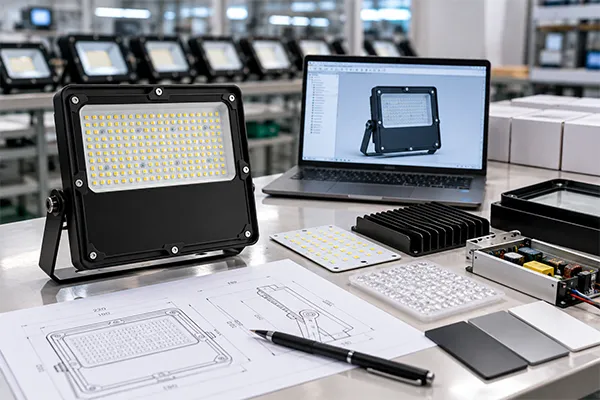
In my quotation discussions with lighting brands, I see a common pattern: a buyer asks for a complete quote before defining where the floodlight will be installed or what competing product it needs to outperform. That approach can produce a fast number, but it rarely produces a strong, differentiated floodlight range.
Why Do ODM LED Flood Light Solutions Need a Clear Product Brief?
A vague floodlight brief creates a familiar procurement problem. The buyer receives several low-priced offers that appear comparable on paper, yet the products may be designed for different operating conditions, market positions, and expected service levels. I believe the solution starts with a structured product brief before the quotation stage.
ODM LED flood light solutions need a clear product brief because the installation environment, lighting task, mounting method, target customer, and desired market position determine which specifications actually matter1. A defined brief helps an ODM supplier recommend commercially realistic configurations instead of quoting a generic product that may not fit the brand’s intended range.
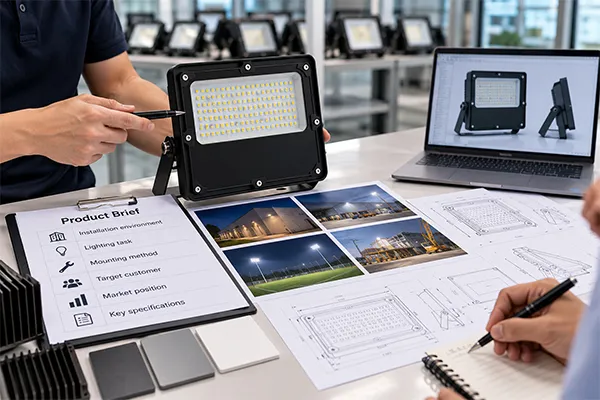
Start With the Application, Not the Catalogue Page
A floodlight is not only a wattage and a housing. It is part of a lighting task. The same nominal 50 W or 100 W floodlight can serve very different roles:
- Perimeter and security lighting
- Building facade illumination
- Signage and billboard lighting
- Small sports or recreation areas
- Industrial yards and loading areas
- Retail exterior lighting
- Residential or light-commercial landscape areas
Each application affects the product decisions that a brand should discuss with its ODM partner. For example, a contractor-focused range for industrial yards may prioritize robust mounting, practical beam distribution, surge protection options, and a clear installation process. A retail-oriented exterior range may place more weight on visual appearance, compact dimensions, color consistency, and packaging presentation.
In my experience, a responsible supplier should ask questions before treating a request as a standard quote:
-
Where will the LED floodlight be installed?
The location may be coastal, hot, dusty, wet, cold, or exposed to frequent electrical disturbances.2 -
What surface and mounting method will be used?
Wall mounting, ground mounting, pole mounting, or adjustable bracket mounting can change the required design details.3 -
What lighting task must the product perform?
Buyers should define whether the objective is area lighting, accent lighting, security coverage, or facade washing. -
Which market and sales channel will the range target?
A distributor stock item, an e-commerce private-label item, and a project-oriented product line may require different packaging, documentation, accessory, and service approaches. -
Which competing products must the range match or improve upon?
This question turns “customization” into a commercial objective rather than a list of random changes.
Build a Brief That Can Be Quoted Consistently
I recommend that brands record the key requirements in a simple approval-ready format. This reduces misunderstandings between purchasing, product management, engineering, and the supplier.
| Brief Area | Questions to Define | Why It Matters |
|---|---|---|
| Product role | Is this an entry-level, mid-market, or premium line? | Guides component and finish choices |
| Environment | Will the unit face rain, dust, heat, salt air, or vibration? | Influences enclosure and material decisions |
| Optical needs | What beam angle, CCT, and glare control are needed? | Supports lighting-task suitability |
| Electrical needs | What voltage range, driver expectations, and surge requirements apply? | Helps define market and application fit |
| Brand identity | Are logo, housing color, label, packaging, or manual changes needed? | Creates a consistent private-label offer |
| Commercial plan | What is the forecast, target MOQ, and launch timing? | Determines whether customization is viable |
A good brief does not need to be complicated. It needs to be specific enough that every quotation refers to the same product intention. This is one of the most useful steps a brand can take when comparing ODM LED flood light solutions.
How Should Brands Compare ODM LED Flood Light Solutions Beyond Price?
Price comparisons become unreliable when the quoted products are only superficially similar.4 A low quotation can be commercially attractive, but it does not prove that the supplier is quoting the same driver approach, thermal design5, material grade, assembly control, or documentation support. I encourage brands to compare the full configuration.
Brands should compare ODM LED flood light solutions through a controlled specification matrix that covers electrical components, thermal management, optical configuration, materials, quality-control procedures, customization scope, and delivery conditions. The goal is not to find the highest specification in every category, but to confirm that the quoted product supports the intended brand position at a realistic cost.
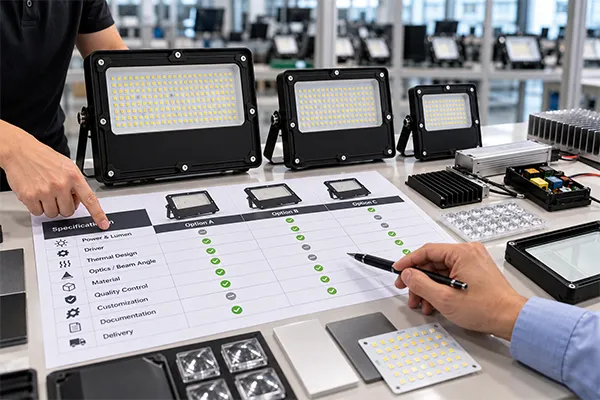
Similar Headline Specifications Can Hide Important Differences
A common pattern I see in brand inquiries is a request such as: “Please quote 100 W, 10,000 lm, IP66, at the lowest price.” That is an understandable starting point, but it is not yet a complete comparison basis.
Two quotations may state similar wattage, lumen output, and ingress-protection claims.6 Yet the products can differ in areas that affect production consistency, installation suitability, and long-term commercial risk. Buyers should ask each supplier to clarify what is included rather than assuming all terms mean the same thing.
Key comparison points include:
- LED source type and binning approach7
- Driver brand, specification, and input-voltage range
- Driver compartment design and heat management
- Housing material and coating process
- Lens or cover material
- Cable length, cable type, and connector options
- Bracket thickness, adjustment mechanism, and corrosion resistance
- Surge-protection configuration, where applicable
- Stated CCT, CRI, beam angle, and tolerances
- Label, carton, manual, and barcode requirements
- Aging-test process and final inspection records
- Sample approval and mass-production change-control process
At Upward Lighting, I can discuss customization around parameters such as color temperature, wattage, beam angle, CRI, and surface finish colors. However, I would not treat a list of adjustable parameters as proof that every requested combination is equally suitable. The final configuration should match the product’s intended environment, product tier, and target selling price.
Use a Supplier Comparison Matrix
I suggest that purchasing teams avoid comparing suppliers from separate email threads alone. A single comparison table makes missing information visible.
| Evaluation Area | Supplier Questions | Buyer Review Standard |
|---|---|---|
| Specification definition | Is every major component and parameter stated? | Avoid unclear “standard quality” descriptions |
| Sample alignment | Will the approved sample define mass production? | Confirm revision and approval records |
| Customization | Which changes are cosmetic, parameter-based, or structural? | Identify feasibility, MOQ, tooling, and lead-time effects |
| Quality control | What inspections occur before shipment? | Ask for process details and applicable records |
| Documentation | Which technical documents can be supplied? | Verify documents against market and channel needs |
| Supply continuity | How are key components sourced and controlled? | Discuss alternatives and change notification |
| Commercial terms | What is included in the quoted price? | Compare packaging, accessories, labels, and shipping terms |
I do not view the lowest price as automatically good or bad. I view it as a signal that requires explanation. The buyer should understand which assumptions sit behind that number.
For our own production process, every product undergoes a 100% aging test before shipment, typically lasting 4 to 8 hours. Buyers should still clarify what their application requires and request relevant quality information during supplier evaluation. A factory process is useful only when it supports the actual product and market requirement being assessed.
Which Floodlight Customizations Are Commercially Viable?
Many brands want a differentiated floodlight line, but “customizable” can mean several very different things. Some changes can be handled through existing material options or production settings. Others may require tooling, extra validation, new sourcing, increased MOQs, or longer lead times. I find that clear boundaries create better ODM projects.
Commercially viable ODM LED flood light solutions usually begin with configurable parameters such as CCT, wattage, beam angle, CRI, surface color, branding, and packaging. More extensive changes to housings, optics, electrical architecture, or mounting systems may require additional development, sampling, validation, investment, minimum order quantities, and lead-time planning.8
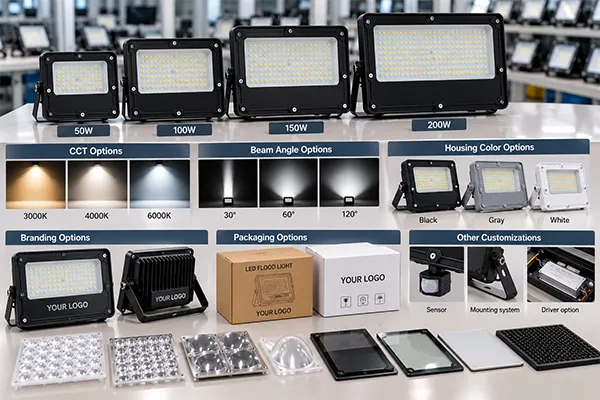
Separate Adaptation From Product Development
I usually divide customization conversations into three practical levels. This gives brands a more realistic way to plan their product launch.
| Customization Level | Typical Examples | Commercial Considerations |
|---|---|---|
| Existing-option adaptation | CCT, wattage selection, beam angle, housing color, logo label | Often more practical for faster launches |
| Brand presentation customization | Packaging, manuals, color boxes, labels, barcodes, product naming | Requires artwork approval and MOQ planning |
| Engineering development | New housing, custom bracket, new optics, structural changes | May require tooling, samples, testing, validation, and longer timelines |
A brand should not assume that a factory can provide a completely new floodlight design at the same cost, quantity, or lead time as a standard configuration. The supplier may be technically capable, but the commercial case may still be weak.
For example, a custom surface color might be reasonable if the expected volume supports a dedicated coating batch. A special mounting bracket may be reasonable if a brand serves a defined project segment that needs a particular installation method. In contrast, a completely new die-cast housing for a small initial order may introduce tooling cost and approval risk9 that outweighs the product’s commercial benefit.
Ask What Each Change Affects
I advise brands to ask a supplier four direct questions for every requested change:
- Does this change affect unit cost?
- Does it create a new MOQ or component minimum?
- Does it require a new sample or validation step?
- Does it change the expected production lead time?
These questions protect both sides. They help the buyer avoid over-promising a launch date internally. They also help the supplier avoid quoting a configuration before the necessary details are defined.
In repeated inquiries, I have seen brands request “all options” at once: multiple wattages, several CCTs, special colors, branded cartons, different beam angles, and custom accessories. That may be the right final range, but I often suggest prioritizing the configurations that have the clearest sales case first. A focused launch range can create better purchasing leverage and simpler inventory management than too many low-volume variations.
The strongest ODM LED flood light solutions are not those with the longest customization list. They are the ones where each selected change has a clear purpose for the brand, channel partner, contractor, or end user.
How Can a Brand Create Meaningful Floodlight Differentiation?
A crowded floodlight category makes superficial differentiation easy to copy. A different housing color or a larger wattage label may attract attention, but it may not give distributors or project customers a strong reason to choose the product. I believe brands need differentiation that connects directly to customer needs.
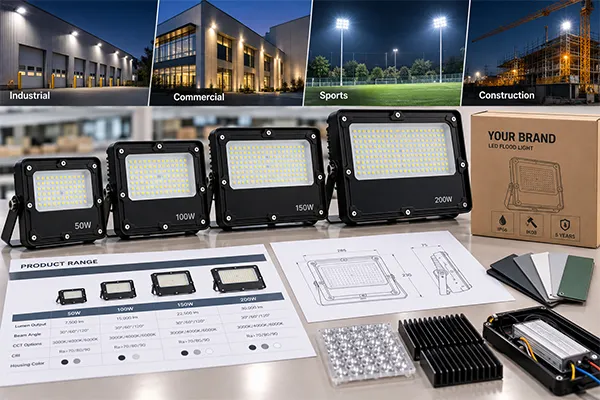
Meaningful differentiation in ODM LED flood light solutions comes from a coherent product proposition: the right configuration for a defined application, clear documentation, consistent visual identity, sensible installation features, and a specification level that fits the brand’s target price tier. The best differentiator is a product range that solves a recognizable buying problem better than nearby alternatives.
Define the Competitive Set First
Before choosing product features, I recommend that a brand identify the products it expects to compete against. The comparison does not need to be formal market research. It can begin with the existing products sold through the brand’s distributors, electrical channels, contractors, or online partners.
A practical competitive review can include:
- Common wattages and CCT options in the target range
- Typical price bands
- Housing styles and sizes
- Installation complaints or recurring return reasons
- Standard packaging and accessory expectations
- Available technical information
- Gaps in the current range
For example, a brand may find that many competing floodlights are visually similar and that channel partners struggle to explain the differences. In that situation, the better opportunity may be to create a simpler, more clearly segmented range rather than adding another near-identical model.
Build a Product Proposition, Not a Feature List
I suggest framing each range around a clear statement:
“This floodlight range is designed for [target user] who needs [application benefit] with [commercial or installation advantage].”
That statement can guide the product decisions. A contractor-oriented range may emphasize mounting practicality, accessible specifications, and reliable replenishment. A private-label distribution range may focus on consistent appearance, branded packaging, a rational wattage ladder, and predictable order handling. A premium architectural range may require more attention to finish, optical control, and visual presentation.
Here is a simplified example of how positioning can influence configuration:
| Product Position | Possible Priority | Avoidable Mistake |
|---|---|---|
| Value distribution range | Focused wattage selection and dependable standard specification | Adding expensive features with no channel demand |
| Contractor range | Installation practicality and clear technical information | Choosing cosmetic features over field usability |
| Brand premium line | Finish, product identity, and controlled configuration | Claiming premium status without supporting details |
| Project-focused range | Application-specific options and documentation planning | Treating every project request as a standard stock item |
I also encourage buyers to consider repeat supply. A differentiated product line must remain manageable after the launch order. The brand should ask how the supplier will handle approved specifications, artwork versions, component substitutions, and future reorder consistency.
At Upward Lighting, I work with global customers that include brands, importers, wholesalers, distributors, and project-related channel partners. I see long-term cooperation work best when both sides define the product role early and keep approved requirements traceable. A product range should be distinctive, but it should also be possible to reorder reliably.
What Should Brands Verify Before Selecting an ODM Supplier?
Supplier selection can become rushed when a product launch is approaching or an existing supplier has delivery or quality issues. That pressure can lead buyers to select based on a sample, a low quote, or a broad factory presentation. I recommend a structured review that tests whether the supplier can support the range over time.
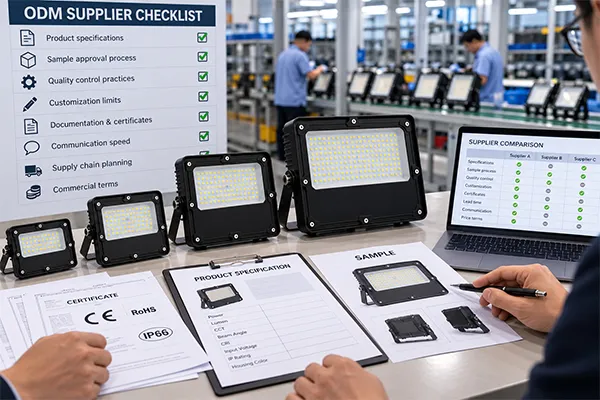
Before selecting an ODM partner, brands should verify product specifications, sample approval procedures, quality-control practices, customization limits, documentation availability, communication speed, supply-chain planning, and commercial terms. Buyers should also verify whether certifications and technical documents apply to their intended market, product configuration, and sales channel.
Review the Supplier’s Process, Not Only the Sample
A sample is important, but it is only one stage of the evaluation. Buyers should ask how the supplier moves from sample confirmation to repeat production. I have found that the following checklist helps teams identify gaps before placing a larger order.
ODM supplier qualification checklist
- Confirm the approved product specification and revision number.
- Confirm the bill-of-material assumptions for major components where appropriate.
- Ask how production changes are communicated and approved.
- Review the supplier’s aging and inspection process.
- Clarify packaging, labeling, manuals, and barcode requirements.
- Confirm small-batch order conditions and future MOQ expectations.
- Discuss standard and customized lead times separately.
- Ask what happens if a key material requires substitution.
- Request relevant certification documents for review.
- Verify market-specific compliance requirements with qualified professionals or relevant authorities.
Our products hold documents such as CE and RoHS certifications. However, I would always advise buyers to verify the relevant documents and assess their applicability to the destination market, product version, customer channel, and project requirement. Certifications should be reviewed as part of due diligence, not treated as automatic approval for every country or use case.10
Communication Is a Procurement Control
Fast quotation turnaround is valuable, but I think the quality of the questions behind the quote matters more. A supplier that asks about the application, intended market, packaging, and expected order plan may take a more disciplined approach than one that immediately promises every option.
I believe buyers should evaluate communication through practical indicators:
- Are questions answered clearly and consistently?
- Does the supplier identify assumptions in the quotation?
- Does the supplier explain the effect of custom changes?
- Are samples, drawings, and artwork approvals traceable?
- Can the supplier distinguish standard options from development work?
- Does the supplier respond constructively when specifications change?
These details often determine whether ODM LED flood light solutions become a stable product line or a recurring source of quality, delivery, and communication friction.
Frequently Asked Questions
What is the difference between OEM and ODM LED floodlights?
OEM usually focuses on producing a product under the buyer’s brand, often from an existing design or defined specification. ODM can involve more supplier input into product configuration and adaptation.11 In practice, buyers should confirm the exact scope because suppliers may use these terms differently.
Can I customize wattage, CCT, beam angle, and housing color?
Many ODM LED flood light solutions can support adjustments to wattage, color temperature, beam angle, CRI, surface finish, branding, and packaging. However, each change may affect pricing, MOQ, component sourcing, sampling, validation, or lead time. Buyers should request a written feasibility review.
Is the lowest LED floodlight quotation the best choice?
The lowest quotation may be suitable if it meets the required product specification and supply conditions. However, similar wattage and lumen claims do not confirm equivalent components, thermal design, quality controls, or customization support. Buyers should compare complete specifications and commercial assumptions.
What documents should I request from an LED floodlight ODM supplier?
I recommend requesting product specifications, drawings where relevant, sample approval records, packing details, labeling information, inspection-process details, and applicable certification documents. Buyers should verify that documents match the exact product configuration and their destination market requirements.
How can I reduce risk when changing floodlight suppliers?
A brand can reduce risk by approving samples against a documented specification, confirming packaging and artwork, discussing component-change control, placing a controlled initial order, and reviewing inspection requirements. A phased transfer is often more manageable than changing an entire range without validation.
Conclusion
Choosing ODM LED flood light solutions is not simply a price comparison or a search for the highest wattage claim. I believe the better decision comes from defining the application, product position, customization priorities, and repeat-supply expectations before requesting final quotes. Brands should compare suppliers through specification clarity, viable customization, quality-control processes, documentation, and communication discipline. If you are building or refreshing a private-label floodlight range, I invite you to share your application brief, target market, and product goals with Upward Lighting so we can discuss a practical ODM path.
"Lighting Specification Guidance for Schools", https://www.energy.gov/sites/default/files/2024-12/lighting-spec-guidance-school_nov24.pdf. Outdoor-lighting guidance recognizes that luminaire selection and layout should be matched to the visual task, installation geometry, environmental exposure, and required light distribution. Evidence role: general_support; source type: institution. Supports: Lighting-design guidance explaining that outdoor luminaire selection should account for the task, site conditions, mounting arrangement, and required light distribution.. Scope note: Such guidance supports the selection principle generally; it does not prescribe a single ODM product brief. ↩
"CBEA LED Site Lighting Performance Specification", https://www1.eere.energy.gov/buildings/publications/pdfs/alliances/led_site_lighting_spec_02_09.pdf. Outdoor luminaires may require protection appropriate to moisture, particulate ingress, corrosion, temperature conditions, and transient electrical surges present at the installation site. Evidence role: mechanism; source type: institution. Supports: Technical guidance describing how moisture, dust, corrosion, temperature, and electrical surges can affect outdoor lighting equipment and its design requirements.. Scope note: The applicable protection level depends on the specific site, electrical system, enclosure design, and governing standard. ↩
"Tools of the Trade: Site and Street Lighting", https://ies.org/lda/tools-of-the-trade-site-and-street-lighting-2/. Luminaire mounting arrangements influence mechanical support, aiming, wiring methods, and installation requirements, so mounting details should be evaluated for the intended application. Evidence role: mechanism; source type: institution. Supports: Electrical-safety or lighting-installation guidance showing that mounting arrangement affects luminaire support, aiming, wiring, and installation considerations.. Scope note: The exact design implications vary by luminaire weight, mounting surface, wind exposure, and local installation rules. ↩
"Part 31 - Contract Cost Principles and Procedures", https://www.acquisition.gov/far/part-31. Public-procurement guidance commonly distinguishes lowest initial price from evaluation against defined technical requirements and relevant whole-life cost considerations. Evidence role: general_support; source type: government. Supports: Procurement guidance stating that evaluations should compare defined requirements and relevant whole-life or total-cost factors rather than purchase price alone.. Scope note: This supports the procurement principle, not a determination that any particular floodlight quotation is unsuitable. ↩
"LED Luminaire Reliability: Impact of Color Shift", https://www.energy.gov/sites/prod/files/2017/04/f34/lsrc_colorshift_apr2017.pdf. LED performance and reliability are temperature-dependent; thermal management helps control junction temperature and can influence luminous output, color stability, and lumen maintenance. Evidence role: mechanism; source type: research. Supports: Research showing that LED junction temperature and thermal management influence light output, color behavior, and component reliability or lifetime.. Scope note: A general thermal-performance relationship does not establish the adequacy of a particular floodlight’s thermal design. ↩
"Lumen (unit)", https://en.wikipedia.org/wiki/Lumen_(unit). Luminous flux, electrical input power, and ingress-protection classification describe different properties of a luminaire and do not by themselves specify its complete optical, thermal, mechanical, or reliability performance. Evidence role: definition; source type: government. Supports: Authoritative definitions showing that lumens measure luminous flux, watts measure electrical power, and IP codes classify protection against ingress of solids and water.. ↩
"LED Color Characteristics", https://www.energy.gov/sites/prod/files/2016/08/f33/led-color-characteristics-factsheet.pdf. LED binning is used to classify manufactured LEDs by specified performance ranges, commonly including chromaticity and luminous-flux characteristics, and can affect consistency among luminaires. Evidence role: mechanism; source type: research. Supports: Research or laboratory guidance explaining that LED binning groups devices by characteristics such as chromaticity and luminous flux to manage product variation.. Scope note: Binning practices and their visible effect depend on the LED package, bin range, optical system, drive conditions, and production controls. ↩
"National strategy for ADVANCED MANUFACTURING", https://www.manufacturing.gov/sites/default/files/2022-10/FINAL%20National%20Strategy%20for%20Advanced%20Manufacturing%2010072022%20Approved%20for%20Release.pdf. Manufacturing product-development processes generally require prototype iteration, verification or validation, and production-readiness planning when changes alter a product’s structure, materials, optics, or electrical design. Evidence role: general_support; source type: government. Supports: Manufacturing-development guidance explaining that structural or engineering changes can require design iteration, prototypes, verification or validation, and production-tooling planning.. Scope note: Minimum order quantities, investment levels, and lead times are commercial terms that vary by supplier, process, and component availability. ↩
"Development of Functional Rapid Prototyping for the ...", https://scholarworks.uni.edu/cgi/viewcontent.cgi?article=4828&context=grp. Die-cast parts are produced using dedicated dies, and introducing a new housing typically entails tooling design, trial production, and part-approval activities before stable volume manufacture. Evidence role: mechanism; source type: education. Supports: Engineering or manufacturing material explaining that die casting uses dedicated tooling and that tool design, trial runs, and part approval are part of production preparation.. Scope note: The resulting cost and approval risk depend on part geometry, alloy, tool complexity, production volume, and supplier capability. ↩
"CE marking – obtaining the certificate, EU requirements", https://europa.eu/youreurope/business/product-rules-compliance/general-product-compliance/ce-marking/index_en.htm. Official conformity-assessment guidance indicates that compliance documentation and product marking must be assessed against the applicable legislation and the specific product placed on the relevant market. Evidence role: expert_consensus; source type: government. Supports: Official market-access guidance explaining that conformity documentation and marking obligations depend on applicable legislation, product scope, and the responsible economic operator.. Scope note: This is not legal advice; applicable obligations vary by jurisdiction, product configuration, intended use, and route to market. ↩
"Original design manufacturer", https://en.wikipedia.org/wiki/Original_design_manufacturer. OEM and ODM are commonly used manufacturing terms: OEM arrangements generally concern production to another party’s specification or brand, whereas ODM arrangements commonly include supplier-developed product design marketed by the buyer. Evidence role: definition; source type: encyclopedia. Supports: Neutral definitions distinguishing an original equipment manufacturer from an original design manufacturer and describing the latter's role in designing products for another company to market.. Scope note: Industry usage is not legally uniform, so the parties’ contract and approved specification should define the actual scope of design responsibility. ↩