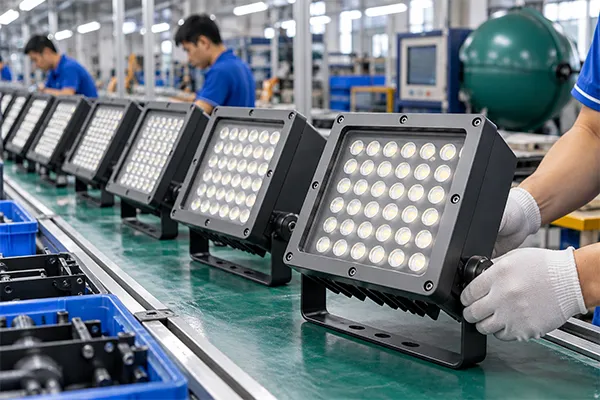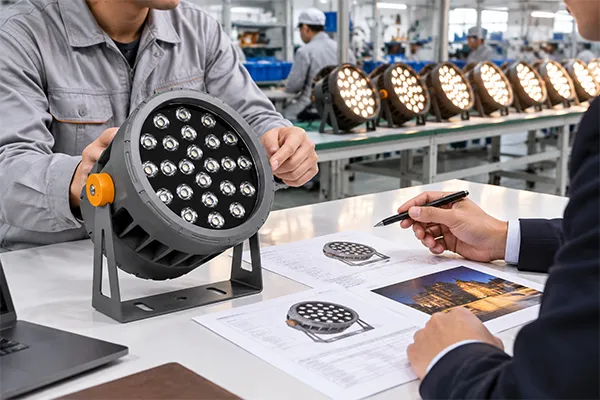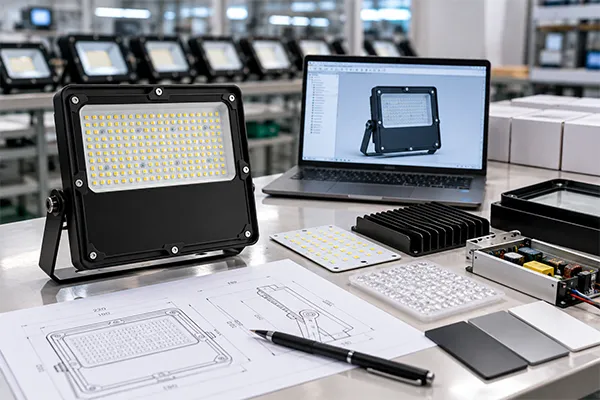

Wholesale LED flood lights can look easy to source because many suppliers offer similar wattages, housings, and quoted prices. However, a low unit price can hide batch inconsistency, unclear certification documents, delayed replenishment, and expensive after-sales work. I believe buyers need a practical supplier-evaluation process before placing a meaningful order.
Wholesale LED flood lights should be selected through a staged supplier review: screen the supplier’s communication and documentation, approve a representative sample, and confirm production, customization, quality-control, and delivery details before ordering. The best supplier is not necessarily the cheapest, largest, or factory-direct option; it is the supplier whose commitments can be verified against your resale, project, and replenishment needs.
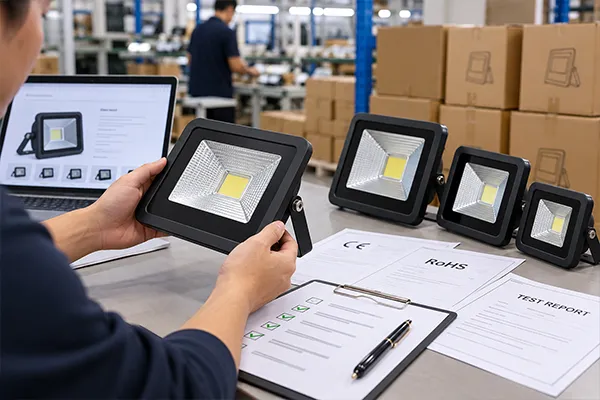
I have worked with importers, contractors, distributors, and local lighting brands that ask many of the same questions before purchasing. They want competitive pricing, but they also need stable specifications and responsive support. The sections below explain how I would turn those concerns into a repeatable procurement checklist.
Why Is the Lowest Price for Wholesale LED Flood Lights Not Always the Best Value?
A low quotation for wholesale LED flood lights can be attractive when buyers are managing tight project budgets or competing resale margins. Yet price differences often create uncertainty when the quoted configuration, component selection, packaging, or delivery scope is not fully defined. I recommend looking beyond the initial unit cost.
The lowest wholesale LED flood lights price is not always the lowest total procurement cost.1 Buyers should compare the full commercial scope, including confirmed specifications, sample consistency, packaging, lead time, spare-part policy, shipment coordination, and the supplier’s ability to support repeat orders. A slightly higher unit quote may reduce operational risk when it includes clearer controls.
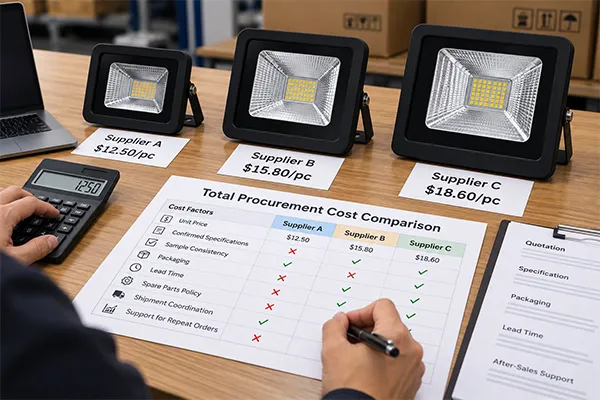
Compare Total Procurement Cost, Not Only EXW Price
I often see buyers begin with one question: “What is your best price?” That question is reasonable, but I find that it works best when followed by more specific questions. A quote only becomes comparable when each supplier is pricing the same product, the same order conditions, and the same delivery basis.
For example, two 100W LED flood lights may have similar appearance but differ in2:
- LED chip brand or binning approach
- Driver model, input-voltage range, and surge-protection specification
- Housing thickness and thermal design
- Cable length, plug type, and terminal configuration
- IP rating test approach and gasket design
- Color temperature and beam-angle availability
- Outer carton strength and pallet requirements
- Warranty wording and after-sales response procedure
A lower price is not automatically a warning sign. Some suppliers have lower overhead, better component purchasing, simpler product ranges, or more efficient production planning. I would not reject a supplier solely because it offers a low quote. Instead, I would ask what is included and what may change between sample approval and mass production.
| Procurement cost area | Question I recommend asking | Risk if it is unclear |
|---|---|---|
| Unit price | Does the quote cover the exact wattage, CCT, beam angle, cable, and finish? | Buyers may compare unlike products |
| Packaging | Is export carton, inner protection, and label printing included? | Damage or added packing cost |
| Quality process | What inspections occur before shipment? | Greater uncertainty about batch consistency |
| Lead time | Does lead time start after deposit, artwork approval, or material confirmation? | Delivery planning becomes difficult |
| Replenishment | Can the supplier repeat the approved configuration? | Future batches may vary |
| Shipping support | Can the supplier coordinate labeling, consolidation, or forwarder handover? | More logistics friction |
Make the Quote Scope Visible
I recommend asking every shortlisted supplier for a written quotation scope. This document does not need to be complicated. It should state the product model, wattage, CCT, voltage, beam angle, finish, quantity, trade term, packing details, lead time, and payment terms.
When I prepare a quotation, I know buyers often need a fast response. Still, fast quotation should not mean vague quotation. A fast but incomplete price can create confusion later, especially when a buyer needs custom labels, a specific carton design, or small-batch mixed quantities.
In my experience, the most useful quote is not the shortest quote. It is the quote that gives a purchasing team enough detail to compare suppliers fairly.
A buyer should also ask whether quoted pricing depends on raw-material movement, component availability, or minimum order quantity. That does not mean the supplier is unreliable. It simply allows the buyer to plan for real purchasing conditions rather than assume that a preliminary price will remain unchanged indefinitely.
Which Wholesale LED Flood Light Specifications Should Buyers Verify Before Ordering?
Many buyers receive product sheets full of wattage, lumen output, IP ratings, and dimensions. Those specifications matter, but I do not think a generic data sheet is enough for supplier selection. Buyers should connect each requested parameter to a confirmation method, a sample, and a production commitment.
Buyers should verify wholesale LED flood light specifications by confirming the exact requested configuration in writing, reviewing a representative sample where practical, and documenting the approved parameters for mass production. Wattage, CCT, beam angle, CRI, voltage, finish, cable, and packaging should be treated as sourcing controls rather than marketing descriptions.
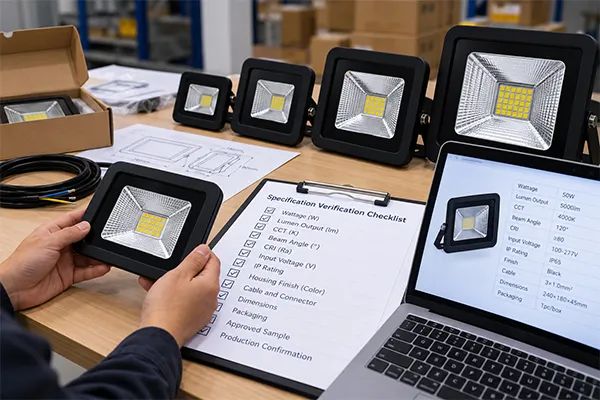
Ask How the Configuration Will Be Controlled
I regularly receive pre-sales questions such as, “Can you provide 3000K instead of 6500K?” or “Can we use our own brand label?” These are not minor questions. Every requested variation can affect material planning, production instructions, sample preparation, lead time, and future repeat orders.
At Upward Lighting, we can discuss configurable parameters such as color temperature, wattage, beam angle, CRI, and surface finish colors for OEM and ODM requirements. However, I would always encourage buyers to verify what a supplier can actually produce for the requested model and order quantity. A supplier’s general customization list is not the same as confirmation for your particular purchase order.
Use a Configuration Approval Sheet
I recommend creating a short configuration approval sheet before mass production. This sheet can be attached to the purchase order and used by both the buyer and supplier.
| Parameter | What buyers should confirm | Why it affects procurement risk |
|---|---|---|
| Wattage | Rated wattage, power tolerance, and product label wording | Prevents incorrect market positioning or project mismatch |
| CCT | Required color temperature, tolerance expectation, and sample reference | Helps reduce visual inconsistency across installations |
| Beam angle | Beam distribution requirement and available optic | Affects illumination planning and application suitability |
| CRI | Minimum required CRI and how it is specified | Supports product positioning and project requirements |
| Input voltage | Required voltage range and frequency | Helps align products with destination use conditions |
| IP rating | Declared rating, construction details, and available test documentation | Supports due diligence for outdoor applications |
| Finish color | Powder-coat or surface-finish requirement | Important for brand presentation and site aesthetics |
| Cable and plug | Cable length, conductor requirement, plug type, or terminal | Avoids installation changes after delivery |
| Branding | Logo, label, carton artwork, manuals, and barcode | Supports channel and private-label requirements |
Review Samples as Purchasing Evidence
A sample is valuable, but I do not view it as automatic proof that every future unit will be identical. A sample is one stage of verification.3 The buyer should check that the sample matches the final written requirements and should record any changes requested before approving it.
For application-specific decisions, I recommend that buyers involve a qualified lighting designer, electrical engineer, or project technical lead. A flood light that appears suitable from a catalogue may not meet the actual lighting layout, mounting height, glare control, electrical protection, or local installation requirements.4
During sample review, I would encourage buyers to inspect:
- Product labeling: Does the label show the agreed model, voltage, wattage, and branding?
- Housing and finish: Does the surface appearance meet the expected quality level?
- Cable and mounting bracket: Are the practical installation details suitable for the application?
- Light appearance: Does the CCT look appropriate compared with the approved reference?
- Packaging: Does the carton provide adequate protection and match agreed branding?
- Documentation: Do the supplied documents correspond to the model being evaluated?
This approach gives the buyer a clearer basis for approving a supplier of wholesale LED flood lights, rather than relying only on a product image or a broad catalogue description.
How Should Buyers Evaluate Wholesale LED Flood Lights Quality Control?
Quality claims are common in LED lighting procurement. Terms such as “strict QC,” “high quality,” and “100% tested” can be useful starting points, but I believe buyers should ask what those claims mean in practice. A quality process is more meaningful when the supplier can explain its stages and records.
Buyers should evaluate wholesale LED flood lights quality control by asking how incoming materials, assembly, aging, functional testing, appearance inspection, and pre-shipment checks are handled. Aging tests and certification labels are not universal guarantees; buyers should verify the process, the documents, and the relevance of each control to their order.
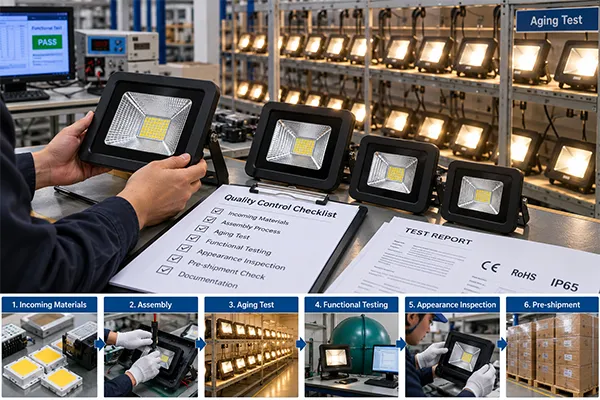
Turn Quality Claims Into Verifiable Questions
At our facility, every product undergoes a 100% aging test before shipment, generally lasting between 4 and 8 hours, depending on the product and production arrangement. I describe this as part of our normal workflow, not as a universal guarantee of field performance. Buyers should ask any supplier what its aging process includes, how long it lasts, and whether it applies to the exact model being quoted.
The purpose of an aging test is generally to identify some early functional issues before shipment.5 However, it does not replace component control, assembly inspection, electrical testing, packaging checks, or proper product selection for the final application.6
I suggest that buyers ask questions such as:
- Does the supplier inspect incoming LED chips, drivers, housings, and cables?
- Is the product tested after assembly for basic function?
- Is every unit aged, or is aging based on sampling?
- What is the normal aging duration for this model?
- Does the supplier inspect labels, finish, screws, brackets, and cables?
- Is there a final pre-shipment inspection before packing or loading?
- Can the supplier share relevant inspection records for the order, where appropriate?
- How does the supplier manage nonconforming products found during production?
Review Certifications as Documents, Not Just Logos
CE and RoHS are often requested by buyers sourcing for international markets.7 At Upward Lighting, our products hold CE and RoHS certifications that support market-entry documentation requirements in many purchasing discussions. However, I always recommend that buyers verify documents carefully for their destination market, product model, and intended sales channel.
A logo printed on a carton, label, or catalogue page is not enough for responsible procurement.8 Buyers should request documentation and confirm whether the documents correspond to the exact model or product family. They should also consult qualified compliance professionals when a project, tender, or destination market has specific legal or technical requirements.
Evaluate Consistency Across Repeat Orders
The more important quality question for many wholesalers is not only “Is this sample acceptable?” It is “Can the supplier repeat this approved version six months later?”
This is where production coordination matters. A supplier should be able to identify the approved model, configuration, labeling, and packaging requirements for reorders. Buyers should ask how the supplier records custom requirements and what happens if a component needs to be changed because of availability.
I find that transparent communication is more valuable than unrealistic promises. If a driver, LED package, or packaging material changes, a reliable supplier should discuss the impact before production rather than make an unannounced substitution.9
What Delivery and Reorder Questions Should Buyers Ask a Supplier?
A suitable flood light can still create commercial problems if the supplier cannot coordinate production timing, labeling, packing, and shipment handover. I have seen that importers and distributors often need more than a production date. They need information they can use for inventory planning, customer commitments, and freight booking.
Buyers should assess delivery capability by confirming lead-time triggers, MOQ flexibility, production capacity for the required configuration, packaging readiness, inspection timing, and shipment coordination. For wholesale LED flood lights, repeat-order support and clear communication are often as important as the first shipment date.

Clarify What “Lead Time” Means
I recommend asking suppliers to define their lead time precisely. Some suppliers count lead time from deposit receipt. Others begin after sample approval, artwork confirmation, component confirmation, or final purchase-order approval. None of these approaches is inherently wrong, but the buyer needs to understand the starting point.
A realistic delivery plan should include the following stages:
- Product specification and quotation confirmation
- Sample approval, if required
- Artwork approval for labels, cartons, or manuals
- Deposit or payment confirmation
- Material preparation and production scheduling
- Assembly, aging, and inspection
- Final packing and buyer inspection, if arranged
- Forwarder handover, container loading, or collection
I often advise buyers to build time buffers around artwork approvals and shipping bookings. These steps can affect the delivery schedule even when factory production itself is moving smoothly.
Consider Small Batches and Mixed Orders
Small-batch orders are useful for new market testing, pilot projects, and private-label launches. They can also be more difficult to coordinate because custom components, labels, or packaging may have higher minimums than the finished products themselves.10
At Upward Lighting, we support small-batch orders where practical, and we discuss customization based on the actual product and order conditions. Buyers should still ask suppliers about the MOQ for each element, including:
- Standard product quantity
- Custom CCT or wattage quantity
- Custom color finish quantity
- Private-label logo quantity
- Printed carton or manual quantity
- Mixed-model order requirements
This detail helps buyers avoid a common issue: the product MOQ may be manageable, but customized packaging may require a much larger run.
Assess Supplier Communication Before You Need Urgent Help
I think pre-sales communication is one of the best indicators buyers can observe before placing an order. A supplier does not need to answer every question instantly, but the supplier should answer clearly, identify missing information, and explain realistic next steps.
In our daily conversations, buyers often ask for rapid quotations, specification adjustments, shipping support, and photos before shipment. These requests are normal. A supplier’s response should show whether its sales and production teams can coordinate internally.
I recommend tracking the following during supplier evaluation:
| Supplier behavior | What it may indicate |
|---|---|
| Clear answers with model-specific details | Better quotation and production traceability |
| Willingness to clarify unknowns | More transparent communication |
| Consistent follow-up on samples and artwork | Stronger order coordination |
| Written confirmation of changes | Lower risk of misunderstanding |
| Realistic production schedules | More useful planning information |
| Responsive support after quotation | Better indication of future collaboration potential |
I believe a supplier relationship should become easier after the first order, not more confusing. Clear records and consistent communication create that foundation.
Frequently Asked Questions
What should I ask before requesting a wholesale LED flood lights quotation?
I recommend that buyers provide the target wattage, CCT, voltage, quantity, beam angle, IP requirement, destination market, branding needs, and preferred trade term. Buyers should also ask for packing details, lead time, MOQ, available documents, sample options, and the process for approving custom configurations.
Is a factory always a better choice than a trading company?
A factory is not automatically the best choice, and a trading company is not automatically less reliable. Buyers should evaluate product knowledge, quality controls, response speed, documentation, customization support, price transparency, and delivery coordination. The right option depends on the buyer’s product range and procurement requirements.
Does a 100% aging test guarantee LED flood light quality?
A 100% aging test can be an important quality-control step because it may identify certain early functional issues before shipment.11 However, it does not guarantee long-term performance or application suitability. Buyers should also review component control, assembly checks, inspection procedures, documentation, and sample consistency.
How can I verify CE and RoHS documents for LED flood lights?
Buyers should request the relevant documents and check whether they apply to the specific product model or product family being purchased. Buyers should verify names, model numbers, issuing parties, dates, and destination-market requirements.12 For market-specific compliance decisions, I recommend consulting qualified regulatory or testing professionals.
Can I order customized LED flood lights in small quantities?
Small-batch customization may be possible, but it depends on the requested product and custom elements. A supplier may support low product quantities while requiring higher minimums for printed cartons, special finishes, labels, or nonstandard components. Buyers should confirm MOQ for every customization item before approving the order.
Conclusion
Selecting wholesale LED flood lights is a procurement-risk decision, not simply a search for the lowest unit price. I recommend that buyers compare complete quotation scopes, verify configuration controls, review samples and documents, understand quality workflows, and confirm delivery planning before production begins. A dependable supplier relationship is built through evidence, clear records, and responsive coordination. If you are sourcing LED flood lights with OEM, ODM, private-label, or small-batch requirements, I invite you to contact Upward Lighting for a detailed quotation and configuration discussion.
"A data-driven life cycle cost model for tender evaluation ... - PMC", https://pmc.ncbi.nlm.nih.gov/articles/PMC12988185/. Total-cost-of-ownership approaches assess purchasing decisions using costs beyond the initial price, including operating, maintenance, logistics, and risk-related costs. Evidence role: general_support; source type: institution. Supports: Procurement guidance recognizing that purchase price is only one element of total cost and that operating, quality, logistics, and risk considerations can affect value.. Scope note: Such guidance establishes a procurement principle; it does not quantify the cost difference for a particular LED flood-light order. ↩
"Impact of Thermal Dissipation on the Lighting Performance ...", https://pmc.ncbi.nlm.nih.gov/articles/PMC8776062/. LED luminaires are system products whose light output, distribution, efficiency, and reliability are influenced by the LED package, driver, optics, and thermal design in addition to rated input power. Evidence role: mechanism; source type: government. Supports: LED luminaire performance and reliability depend on system-level factors such as the driver, LEDs, optics, thermal management, and mechanical construction, not wattage alone.. Scope note: This supports the technical non-equivalence of same-wattage products, not the quality of any particular supplier's flood light. ↩
"6.2.2.2. Choosing a Sampling Plan with a given OC Curve", https://www.itl.nist.gov/div898/handbook/pmc/section2/pmc222.htm. Acceptance sampling is a statistical inspection method for assessing lots or processes; approval of a sample does not by itself establish conformance of every unit subsequently produced. Evidence role: general_support; source type: government. Supports: Acceptance sampling and sample inspection provide information about a lot or process but do not guarantee that every unit in continuing production conforms.. Scope note: Sampling standards address inspection logic generally and do not prescribe the contractual sample-approval process for LED flood lights. ↩
"Understanding Fixture Design Tools", https://www1.eere.energy.gov/buildings/publications/pdfs/ssl/bair_msslc-boston2012.pdf. Outdoor-lighting design guidance evaluates luminaires in relation to photometry, mounting geometry, glare, illuminance needs, and applicable installation requirements rather than catalogue appearance alone. Evidence role: general_support; source type: government. Supports: Outdoor-lighting suitability requires application-specific design considerations, including photometric distribution, mounting conditions, glare, and applicable electrical requirements.. Scope note: Design guidance cannot determine compliance or performance for a specific site without a project-specific lighting and electrical assessment. ↩
"A Methodology for Testing", https://nvlpubs.nist.gov/nistpubs/Legacy/IR/nbsir76-1157.pdf. Burn-in is a reliability-screening practice intended to precipitate certain early-life failures or latent defects before products enter service. Evidence role: mechanism; source type: research. Supports: Burn-in testing is used in electronics reliability practice to expose some early-life or latent defects under defined operating conditions.. Scope note: Its effectiveness depends on the test profile, duration, stresses, failure mechanisms, and manufacturing process; it cannot demonstrate long-term reliability by itself. ↩
"A Methodology for Testing", https://nvlpubs.nist.gov/nistpubs/Legacy/IR/nbsir76-1157.pdf. Reliability screening such as burn-in is normally used alongside, rather than in place of, controlled materials, manufacturing-process inspection, functional testing, and requirements verification. Evidence role: expert_consensus; source type: research. Supports: Reliability screening is one control within a broader quality system that also includes process control, inspection, testing, and verification of requirements.. Scope note: The relative importance and test methods for these controls depend on the product design, production process, and intended application. ↩
"CE marking", https://en.wikipedia.org/wiki/CE_marking. For applicable electrical and electronic equipment placed on the European Union market, CE marking and compliance with the Restriction of Hazardous Substances framework may be relevant legal requirements. Evidence role: historical_context; source type: government. Supports: CE marking and the RoHS framework are relevant regulatory concepts for applicable electrical and electronic equipment placed on the EU market.. Scope note: Requirements vary by product category, economic operator, and destination; CE and RoHS are not universal certifications for all international markets. ↩
"Preparing technical documentation - Your Europe", https://europa.eu/youreurope/business/product-rules-compliance/general-product-compliance/preparing-technical-documentation/index_en.htm. CE marking is supported by the applicable conformity-assessment process, EU declaration of conformity, and technical documentation; the mark alone does not establish that those underlying obligations have been met. Evidence role: definition; source type: government. Supports: CE marking is associated with a manufacturer's conformity-assessment obligations and supporting documentation, rather than functioning as an independently issued product certificate displayed by a logo.. Scope note: The documentation and assessment route depend on the applicable EU legislation and product category. ↩
"configuration management - Glossary", https://csrc.nist.gov/glossary/term/configuration_management. Quality-management practice treats changes to product specifications, materials, and production processes as controlled changes that should be reviewed for their effects and documented appropriately. Evidence role: general_support; source type: institution. Supports: Quality-management and configuration-management practices require planned, controlled changes and retention of information needed to assess their effects.. Scope note: General quality-system guidance does not establish that every component or packaging change requires buyer approval under every commercial contract. ↩
"(PDF) THE EFFECT OF APPLYING THE ECONOMIC ORDER ...", https://www.academia.edu/19832792/THE_EFFECT_OF_APPLYING_THE_ECONOMIC_ORDER_QUANTITY_MODEL_IN_THE_FIELD_OF_INVENTORY. Operations-management research explains that minimum-order quantities may reflect setup costs, batch-production economics, and inventory constraints, which can apply separately to customized inputs such as printed packaging and labels. Evidence role: mechanism; source type: paper. Supports: Minimum-order quantities can arise from supplier setup costs, production batch economics, and inventory considerations for customized materials.. Scope note: The specific minimums for labels, cartons, finishes, or components are determined by the individual supplier and production method. ↩
"II Defects: Physical Imperfections", https://web.ece.ucsb.edu/~parhami/docs_folder/f33-book-dep-comp-pt2.pdf. When applied to each unit, burn-in screening can identify certain defects that manifest during the specified operating interval before shipment. Evidence role: mechanism; source type: research. Supports: Unit-by-unit burn-in or screening can detect some failures that manifest during the defined test interval before delivery.. Scope note: A 100% test rate does not establish that all failure modes are detectable or that the products will meet a particular service-life expectation. ↩
"Signing an EU declaration of conformity - Your Europe", https://europa.eu/youreurope/business/product-rules-compliance/general-product-compliance/signing-declaration-conformity/index_en.htm. Conformity documentation for applicable EU product rules identifies the product and responsible economic operator and declares conformity with the relevant legislation, so product-specific identification and legal applicability should be checked. Evidence role: definition; source type: government. Supports: EU conformity documentation identifies the product and responsible manufacturer and is tied to the applicable legislation and conformity declaration.. Scope note: Document formats and mandatory content vary across regulatory regimes, and destination-market requirements may extend beyond EU CE and RoHS obligations. ↩