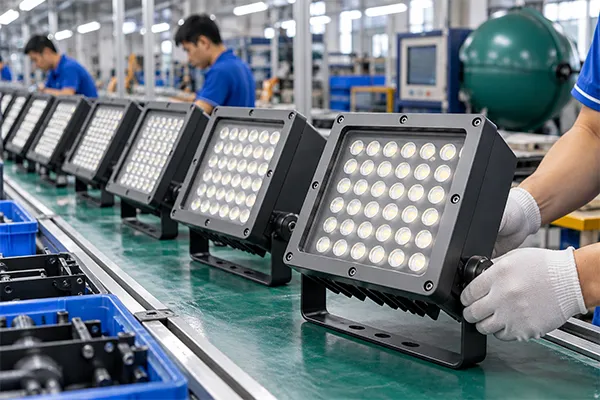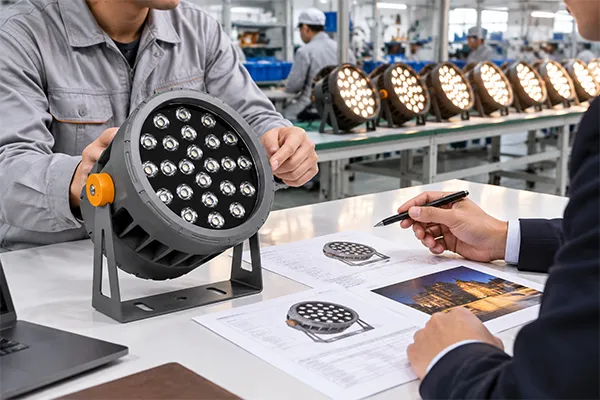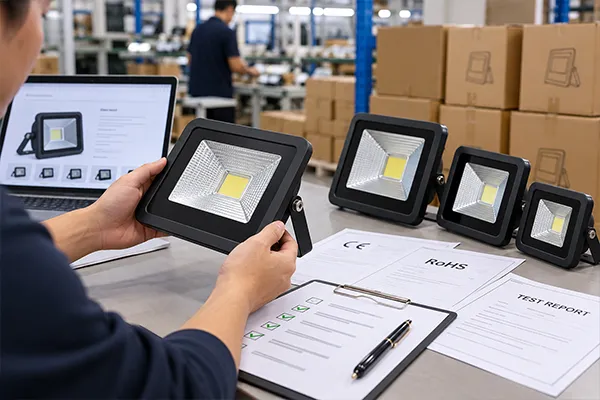

LED flood lights from China can look easy to source when dozens of suppliers offer similar wattage, photos, and prices. However, a low quote can quickly become expensive if the lights do not match the installation environment, arrive with inconsistent specifications, or create replacement work. I recommend defining the application and full product configuration before comparing suppliers.
Importers should buy LED flood lights from China only after they define the intended application, installation conditions, technical specifications, compliance documents, packaging needs, and order expectations. A comparable quotation should cover more than wattage and price. Buyers should also assess whether a supplier can explain trade-offs, document the agreed configuration, conduct relevant quality checks, and support repeat orders consistently.
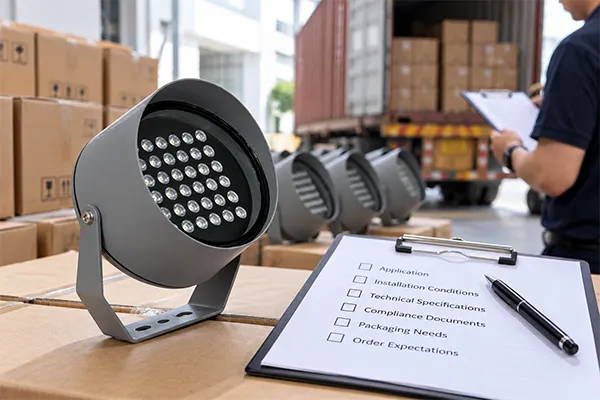
In my work with export inquiries, I often see buyers begin with a simple request: “Please quote 100W LED floodlight.” That request is a useful starting point, but it is not enough for a sound procurement decision. The same stated wattage can represent very different products, materials, light distributions, and commercial risks.
Why Is a Simple Price Quote for LED Flood Lights from China Not Enough?
A basic price quote for LED flood lights from China can create a false sense of certainty. Importers may compare two prices that appear to cover the same product, only to discover later that the beam angle, driver quality, housing design, cable length, or packaging is different. The result can be margin pressure, complaints, or project delays.
A price quote is only comparable when each supplier quotes the same written configuration.1 Importers should compare application requirements, wattage, lumen target, beam angle, input voltage, IP rating2, materials, driver specification, color temperature, documents, packaging, and order terms. A lower price may reflect a different product configuration rather than better purchasing value.
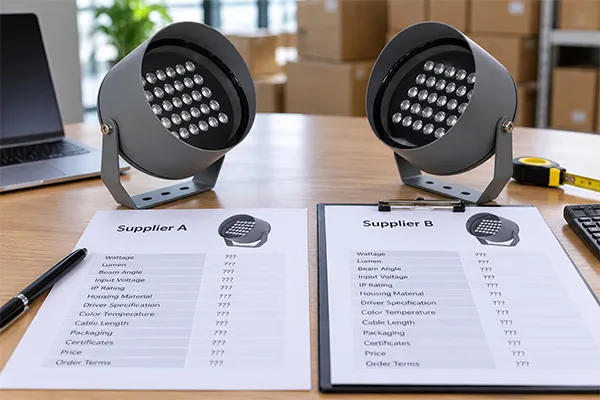
A wattage label does not define the whole product
Wattage is important because it affects energy consumption and can influence light output. However, wattage alone does not tell me whether a flood light will perform well in a warehouse yard, construction site, façade installation, parking area, sports court, or retail channel.
When I review an inquiry, I need to understand what the buyer expects the light to do. A 100W unit may be selected for its nominal power, but the project may actually need a particular lighting level across a certain mounting height and area. In that case, the beam angle, optical distribution, lumen output, mounting position, and spacing can matter more than the number printed on the carton.3
A meaningful quotation should identify the product in enough detail that the buyer can compare it against another offer.
| Quote Item | Why It Matters to Importers | Question to Ask |
|---|---|---|
| Wattage | Indicates nominal power consumption | What is the actual rated power? |
| Lumen output | Supports lighting-design evaluation | What is the stated lumen output and test basis? |
| Beam angle | Affects coverage and glare | Is 60°, 90°, 120°, or asymmetric distribution required? |
| Color temperature | Changes visual appearance | Is 3000K, 4000K, 5000K, or 6500K suitable? |
| Input voltage | Must match the local electrical system | Is the product suitable for 100–277V, 220–240V, or another range? |
| IP rating | Relates to environmental protection | Does the planned installation need IP65, IP66, or another level? |
| Cable and plug | Can affect installation time | What cable length, plug, and wire specification are required? |
| Packaging | Affects damage risk and branding | Is retail packaging, neutral packaging, or OEM artwork needed? |
The lowest price may represent omitted requirements
I have seen buyers request a “best price” before confirming even the basic sales terms. A supplier may respond quickly with a low number, but that number can exclude details the buyer assumed were included. For example, it may be based on:
- A different LED driver configuration
- A lower-cost housing or thinner aluminum body
- A standard cable rather than the required cable length
- Neutral carton packaging instead of branded packaging
- A different color temperature or beam angle
- A lower IP-rated configuration
- Different inspection, sampling, or spare-parts expectations
- A different Incoterm, such as EXW rather than FOB
The issue is not that a lower-cost option is always unsuitable. Many channel buyers need an entry-level product for a defined market segment. The issue is whether the product is deliberately specified and transparently quoted.
I advise buyers to treat a quotation as a configuration document, not merely a price list.
Before selecting among LED flood lights from China, I recommend asking every shortlisted supplier to quote against the same specification sheet. This process takes more time at the beginning, but it can prevent much larger costs after production or delivery.
Which Specifications Should Importers Confirm Before Buying LED Flood Lights from China?
Importers often face uncertainty because LED flood lights from China can share similar external designs while using different internal components and production standards. If buyers leave key specifications open, suppliers may interpret requirements differently. This can make samples, production orders, and future repeat orders difficult to control.
Before buying LED flood lights from China, importers should confirm the application, mounting method, installation environment, wattage, beam angle, color temperature, voltage, ingress-protection requirement, light-output target, cable details, packaging, labeling, and required market documents. These details should be recorded in a quotation, product specification, or approved sample record before mass production.
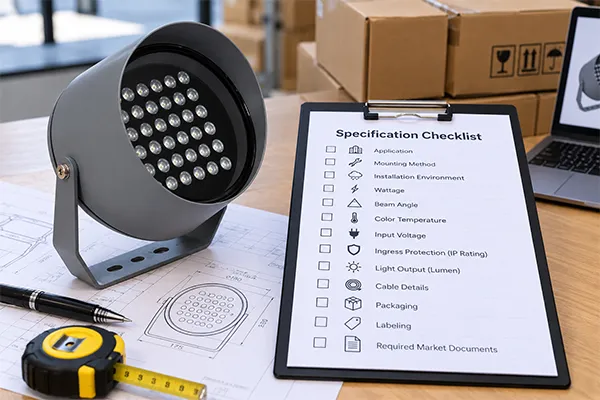
Start with the installation, not the catalog photo
The best product choice usually starts with the use case. I ask buyers where the flood light will be installed, how high it will be mounted, what it needs to illuminate, and what environmental conditions it will face.
For example, a flood light for a sheltered building entrance may not need the same configuration as one installed in a coastal area, on an exposed pole, or near heavy dust and rain.4 An outdoor sports or yard project may require different beam control from a signboard or façade application.
Buyers should prepare a short project brief before requesting quotations:
- Application: What is being illuminated?
- Installation location: Indoor, outdoor, covered, exposed, coastal, industrial, or dusty?
- Mounting height and position: Wall, bracket, pole, ground, truss, or façade?
- Target lighting effect: Wide-area coverage, concentrated projection, uniform illumination, or accent lighting?
- Electrical conditions: Local voltage, frequency, wiring method, plug requirements, and surge-protection expectations.
- Commercial model: Project delivery, wholesale stock, e-commerce, distribution, or private-label resale?
- Order profile: Sample quantity, trial order, forecast volume, repeat-order potential, and requested delivery period.
Build a practical technical specification
A complete specification does not need to be excessively complex. It does need to remove ambiguity. I find that a one-page document can be enough for many standard products if it covers the right information.
| Specification Area | Example Buyer Requirement | Procurement Value |
|---|---|---|
| Product type | Outdoor LED flood light with adjustable bracket | Defines the base construction |
| Rated wattage | 50W, 100W, or 150W | Supports energy and price comparison |
| CCT | 4000K or 5000K | Keeps batch appearance consistent |
| Beam angle | 90° or 120° | Matches coverage needs |
| CRI | Minimum requested CRI | Supports visual-quality expectations |
| Housing finish | Black, gray, or custom color | Supports project or brand requirements |
| IP requirement | IP65 or project-specific requirement | Addresses environmental exposure |
| Input voltage | 220–240V or 100–277V | Prevents market mismatch |
| Cable | Required length and plug type | Reduces installation changes |
| Branding | Logo, label, carton artwork | Supports OEM or private-label sales |
| Documents | Required test reports and declarations | Supports market-entry review |
Verify documents for the intended market
Certifications and declarations are important, but buyers should avoid treating any single document as universal approval. CE, RoHS, and related documents may be relevant to certain market requirements5, but the exact obligation can depend on the country, product configuration, importer role, application, and project specification.
At Upward Lighting, we can provide product documentation such as CE and RoHS-related materials for applicable products. However, I encourage buyers to verify that the documents correspond to the exact model, electrical configuration, destination market, and required standards. A qualified compliance professional or local testing partner can help where the application has specific legal, safety, or tender requirements.
How Can Importers Evaluate Quality and Consistency in LED Flood Lights from China?
Quality concerns can make first-time importers nervous, especially when they cannot visit every factory or inspect every shipment personally. The risk becomes greater when buyers rely only on supplier photos, broad claims, or a single sample. A more useful approach is to evaluate the quality-control process and define measurable acceptance criteria.
Importers can evaluate LED flood lights from China by reviewing samples, approved specifications, component information, production controls, aging-test procedures, inspection records, packaging standards, and pre-shipment checks. These steps can reduce procurement risk and support consistency, but they cannot guarantee zero defects or identical performance in every installation.
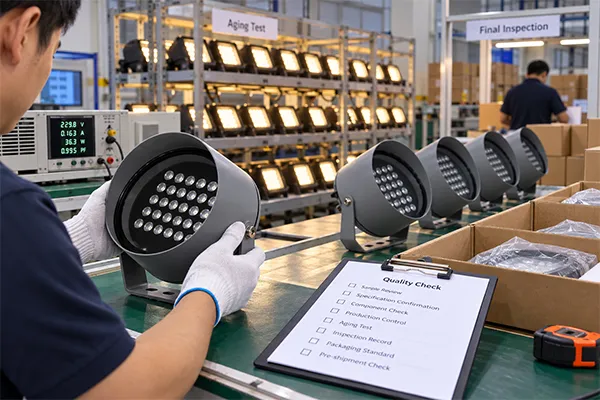
Look beyond visual appearance
A sample can show whether the exterior appearance, bracket design, finish color, labeling, and basic operation match expectations. However, a sample alone does not fully prove future batch consistency.6 Buyers should use the sample as one part of a wider approval process.
I recommend that buyers inspect or ask about the following areas:
- Housing and heat dissipation: Is the housing suitable for the requested power level and installation environment?
- Lens and sealing design: Are visible seals, screws, and cable-entry areas appropriate for the stated ingress-protection design?
- LED light source and driver: What component configuration is specified, and can it be kept consistent for repeat orders?
- Cable and connector details: Do cable length, gauge, plug type, and strain relief meet the buyer’s installation needs?
- Bracket and mounting hardware: Does the bracket support the planned mounting method?
- Marking and labels: Are model numbers, voltage details, branding, and required labels correctly stated?
- Carton protection: Can the packaging reduce reasonable transport damage risk?
Understand the role of aging tests
At our factory, each product undergoes a 100% aging test before shipment, normally lasting between 4 and 8 hours. This process is part of our internal quality-control workflow. It helps us check whether products operate during the defined test period and supports a basic consistency check before packing.
Still, I do not present aging as proof that a product will never fail. An aging test does not remove every possible risk related to transport, installation quality, local voltage conditions, ambient temperature, moisture exposure, surge events, or long-term use.7 Buyers should view it as one control within a broader quality process.
Use a written inspection plan
For larger orders or project-sensitive deliveries, buyers can use an inspection plan before production begins. The plan should state what will be checked, how many units will be sampled where applicable, and what constitutes an acceptable result.
| Inspection Stage | Typical Review Points | Buyer Benefit |
|---|---|---|
| Pre-production | Approved sample, labels, packaging artwork, specifications | Avoids misunderstandings before assembly |
| During production | Material appearance, assembly consistency, order identification | Identifies issues before final packing |
| Aging test | Product operation over the defined internal test period | Supports functional screening |
| Pre-shipment inspection | Quantity, appearance, labeling, packaging, selected functional checks | Confirms shipment against agreed requirements |
| Loading review | Carton condition and shipping marks | Helps reduce dispatch errors |
I have found that buyers receive better results when they state their acceptance criteria early. A supplier can respond more effectively when the buyer clearly explains which points are essential for resale, tender submission, or project handover.
What Should Buyers Ask a Chinese LED Flood Light Supplier Before Ordering?
A supplier relationship can become difficult when the supplier simply answers “yes” to every request without asking follow-up questions. Buyers may receive a fast quote, but they may not receive guidance on whether the selected configuration fits the application. Good supplier evaluation focuses on communication quality as well as price and product range.
Before placing an order, buyers should ask a Chinese LED flood light supplier how it clarifies applications, controls specifications, manages samples, handles customization, performs testing, documents inspections, protects packaging, and supports repeat orders. A capable supplier should explain trade-offs and put the agreed configuration into writing.
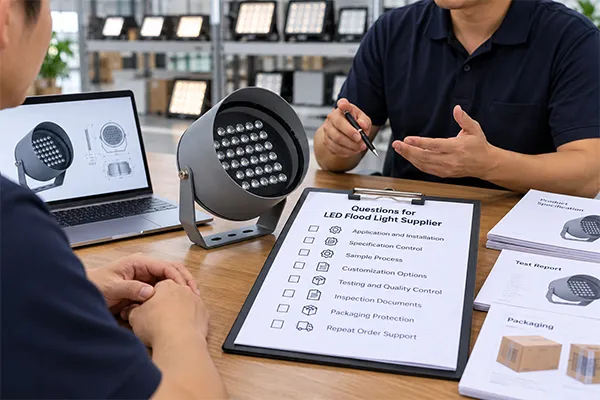
Evaluate the questions the supplier asks you
One of the clearest signals appears early in the inquiry stage. If a supplier immediately sends a price without asking about voltage, beam angle, installation conditions, market, packaging, or quantity, the quotation may be based on assumptions.
In contrast, a supplier that asks clarifying questions may be trying to reduce uncertainty. The conversation should not become unnecessarily technical, but it should establish the basis for the product recommendation.
I usually suggest buyers ask suppliers these questions:
- Can you recommend a configuration based on my installation application?
- Can you provide a written specification with the quotation?
- Which details can be customized, such as wattage, CCT, beam angle, CRI, surface color, label, or packaging?
- What is the sample process, and how will the production order match the approved sample?
- What internal aging and inspection steps do you use?
- Can you provide photos, test information, and packing details before shipment?
- What is the production lead time for samples, standard orders, and customized orders?
- What are the payment terms, Incoterms, warranty terms, and process for handling an issue?
- Can you support small-batch orders as the buyer develops the market?
- What documents can you provide, and how should the buyer verify their suitability for the destination market?
Assess communication as a commercial control
In my experience, clear communication is not a soft issue. It is a procurement control. Most avoidable problems begin with unclear specifications, unconfirmed assumptions, or changes that were discussed verbally but not documented.8
For OEM and ODM buyers, written confirmation becomes even more important. A custom surface finish, private-label carton, different color temperature, or revised cable configuration can affect lead time, minimum order quantity, pricing, and approval steps.
At Upward Lighting, we handle OEM/ODM requests involving parameters such as color temperature, wattage, beam angle, CRI, and surface finish colors. However, I believe buyers should judge any supplier by the documentation and process behind the promise. The buyer should ask for a formal quotation, specification sheet, artwork approval where applicable, sample confirmation, and pre-shipment information.
Consider total procurement cost
The factory unit price matters, but it is only one part of the commercial decision. A low-cost product can create hidden costs if it leads to return handling, installer complaints, replacement freight, delayed project completion, or damage to a distributor’s local reputation.9
A total-cost review can include:
- Unit price and payment terms
- Freight and Incoterms
- Import duty, local compliance costs, and clearance requirements
- Packaging quality and transport-damage exposure
- Spare-unit or replacement planning
- Sample and inspection costs
- Lead time and stock availability
- Rework risk at the project site
- Brand and customer-service impact
For many importers, the best value is not the cheapest LED flood light. It is the configuration that supports a reliable sale, installation, and repeat order.
How Should Importers Manage Samples, Orders, and Repeat Purchases?
Importers can lose control of a purchase when a sample is approved informally and the bulk order is placed without a clear reference. Small details can then change between stages, especially if several people handle sales, purchasing, technical review, and logistics. A structured approval process helps protect both buyer and supplier.
Importers should manage LED flood lights from China through a documented sequence: application brief, supplier shortlist, written quotation, sample approval, purchase order, production confirmation, inspection review, shipping approval, and repeat-order record. Each stage should reference the same agreed model and specification to reduce avoidable changes.
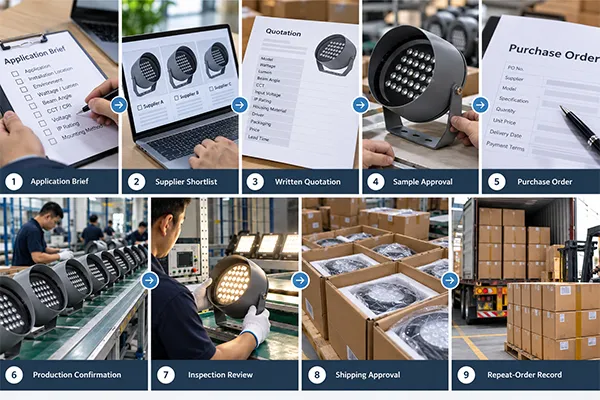
Create an approval trail
A useful procurement trail does not need to be bureaucratic. It should simply make it possible for everyone to identify the approved product and commercial terms.
I recommend retaining the following documents in one shared file or purchasing folder:
- Final quotation with Incoterm and validity period
- Product specification sheet
- Approved sample photos and sample reference
- Label artwork and carton artwork, if customized
- Required documentation list
- Purchase order with model codes and quantities
- Agreed production lead time
- Inspection criteria and pre-shipment checklist
- Shipping marks and packing list
- Records of approved changes
This record is especially valuable when buyers place a repeat order months later.10 It can reduce the risk that a new purchasing staff member requests “the same model” but receives a different version because the original details were not recorded.
Plan for scale without assuming immediate volume
Many importers begin with samples or a small trial order. This approach can be sensible when the buyer is testing a market, validating a local customer response, or evaluating installation feedback. The buyer should be transparent about this plan rather than promising unrealistic volumes to obtain a lower price.
Suppliers may have different minimum-order quantities for standard products, custom branding, special finishes, or nonstandard electrical configurations. Buyers should ask what changes when the order grows. For example:
| Order Stage | Buyer Focus | Supplier Discussion |
|---|---|---|
| Sample | Product fit and appearance | Sample cost, lead time, shipping method |
| Trial order | Market response and delivery reliability | Standard packaging, available configurations |
| Repeat order | Batch consistency and commercial stability | Component continuity, lead time, pricing basis |
| OEM expansion | Brand control and differentiation | Artwork approval, MOQ, customization process |
| Project order | Compliance and delivery coordination | Documentation, inspection, shipping schedule |
A buyer should also discuss whether the supplier has a process for component substitutions. Supply chains can change11, and a responsible procurement process should require written approval before material changes affect an agreed product configuration.
Keep installation feedback in the loop
Importers, distributors, and project purchasers should collect feedback from installers and end users after early shipments. This feedback can identify issues that are not obvious during desk-based evaluation, such as bracket convenience, cable length, glare, carton handling, or local mounting practices.12
I recommend recording feedback in practical terms:
- Was the mounting bracket easy to adjust?
- Was the cable suitable for local installation practice?
- Did the chosen beam angle provide the expected coverage?
- Was the color temperature acceptable to the customer?
- Did carton labeling help warehouse identification?
- Did the product configuration meet the project’s documented requirements?
This information helps buyers refine their next LED flood lights from China order. It also gives suppliers a clearer basis for recommending improvements rather than guessing what the market needs.
Frequently Asked Questions
Are LED flood lights from China good quality?
LED flood lights from China can vary significantly in configuration, materials, documentation, and production control. Country of origin alone does not define quality. I recommend that buyers evaluate the written specification, approved sample, supplier communication, inspection process, packaging, and suitability for the intended installation.
What should I include in an LED flood light inquiry?
An effective inquiry should include the application, wattage, color temperature, beam angle, voltage, IP requirement, mounting method, quantity, destination market, packaging needs, branding requirements, and expected delivery date. This information helps suppliers provide a more relevant and comparable quotation.
Is a 100% aging test a guarantee that flood lights will not fail?
No. A 100% aging test can help screen products during a defined internal test period and support quality-control consistency. However, it cannot guarantee zero failures, a fixed product lifetime, or identical results under every installation condition, voltage environment, or weather exposure.
Do CE and RoHS documents automatically allow me to sell flood lights in any country?
No. CE and RoHS documentation may be relevant for certain markets and products, but buyers must verify destination-country requirements, product applicability, labeling obligations, and project-specific rules. I recommend consulting qualified compliance or testing professionals when the market or project has specific requirements.
Should I choose the lowest-priced LED flood light supplier?
I do not recommend selecting a supplier based only on the lowest price. Buyers should compare equivalent configurations and assess total procurement cost, including product consistency, shipping terms, quality controls, documentation, lead time, replacement exposure, and the supplier’s ability to support future orders.
Conclusion
Buying LED flood lights from China is not mainly a search for the lowest unit price. I believe the strongest import decisions begin with a clear application and a written, comparable specification. Buyers should then assess samples, supplier communication, quality-control steps, documents, packaging, and repeat-order capability. At Upward Lighting, we support importers, distributors, brands, and project buyers with LED flood light quotations, OEM/ODM configuration discussions, small-batch options, aging tests, and pre-shipment checks. Contact us with your application details, and we can help you build a more reliable sourcing specification.
"MCC Procurement Guidance Note: Price-Reasonableness ...", https://www.mcc.gov/resources/doc/guidance-price-reasonableness/. Procurement guidance generally treats clear, common technical specifications as necessary for fair comparison of competing offers and for reducing ambiguity in contract performance. Evidence role: general_support; source type: institution. Supports: Standardized technical specifications allow purchasers to compare offers on an equivalent basis and reduce ambiguity in procurement.. Scope note: Such guidance concerns procurement practice broadly and does not establish that every lighting quotation will differ materially. ↩
"IEC 60529", https://en.wikipedia.org/?title=IEC_60529&redirect=no. The IEC 60529 IP Code classifies the degree of protection provided by an enclosure against access, solid foreign objects, dust, and water. Evidence role: definition; source type: encyclopedia. Supports: The IP Code classifies enclosure protection against access, solid foreign objects, dust, and water under IEC 60529.. Scope note: An IP classification addresses ingress protection under specified test conditions; it does not by itself establish overall product durability or suitability for every outdoor exposure. ↩
"Chapter 11 - Street Lighting", https://www.intrans.iastate.edu/wp-content/uploads/sites/15/2020/03/Chapter_11.pdf. Lighting-engineering guidance explains that the illuminance and uniformity delivered to a surface depend on luminaire photometric distribution, luminous flux, mounting geometry, aiming, and spacing rather than rated electrical power alone. Evidence role: mechanism; source type: institution. Supports: Illuminance and uniformity are determined by luminaire photometry and installation geometry, including mounting height, aiming, and spacing.. Scope note: The relative importance of these variables varies by application, target illuminance, and luminaire design. ↩
"Corrosion Risk Assessment in Coastal Environments Using ...", https://pmc.ncbi.nlm.nih.gov/articles/PMC12252465/. Research and engineering guidance on outdoor electrical equipment identify moisture, dust, corrosive atmospheres, and salt-laden coastal air as environmental exposures that can affect enclosure, material, and protection requirements. Evidence role: general_support; source type: research. Supports: Environmental factors such as moisture, particulate exposure, salt-laden air, and corrosion can affect the selection and service performance of outdoor electrical equipment.. Scope note: The appropriate configuration must still be determined from the specific site conditions, applicable standards, and product ratings. ↩
"RoHS Directive - Environment - European Commission", https://environment.ec.europa.eu/topics/waste-and-recycling/rohs-directive_en. European Commission guidance states that CE marking applies only to products covered by relevant EU harmonisation legislation, while the RoHS Directive restricts specified hazardous substances in applicable electrical and electronic equipment. Evidence role: general_support; source type: government. Supports: EU rules establish CE-marking obligations for products covered by relevant harmonized legislation and restrict specified hazardous substances in applicable electrical and electronic equipment under RoHS.. Scope note: Applicability depends on the product, destination, and legal framework; CE marking and RoHS compliance are not universal authorization for all countries or uses. ↩
"Metrological Traceability: Frequently Asked Questions and ...", https://www.nist.gov/metrology/metrological-traceability. Statistical quality-control guidance explains that inspection of a sample provides information about the sampled lot, whereas sustained production consistency requires control of the manufacturing process and its variation. Evidence role: mechanism; source type: government. Supports: Sampling inspection provides evidence about sampled items or lots but does not replace process control or guarantee conformity of all future production.. Scope note: The strength of inference from a sample depends on the sampling plan, lot size, inspection method, and production controls. ↩
"A Methodology for Testing", https://nvlpubs.nist.gov/nistpubs/Legacy/IR/nbsir76-1157.pdf. Reliability literature distinguishes burn-in or short-duration operational screening from long-term field reliability, noting that later performance may be affected by electrical, thermal, moisture, mechanical, and installation-related stresses. Evidence role: mechanism; source type: paper. Supports: Burn-in and operational screening can identify some early failures but do not reproduce all field stresses or prove long-term reliability.. Scope note: The failure modes detected by a particular aging test depend on its duration, loading conditions, test environment, and product design. ↩
"FGMSD-80-4 Contracting for Computer Software ...", https://www.gao.gov/assets/fgmsd-80-4.pdf. Project and contract-management literature identifies ambiguous requirements, unrecorded assumptions, and uncontrolled changes as common contributors to rework, disputes, and delivery problems. Evidence role: general_support; source type: research. Supports: Ambiguous requirements and uncontrolled changes are recognized sources of rework, disputes, and performance problems in projects and contracts.. Scope note: This general evidence does not show that such factors are the primary cause of problems in every lighting purchase. ↩
"Part 31 - Contract Cost Principles and Procedures", https://www.acquisition.gov/far/part-31. Lifecycle-costing guidance recognizes that purchasing decisions may include costs beyond the acquisition price, including operation, maintenance, replacement, and other costs arising during use. Evidence role: general_support; source type: institution. Supports: Lifecycle and total-cost-of-ownership approaches include costs beyond the initial purchase price, such as operation, maintenance, replacement, and risk-related costs.. Scope note: The magnitude of return, delay, reputation, and replacement costs is business- and project-specific. ↩
"baseline configuration - Glossary", https://csrc.nist.gov/glossary/term/baseline_configuration. Configuration-management guidance describes documented product baselines and formal change control as methods for maintaining consistency when products are reproduced, modified, or procured over time. Evidence role: mechanism; source type: government. Supports: Configuration management uses documented baselines and controlled changes to maintain consistency of products and associated information over time.. Scope note: Documentation improves traceability and control but cannot prevent errors if records are incomplete, obsolete, or not followed. ↩
"OECD Supply Chain Resilience Review: Navigating Risks", https://www.oecd.org/content/dam/oecd/en/publications/reports/2025/06/oecd-supply-chain-resilience-review_9930d256/94e3a8ea-en.pdf. International and government analyses of recent supply-chain disruptions document that constrained component availability can affect manufacturing schedules and sourcing decisions, including for electronic components. Evidence role: historical_context; source type: institution. Supports: Supply-chain disruptions and shortages can constrain the availability of electronic components and affect manufacturing continuity.. Scope note: This contextual evidence does not establish that a particular supplier will substitute components or that a substitution will alter product performance. ↩
"Industry Usability Reporting", https://www.nist.gov/itl/tted/industry-usability-reporting. Human-factors research finds that field evaluation and user feedback can reveal context-specific usability and installation issues that may not be apparent in controlled or desk-based assessment. Evidence role: general_support; source type: research. Supports: Field evaluation and user feedback can identify context-of-use and usability problems that controlled or desk-based assessments may not reveal.. Scope note: The usefulness of feedback depends on the representativeness of users, installations, and the method used to collect and analyze reports. ↩