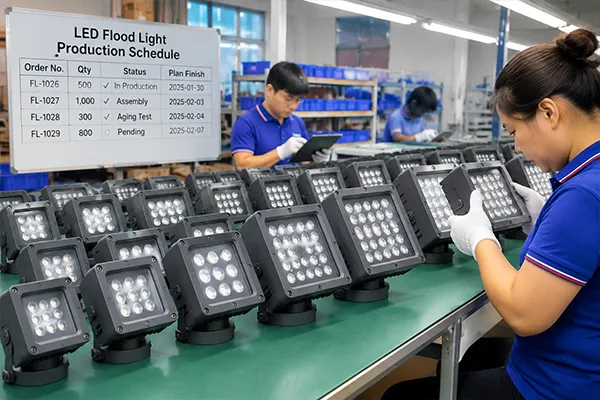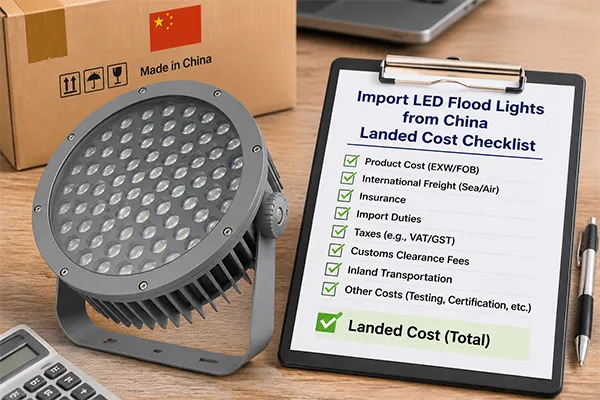

A professional LED flood light manufacturer can be difficult to identify when many suppliers offer similar product photos, low quotations, and certification claims. This creates procurement risk: a suitable sample may not match later batches, specifications can drift, and delivery issues can disrupt a project. I believe buyers should evaluate the supplier’s full ability to control requirements, production, and communication.
A professional LED flood light manufacturer differs by converting real application requirements into confirmed specifications, maintaining those specifications through mass production, coordinating delivery realistically, and responding clearly when changes or quality questions arise. A factory label, a low price, a single successful sample, or CE and RoHS documents alone do not prove this capability.
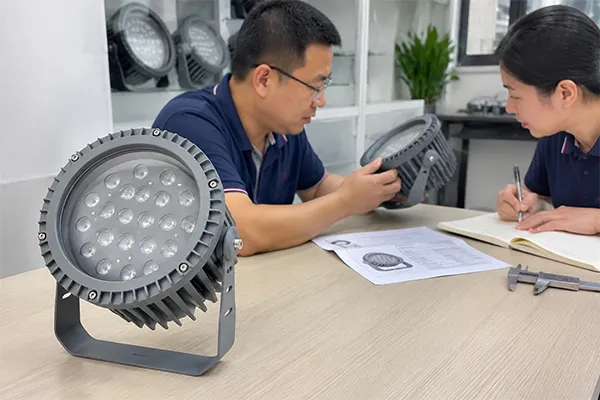
In my experience working with overseas buyers, the strongest sourcing decisions start before the order is placed. Buyers who ask detailed questions about specifications, production control, documentation, and replenishment planning usually reduce the risk of expensive supplier changes later.
Does a Professional LED Flood Light Manufacturer Start With Application Requirements?
Many buyers begin by sending a wattage request, such as “100W LED floodlight,” and expect a simple quote. The problem is that wattage alone does not define the required lighting result, installation environment, or product construction1. This can lead to unsuitable products, unexpected revisions, or mismatched expectations after delivery.
A professional LED flood light manufacturer should begin by clarifying the application, installation conditions, target performance, and commercial requirements before confirming a model. The supplier should translate these needs into a written specification covering wattage, lumen expectations, CCT, beam angle, CRI, voltage, IP rating, finish, mounting, packaging, and relevant market documents.
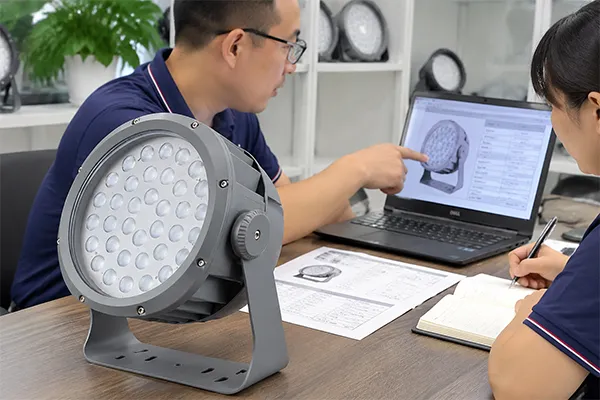
A Floodlight Is More Than a Wattage Number
I often see that two floodlights with the same nominal wattage are not automatically interchangeable2. Their optical design, driver configuration, thermal structure, LED selection, beam distribution, and intended operating environment may differ. A 100W product for a building façade may not be the right choice for a loading yard, sports perimeter, warehouse exterior, or temporary construction area.
A useful supplier discussion should cover the full application context. For example, buyers may need to clarify:
- Installation height: A fixture installed at 4 meters has different beam and glare requirements from one installed at 12 meters3.
- Target area: A narrow pathway, broad yard, signboard, façade, or security perimeter needs different light distribution.
- Operating environment: Coastal, humid, dusty, hot, cold, or high-vibration locations can affect material and protection requirements4.
- Color temperature: Common choices include 3000K, 4000K, 5000K, and 6500K, but the correct choice depends on the project brief and local preference.
- Color rendering: Higher CRI may matter where color recognition is important, while other applications may prioritize efficacy or cost.
- Input voltage and control needs: Buyers should confirm local voltage, frequency, dimming, sensors, photocells, or other control requirements.
- Mounting method: Brackets, poles, wall mounting, U-brackets, and adjustable angles must suit the site plan.
What Should Be Confirmed Before Sampling?
A professional supplier does not need to be a lighting-design authority to ask practical procurement questions. However, the supplier should recognize when a requirement is incomplete and request clarification before production moves forward.
I recommend buyers ask for a specification sheet or approved product confirmation that includes the following:
| Specification Area | What Buyers Should Confirm | Why It Matters |
|---|---|---|
| Product model | Exact internal model number | Prevents confusion between similar housings |
| Power | Rated wattage and tolerance expectations | Supports consistent ordering |
| CCT | For example, 3000K, 4000K, 5000K, or 6500K | Keeps visual appearance consistent |
| Beam angle | Such as 60°, 90°, 120°, or asymmetric distribution | Affects coverage and glare |
| CRI | Required color rendering level | Supports application needs |
| Voltage | Input range and destination-market compatibility | Avoids installation mismatch |
| IP rating | Required ingress protection rating | Helps match environmental exposure |
| Finish | Housing color and surface treatment | Supports branding and project appearance |
| Packaging | Inner box, master carton, labels, and barcodes | Reduces channel and logistics errors |
For application-specific decisions, I encourage buyers to involve a qualified lighting professional, electrical engineer, or project consultant where needed. A manufacturer can support product selection and specification confirmation, but site lighting design and local installation requirements require separate professional judgment.
Can a Good Floodlight Sample Prove Mass-Production Quality?
A successful sample can create confidence, but it can also create false certainty. A sample usually proves that a supplier can produce one unit to an agreed starting point. The real challenge begins when the supplier must repeat the same result across a production batch and future replenishment orders.
A good LED floodlight sample does not by itself prove mass-production consistency5. Buyers should verify how the supplier controls approved specifications, component changes, production records, inspection steps, and communication before moving from sample approval to bulk purchasing.
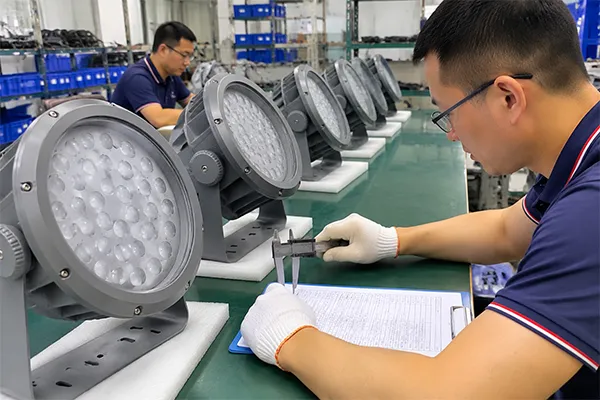
The Risk Between Sample Approval and Bulk Delivery
A sample may use a specific LED source, driver, housing finish, lens, cable, or packaging method. If these details are not locked in clearly, the bulk order may vary in ways that are not immediately visible in listing photos.
This does not mean every variation is unacceptable. In manufacturing, component availability and supply-chain conditions can change6. The important issue is whether the manufacturer has a process to identify material changes, assess their impact, and communicate with the buyer before shipment.
In our work at Upward Lighting, I have found that a clear pre-production confirmation reduces misunderstandings. Buyers can confirm parameters such as:
- Wattage and voltage
- Color temperature and CRI
- Beam angle or optical lens
- Housing color and surface finish
- Branding, labels, and carton artwork
- Cable length, plug, and mounting accessories
- Packing quantity and shipment marks
- Approved sample reference or signed specification sheet
What Production Consistency Looks Like in Practice
A reliable production process should not depend only on an individual salesperson’s memory. I recommend asking how the supplier links approved requirements to purchasing, assembly, inspection, and packing.
Buyers can use these questions during supplier evaluation:
- How does the supplier record the approved sample and final specification?
- Can the supplier identify the LED source, driver, optics, and housing configuration used for the order?
- What happens if a key component is unavailable?
- Does the supplier ask for approval before making a material substitution?
- How are CCT, wattage, labels, and packaging checked during production?
- Can the supplier support repeat orders with the same agreed configuration?
- Who communicates if lead times or specifications need adjustment?
A professional process is not one that claims nothing will ever change. It is one that makes changes visible, controlled, and reviewable before they become a buyer’s problem.
For OEM and ODM orders, this discipline matters even more. A branded floodlight program may require custom finishes, printed labels, specific CCT options, specialized packaging, or small-batch assortment planning. The supplier should be able to distinguish between a standard catalog item and an approved custom configuration.
How Should Buyers Evaluate LED Floodlight Testing and Certifications?
Testing language can sound reassuring, yet buyers should understand what each test or document actually indicates. The common mistake is to treat an aging test as proof of lifetime performance or to treat CE and RoHS documents as complete evidence that a product is suitable for every market and installation.
Buyers should evaluate LED floodlight testing and certifications as part of a broader verification process. A 4–8 hour aging test can help identify some early failures before shipment7, while CE and RoHS documents can support market-entry review8; however, buyers should verify document validity, product scope, destination requirements, and application-specific compliance separately.
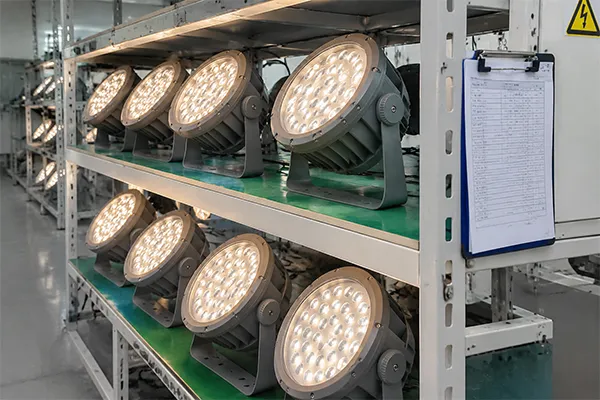
What Can a 100% Aging Test Tell You?
At Upward Lighting, every product undergoes a 100% aging test of approximately 4 to 8 hours before shipment. From a manufacturing quality-control perspective, this process can help screen for certain early issues, such as visible operating abnormalities or failures that appear shortly after initial power-on.
However, I do not consider an aging test a universal guarantee. A 4–8 hour test does not prove that every fixture will achieve the same field lifetime in every climate, voltage condition, operating schedule, or installation method9. Real-world performance can be influenced by ambient temperature, installation quality, electrical conditions, ventilation, maintenance, usage hours, and application environment.
A buyer should ask what the aging process includes and how the supplier handles units that do not pass. Useful questions include:
- Is every finished fixture powered during the aging process?
- How long is the aging period for this specific order?
- Are visual function checks completed before packing?
- Are failed units repaired, replaced, or separated from shipment?
- Are inspection results linked to the production order?
- Are there additional checks for labels, appearance, packaging, and accessories?
How to Review CE and RoHS Documents Responsibly
CE and RoHS are important documents for many buyers, especially those supplying applicable markets. Still, the buyer should verify that documents relate to the actual product model and intended destination. A document that appears relevant at first glance may not cover every variation in wattage, driver, or product configuration10.
| Verification Point | Why Buyers Should Check It |
|---|---|
| Product model reference | The document should match the ordered floodlight family or configuration |
| Issuing organization | Buyers should review the source and document credibility |
| Test report date | Older reports may need further review for current products |
| Rated voltage and power | These should align with the ordered version |
| Applicable standards | Requirements differ by market and product use |
| RoHS material scope | Buyers should verify the declaration or report supports the product supplied |
| Destination-market rules | Importers should confirm current local obligations |
I recommend that buyers consult qualified compliance professionals or local authorities for market-specific requirements. Requirements can vary by destination, product category, installation environment, and sales channel. A responsible professional LED flood light manufacturer should support document sharing and clear product information, but the importer or project owner should not assume that one certificate answers every compliance question.
Does Delivery Coordination Separate a Professional LED Flood Light Manufacturer From a Basic Supplier?
A floodlight can meet the agreed specification and still create a business problem if delivery timing, packing, documentation, or replenishment coordination is weak. For distributors and contractors, delayed stock can mean missed sales, project disruption, or costly urgent replacement purchases from another source.
A professional LED flood light manufacturer supports dependable delivery by confirming realistic lead times, managing material availability, coordinating packaging and shipping documents, and communicating early when an issue could affect the order schedule. Reliable delivery is not a promise of zero disruption; it is a disciplined process for reducing surprises.
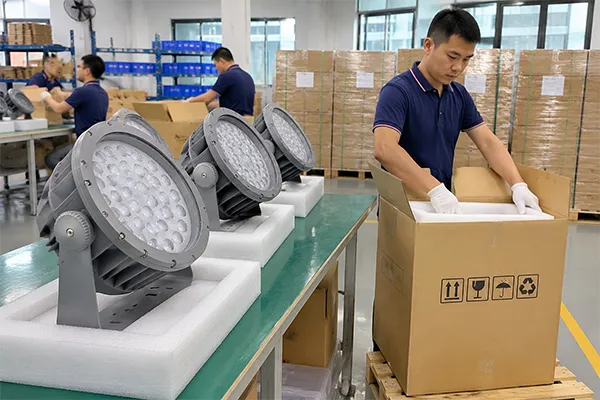
Lead Time Is a Planning Commitment
I believe a lead-time quotation should be treated as a planning commitment, not as a marketing phrase. Buyers need to know when sampling, artwork approval, component procurement, production, aging, inspection, packing, and shipment booking will occur.
For standard products, the process may be straightforward. For OEM floodlights, mixed-CCT orders, custom finishes, branded packaging, or small-batch programs, additional steps may affect the timeline. The supplier should explain this early rather than waiting until the goods are almost ready.
A practical delivery discussion can include:
- Required delivery date and destination
- Sample approval deadline
- Artwork and label approval timing
- Material lead times for custom configurations
- Production schedule and quality-control window
- Carton dimensions, gross weight, and loading plan
- Export documentation requirements
- Shipping method and booking responsibility
MOQ Flexibility and Long-Term Sourcing
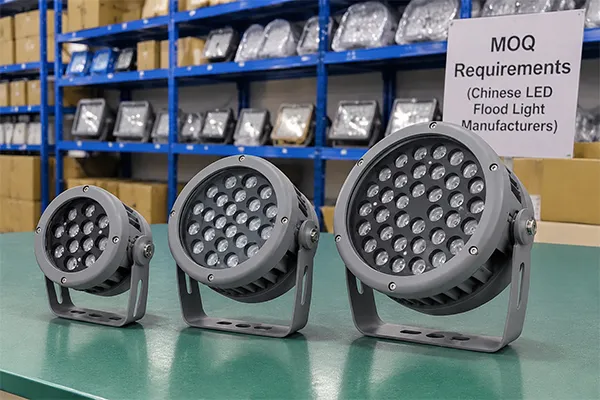
MOQ is not only a pricing issue. It affects how importers test a new product range, how distributors manage inventory, and how local lighting brands introduce customized products.
At Upward Lighting, we support small-batch orders where practical, along with OEM/ODM customization for parameters including CCT, wattage, beam angle, CRI, and surface finish colors. Buyers should still confirm the commercial impact of each variation. A low-volume custom configuration may involve different component sourcing, packaging setup, or production planning than a standard product.
For long-term sourcing, I suggest evaluating whether the supplier can support:
| Procurement Need | What to Verify |
|---|---|
| Initial trial order | Sample process, MOQ, and quotation speed |
| Branded product launch | Artwork confirmation and packaging control |
| Repeat purchases | Specification records and replenishment planning |
| Mixed product orders | Packing, labeling, and SKU separation |
| Urgent inquiries | Response time and transparent production updates |
| Quality feedback | Clear contact point and issue-review process |
When buyers choose a supplier only because the first quotation is low, they may overlook these operating details. Supplier switching can later cost more than the original price difference through new sampling, artwork revisions, compliance review, delayed inventory, and uncertain batch consistency11.
How Should Buyers Handle Quality Feedback and Specification Mismatches?
Even careful planning cannot remove every possibility of mismatch, shipping damage, installation question, or quality concern. The real procurement test is how the supplier responds when the buyer raises a clear issue with photos, records, quantities, and order references.
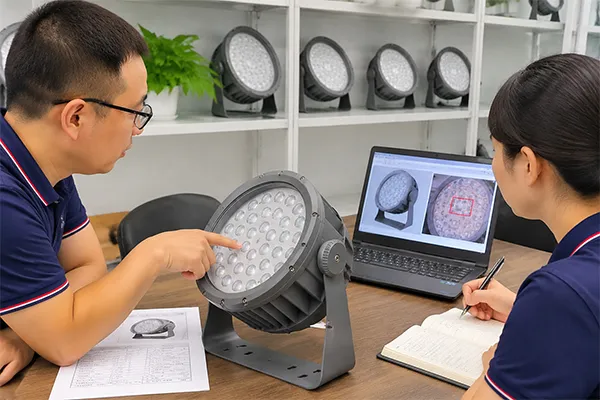
Buyers should assess a supplier’s quality-feedback process before placing large orders. A professional LED flood light manufacturer should provide a clear communication channel, request evidence, compare the issue with approved specifications, identify the likely stage involved, and discuss a practical resolution according to the order terms and verified findings.
A Useful Feedback Process Is Evidence-Based
I have learned that vague messages often slow down problem resolution. A statement such as “the lights are wrong” may be understandable under pressure, but it does not give the supplier enough information to compare the concern with the order record.
Buyers can help speed up the review by providing:
- Purchase order number and product model
- Photos or videos of the product and label
- Carton labels or batch information where available
- Quantity affected
- Description of the observed issue
- Installation conditions, if relevant
- Comparison with the approved sample or specification
- Timing of the issue: on arrival, during installation, or after operation
This documentation does not mean the buyer must solve the technical issue alone. It gives both parties a factual starting point.
Evaluate Communication Before You Need It
Before placing a significant order, I recommend asking a supplier how they manage claims or specification questions. The best answer is not necessarily “we never have problems.” That statement is difficult to verify and does not explain the process.
A more useful answer explains:
- Who receives and tracks the feedback.
- What evidence is needed for review.
- How the supplier compares the concern against approved documents.
- When the supplier provides an initial response.
- How corrective actions, replacements, credits, or other commercial solutions are considered under the agreed terms.
A professional LED flood light manufacturer should communicate directly and avoid hiding behind vague statements. Buyers should also keep their own approved specifications, samples, product photos, and correspondence organized. This creates a stronger foundation for long-term cooperation and makes repeat orders easier to manage.
Frequently Asked Questions
What should I ask an LED flood light manufacturer before placing an order?
I recommend asking about application requirements, exact product specifications, sample approval, component-change control, aging tests, certifications, MOQ, lead time, packaging, and quality-feedback procedures. You should request written confirmation for critical details such as wattage, CCT, beam angle, voltage, IP rating, labels, and carton requirements.
Is CE certification enough for importing LED floodlights?
CE documentation can be important for applicable markets, but it is not automatically enough for every import situation. Buyers should verify that documents match the ordered model and configuration. They should also confirm current destination-market, product-use, and installation requirements with qualified compliance professionals.
Does a 4–8 hour LED floodlight aging test guarantee product lifetime?
No. A 4–8 hour aging test can help identify some early failures before shipment, especially when every unit is powered and checked. It does not guarantee field lifetime, zero failures, or identical performance under all installation, climate, voltage, and operating conditions.
Why can the same wattage LED floodlight have different prices?
The same nominal wattage can involve different LEDs, drivers, housings, optics, thermal designs, IP ratings, cable specifications, finishes, quality-control processes, packaging, and certification support12. Buyers should compare confirmed specifications and supplier processes rather than comparing wattage and unit price alone.
Can a supplier support small-batch custom LED floodlight orders?
Some suppliers can support small-batch OEM or ODM orders, but buyers should confirm MOQ, customization limits, tooling or artwork requirements, sample timing, and cost impact. Custom CCT, wattage, beam angle, CRI, finish, labels, and packaging may affect both pricing and lead time.
Conclusion
A professional LED flood light manufacturer is not defined by a factory claim, a low quote, an attractive sample, or a certificate alone. I believe professionalism appears in the full procurement process: clarifying application needs, locking specifications, controlling consistency from sample to mass production, conducting sensible pre-shipment checks, coordinating delivery, and addressing feedback with evidence-based communication. At Upward Lighting, we support buyers with OEM/ODM customization, small-batch options, 100% 4–8 hour aging tests, and responsive order coordination. Contact us to discuss your floodlight specification and sourcing requirements.
"CALiPER Application Summary Report 20: LED PAR38 Lamps", https://www1.eere.energy.gov/buildings/publications/pdfs/ssl/caliper_20_summary.pdf. Electrical wattage is a measure of power input rather than a complete measure of lighting performance; delivered illumination also depends on light output, efficacy, optical distribution, and the installation context. Evidence role: mechanism; source type: government. Supports: Electrical wattage measures power consumption, whereas lumen output, efficacy, optical distribution, and installation conditions affect the lighting result.. ↩
"LED Basics", https://www.energy.gov/cmei/ssl/led-basics. Products with the same nominal input wattage need not provide equivalent lighting because lumen output, optical distribution, thermal design, and rated operating conditions can differ between luminaires. Evidence role: general_support; source type: institution. Supports: LED luminaires with similar input power can have different lumen output, distribution, thermal performance, and intended applications.. ↩
"Best Flood Lights for Backyard: A Practical, Long-Form Guide", https://ckalagher.sacsites.csus.edu/best-flood-lights-for-backyard-a-practical-long-form-guide.html. Lighting geometry changes with mounting height: the height and aiming of a luminaire affect the area covered, illuminance levels, and the potential for direct glare. Evidence role: mechanism; source type: education. Supports: Mounting height and aiming geometry influence illuminance coverage and glare in exterior lighting installations.. ↩
"Circular of the Bureau of Standards no. 80", https://nvlpubs.nist.gov/nistpubs/Legacy/circ/nbscircular80.pdf. Environmental conditions such as moisture, dust, temperature extremes, corrosive atmospheres, and vibration can influence enclosure protection and material-selection requirements for electrical equipment. Evidence role: general_support; source type: institution. Supports: Dust, water, temperature, corrosion exposure, and vibration are relevant environmental factors in equipment enclosure and material selection.. Scope note: The applicable protection level and material specification depend on the particular site exposure, installation, and governing standard. ↩
"End-to-End Quality Information Framework (QIF) ...", https://nvlpubs.nist.gov/nistpubs/ir/2016/NIST.IR.8127.pdf. Acceptance of an individual sample demonstrates the characteristics of that unit, whereas continued production conformity requires documented controls, change management, and appropriate inspection of subsequent output. Evidence role: general_support; source type: institution. Supports: A single approved unit cannot establish continuing batch conformity without controlled production processes, documented specifications, and inspection.. Scope note: The extent of verification needed depends on the product risk, production volume, and contractual quality requirements. ↩
"Securing Medical Supply Chains in a Post-Pandemic World", https://www.oecd.org/en/publications/securing-medical-supply-chains-in-a-post-pandemic-world_119c59d9-en/full-report/component-5.html. Reports on electronics supply chains document that shortages and other disruptions can constrain access to specified components, creating a need for controlled sourcing and transparent management of substitutions. Evidence role: historical_context; source type: institution. Supports: Supply-chain disruptions and component shortages can affect manufacturers' access to specified electronic parts.. Scope note: Supply-chain context does not establish that a particular supplier changed components in a particular order. ↩
"A Methodology for Testing - Life-Cycfe Performance of", https://nvlpubs.nist.gov/nistpubs/Legacy/IR/nbsir76-1157.pdf. Reliability engineering literature describes burn-in and related screening as methods that may expose certain early-life or latent defects before products enter service. Evidence role: mechanism; source type: paper. Supports: Burn-in or screening can reveal some early-life defects in electronic products before release.. Scope note: The detection capability of a 4–8 hour test depends on the stress conditions, failure mechanisms, test setup, and inspection criteria; it does not establish long-term reliability. ↩
"CE marking – obtaining the certificate, EU requirements", https://europa.eu/youreurope/business/product-rules-compliance/general-product-compliance/ce-marking/index_en.htm. For products within their scope, EU CE-marking rules require conformity assessment and declaration procedures, while the RoHS framework restricts specified hazardous substances in electrical and electronic equipment. Evidence role: general_support; source type: government. Supports: CE marking and RoHS obligations are EU regulatory mechanisms relevant to certain electrical and electronic products placed on the EU market.. Scope note: Whether these requirements apply, and whether available documents are sufficient, depends on the product's scope, configuration, economic operator role, and destination-market rules. ↩
"LED Luminaire Reliability: Impact of Color Shift", https://www.energy.gov/sites/prod/files/2017/04/f34/lsrc_colorshift_apr2017.pdf. LED system lifetime is influenced by thermal environment, electrical operating conditions, duty cycle, component design, and installation context; consequently, a short pre-shipment operating test cannot demonstrate uniform field lifetime across all conditions. Evidence role: mechanism; source type: research. Supports: LED-luminaire reliability and lifetime are affected by thermal conditions, electrical stress, operating profile, and component-level behavior.. Scope note: This evidence explains why universal lifetime assurance is not justified, but it does not predict the lifetime of a specific floodlight model. ↩
"CE marking – obtaining the certificate, EU requirements", https://europa.eu/youreurope/business/product-rules-compliance/general-product-compliance/ce-marking/index_en.htm. Conformity documentation is required to describe and support the product placed on the market; material differences in design, components, ratings, or configuration may require review of whether the existing assessment remains applicable. Evidence role: general_support; source type: government. Supports: Technical documentation and conformity assessment must correspond to the product placed on the market, including relevant design or configuration changes.. Scope note: The significance of a variant depends on the governing legislation, harmonized standards, and technical effect of the change. ↩
"Supply Chain Disruptions: What Causes Them and How ...", https://ies.ncsu.edu/news/supply-chain-disruptions-what-causes-them-and-how-manufacturers-can-build-resilience/. Procurement and supply-chain research recognizes that changing suppliers can involve qualification, coordination, transaction, and disruption costs that are not captured by a comparison of unit prices alone. Evidence role: general_support; source type: paper. Supports: Supplier changes can create transaction, qualification, coordination, and operational-disruption costs beyond the quoted purchase price.. Scope note: The magnitude of switching costs varies with product complexity, contracts, inventory exposure, regulatory requirements, and the buyer's transition process. ↩
"Solid State Lighting LED Product Development and ...", https://www.energy.gov/documents/ledrtprdctmfg-reportoct2016pdf. An LED luminaire is a system comprising light sources, drivers, optics, thermal-management features, and an enclosure; differences in these elements can affect performance, durability, environmental suitability, and manufacturing cost independently of nominal wattage. Evidence role: mechanism; source type: research. Supports: LED luminaire performance and construction depend on interacting components including LEDs, drivers, optics, heat management, and enclosure design.. Scope note: This system-level evidence does not establish the quality or price justification of any particular supplier's product. ↩