
A LED flood light supplier can appear easy to compare when every quotation lists wattage, lumen output, and unit price. Yet buyers often face costly problems after ordering because the product does not fit the installation, bulk units vary from samples, or documents do not match the actual order. We recommend starting with the project requirements, then verifying how a supplier will deliver them consistently.
A reliable LED flood light supplier should translate your application into a documented product specification, support that specification with relevant verifiable documents, and explain how approved samples connect to bulk production. Price matters, but buyers should also evaluate application fit, batch consistency, communication, delivery planning, and accountability before selecting a long-term partner.
In our daily quotation conversations, we often see buyers begin by asking for “the best price for 100W.” That is understandable, but wattage alone rarely defines the right product1. The questions below help us and our customers reduce uncertainty before a purchase order turns into an installation problem.
What Should You Tell a LED Flood Light Supplier About Your Application?
When buyers provide only a wattage and quantity, they risk receiving a product that looks comparable on paper but performs poorly in the actual location. The wrong beam angle, mounting position, color temperature, or housing finish can create rework, delays, and customer complaints. We encourage buyers to define the job before comparing quotations.
You should tell a LED flood light supplier where the fixture will be installed, what area it must illuminate, how it will be mounted, what visual result is expected, and how you plan to purchase. This information allows the supplier to recommend and document appropriate wattage, beam angle, CCT, ingress protection expectations, cable requirements, and packaging arrangements.
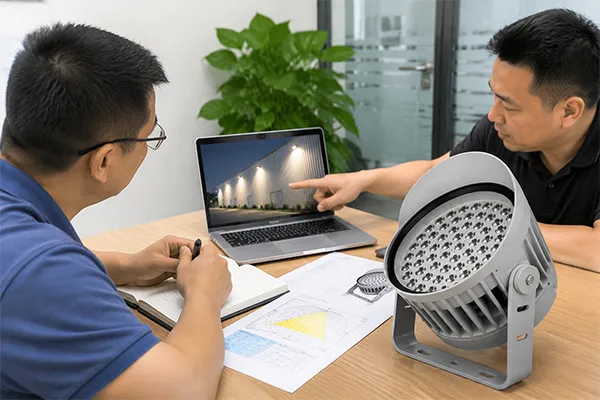
Start With the Installation, Not the Catalogue Page
We regularly receive inquiries that say, “Please quote 100W floodlights,” followed by a request for the lowest possible price. We understand why buyers start there. Wattage is familiar, quick to compare, and often appears in tender documents.
However, a floodlight installed 3 metres above a loading bay does not have the same needs as a unit installed 12 metres above a warehouse yard. A façade lighting application may need controlled direction and appearance. A sports or recreational area may require a different lighting calculation, glare approach, and mounting arrangement.2 A coastal installation may create different environmental concerns from an indoor covered space.
Before we prepare a meaningful LED floodlight quotation, we prefer to clarify the following points:
- Installation location: Is the site outdoor, semi-outdoor, industrial, commercial, residential, coastal, humid, dusty, or exposed to vibration?
- Mounting height and angle: How high will the fixture sit, and can the bracket be adjusted after installation?
- Target area: What needs illumination: a gate, yard, pathway, sign, parking area, façade, storage area, or work zone?
- Desired lighting effect: Does the buyer need broad ambient coverage, focused illumination, wall washing, security lighting, or visual emphasis?
- Electrical conditions: What input voltage, plug type, cable length, and local installation practice apply?
- Order model: Is this a sample order, a distributor stock order, a private-label program, or a project-based purchase?
Why This Protects Procurement Decisions
A lower-priced unit can become expensive when it creates a mismatch. For example, a wide beam angle may spread light beyond the required zone, while a narrow beam may leave dark areas3. A cool-white color temperature may be commercially acceptable in one market but unsuitable for a hospitality or architectural setting where the buyer expects warmer light.4
We do not treat a catalogue model as a complete project recommendation. Instead, we use the buyer’s information to create a clearer basis for discussion. If an application needs professional photometric design, local code interpretation, or installation-specific engineering judgment, we recommend that the buyer work with a qualified lighting designer, electrical consultant, or local professional.
A useful supplier conversation begins with the question, “What must this installation achieve?” rather than “What is your cheapest wattage?”
Information We Recommend Including in an RFQ
| Requirement | Why It Matters | Risk if It Is Missing |
|---|---|---|
| Installation photos or drawings | Helps us understand mounting and surroundings | Incorrect bracket, beam direction, or cable arrangement |
| Mounting height | Influences output and beam selection | Dark spots or excessive glare |
| Required quantity | Supports production and packaging planning | Unclear price assumptions or lead time |
| Target market | Helps identify relevant documentation discussions | Documentation gaps at import or project review |
| Preferred CCT and finish | Defines visual expectations | Inconsistent appearance across the order |
| Delivery destination | Supports freight and lead-time planning | Delayed delivery or incorrect logistics assumptions |
When we receive these details early, we can provide a more useful quotation and avoid treating every LED flood light as an interchangeable commodity.
How Does the LED Flood Light Supplier Confirm the Final Specification?
A catalogue listing can introduce a product range, but it should not replace an order-specific agreement. Buyers may assume that a product image, a wattage label, or an earlier message covers every detail. That assumption creates disputes when the delivered product differs in a small but important parameter. We recommend asking how the supplier confirms the final specification.
A capable LED flood light supplier should convert your requirements into a written, reviewable specification before production. The document should identify the agreed model, wattage, color temperature, beam angle, CRI where relevant, input voltage, finish, cable, branding, packaging, quantity, and any approved customization. Buyers should confirm these points before deposit payment or production release.
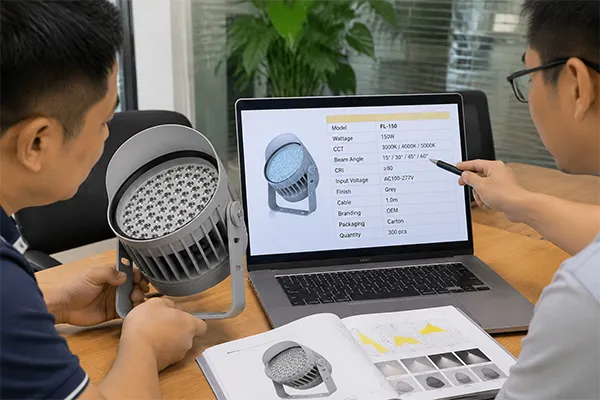
Document the Parameters That Affect the Delivered Product
At Upward Lighting, we provide OEM and ODM support because many buyers need more than a standard stock configuration. A distributor may require a specific surface color. A local brand may need its own label and packaging. A contractor may need a particular color temperature or beam angle for a defined project.
The important point is not simply whether customization is available. The important point is whether the requested configuration is clearly recorded and confirmed.
We suggest buyers ask for an order confirmation or specification sheet that includes, where applicable:
- Product model and housing style
- Rated wattage
- Input voltage and frequency
- Color temperature, such as 3000K, 4000K, 5000K, or 6500K
- Beam angle
- CRI requirement, when color rendering is important to the application
- Housing finish and visible component colors
- Cable type, cable length, plug, or terminal arrangement
- Branding, label artwork, and carton marks
- Packaging quantity and pallet requirements
- Approved sample reference, if a sample was reviewed
- Delivery terms, quantity tolerance, and production timing
Do Not Leave “Standard” Undefined
The word “standard” causes avoidable confusion. One buyer may mean standard 6500K. Another may expect 4000K. One supplier may consider a short cable standard, while another uses a different length. A buyer may expect a black fixture from a product photograph, but production could be based on a different standard finish unless the finish is stated in writing.
We have seen buyers compare several quotations that appear identical because each says “100W LED floodlight.” In reality, the offers may differ in beam angle, input range, cable arrangement, driver configuration, packaging, or the level of customization included. A lower quote may reflect a different configuration rather than a better purchasing result.
A Practical Specification-Control Question
We recommend asking this direct question:
“Can you send us the final order specification and identify every parameter that differs from your standard catalogue version?”
That question gives the buyer a concrete way to detect assumptions before production begins. It also creates clearer accountability for both sides.
For application-critical work, buyers should keep approved documents with their purchase order records. The purchasing team, project manager, and receiving team can then compare the shipped goods against the same reference instead of relying on memory or informal chat messages.
Can a Sample Prove That a LED Flood Light Supplier Will Deliver Consistent Bulk Quality?
A sample is valuable because it lets buyers inspect appearance, mounting, light color, packaging, and general workmanship. Still, a sample is only one unit from one point in time. Buyers who treat it as complete proof of mass-production reliability may discover differences after the main shipment arrives. We encourage a deeper conversation about production controls.
A sample cannot by itself prove bulk consistency.5 Buyers should ask a LED flood light supplier how approved samples are linked to production records, incoming materials, assembly checks, aging procedures, labeling, packaging, and final inspection. The goal is to understand what process reduces variation between the approved sample and the delivered batch.
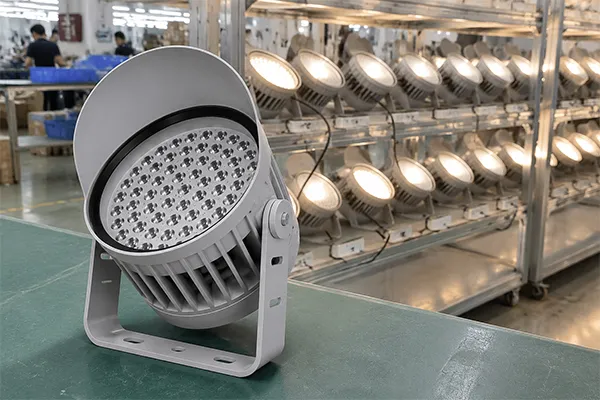
Ask About the Connection Between Sample Approval and Production
We consider sample approval a starting point for production alignment, not the end of buyer due diligence. A buyer should ask whether the approved sample is retained as a reference, photographed, coded, or otherwise linked to the production order.
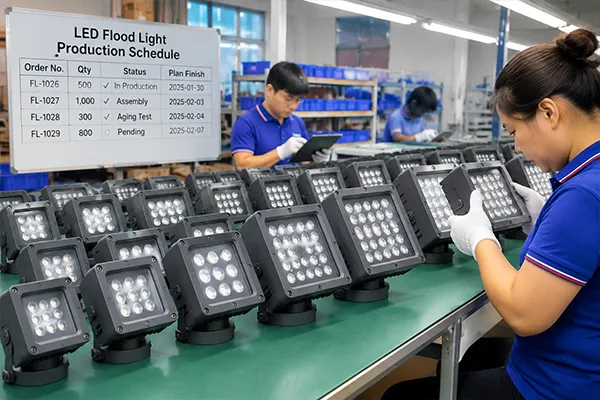
At our facility, products undergo a 100% aging test lasting between 4 and 8 hours before shipment, depending on the product and production arrangement. This process is part of our internal quality-control workflow. It does not guarantee performance in every site condition, installation method, electrical environment, or project application. However, it provides a defined checkpoint that buyers can discuss and verify as part of supplier evaluation.
A buyer can ask practical questions such as:
- Is each finished unit powered during the aging process?
- What product identification connects the batch to the purchase order?
- How does the factory check that labels and cartons match the approved configuration?
- How are customized CCT, wattage, finish, or branding requirements separated from standard orders?
- What happens when a unit does not pass the factory’s internal check?
- Can the supplier provide production photos, inspection records, or pre-shipment communication where appropriate?
Evaluate Process Transparency, Not Perfect Promises
We recommend caution when a supplier gives broad claims such as “zero defects” or “no failures.” Manufacturing involves materials, assembly, transport, installation, and operating conditions. No responsible supplier should present internal checks as proof that every unit will perform identically in every real-world situation.6
Instead, buyers should look for clear and specific process explanations. A supplier should be able to explain what it checks, when it checks it, and how it handles deviations.
| Evaluation Area | Useful Buyer Question | Buyer Risk Addressed |
|---|---|---|
| Approved sample | How is the sample configuration recorded for bulk production? | Bulk product differs from the approved unit |
| Aging test | Is every finished unit included in the aging process? | Unclear pre-shipment quality-control process |
| Appearance check | How are finish color, labels, and branding verified? | Inconsistent brand presentation |
| Packaging check | How do you confirm carton marks and packing quantity? | Warehouse receiving and distribution errors |
| Custom orders | How are custom parameters identified on the production order? | Standard configuration shipped by mistake |
Plan a Receiving Inspection Too
Buyers also need their own inspection plan. We suggest checking a reasonable sample of the delivered batch against the approved specification when goods arrive. The receiving team can verify model numbers, visible finish, labels, carton marks, quantities, and obvious physical condition before the products are distributed or installed.
For large or application-sensitive orders, buyers may choose to arrange third-party inspection7 or appoint a qualified representative. That decision depends on order value, risk tolerance, destination requirements, and internal procurement policy.
Which Documents Should You Verify With a LED Flood Light Supplier?
Many buyers ask first, “Do you have CE?” or “Do you have RoHS?” These are valid questions, especially for market-entry and customer-documentation purposes. Yet a certificate alone does not establish that a particular floodlight configuration fits the intended application, meets every local rule, or will be delivered consistently8. Buyers should review documents in context.
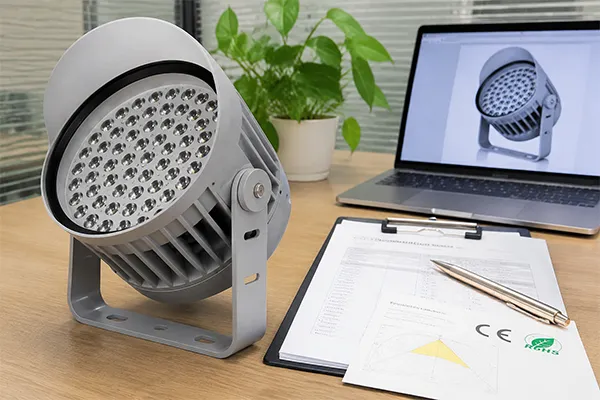
You should ask a LED flood light supplier for relevant compliance documents and verify that they relate to the product, destination market, and current order configuration. CE, RoHS, and similar documents may support specific regulatory or customer requirements9, but buyers should separately evaluate application suitability, document relevance, supplier capability, and local compliance obligations.

Separate Compliance From Product Suitability
At Upward Lighting, our products hold certifications such as CE and RoHS. Buyers should review the relevant documents and confirm their applicability to the products and markets involved. We do not present these documents as universal proof of product quality or as automatic approval for every country, project, or installation.
A certificate may be relevant to a market-entry discussion, but it does not answer every procurement question. It does not automatically confirm:
- The correct beam angle for a site
- The preferred CCT for an end user
- The suitability of mounting hardware for a specific structure
- Compatibility with local wiring and installation practices
- The availability of a customized model
- The consistency of the next production batch
- The customer’s own tender or project-document requirements
Market requirements can change and may differ by country, buyer type, application, and sales channel.10 We recommend that buyers verify local regulatory obligations with their importer of record, local compliance specialist, qualified electrician, testing body, or legal adviser where needed.
Review the Document Against the Actual Order
Buyers should compare the documents with the item they plan to buy. This review does not require laboratory authority. It requires careful procurement discipline.
We suggest checking:
- Product identification: Does the model reference align with the quoted product or product family?
- Document holder: Is the supplier or manufacturer clearly connected to the document?
- Scope and date: Is the document current enough for the buyer’s internal requirements?
- Configuration relevance: Does a customized wattage, driver, or electrical arrangement require additional confirmation?
- Destination requirements: Does the target market require other documentation, labels, declarations, or testing?
- Order records: Are the final specifications and compliance documents stored together?
Ask About Delivery and Communication Documents Too
Documentation is broader than certificates. A dependable supplier should also clarify commercial records that affect delivery and accountability:
- Quotation validity period
- MOQ for standard and customized products
- Sample timing and bulk-order lead time
- Deposit and balance-payment terms
- Packaging details
- Shipping terms and destination port or address
- Proforma invoice and order confirmation
- Label and carton-mark approval
- Communication contact for production updates
We have found that documentation gaps often create more purchasing friction than product questions. For example, a buyer may approve a technical sample but delay shipment because final artwork, carton marks, or destination paperwork was never confirmed.
How Can You Evaluate a LED Flood Light Supplier Beyond the Unit Price?
The lowest quotation can look attractive during initial comparison, especially when several suppliers use similar product descriptions. However, a low unit price can hide different assumptions about product configuration, MOQ, packaging, delivery, or service11. Buyers need a comparison method that captures the full procurement cost and risk.
You can evaluate a LED flood light supplier beyond unit price by comparing the complete commercial and operational offer: confirmed specification, MOQ, sample process, customization ability, communication speed, production timing, packaging, payment terms, documents, and post-shipment accountability. A comparable quotation should reflect comparable requirements.
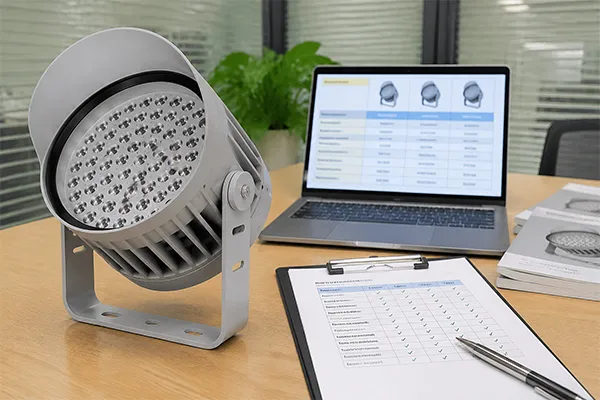
Compare Like for Like
We recommend building a simple supplier comparison sheet before making a decision. This prevents a buyer from comparing one supplier’s basic standard configuration with another supplier’s customized, documented offer.
| Comparison Point | Supplier A | Supplier B | Why It Matters |
|---|---|---|---|
| Confirmed wattage and CCT | Prevents specification mismatch | ||
| Beam angle and CRI stated | Supports application review | ||
| MOQ | Affects inventory and cash flow | ||
| Sample cost and timing | Supports product approval planning | ||
| Custom branding support | Important for private-label programs | ||
| Bulk production lead time | Reduces delivery disruption | ||
| Aging and inspection explanation | Helps assess process transparency | ||
| Compliance documents available | Supports buyer-side verification | ||
| Packaging details | Affects logistics and channel readiness | ||
| Communication response time | Reduces decision and production delays |
Consider the Cost of Unclear Communication
For importers, distributors, and project buyers, slow or vague communication can become a commercial risk. An unanswered question about carton marks, a missing revised quotation, or an unclear delivery date can affect customer commitments downstream.
Our team aims to provide rapid quotation responses and clear follow-up because we know buyers often coordinate several moving parts: internal approvals, customer expectations, shipping bookings, warehouse planning, and local installation schedules. Still, buyers should evaluate this capability directly during the inquiry stage.
We suggest observing:
- Does the supplier ask useful questions about the application?
- Does the supplier identify assumptions instead of hiding them?
- Does the quotation clearly state what is included?
- Does the supplier provide revisions when requirements change?
- Does the supplier explain MOQ and lead-time impacts of customization?
- Does the supplier give one accountable contact for the order?
Use Small Orders Strategically
Small-batch orders can help buyers evaluate a supplier before committing to a larger program.12 They are especially useful for distributors testing a local market, contractors reviewing a product for a new customer, or brands developing an OEM lighting line.
At the same time, buyers should confirm whether the small order uses the same production process, materials, and specification controls expected for future bulk orders. A successful trial order should lead to a documented path for repeat purchasing, not a new round of assumptions each time.
Frequently Asked Questions
What is the most important question to ask a LED flood light supplier?
We believe the most important question is: “How will this product be specified for our actual application?” The answer should cover installation environment, mounting height, target lighting effect, wattage, beam angle, CCT, electrical requirements, and order-specific customization. This reduces the risk of buying a technically unsuitable product.
Are CE and RoHS documents enough to approve LED floodlights?
No. CE and RoHS documents may be relevant to certain market-entry or customer requirements, but buyers should verify document relevance for their product and destination market. They should also assess application fit, installation requirements, order consistency, commercial terms, and local compliance obligations with qualified local support where needed.
Should I approve a LED floodlight sample before placing a bulk order?
Yes, a sample can help you evaluate appearance, mounting, light color, and general configuration. However, you should also ask how the supplier links the approved sample to bulk production, aging procedures, labeling, packaging, and final inspection. A sample alone does not prove batch consistency.
What details should appear on a LED floodlight order confirmation?
An order confirmation should state the model, wattage, input voltage, CCT, beam angle, CRI where relevant, housing finish, cable details, labels, branding, packaging, quantity, delivery terms, and any approved customization. Buyers should review these details before production begins.
How should I compare LED floodlight quotations from different suppliers?
You should compare quotations only after aligning the specification. Review product parameters, MOQ, packaging, compliance documents, sample process, customization scope, production lead time, payment terms, shipping terms, and communication quality. A lower price may reflect a different product configuration or a different level of service.
Conclusion
Selecting a LED flood light supplier requires more than finding a competitive price or collecting a certificate. We recommend that buyers begin with the installation and desired lighting result, then require a documented specification, a clear explanation of bulk-production controls, and relevant documents for buyer-side verification. A strong supplier relationship depends on shared expectations, responsive communication, and transparent commercial planning. If you are sourcing floodlights for a project, distribution program, or private-label range, contact our team to discuss your required configuration and quotation details.
"CALiPER Application Summary Report 20: LED PAR38 Lamps", https://www1.eere.energy.gov/buildings/publications/pdfs/ssl/caliper_20_summary.pdf. Government lighting guidance explains that wattage measures electrical power consumption, whereas useful lighting selection also depends on light output and application-specific performance characteristics. Evidence role: general_support; source type: government. Supports: Lighting-selection guidance distinguishing wattage from light output and application-specific lighting performance.. Scope note: The guidance supports the general distinction between wattage and lighting suitability; it does not determine the correct fixture for a particular site. ↩
"CSU-Sports-Lighting-Environmental-Impact. ...", https://source.colostate.edu/wp-content/uploads/2016/01/CSU-Sports-Lighting-Environmental-Impact.pdf. Sports-lighting design guidance identifies illuminance calculations, luminaire location and aiming, and glare limitation as interrelated considerations in recreational and competitive lighting installations. Evidence role: general_support; source type: institution. Supports: Technical guidance showing that sports-area lighting design considers illuminance, luminaire placement, aiming, and glare.. Scope note: Specific criteria vary with the sport, competition level, venue geometry, and applicable local standards. ↩
"An Investigation of LED Street Lighting's Impact on Sky Glow", https://www.energy.gov/sites/prod/files/2017/05/f34/2017_led-impact-sky-glow.pdf. Photometric guidance shows that beam distribution and fixture aiming determine how luminous flux is distributed across a target plane, affecting both coverage uniformity and light outside the intended area. Evidence role: mechanism; source type: research. Supports: Photometric evidence that a luminaire's beam distribution and aiming affect the spatial distribution of illuminance and potential spill light.. Scope note: Actual coverage depends additionally on mounting height, fixture optics, orientation, reflectance, and surrounding obstructions. ↩
"human response to architectural lighting: a systematic review", https://ufdcimages.uflib.ufl.edu/UF/E0/05/92/69/00001/Gavrina_A.pdf. Lighting research indicates that correlated color temperature can influence perceived ambience and user preference, making its selection dependent on the intended setting and visual objective. Evidence role: general_support; source type: paper. Supports: Research or professional guidance linking correlated color temperature to visual ambience and user preference in indoor and architectural settings.. Scope note: Preference findings are context- and population-dependent and do not establish one universally suitable color temperature for hospitality or architectural projects. ↩
"What kinds of Lot Acceptance Sampling Plans (LASPs) are ...", https://www.itl.nist.gov/div898/handbook/pmc/section2/pmc22.htm. Statistical acceptance-sampling guidance explains that inspection of a sample provides probabilistic information about a lot and cannot by itself guarantee the conformity of every unit in bulk production. Evidence role: mechanism; source type: government. Supports: Statistical quality-control principles showing that sample inspection provides evidence about, but cannot guarantee, the quality of an entire production lot.. Scope note: The strength of inference depends on the sampling plan, lot size, defect definition, and manufacturing-process stability. ↩
"A Methodology for Testing - Life-Cycfe Performance of", https://nvlpubs.nist.gov/nistpubs/Legacy/IR/nbsir76-1157.pdf. Reliability research on LED systems indicates that temperature, electrical stress, environmental exposure, and installation conditions can affect field performance beyond what routine production testing alone can establish. Evidence role: general_support; source type: research. Supports: Reliability evidence that product performance is affected by operating and environmental conditions beyond routine factory inspection.. Scope note: This evidence supports the general limitation of factory testing; it does not evaluate the quality-control procedures or field performance of any particular supplier. ↩
"Inspection", https://thedocs.worldbank.org/en/doc/735641553266058843-0090022019/original/Section6Inspection.pdf. Conformity-assessment guidance describes third-party inspection as evaluation performed by an independent body, which can provide an additional check against specified requirements before acceptance or shipment. Evidence role: definition; source type: institution. Supports: Conformity-assessment guidance defining independent third-party inspection as an external assessment activity.. Scope note: Third-party inspection scope, sampling, and authority are defined by the inspection contract and do not replace the buyer's own specification and acceptance procedures. ↩
"CE marking", https://en.wikipedia.org/wiki/CE_marking. Conformity-assessment principles distinguish evidence of conformity with specified requirements from separate judgments about fitness for a particular use, local installation obligations, and consistency of subsequent production. Evidence role: general_support; source type: institution. Supports: Conformity-assessment principles distinguishing documented conformity to stated requirements from fitness for a particular application and ongoing production control.. Scope note: The exact evidentiary value of a certificate depends on its scope, issuing body, product identification, applicable rules, and any accompanying production-control arrangements. ↩
"EU WEEE_RoHS", https://www.trade.gov/eu-weeerohs. European Union guidance states that CE marking indicates a manufacturer's declaration of conformity with applicable EU requirements, while the RoHS framework restricts specified hazardous substances in electrical and electronic equipment. Evidence role: definition; source type: government. Supports: Official definitions of CE marking and the EU RoHS framework for electrical and electronic equipment.. Scope note: Applicability depends on the product, applicable legislation, economic operator responsibilities, and the market in which the product is placed. ↩
"Foreign Regulations", https://www.trade.gov/foreign-regulations. International trade guidance recognizes that technical regulations, standards, labeling rules, and conformity-assessment procedures may differ by destination market and are subject to regulatory change. Evidence role: general_support; source type: institution. Supports: International trade or regulatory guidance showing that technical regulations and conformity requirements differ across markets and may be amended.. Scope note: This general principle does not identify the current requirements for a specific floodlight, destination country, or sales channel. ↩
"Quick Reference Guide Purchasing Policy", https://www.brookhavenga.gov/DocumentCenter/View/3979. Procurement guidance on total cost of ownership advises evaluators to consider specification compliance, logistics, operating implications, delivery, and other non-price terms in addition to the initial purchase price. Evidence role: general_support; source type: institution. Supports: Procurement guidance supporting comparison of total cost and non-price terms rather than unit price alone.. Scope note: The relevant cost factors and weighting depend on the buyer's procurement rules, contract structure, and intended application. ↩
"PART 46 – QUALITY ASSURANCE", https://www.acquisition.gov/dlad/part-46-%E2%80%93-quality-assurance. Supplier-development and quality-management literature describes pilot runs and initial limited production as means of evaluating process capability, communication, and conformance before broader production commitments. Evidence role: general_support; source type: paper. Supports: Supply-chain and quality-management evidence that pilot production or initial limited orders can inform supplier qualification before scale-up.. Scope note: A small order may not fully represent later bulk production unless materials, process controls, capacity, and specifications remain comparable. ↩