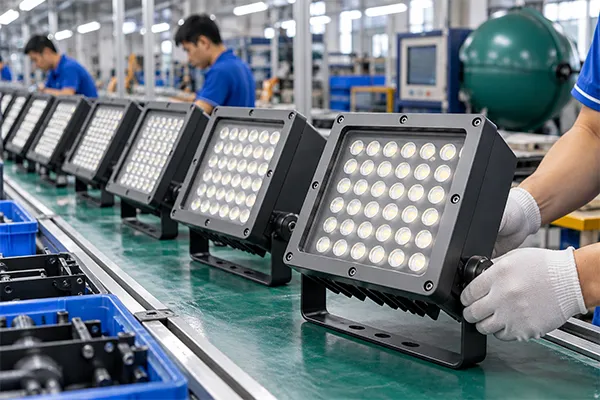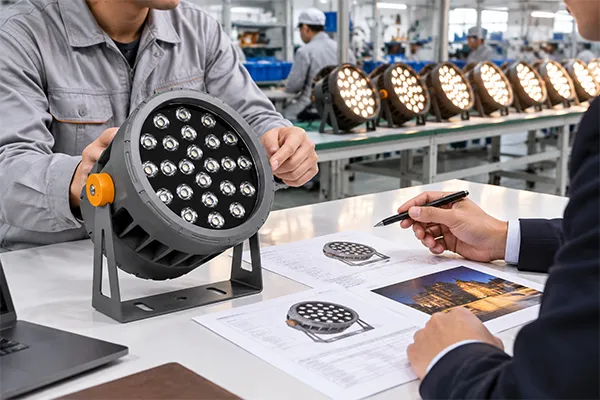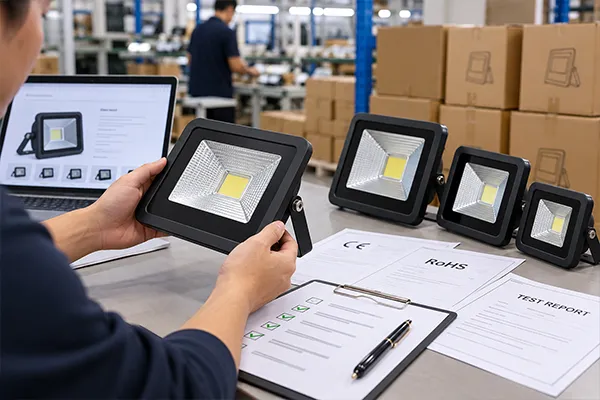

OEM LED flood light manufacturing in China can become difficult when buyers compare only wattage and unit price. A low quotation may hide mismatched specifications, unclear compliance documents, inconsistent production controls, or unsuitable packaging for the target market. I recommend treating the purchase as a supplier-selection and specification-control process, not a simple price negotiation.
OEM LED flood light manufacturing in China requires buyers to define the application, freeze approved specifications, verify compliance documents for the destination market, and review how the factory controls production consistency. The best sourcing decision is not necessarily the lowest-priced 100W flood light; it is the product and supplier combination that meets commercial, technical, branding, and repeat-order requirements.
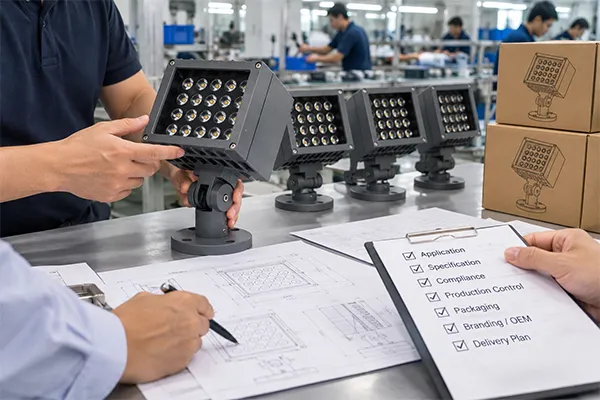
In my work with OEM and ODM flood light inquiries, I often see a short request such as, “Please quote your 100W flood light.” That is a reasonable starting point, but it is rarely enough to support a dependable quotation or production plan. The next sections explain the questions I believe buyers should ask before approving a supplier or placing a bulk order.
Why Should Buyers Start OEM LED Flood Light Manufacturing in China With an Application Brief?
Buyers often begin with a target wattage because it is easy to compare across catalogues. However, wattage alone does not explain where the flood light will be installed, what lighting result is required, or which market rules apply1. This can lead to samples that look acceptable but do not fit the real project or private-label product plan.
I recommend that buyers begin OEM LED flood light manufacturing in China with an application-led brief. The brief should confirm the installation environment, wattage, color temperature, beam angle, CRI, finish, mounting method, target quantity, and destination market. This information helps both sides evaluate suitable configurations and clarify performance trade-offs before quoting.
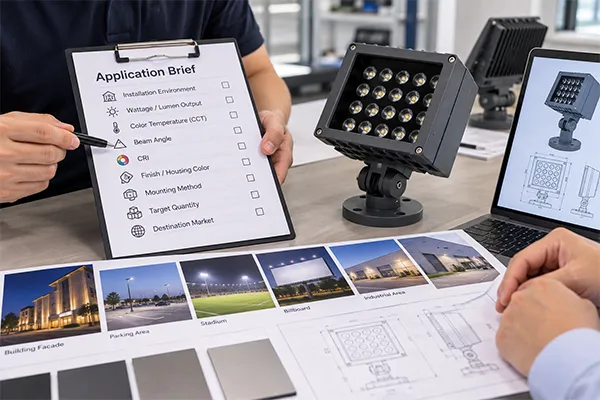
A “100W” Request Is Not a Complete Product Definition
A 100W LED flood light may be used for a warehouse exterior, small sports area, parking zone, construction site, façade, signboard, or general security lighting. These applications can require different optical distributions, mounting positions, glare control, color temperatures, ingress-protection expectations, and visual appearance.2
For example, a buyer may need a 100W unit for a parking area. In that situation, I would normally encourage the buyer to consider more than the power rating:
- Mounting height: A 3-meter installation creates different lighting needs from an 8-meter pole installation.
- Beam angle: A wider beam may suit close-range area lighting, while a narrower distribution may suit longer throw requirements.3
- Color temperature: A 3000K or 4000K option may be preferred for some architectural or residential contexts, while 5000K or 5700K may be requested for utility and security applications.
- Color Rendering Index: A higher CRI may matter where color recognition is important, but it can affect product configuration and cost.
- Installation conditions: Outdoor exposure, coastal environments, dust, vibration, and ambient temperature should all be considered.4
- Control requirements: Some projects may need basic on/off operation, while others may require photocells, sensors, dimming, or external control compatibility.
I have seen quotation discussions move much faster once a buyer shares a simple installation photo, product drawing, or target-market requirement. That material gives our team a practical basis for discussing the flood light instead of guessing what “100W” means.
Use a Procurement Brief Before Requesting Quotations
I suggest that importers and private-label managers prepare a short request-for-quotation document. It does not need to be complex. A one-page checklist can reduce misunderstandings and make supplier quotations easier to compare.
| Item to Confirm | Example Buyer Requirement | Why It Matters |
|---|---|---|
| Application | Parking area, exterior façade, sports court | Guides optical and installation recommendations |
| Wattage | 50W, 100W, 150W, 200W | Establishes the starting configuration |
| Input voltage | AC 100–277V or market-specific voltage | Must fit the intended electrical system |
| Color temperature | 3000K, 4000K, 5000K | Affects visual appearance and market preference |
| Beam angle | 60°, 90°, 120° | Influences light distribution |
| CRI | Ra 70, Ra 80, or project requirement | Supports visual-quality expectations |
| Housing finish | Black, grey, custom RAL color | Supports branding and site appearance |
| Branding | Logo, label, carton artwork | Defines OEM scope |
| Destination market | UK, UAE, Canada, Australia, etc. | Helps identify documents and labeling to review |
| Order plan | Sample, trial order, annual forecast | Helps assess commercial feasibility |
The purpose is not to make procurement slower. The purpose is to reduce avoidable revisions after a sample is already made or a production order is underway.
I believe a detailed RFQ is one of the lowest-cost risk-control tools available to a flood light buyer.
What Does OEM LED Flood Light Manufacturing in China Actually Include?
Many buyers use “OEM” to mean adding a logo to an existing product. Logo printing can be part of an OEM order, but it is only one element. A stronger OEM process defines what will be supplied, how it will look, how it will be labeled, and which approved sample or documents will serve as the production reference.
OEM LED flood light manufacturing in China should include a written agreement on technical specifications, product appearance, branding, labeling, packaging, and approved samples. Buyers should distinguish between simple private labeling and deeper customization, because each level has different cost, lead-time, tooling, and minimum-order implications.
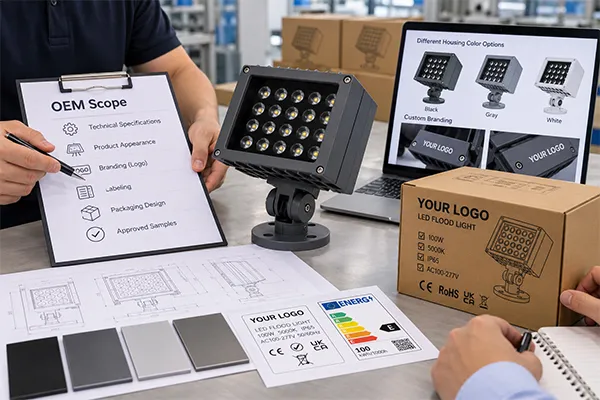
OEM Is a Specification-Control Process
In my experience, the smoothest OEM projects have a clear approval path. The buyer and supplier do not rely only on chat messages or an initial quotation. Instead, they create records that can be checked again before bulk production.
A practical OEM flood light approval package may include:
-
Technical specification sheet
This can list wattage, voltage, LED configuration, driver parameters, color temperature, beam angle, CRI, IP rating claim, cable length, mounting bracket, and other agreed items. -
Product appearance reference
This may include product photos, drawings, finish color references, logo position, label location, and visible hardware requirements. -
Label artwork
The label should be reviewed carefully. It may contain model number, electrical data, brand name, warnings, batch information, marks, and country-of-origin wording where appropriate. -
Packaging artwork and packing method
Buyers should confirm inner box design, master carton markings, barcode needs, carton quantity, and pallet requirements if relevant. -
Approved sample record
The buyer should confirm whether the sample is approved as a visual reference only or as a complete technical and packaging reference.
Compare Levels of Customization
Not every project needs full ODM development. In many cases, a standard flood light platform with controlled branding and selected parameters offers a practical balance between differentiation and commercial risk.
| Customization Level | Typical Scope | Buyer Consideration |
|---|---|---|
| Private label | Logo, label, carton artwork | Often suitable for distributors and wholesalers |
| Configured OEM | Wattage, CCT, beam angle, cable, finish, packaging | Requires clear technical confirmation |
| Appearance customization | Housing color, bracket design, selected visible parts | May involve additional development and MOQ review |
| ODM development | New housing, optics, structure, or feature set | Requires engineering review, tooling discussion, and longer planning |
At Upward Lighting, we can discuss parameters such as color temperature, wattage, beam angle, CRI, and surface finish colors according to project needs. However, I would not assume that every requested combination is commercially suitable until our team reviews the technical details, order quantity, components, and production schedule.
Freeze Changes Before Mass Production
Late changes are a common source of avoidable cost and delay. A buyer may approve a black housing sample, then request a different RAL color after cartons have been printed. Another buyer may approve a label but later need a different voltage marking for a new destination market.
I recommend setting a formal “specification freeze” point before production. At that stage, the buyer should confirm:
- Final product model and electrical configuration
- Branding files and placement
- Product labels and safety wording
- Carton artwork and shipping marks
- Sample approval status
- Quantity by SKU
- Inspection expectations
- Delivery address and shipping terms
This discipline does not remove all risk. It does give both parties a shared production reference.
How Should Buyers Verify CE, RoHS, and Other Flood Light Documents?
Compliance documents can be important to importers, distributors, and project contractors. However, a CE or RoHS document should not be treated as a universal passport for every country, tender, installation, or end use.5 The buyer must verify whether the documents apply to the exact product and the specific destination-market requirements.
Buyers should verify CE, RoHS, test reports, declarations, and related documents against the exact LED flood light model, configuration, and destination-market requirement. I recommend checking document scope, issuing organization, dates, product identifiers, and any project-specific rules rather than assuming a document automatically guarantees market access.
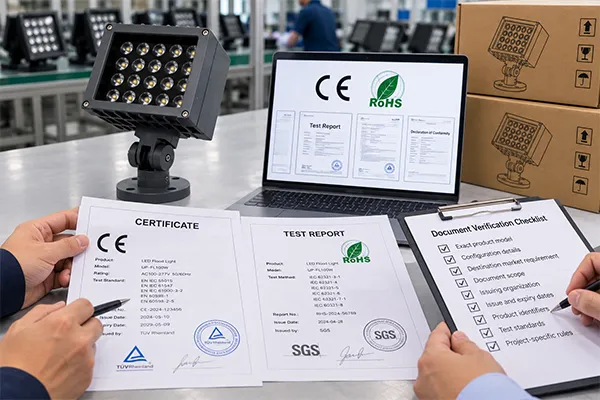
Ask the Right Questions About Documentation
At Upward Lighting, our products hold certifications such as CE and RoHS. These documents can support market-entry and environmental-compliance discussions for applicable products and markets. Still, I always believe the buyer should review the documents independently and determine whether they meet the requirements of the intended country, customer, project, or sales channel.
A careful buyer can ask the supplier:
- Which exact product model does this document cover?
- Does the model number match the quotation and sample?
- Does the report cover the requested voltage, wattage, driver, and product series?
- Who issued the document, and can the issuer be verified?
- What is the issue date, and is the documentation still relevant?
- Is there a Declaration of Conformity where required?
- Are there country-specific labeling, registration, testing, or importer obligations?
- Does the end customer or tender require additional third-party evidence?
Documents Must Match the Supplied Configuration
A key issue is configuration control. A certificate or report may reference one model, one driver arrangement, or one rated input.6 If the buyer requests a different wattage, new driver, revised housing, or market-specific cable, the buyer should ask whether the existing documentation remains applicable.
This is especially important for private-label procurement. A new brand label does not necessarily change the technical product. However, the importer may have legal, documentation, traceability, or labeling responsibilities in the destination market.7 A qualified compliance professional, local testing body, or legal adviser can help evaluate those responsibilities.
Build a Document-Verification File
I recommend that purchasing teams keep a simple compliance file for each SKU. This file can support future repeat orders, customer questions, and internal quality reviews.
| File Item | Buyer Checkpoint |
|---|---|
| Quotation | Exact model, configuration, Incoterms, quantity |
| Product specification | Wattage, voltage, CCT, CRI, beam angle, dimensions |
| Approval sample record | Photos, date, approved configuration |
| CE/RoHS documents | Scope, product match, issuer, date |
| Label artwork | Brand, model, warnings, ratings |
| Packaging artwork | SKU, barcode, carton marks |
| Inspection record | Quantity checked, findings, corrective actions |
| Shipping documents | Batch and shipment traceability |
I do not view compliance verification as paperwork for its own sake. I view it as part of supplier qualification and product-risk management.
How Can Buyers Control Consistency From Flood Light Sample to Bulk Order?
A sample can show whether a product appears suitable at one point in time. It does not, by itself, prove that every unit in a future production order will be identical8 or that the product will meet every application-specific performance expectation. Buyers need to understand the supplier’s controls from sample confirmation through assembly, aging, final inspection, and shipment.
To improve consistency in OEM LED flood light manufacturing in China, buyers should ask how approved specifications are transferred into production, how components and labels are controlled, what inspections occur before shipment, and how aging tests are used. A sample approval should be combined with documented production checkpoints and, where appropriate, independent inspection.
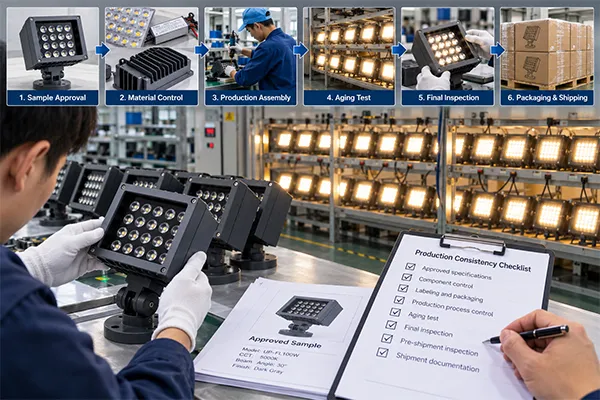
Ask About the Production-Control Sequence
I find that buyers receive better answers when they ask specific process questions rather than general questions such as, “How do you guarantee quality?” No factory can responsibly promise zero failures across every use condition. However, a supplier should be able to explain its own procedures, records, and checkpoints.
At our facility, products undergo a 100% aging test before shipment, typically lasting 4 to 8 hours, as part of our pre-shipment process. This process is intended to identify certain early functional issues before dispatch. It should not be interpreted as proof of full product lifetime, zero-defect output, or universal performance under every field condition.
A buyer can ask about the following checkpoints:
-
Incoming component controls
How does the factory identify drivers, LEDs, housings, cables, and other materials for the approved product configuration? -
Production instructions
Is there a production reference based on the approved sample, bill of materials, label artwork, and packing instructions? -
In-process inspection
Are workers or quality staff checking assembly, wiring, sealing, product appearance, and key functional steps? -
Aging-test procedure
What is the aging duration? Is the test conducted on every unit or selected samples? What happens when a unit fails during the test? -
Final inspection and packing
How are labels, carton quantities, accessories, and cosmetic appearance checked before shipment? -
Traceability
Can the supplier identify production batches or shipment records if an issue is reported later?
Consider a Pre-Shipment Inspection Plan
For larger orders, I suggest that buyers define inspection requirements before production starts. The buyer may use internal staff, a third-party inspection company, or an agreed factory inspection process.9 The best method depends on order value, risk level, technical complexity, and customer commitments.
A pre-shipment inspection plan can include:
- Quantity verification
- SKU and carton-marking checks
- Product appearance checks
- Label and logo review
- Accessory confirmation
- Basic functional checks
- Packaging-drop or carton-condition review where applicable
- Sampling level and acceptance criteria
- Photo documentation
I have found that clear inspection criteria reduce emotional disputes. Both parties can discuss facts, samples, records, and agreed requirements.
Plan for Repeat Orders, Not Just the First Shipment
The first order is important, but repeat-order consistency is often where supplier relationships are tested. Buyers should keep approved samples, specification files, artwork versions, and inspection records. I also recommend reviewing any component or packaging change before the supplier applies it to a repeat order.
A reliable long-term process includes regular communication about forecast changes, updated market requirements, customer feedback, and packaging revisions. This approach is more useful than expecting a supplier to guess what must remain unchanged.
Frequently Asked Questions
What is the minimum order quantity for OEM LED flood lights from China?
Minimum order quantities vary by product platform, branding requirement, packaging changes, and customization depth. I recommend asking for MOQ separately for standard products, logo printing, custom cartons, custom colors, and new tooling. Small trial orders may be possible in some cases, but buyers should confirm the commercial terms before planning a launch.
Is a CE certificate enough to sell LED flood lights in every country?
No. CE documentation is not an automatic approval for every country, project, or use case. Buyers should verify the document scope, product match, applicable regulations, labeling duties, and customer requirements for the destination market. I recommend consulting qualified local compliance professionals for application-specific decisions.
Does a 100% aging test guarantee LED flood light lifetime?
No. A 100% aging test can help identify certain early functional problems before shipment10, depending on the factory’s procedure. It does not prove lifetime performance, prevent every future failure, or replace application-specific testing.11 Buyers should ask how the test is performed and how test failures are recorded and handled.
What should I approve before bulk OEM flood light production?
I recommend approving the technical specification, product appearance, logo position, label artwork, packaging artwork, carton marks, accessories, and sample configuration. Buyers should also confirm inspection expectations, order quantities, delivery terms, and any destination-market documentation requirements before production begins.
How can I compare LED flood light supplier quotations fairly?
Buyers should compare quotations on a like-for-like basis. I recommend checking the exact wattage, voltage, driver, LED configuration, CCT, CRI, beam angle, housing finish, cable, branding scope, packaging, document availability, order quantity, lead time, and shipping terms. A lower price is meaningful only when the supplied configuration is equivalent.
Conclusion
OEM LED flood light manufacturing in China is most effective when buyers control specifications before comparing prices. I recommend starting with the installation application, documenting the full OEM scope, verifying CE, RoHS, and related documents for the actual target market, and reviewing the supplier’s sample-to-production quality process. At Upward Lighting, we support OEM and ODM discussions around flood light parameters, branding, packaging, and pre-shipment aging-test procedures. Contact our team with your product brief, target market, and order plan for a focused quotation and specification review.
"LED Basics", https://www.energy.gov/cmei/ssl/led-basics. LED wattage expresses electrical power consumption rather than, by itself, the delivered illumination or suitability of a luminaire for a particular installation; lighting performance also depends on output, distribution, and installation conditions. Evidence role: general_support; source type: government. Supports: That LED wattage measures electrical input power, while light output and suitability depend on factors such as lumens, distribution, installation conditions, and applicable requirements.. Scope note: The source provides general lighting guidance and does not assess a specific flood-light model or destination-market rule. ↩
"Understanding LM-79 Reports", https://betterbuildingssolutioncenter.energy.gov/sites/default/files/attachments/understanding_lm79_reports.pdf. Outdoor-lighting practice evaluates luminaire distribution, mounting geometry, glare, color characteristics, and environmental exposure in relation to the intended visual task and site conditions. Evidence role: general_support; source type: institution. Supports: That outdoor lighting design considers luminaire distribution, mounting geometry, glare, color characteristics, and environmental conditions in relation to the application.. Scope note: Design guidance identifies relevant factors but does not prescribe one configuration for every warehouse, parking, sports, or security application. ↩
"Understanding LM-79 Reports", https://betterbuildingssolutioncenter.energy.gov/sites/default/files/attachments/understanding_lm79_reports.pdf. A luminaire's beam angle and photometric distribution determine how its luminous flux is spread across an area, so narrower and wider distributions produce different coverage patterns at a given mounting position. Evidence role: mechanism; source type: education. Supports: That beam angle and photometric distribution determine how a luminaire spreads luminous flux over an illuminated area.. Scope note: The resulting illumination also depends on mounting height, aiming, lumen output, surrounding surfaces, and the site's geometry. ↩
"IP code", https://en.wikipedia.org/wiki/IP_code. IEC 60529 classifies the protection provided by enclosures against access, solid foreign objects, and water, supporting the need to match outdoor equipment to expected environmental exposure. Evidence role: general_support; source type: institution. Supports: That enclosure protection against access, solid foreign objects, and water is classified through the IEC IP Code and must be matched to expected exposure.. Scope note: IP ratings address specified ingress conditions and do not by themselves establish resistance to corrosion, vibration, ultraviolet exposure, temperature extremes, or all field conditions. ↩
"CE marking - Internal Market, Industry, Entrepreneurship and ...", https://single-market-economy.ec.europa.eu/single-market/goods/ce-marking_en. CE marking indicates conformity with applicable European Union requirements for products placed on the EEA market; it is not a general authorization applicable to all non-EEA jurisdictions or project-specific procurement rules. Evidence role: general_support; source type: government. Supports: That CE marking is used for products within the European Economic Area where applicable EU rules require it, and that legal requirements vary by product and jurisdiction.. Scope note: The applicable legislation depends on the product, intended market, economic operator, and use case, and may require jurisdiction-specific professional advice. ↩
"Preparing technical documentation - Your Europe", https://europa.eu/youreurope/business/product-rules-compliance/general-product-compliance/preparing-technical-documentation/index_en.htm. Conformity assessment and supporting technical documentation are product-specific: they must identify the product and provide evidence that the configuration placed on the market meets the applicable legal requirements. Evidence role: mechanism; source type: government. Supports: That EU conformity documentation and technical files must identify the product and demonstrate conformity with applicable requirements for the product placed on the market.. Scope note: Whether a particular component substitution or rating change invalidates existing evidence depends on the applicable legislation, standards, risk assessment, and the nature of the change. ↩
"CE marking - Internal Market, Industry, Entrepreneurship and ...", https://single-market-economy.ec.europa.eu/single-market/goods/ce-marking_en. Under the EU product-compliance framework, importers of regulated products have duties that can include verifying conformity procedures, ensuring required information accompanies the product, retaining documentation, and supporting traceability. Evidence role: general_support; source type: government. Supports: That EU importers have responsibilities to verify compliance, ensure required documentation and marking are present, and provide traceability information for regulated products.. Scope note: These duties are stated in the EU framework; obligations in other destination markets and for particular product categories may differ. ↩
"1C. Quality Assurance vs. Quality Control", https://nvlpubs.nist.gov/nistpubs/SpecialPublications/NIST.SP.1500-28pt1C.pdf. Quality-management practice treats product conformity as the result of controlled production processes, monitoring, and verification; an individual approved sample is not, on its own, evidence of conformity across a production population. Evidence role: general_support; source type: institution. Supports: That consistent production quality requires controlled processes, monitoring, and verification rather than reliance on an individual product sample alone.. Scope note: The source states general quality-management principles and does not measure the consistency of any named supplier's flood-light production. ↩
"Inspection", https://thedocs.worldbank.org/en/doc/735641553266058843-0090022019/original/Section6Inspection.pdf. Inspection may be undertaken by supplier, purchaser, or independent bodies, while ISO/IEC 17020 sets competence and impartiality principles for organizations performing inspection. Evidence role: definition; source type: institution. Supports: That inspection activities may be performed by different parties and that inspection-body competence and impartiality are addressed by ISO/IEC 17020.. Scope note: The standard addresses inspection-body operation and does not determine which inspection arrangement is commercially appropriate for a particular purchase order. ↩
"A Methodology for Testing", https://nvlpubs.nist.gov/nistpubs/Legacy/IR/nbsir76-1157.pdf. Burn-in screening is used in electronics reliability practice to expose certain early-life failures before deployment, thereby detecting some defects that may not be evident in an initial functional check. Evidence role: mechanism; source type: research. Supports: That burn-in or screening tests are used in electronics reliability practice to detect some early-life failures before field deployment.. Scope note: Its effectiveness depends on the stress conditions, duration, failure mechanisms, and test coverage; it cannot demonstrate the lifetime reliability of every unit. ↩
"Reliability technology for cardiac pacemakers III", http://nvlpubs.nist.gov/nistpubs/Legacy/SP/nbsspecialpublication400-50.pdf. Reliability engineering distinguishes production screening from life testing: a short pre-shipment burn-in may screen for selected early failures but does not establish service life, field failure rate, or performance under all operating environments. Evidence role: mechanism; source type: research. Supports: That screening tests and life tests serve different reliability purposes, and short-duration screening does not establish service life or field failure rates.. Scope note: The precise inference available from an aging test depends on its documented procedure, sample coverage, electrical and thermal stress, and the intended application. ↩