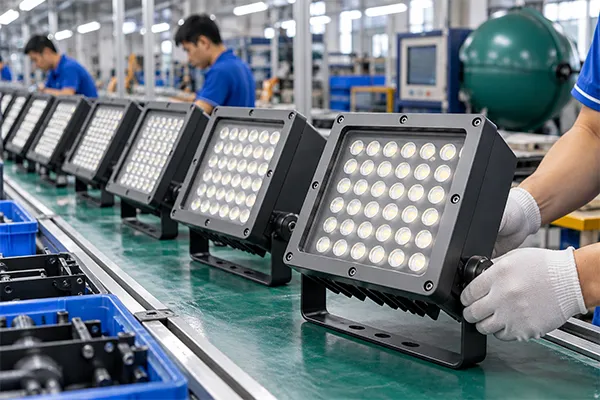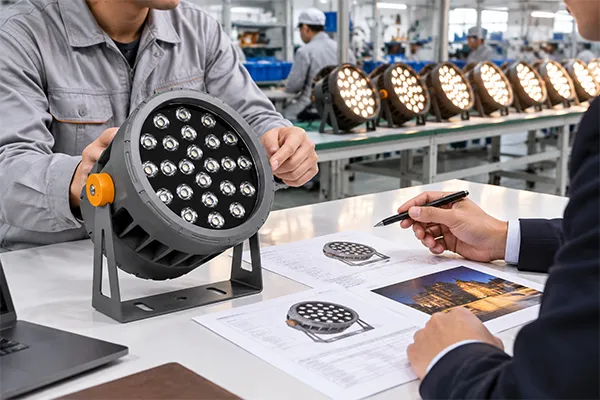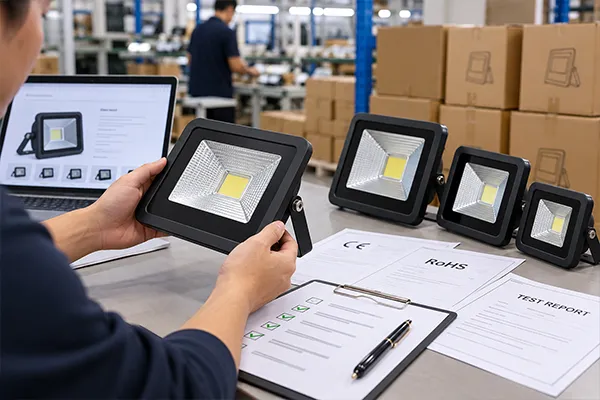

LED flood lights for government projects can look similar on a quotation sheet, yet the wrong choice can create costly problems with tender documents, sample approval, installation, inspection, or delivery timing. I have seen that price and wattage alone rarely reveal these risks. A structured specification and supplier review process helps buyers avoid them.
LED flood lights for government projects should be selected as part of a bid-to-delivery risk-management process, not as a simple wattage, lumen, or unit-price comparison. I recommend starting with tender requirements, defining the lighting task and installation conditions, verifying required documents, and confirming how the supplier will control samples, batch consistency, inspection, and delivery.

In our manufacturing work, we often receive RFQs that contain only a wattage, quantity, and target price. That information may be enough to begin a conversation, but it is not enough to responsibly confirm a deliverable floodlight solution. The details below explain how I would turn an early request into a clearer procurement checklist.
Why Should LED Flood Lights for Government Projects Start With Tender Documents?
When a buyer begins with a product catalog, important bid requirements can be missed. That gap can create stress later, especially when a contractor must submit technical files, samples, test reports, or production information on a fixed schedule. I recommend reviewing the tender package before comparing models.
For LED flood lights for government projects, the tender package should be the starting point because it defines the required performance, documentation, approvals, tests, delivery terms, and responsible parties1. Buyers should convert these requirements into a checklist before requesting final quotations or approving a proposed model.
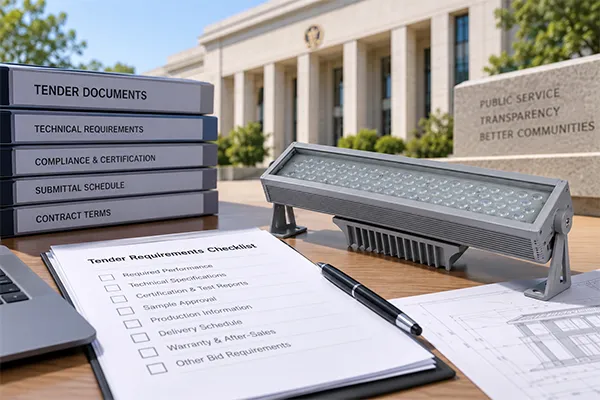
Turn the Tender Into a Requirement Matrix
I find that the most useful first step is to create a simple requirement matrix. This document does not need to be complicated. Its purpose is to make every requirement visible and assign an owner for each action.
A government or public-sector tender may request some combination of:
- Product datasheets and dimensional drawings
- Electrical specifications, including voltage and frequency
- Rated wattage, luminous flux, efficacy, CCT, CRI, and power factor
- IP rating, IK rating, surge protection, and operating temperature information
- Photometric files, such as IES or LDT files
- Material descriptions, housing finish, mounting bracket details, and cable length
- Sample submission and sample approval requirements
- Factory inspection, pre-shipment inspection, or third-party inspection arrangements
- Packaging, labeling, palletization, and shipping-mark requirements
- Warranty wording and spare-parts expectations
- Certificates, declarations, and test documents specified by the project
At Upward Lighting, I would review these points against the actual product configuration before making a final commitment. We can support OEM/ODM adjustments such as wattage, color temperature, beam angle, CRI, and surface finish. However, I believe it is important to separate what we can manufacture from what must be approved by the project team, consultant, local authority, or qualified professional.
Verify Documents Against the Actual Configuration
A common procurement risk appears when a general certificate or report is treated as proof that every customized version meets every project requirement2. I do not recommend this assumption.
Our products can be supplied with documents such as CE and RoHS documentation where applicable. Buyers should still verify whether the exact documents, standards, report scope, issuing body, product model, and validity period match the current tender and destination market. CE and RoHS are not universal evidence of government-project compliance, local electrical-code compliance, or tender acceptance.3
| Checklist Item | Buyer Question | Typical Responsible Party |
|---|---|---|
| Product performance | Does the proposed model meet the stated technical schedule? | Supplier and project technical reviewer |
| Lighting calculation | Does the layout achieve the required illumination and uniformity? | Qualified lighting designer or engineer |
| Local regulation | Does the product meet local installation and market requirements? | Local code consultant, contractor, or authority |
| Product documents | Are reports and declarations relevant to the exact model? | Supplier, verified by buyer |
| Tender submission | Are all forms and attachments complete and on time? | Bidder or contractor |
| Final acceptance | Does the delivered installation meet project conditions? | Project approver and relevant stakeholders |
I have learned from contractor and channel-partner feedback that document gaps are often discovered late, after a supplier has already been compared mainly on price. A better process identifies those gaps before a bid is submitted or a purchase order is released.
How Do Installation Conditions Shape LED Flood Lights for Government Projects?
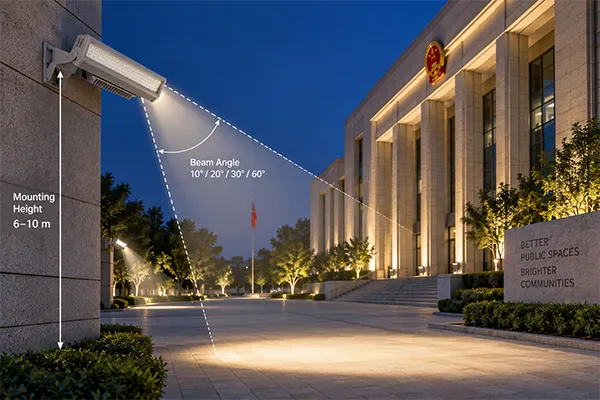
A floodlight may have an attractive wattage, output figure, and price, but those figures do not tell us whether it will illuminate the intended area correctly. Poor beam selection or mounting assumptions can produce glare, dark zones, uneven coverage, or unnecessary energy use. I always ask how and where the product will be installed.
LED flood lights for government projects should be configured around the lighting task, mounting height, target area, beam distribution, site environment, and control approach. Wattage is only one input.4 A qualified lighting designer or engineer should confirm application-specific lighting calculations and installation suitability.
Define the Lighting Task Before Selecting the Model
Public and municipal applications can include very different lighting tasks. A floodlight for a building façade does not necessarily suit a parking area, pedestrian zone, sports perimeter, port facility, public square, or maintenance yard.
Before I prepare a meaningful quotation, I try to collect the following information:
- Target area dimensions: Length, width, obstructions, and adjacent spaces matter.
- Mounting position: I need to know whether the fixture will be wall-mounted, pole-mounted, bracket-mounted, or installed on an existing structure.
- Mounting height and tilt angle: These factors strongly affect coverage and glare.
- Required lighting objective: The project may prioritize security, orientation, architectural emphasis, operational visibility, or a stated illuminance target.
- Operating duration: A fixture running several hours nightly has different maintenance and control considerations than one used occasionally.
- Ambient conditions: Temperature, rain, dust, coastal exposure, vibration, and corrosive conditions can affect the suitable construction.
- Power and controls: Voltage, frequency, dimming, photocells, timers, and external control systems should be identified early.
Compare Beam Distribution, Not Just Lumen Output
Two floodlights with a similar rated wattage can perform very differently after installation. Their optics, beam angles, mounting positions, and aiming directions may send light to different places.5
For example, a wide beam may cover a short, broad area at a lower mounting height. A narrower beam may be more suitable for reaching a more distant target from a higher point. Neither option is automatically “better.” The correct choice depends on the lighting layout.
| Project Factor | Why It Matters | Procurement Action |
|---|---|---|
| Mounting height | Changes beam spread and target illumination | Confirm dimensions on drawings or site survey |
| Beam angle | Influences coverage, spill light, and glare | Request relevant optical data |
| Pole spacing | Affects uniformity between fixtures | Ask for a lighting layout from a qualified designer |
| [Site environment | Influences corrosion and ingress-protection needs](https://www.nist.gov/programs-projects/metrology-accelerated-laboratory-weathering)%%%FOOTNOTE_REF_6%%% | Confirm environmental exposure |
| [Surrounding residences or roads | May increase glare and spill-light concerns](https://darksky.org/resources/what-is-light-pollution/light-pollution-solutions/lighting/my-neighbors-lighting/)%%%FOOTNOTE_REF_7%%% | Review aiming and shielding requirements |
| Existing electrical system | Determines voltage and connection suitability | Verify with electrical professionals |
From our customer-provided context, contractors supporting public-area projects often face the same late-stage issue: a proposed floodlight is technically available, but the intended mounting layout was never clearly confirmed. I consider it safer to identify this before production rather than trying to solve it after fixtures arrive at the site.
I can provide product data and discuss manufacturable configurations. I would not replace a qualified lighting designer, electrical engineer, code consultant, or project approver. Those professionals should evaluate the final layout, applicable standards, wiring method, protection devices, and installation safety.
What Should a Floodlight Delivery Checklist Include Before Quotation?
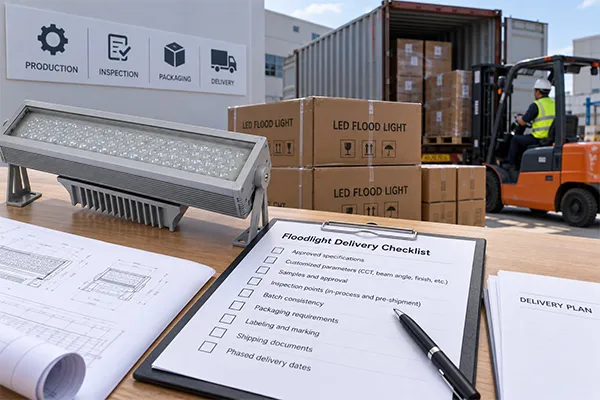
A quotation can be commercially competitive and still be operationally incomplete. Missing details about samples, finish color, labeling, inspection, or delivery batches can cause delays after an order is awarded. I use a delivery checklist to convert technical discussions into a practical manufacturing plan.
Before ordering LED flood lights for government projects, buyers and suppliers should agree on a delivery checklist covering approved specifications, customized parameters, samples, inspection points, batch consistency, packaging, labeling, shipping documents, and phased delivery dates. This process reduces ambiguity between bid award and site delivery.
Confirm the Exact Bill of Requirements
In manufacturing, small wording differences can change the product that must be made. “Black floodlight,” for example, may require confirmation of the specific finish expectation. “Warm white” should be tied to a requested CCT range. “Outdoor use” should be supported by clearly stated environmental and construction requirements.
I recommend confirming the following points in a written order specification:
- Product model and product photograph
- Rated wattage and input voltage
- Color temperature and acceptable tolerance
- CRI requirement
- Beam angle or optical distribution
- Housing color and surface-finish expectation
- IP, IK, surge-protection, and cable requirements where specified
- Bracket, mounting accessory, and fastener requirements
- Logo, label, barcode, and carton-marking requirements
- Quantity by model and by shipment phase
- Required documents and submission deadlines
- Sample approval status
- Inspection method and acceptance criteria
- Delivery destination, Incoterm, and required arrival date
At Upward Lighting, we support customization for parameters including CCT, wattage, beam angle, CRI, and finish colors. I would still advise buyers to lock the agreed parameters before mass production. Changes after material preparation can affect lead time, component availability, document consistency, and cost.8
Build Sample Approval Into the Schedule
A sample is more than a visual reference. It can become the shared benchmark for appearance, mounting details, labeling, packaging, and functional expectations.9 The buyer should decide whether the project requires a product sample, a pre-production sample, a golden sample, or another formal approval process.
I have found that the most practical schedule separates these stages:
| Stage | Main Purpose | Buyer Check |
|---|---|---|
| Technical review | Confirm specification feasibility | Compare supplier offer with tender matrix |
| Sample stage | Confirm visible and functional details | Record approval comments in writing |
| Pre-production confirmation | Freeze mass-production configuration | Check labels, accessories, and packaging |
| Mass production | Manufacture approved configuration | Monitor agreed production timeline |
| Inspection | Check defined quality criteria | Confirm inspector and reporting format |
| Shipment release | Authorize delivery | Verify shipping documents and carton marks |
We conduct a 100% aging test of 4 to 8 hours before shipment as part of our normal production quality-control process. I see this as one useful manufacturing control, not as a substitute for project-specific inspections, site testing, or contractual acceptance procedures. Buyers should define any additional test, inspection, witness point, or third-party verification in advance.
Plan for Batch Consistency and Phased Delivery
Large public projects may require multiple delivery stages. A contractor may need initial quantities for installation, later quantities for additional areas, or replacement units for commissioning. The supplier should understand whether later batches must match the first approved sample in appearance and configuration10.
For phased projects, I recommend confirming:
- Whether the same LED source and driver configuration must be maintained
- Whether the same housing color and surface texture must match
- Whether replacement units must remain available after initial delivery
- Whether each shipment needs separate inspection or documents
- Whether the site has storage restrictions or delivery windows
- Whether packaging must support distribution to multiple installation zones
This planning reduces the risk of a project team receiving a technically similar but visibly inconsistent product later in the schedule.
How Can Buyers Evaluate a Supplier Beyond Price?
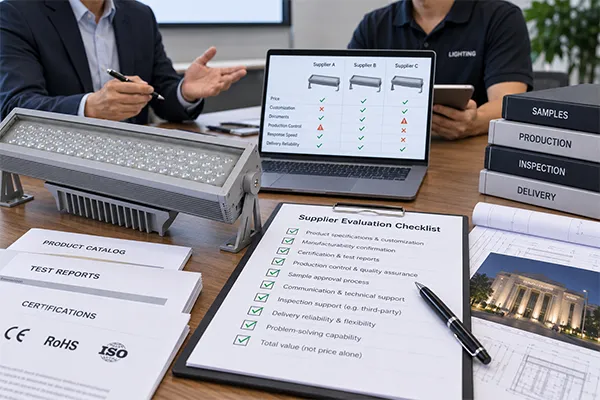
Low unit price can be attractive in a tender, but it does not show how a supplier handles customization, documents, production control, communication, or delivery changes.11 Buyers need to assess whether the supplier can reduce execution friction after the purchase order is issued.
The best supplier for LED flood lights for government projects is not necessarily the lowest-priced supplier. I recommend evaluating whether the supplier can clearly confirm manufacturability, provide relevant documentation, maintain production consistency, respond quickly to questions, support inspections, and identify project gaps before they become delivery problems.
Review Communication Quality During the RFQ Stage
In my experience, the RFQ stage provides useful evidence about how a supplier may perform later. A supplier that gives only a price may not have reviewed the full technical and delivery requirements. A supplier that asks specific questions may be trying to prevent avoidable mistakes.
Useful supplier-review questions include:
- Does the supplier identify missing information rather than making silent assumptions?
- Does the supplier distinguish standard product features from custom requirements?
- Does the supplier explain which documents are available for review?
- Does the supplier state what needs project-side verification?
- Does the supplier provide clear lead-time assumptions?
- Does the supplier have a defined sample and approval process?
- Does the supplier accept reasonable inspection arrangements?
- Does the supplier explain packaging and shipment options clearly?
I believe buyers should value transparent limitations. For example, I would rather state that a requested report needs verification or that a custom configuration requires additional lead time than create an unrealistic expectation.
Assess Manufacturing and Quality-Control Discipline
A supplier review should also consider whether the factory has repeatable controls. Buyers do not need to assume that every factory follows the same process. They should ask for evidence relevant to the order.
At Upward Lighting, we are an LED lighting manufacturer based in Zhongshan City, China, established in 2009. We serve contractors, brands, wholesalers, importers, distributors, traders, and electrical or building-material channel partners across international markets. Our team supports small-batch orders as well as customized project discussions, and we conduct aging tests before shipment.
For procurement evaluation, I would encourage buyers to ask every potential supplier about:
| Evaluation Area | Evidence to Request |
|---|---|
| Product identity | Datasheet, drawings, model coding, product photos |
| Customization control | Written specification confirmation and sample process |
| Quality process | Inspection flow, aging-test description, QC records where available |
| Batch traceability | Labeling or production-batch identification approach |
| Documents | Relevant declarations, reports, and document scope |
| Delivery capability | Lead-time breakdown, packaging plan, and shipping readiness |
| Communication | Response quality during technical clarification |
Separate Supplier Support From Approval Responsibility
This distinction matters in public-sector procurement. I can support product selection discussions, quotation clarification, manufacturing feasibility, sample preparation, quality-control communication, and shipment preparation. However, I cannot promise that a tender will be accepted, that a local authority will approve a product, or that a completed installation will meet every application-specific obligation.
The contractor, bidder, consultant, engineer, and project approver each have their own responsibilities. Buyers should verify current tender documents, local requirements, contractual obligations, and design assumptions with qualified professionals.
That clear division of responsibility protects the project. It also helps suppliers focus on what they can genuinely control: producing the agreed floodlight configuration consistently and preparing the agreed order for delivery.
Frequently Asked Questions
Are CE and RoHS documents enough for government floodlight tenders?
No. CE and RoHS documents may be relevant to certain market-entry, safety, or environmental requirements, but they are not universal proof of tender compliance. I recommend verifying the exact tender requirements, document scope, applicable standards, model coverage, and destination-market obligations before submission.
What information should I send when requesting a floodlight quotation?
I recommend sending the tender technical schedule, quantity, destination, required delivery date, installation drawings, mounting height, target area, beam requirement, voltage, CCT, required documents, sample needs, and inspection expectations. This information helps me prepare a more accurate and manufacturable offer.
Can wattage alone determine the right LED floodlight?
No. Wattage does not determine whether a floodlight will provide suitable coverage, uniformity, glare control, or environmental durability. The mounting height, beam distribution, target area, aiming direction, operating conditions, and lighting objective must also be evaluated by appropriate project professionals.
Should a government project require a sample before mass production?
A sample can be very useful when the project has custom appearance, mounting, labeling, packaging, or technical requirements. I recommend agreeing on what the sample represents, who approves it, and whether it becomes the reference for mass production before the order is released.
How can I reduce the risk of inconsistent floodlight batches?
I recommend freezing the approved product configuration in writing, including LED parameters, driver requirements, optics, housing finish, labels, accessories, and packaging. Buyers should also discuss phased delivery, production-batch identification, inspection points, and spare-unit requirements before production begins.
Conclusion
LED flood lights for government projects require more than a competitive price and a familiar wattage range. I recommend that buyers start with the tender package, define the actual lighting task, verify relevant documents, approve samples carefully, and establish a written delivery checklist. A capable manufacturing partner can reduce avoidable friction by confirming what can be produced, documented, inspected, and shipped. If you are preparing a public-sector floodlight RFQ, I invite you to send us your specification and delivery requirements for a practical manufacturing review and quotation.
"[PDF] Technical Specifications - World Bank Documents", https://documents1.worldbank.org/curated/en/099710507092534067/pdf/IDU-2f5f55a5-f19b-41cb-bf5e-601fd69cce52.pdf. International public-procurement guidance describes solicitation or bidding documents as the instruments through which a procuring entity states technical specifications, contractual requirements, and instructions applicable to bids. Evidence role: general_support; source type: institution. Supports: That bidding or solicitation documents communicate procurement requirements, specifications, contractual conditions, and evaluation information to bidders.. Scope note: The specific allocation of responsibilities and approvals varies by jurisdiction and by the individual tender. ↩
"ISO/IEC 17007:2026(en), Conformity assessment", https://www.iso.org/obp/ui/es/#!iso:std:87493:en. Conformity-assessment guidance treats test reports and declarations as evidence for the identified product and stated assessment scope; changes in product configuration or applicable requirements may require verification that the evidence remains relevant. Evidence role: general_support; source type: institution. Supports: That conformity documentation is tied to the product identification, applicable requirements, and scope of the assessment rather than automatically extending to unassessed variants.. Scope note: The effect of a particular modification depends on the governing standard, certification scheme, and competent assessment body. ↩
"Compliance FAQs: CE Marking", https://www.nist.gov/standardsgov/compliance-faqs-ce-marking. European Commission guidance explains that CE marking concerns conformity with applicable EU harmonisation requirements, while the RoHS framework addresses restricted substances; neither designation by itself demonstrates satisfaction of all project-specific, national installation, or tender conditions. Evidence role: definition; source type: government. Supports: That CE marking indicates conformity with applicable EU harmonisation legislation, while RoHS addresses restrictions on specified hazardous substances in electrical and electronic equipment.. Scope note: Applicable obligations depend on the product, destination market, installation, and procurement documents. ↩
"[PDF] CALiPER Application Summary Report 20: LED PAR38 Lamps", https://www1.eere.energy.gov/buildings/publications/pdfs/ssl/caliper_20_summary.pdf. U.S. Department of Energy lighting guidance distinguishes electrical power (watts) from light output and application performance, which depend on luminaire efficacy, optical distribution, and the installed lighting design. Evidence role: mechanism; source type: government. Supports: That watts measure electrical power, whereas delivered illumination depends on luminaire output, distribution, geometry, and the installation arrangement.. Scope note: The source supports the general distinction; a project-specific design still requires site dimensions and photometric calculations. ↩
"Additive-Manufactured Solid-State Lighting Optics and Luminaire ...", https://www.energy.gov/cmei/ssl/articles/additive-manufactured-solid-state-lighting-optics-and-luminaire-assemblies. Lighting research and design guidance characterizes a luminaire by its luminous-intensity distribution rather than wattage alone; optical distribution, mounting geometry, and aiming determine the location and pattern of delivered light. Evidence role: mechanism; source type: research. Supports: That luminaire optical systems determine luminous-intensity distribution and that aiming and mounting geometry determine where the emitted light falls.. Scope note: Similar photometric distributions can still produce different results when site reflectance, obstructions, and spacing differ. ↩
"Metrology for Accelerated Laboratory Weathering - NIST", https://www.nist.gov/programs-projects/metrology-accelerated-laboratory-weathering. IEC 60529 defines IP codes as classifications of enclosure protection against access, solid foreign objects, and water; outdoor environmental exposure therefore needs to be considered separately when specifying enclosure and material durability. Evidence role: definition; source type: institution. Supports: That the IEC IP Code classifies degrees of protection against ingress of solid objects and water, while environmental exposure is relevant to material durability.. Scope note: An IP rating does not by itself establish corrosion resistance or suitability for every coastal, chemical, or high-vibration environment. ↩
"My neighbor's lighting: What can I do? - DarkSky.org", https://darksky.org/resources/what-is-light-pollution/light-pollution-solutions/lighting/my-neighbors-lighting/. International lighting guidance on obtrusive light identifies light trespass and glare as potential effects of outdoor installations on neighbouring properties and transport environments. Evidence role: general_support; source type: institution. Supports: That outdoor lighting can cause obtrusive light, including light trespass and glare, for adjacent properties and road users.. Scope note: Whether an installation creates an unacceptable impact depends on its intensity, direction, operating hours, surroundings, and applicable local limits. ↩
"[PDF] Engineering Change Management Concepts for Systems Modeling", https://tsapps.nist.gov/publication/get_pdf.cfm?pub_id=913323. Manufacturing and product-development research finds that late engineering changes commonly generate rework and coordination effects that can increase cost and extend lead times. Evidence role: mechanism; source type: paper. Supports: That engineering changes introduced late in product development or production can cause rework, coordination burdens, schedule effects, and additional cost.. Scope note: The size of the impact depends on inventory status, supplier capacity, the type of change, and contractual change-control arrangements. ↩
"[PDF] Procurement Regulations for IPF Borrowers - Public Documents", https://thedocs.worldbank.org/en/doc/6c0602876d68949e80820507d90a14ed-0290012023/original/Procurement-Regulations-September-2023.pdf. Public-procurement guidance recognizes that samples can help specify or verify the characteristics of goods when their use, evaluation criteria, and contractual status are clearly defined. Evidence role: general_support; source type: government. Supports: That samples may be used in goods procurement to clarify required characteristics and support inspection or acceptance when the solicitation or contract defines their role.. Scope note: A sample is binding only to the extent that the tender, purchase order, or contract expressly incorporates it and defines acceptance criteria. ↩
"How does ISO 9001 support traceability requirements in ...", https://connect981.com/faqs/how-does-iso-9001-support-traceability-requirements-in-manufacturing. ISO 9001 quality-management principles emphasize controlled production information, identification and traceability where needed, and control of changes to support consistent conformity of supplied products. Evidence role: general_support; source type: institution. Supports: That quality-management systems use controlled specifications, identification, traceability, and change control to help maintain conformity in repeated production.. Scope note: ISO 9001 certification does not itself guarantee visual matching or that a later batch will meet a particular project reference sample. ↩
"Reforming Public Procurement | OECD", https://www.oecd.org/en/publications/reforming-public-procurement_1de41738-en/full-report/component-8.html. OECD and international public-procurement guidance supports the use of award criteria beyond price, including quality, technical capability, delivery performance, and lifecycle or risk considerations where relevant to the contract. Evidence role: expert_consensus; source type: institution. Supports: That public procurement may evaluate quality, technical merit, delivery, lifecycle cost, and supplier capability alongside price rather than relying solely on the lowest unit price.. Scope note: Permissible evaluation criteria and weighting must follow the applicable procurement law and the published tender documents. ↩