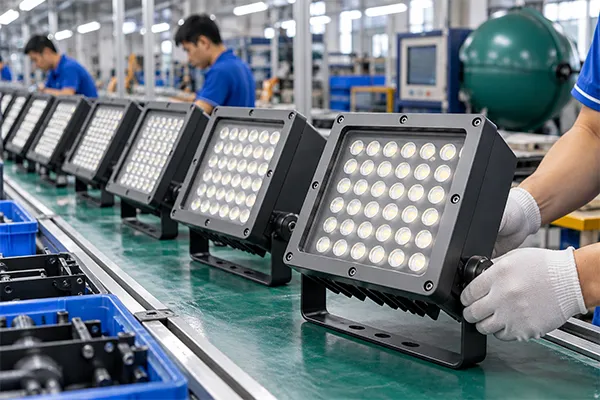
LED flood lights for commercial buildings can look similar on a quotation while creating very different results after installation. If buyers focus only on wattage or unit price, they may face glare, dark areas, mismatched color, or early replacement work. We recommend starting with the lighting task, installation conditions, and verified project requirements before confirming a floodlight specification.
LED flood lights for commercial buildings should be selected according to the application, mounting position, target area, beam angle, required light level, color quality, environmental exposure, and supplier quality controls. Wattage and lumen output matter, but they do not alone prove that a floodlight will perform well in a façade, entrance, parking area, or security zone.
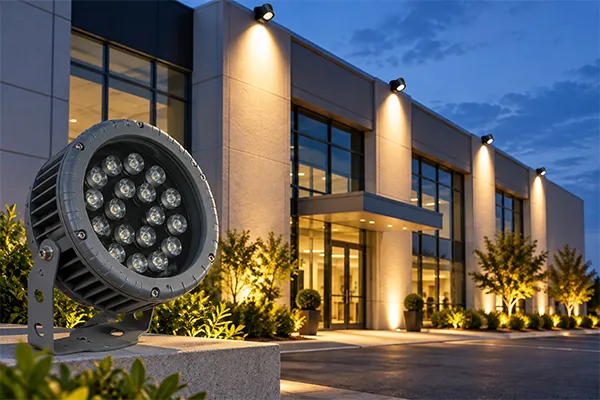
At Upward Lighting, we often see the same questions during quotation and specification discussions: “How many watts do we need?” “Can one model work everywhere?” and “Can you make it brighter?” These questions are understandable, but a practical commercial lighting decision needs a wider view before production begins.
How Should Buyers Define the Lighting Task for LED Flood Lights for Commercial Buildings?
When buyers begin with a product model instead of the lighting task, they can easily select an unsuitable configuration. A powerful fixture may create uncomfortable glare at an entrance, while a lower-output unit may leave a parking lane too dark.1 We encourage buyers to define what each area must achieve before comparing products.
For LED flood lights for commercial buildings, the first step is to identify the purpose of the space: visual presentation, safe movement, vehicle circulation, perimeter visibility, signage illumination, or general security. Each purpose requires different priorities for light distribution, aiming, color temperature, glare control, and reliability.2
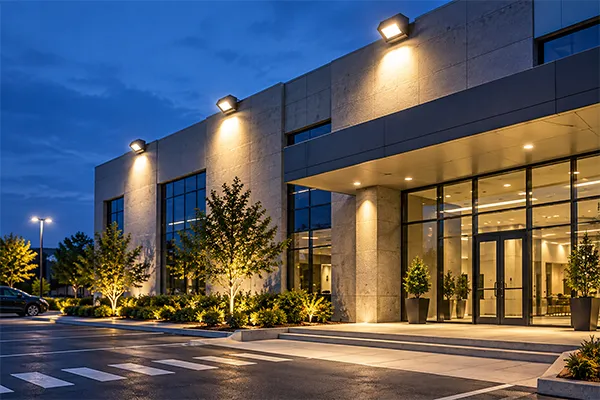
Start With the Area, Not the Wattage
In our specification discussions, we separate commercial exterior applications into clear lighting tasks. This approach helps purchasing teams avoid applying the same floodlight model across every exterior zone.
Common applications include:
- Building façades: These usually need controlled upward or downward light distribution that supports architectural features without excessive spill light.
- Entrances and loading areas: These need clear visibility for pedestrians, deliveries, signs, and access points.
- Parking areas: These need balanced coverage across driving lanes, walkways, corners, and vehicle zones.
- Security perimeters: These often prioritize visibility, uniformity, durability, and appropriate camera support.
- Signage and landscape features: These may need narrower beam angles, more precise aiming, and stronger color rendering.
A floodlight that works well on a warehouse loading bay may not be suitable for illuminating a hotel façade. The warehouse may need broad, functional coverage, while the hotel may need more controlled light with reduced glare for guests and nearby traffic.
We treat the application as the starting point because it influences every later parameter decision, including wattage, optics, color temperature, mounting accessories, and production feasibility.
Ask Practical Project Questions Before Requesting a Quote
Before asking a manufacturer for pricing, we suggest that buyers prepare a basic project brief. Even a short brief can reduce back-and-forth during quotation.
| Project question | Why it matters for procurement |
|---|---|
| What area needs illumination? | It defines the lighting purpose and product category. |
| What is the mounting height? | It affects beam spread, aiming, output needs, and glare risk. |
| What is the target size? | It helps determine whether a narrow, medium, or wide beam may be needed. |
| Is the area near roads, windows, or residences? | It raises glare and spill-light considerations. |
| What is the local environment? | It affects housing, sealing, corrosion resistance, and cable requirements. |
| Is a lighting calculation required? | It may require photometric data and review by a qualified professional. |
| Is the order standard or customized? | It affects validation, MOQ, production planning, and lead time. |
We can support product specification confirmation and provide relevant product information during the sourcing process. However, qualified lighting designers or project engineers should verify lighting calculations, layouts, glare control, local regulations, and final acceptance requirements for the specific site.
Why Are Wattage and Lumens Not Enough for LED Flood Lights for Commercial Buildings?
A high wattage figure can make a quotation look impressive, but it does not explain how light will reach the intended surface. Buyers who compare only wattage, or even only lumens, may receive products that are difficult to aim, too bright in one location, or ineffective across the target area.
Wattage shows electrical input, while lumens indicate total light output.3 Neither measurement alone confirms successful lighting performance.4 For LED flood lights for commercial buildings, mounting height, beam angle, aiming direction, target distance, glare, ambient light, and layout determine whether the emitted light is useful.
Understand the Difference Between Input and Useful Light
Wattage describes how much power a fixture consumes. Lumens describe the quantity of visible light emitted by the fixture. These are useful comparison points, but they are only part of the evaluation.
For example, two commercial floodlights may both be rated at 100 W. Their real-world results can still differ because of:
- LED package selection
- Driver efficiency
- Optical lens design
- Beam angle
- Thermal design
- Fixture orientation
- Light distribution pattern
- Actual installation height
- Maintenance conditions
A fixture with high total lumens may spread light so widely that the target area receives insufficient illumination. In another situation, a narrow-beam floodlight may place too much light in a small area and create harsh brightness or glare.
Beam Angle Changes the Result
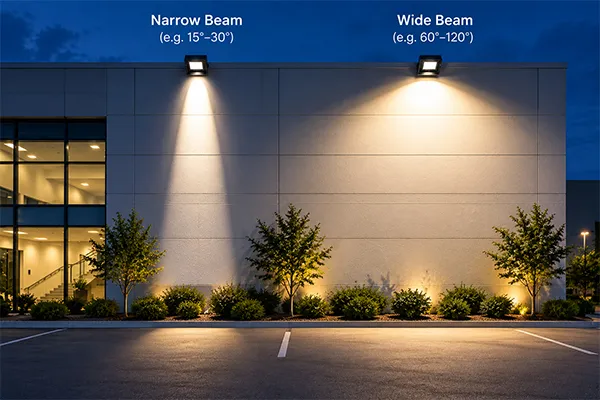
Beam angle deserves careful attention in commercial floodlight procurement. A wide beam can cover a larger area at shorter mounting distances, while a narrower beam can project light farther or highlight a defined feature.5
| Beam pattern approach | Possible application | Buyer consideration |
|---|---|---|
| Narrow beam | Columns, signs, tall façade elements | Requires precise aiming and glare review |
| Medium beam | Entrances, exterior walls, loading zones | Often balances reach and coverage |
| Wide beam | General wall washing, open work areas | May create spill light if poorly positioned |
| Asymmetric distribution | Parking edges or directional areas | Requires project-specific photometric review |
We have seen buyers request “maximum lumens” for a façade project without first confirming the mounting position. When the fixture is mounted close to the wall, a broad beam may create uneven brightness near the top while leaving lower areas less defined. This does not mean broad optics are wrong. It means the optical choice must match the geometry.
Use Photometric Information Carefully
For project confirmation, buyers should ask whether photometric files, beam-angle information, and product drawings are available for the shortlisted fixture. A qualified lighting professional can use these documents to assess illuminance, uniformity, glare, and layout.6
We do not present a product data sheet as a substitute for a complete lighting design. Instead, we see technical data as an important procurement document that helps project teams compare suitable options before production or installation.
Which Specifications Should Be Confirmed Together for LED Flood Lights for Commercial Buildings?
Commercial buyers sometimes choose wattage first, color temperature later, and beam angle only after receiving samples. This fragmented process can create delays and product mismatches. We recommend confirming the core parameters as one connected specification package before a purchase order is released.
The key specifications for LED flood lights for commercial buildings include wattage, lumen output, beam angle, color temperature, CRI, input voltage, housing finish, ingress protection needs, mounting method, cable requirements, and applicable documentation. Buyers should review these variables together because changing one parameter can affect performance, feasibility, cost, and lead time.
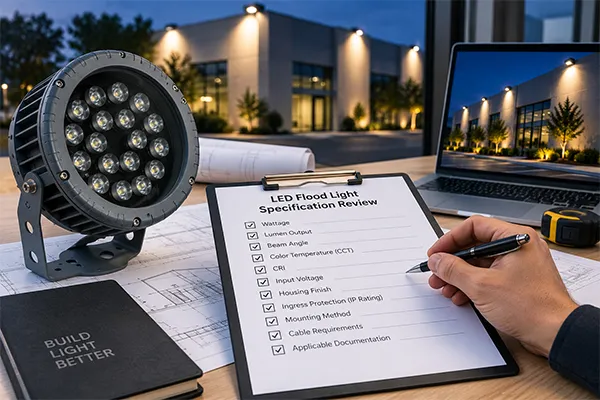
Build a Connected Product Specification
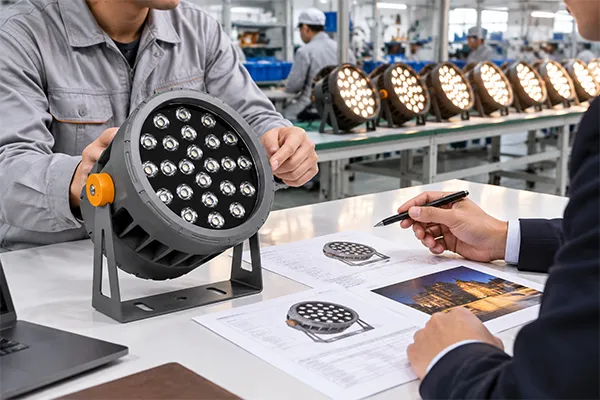
At Upward Lighting, our OEM and ODM discussions often begin with a standard model and then move toward project-specific requirements. We can discuss adjustments to color temperature, wattage, beam angle, CRI, and surface finish colors. However, each change should be evaluated before production.
A connected specification may include the following:
-
Wattage and output target
Buyers should confirm whether the selected wattage supports the intended output range for the chosen configuration. They should not assume that a wattage label alone indicates the final lighting result. -
Beam angle and mounting location
Optical selection should align with mounting height, setback distance, façade shape, or parking-area layout. -
Color temperature (CCT)
Common commercial preferences may include warmer tones for hospitality-focused exteriors and cooler tones for functional outdoor areas. The appropriate choice depends on the project concept, local expectations, surrounding environment, and visual goals. -
Color Rendering Index (CRI)
CRI can matter when the project needs better color distinction for architectural finishes, signs, landscaping, or entry areas.7 Buyers should specify the required CRI rather than assuming that all floodlights provide the same color quality. -
Voltage and electrical requirements
Input voltage, frequency, surge protection requirements, connectors, and cable length should be confirmed for the destination market and installation design. -
Housing and finish
Housing color, bracket style, corrosion exposure, and mounting hardware can matter as much as optical performance in coastal, industrial, or highly visible commercial locations.
Avoid Copying the Last Project
A previous project can provide useful reference information, but it should not become an automatic template. A 50 W floodlight used on one retail façade may not suit another building with a different mounting height, wall color, ambient light level, or visual goal.
I have seen quotation discussions where a buyer initially requested “the same specification as last time,” then later explained that the new building was taller and the installation point was farther from the target surface. That small detail changed the discussion from replacing a previous model to reviewing the beam angle and output more carefully.
For this reason, we recommend documenting every confirmed parameter on the quotation, drawing, sample record, or purchase specification. This reduces ambiguity between the buyer, manufacturer, installer, and end customer.
How Can Buyers Evaluate Quality and Supplier Reliability Beyond Unit Price?
A low unit price can appear attractive at the quotation stage, but it may not reflect the total procurement risk. Commercial floodlights are often installed in elevated, difficult-to-access, or high-visibility locations. If replacement becomes necessary, labor, access equipment, delivery coordination, and reputational costs can exceed the original product price difference.8
For LED flood lights for commercial buildings, buyers should evaluate thermal management, driver quality, production consistency, material controls, test procedures, documentation, communication speed, and supplier responsiveness alongside price. These factors can influence batch stability and the practical cost of ownership over the project lifecycle.
Review the Components and Controls Behind the Product
A commercial floodlight is a system, not simply an LED board inside a metal housing.9 Buyers can ask structured questions about the product and manufacturing process.
Useful supplier-evaluation questions include:
- What driver configuration is used for the selected model?
- How does the fixture manage heat during operation?
- What housing material and surface treatment are used?
- What is the stated ingress-protection level, and what test documentation is available?
- Are key components controlled consistently across repeat orders?
- What incoming inspection and finished-product checks are performed?
- Can the supplier provide drawings, specifications, samples, and relevant test information?
- What is the process if a project requires customized parameters?
- What are the expected MOQ and lead-time implications?
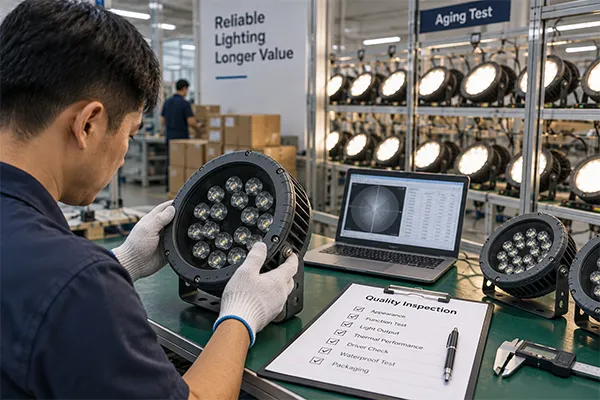
Consider Aging Tests as a Quality-Control Practice
At Upward Lighting, every product undergoes a 100% aging test before shipment, typically lasting 4 to 8 hours. We use this process as part of our pre-shipment quality-control practice to identify obvious operational issues before goods leave the factory.
This process should be understood correctly. A 4-to-8-hour aging test is not a guarantee of a specific field lifetime10, because actual service conditions depend on installation quality, operating hours, ambient temperature, voltage conditions, environmental exposure, maintenance, and other project-specific factors.
However, buyers can reasonably view a documented aging process as one relevant indicator of a supplier’s production discipline. It shows that the manufacturer has a defined pre-shipment check rather than treating the finished fixture as an untested assembly.
Verify Certifications for the Actual Market
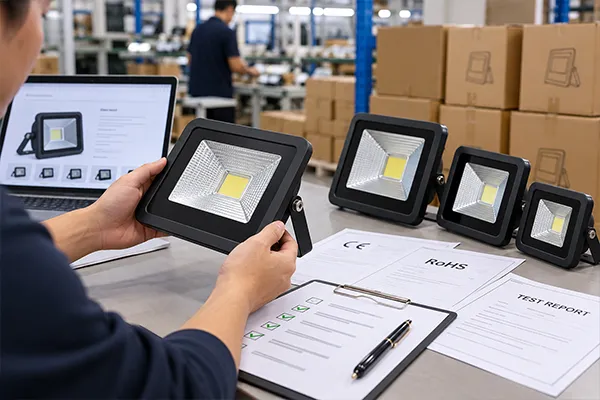
We can provide products with certifications such as CE and RoHS for relevant models and markets. Still, buyers should verify the documents, product scope, destination-market requirements, tender requirements, and local building rules for the actual project.
CE or RoHS documentation should not be treated as automatic approval for every country, installation, or commercial tender.11 Project teams should confirm whether additional standards, reports, declarations, labeling, electrical requirements, or local approvals apply.
When Does Customization Make Sense for Commercial Floodlight Projects?
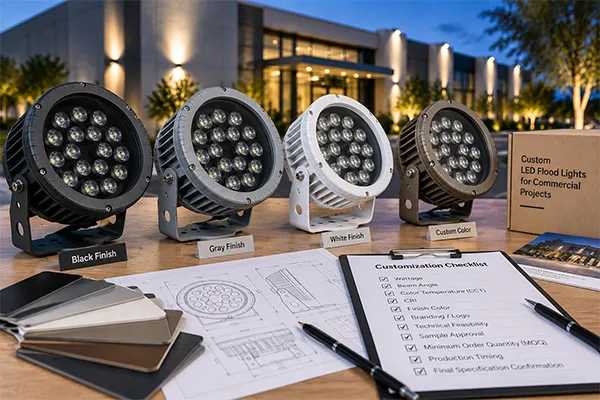
Customization can help a commercial project achieve a better product fit, especially when buyers need specific color temperatures, wattages, beam angles, CRI levels, finishes, or branding details. Yet customization also introduces planning requirements. It is not the same as selecting a standard product from available stock.
Customization for LED flood lights for commercial buildings makes sense when a standard configuration cannot meet the documented project requirement. Buyers should confirm technical feasibility, sample needs, minimum order quantity, validation steps, production timing, and final specification approval before treating a customized product as ready for delivery.
Use Customization to Solve a Defined Need
We support OEM and ODM discussions for buyers who need parameters adjusted for their target customers or projects. Common requests include:
- Specific color temperature, such as 3000K, 4000K, or 5000K
- Adjusted wattage for a product line or project range
- Different beam angles for façade, signage, or general-area use
- Higher or project-defined CRI
- Custom surface finish colors
- Brand packaging, labels, manuals, or product identification
- Small-batch development needs, subject to feasibility and production planning
The strongest custom requests are based on a clear application requirement. For example, a distributor may need a specific housing color to match its existing exterior lighting range. A contractor may need a defined CCT for consistency across a building development. A local brand may need labeling and packaging aligned with its sales channel.
Plan for Confirmation, Validation, and Lead Time
“Customizable” does not mean that every combination can be supplied immediately. A custom combination may require component confirmation, engineering review, sample evaluation, artwork approval, procurement planning, and production scheduling.
We recommend this sequence:
- Define the commercial or technical requirement.
- Share drawings, target parameters, destination market, and expected quantity.
- Confirm feasibility with the manufacturer.
- Review quotation, MOQ, lead time, and documentation needs.
- Approve samples or final specifications where appropriate.
- Release production only after the critical details are confirmed.
This process helps prevent a common issue: a buyer requests customization late in the procurement cycle but expects standard-product timing. Early communication gives suppliers more opportunity to identify workable options and helps buyers avoid delays.
Frequently Asked Questions
How many watts do commercial LED flood lights need?
The appropriate wattage depends on the lighting task, mounting height, beam angle, target area, ambient light, and required light level. We recommend that buyers define the application first and ask qualified lighting professionals to verify calculations and layout rather than selecting wattage alone.
What color temperature is best for commercial building floodlights?
The best color temperature depends on the project’s visual and functional needs. Warmer light may suit hospitality or architectural applications, while neutral or cooler light may suit functional exterior zones. Buyers should also consider neighboring properties, branding, local expectations, and the final lighting design.
Are higher lumens always better for outdoor commercial lighting?
Higher lumens are not always better. Excess output can create glare, light spill, uneven brightness, and unnecessary energy use.12 The useful result depends on how the fixture distributes light across the intended area, not only on its total lumen figure.
What should buyers ask an LED floodlight supplier before ordering?
Buyers should ask about technical specifications, beam angle, driver and thermal design, housing materials, test procedures, customization feasibility, MOQ, lead time, documentation, and available certifications. They should also verify market-specific requirements for the destination project.
Does a 100% aging test guarantee floodlight lifetime?
No. A 100% aging test is a pre-shipment quality-control practice that can help identify early operational issues. Actual field lifetime depends on installation, electrical conditions, operating hours, heat, weather exposure, maintenance, and other site-specific factors.
Conclusion
Choosing LED flood lights for commercial buildings requires more than comparing wattage, lumens, and unit prices. We recommend that buyers begin with the lighting task, then confirm output, beam angle, CCT, CRI, mounting conditions, environmental needs, and documentation as a connected specification. Supplier quality controls, communication, customization planning, and aging-test procedures also deserve careful review. If you are sourcing commercial floodlights for a project, distribution range, or private-label program, contact Upward Lighting to discuss specifications, OEM/ODM options, samples, and quotation requirements.
"1915.82 - Lighting. | Occupational Safety and Health Administration", http://www.osha.gov/laws-regs/regulations/standardnumber/1915/1915.82. Exterior-lighting guidance recognizes that excessive brightness can produce disability or discomfort glare, while insufficient illumination can reduce visibility in pedestrian and vehicle circulation areas. Evidence role: mechanism; source type: government. Supports: Authoritative lighting guidance should explain that glare can impair visual conditions and that adequate illumination is needed for exterior pedestrian and vehicle areas.. Scope note: The appropriate light level and glare criterion vary by task, geometry, ambient conditions, and local requirements. ↩
"[PDF] NGL - A Guide to the Best and the Brightest in LED Fixtures", https://www.energy.gov/sites/prod/files/2015/02/f20/taylor_ngl_grainger2015.pdf. Professional exterior-lighting guidance identifies application objectives, luminaire distribution, aiming, visual comfort, and spill control as interconnected elements of lighting design. Evidence role: general_support; source type: institution. Supports: Professional exterior-lighting guidance explains that lighting objectives and site context affect distribution, aiming, glare control, and other specification choices.. Scope note: This guidance supports the design principle generally; final criteria depend on the site, applicable code, and project lighting calculation. ↩
"NIST Study Suggests Universal Method for Measuring Light Power", https://www.nist.gov/news-events/news/2019/12/nist-study-suggests-universal-method-measuring-light-power. A watt is a unit of power, whereas a lumen quantifies luminous flux, the perceived quantity of light emitted by a source. Evidence role: definition; source type: government. Supports: A metrology or energy authority should define the watt as a unit of power and the lumen as the SI-derived unit for luminous flux.. ↩
"[PDF] Initial Performance and Reliability of Chromaticity Sensors Used for ...", https://www.energy.gov/sites/prod/files/2020/11/f80/ssl-rti-chromaticity-sensors-sep2020.pdf. Lighting performance at a target surface depends on a luminaire's photometric distribution, mounting geometry, aiming, and environmental conditions, not solely on its input power or total lumen output. Evidence role: general_support; source type: education. Supports: Lighting-design materials should show that illuminance and visual performance depend on photometric distribution, distance, orientation, and site geometry in addition to total luminous flux.. Scope note: This principle does not by itself determine whether a particular installation complies with a required illuminance or glare criterion. ↩
"[PDF] Chapter 11 - Street Lighting", https://www.intrans.iastate.edu/wp-content/uploads/sites/15/2020/03/Chapter_11.pdf. Beam angle describes the angular spread of a luminaire's light distribution; broader distributions generally cover a larger nearby area, while narrower distributions concentrate light over a smaller angle. Evidence role: mechanism; source type: education. Supports: Optics and photometry references should explain that beam spread controls angular distribution and changes the illuminated area and intensity at a given distance.. Scope note: Actual reach and target illuminance also depend on luminous intensity distribution, mounting height, aiming, obstructions, and surface reflectance. ↩
"[PDF] Chapter 11 - Street Lighting", https://www.intrans.iastate.edu/wp-content/uploads/sites/15/2020/03/Chapter_11.pdf. Standardized luminaire photometric data can be used in lighting calculations to model illuminance distributions and assess layout-dependent metrics such as uniformity and glare. Evidence role: mechanism; source type: institution. Supports: IES photometric standards and related design guidance should establish that standardized luminaire photometry is used in lighting-calculation software and design analysis.. Scope note: The reliability of a calculation depends on accurate input data and site assumptions and does not replace field verification where required. ↩
"Color rendering of light sources - NIST", https://www.nist.gov/pml/sensor-science/optical-radiation/color-rendering-light-sources. Color rendering metrics, including the Color Rendering Index, characterize how faithfully a light source enables the appearance of object colors relative to a reference illuminant. Evidence role: definition; source type: government. Supports: An authoritative source should explain that color-rendering metrics describe how a light source affects the appearance of object colors compared with a reference illuminant.. Scope note: CRI is not a complete predictor of color preference or visual quality and should be considered alongside spectral characteristics and the intended application. ↩
"Take Five: Life Cycle Costs for Acquisition - Department of Energy", https://www.energy.gov/cmei/femp/articles/take-five-life-cycle-costs-acquisition. Lighting life-cycle cost analyses include purchase, energy, maintenance, replacement, and access-related costs, so the lowest initial fixture price may not represent the lowest ownership cost. Evidence role: general_support; source type: government. Supports: Lifecycle-cost guidance should show that acquisition cost is only one component of lighting ownership cost and that maintenance, replacement, and access costs can be material.. Scope note: Whether these costs exceed an initial price difference depends on failure rates, mounting accessibility, labor rates, operating hours, and project-specific contractual consequences. ↩
"[PDF] LED Luminaire Reliability: Impact of Color Shift - Department of Energy", https://www.energy.gov/sites/prod/files/2017/04/f34/lsrc_colorshift_apr2017.pdf. LED luminaires are integrated optical, electrical, thermal, and mechanical systems; the LEDs, driver, heat dissipation, optics, and enclosure can each affect delivered light and service reliability. Evidence role: mechanism; source type: research. Supports: Research or laboratory guidance should describe LED luminaires as integrated systems whose optical, electrical, thermal, and mechanical components influence performance and reliability.. Scope note: Component-level design information cannot establish the reliability of a particular product batch without product-specific testing and operating data. ↩
"[PDF] OUTDOOR FIELD TESTING AS A COMPLEMENTARY APPROACH ...", https://www.nist.gov/document/dhere-posterpdf. Short-duration burn-in or aging tests can screen for early operational defects but do not, by themselves, predict a luminaire's field life, which is affected by operating conditions and long-term component degradation. Evidence role: mechanism; source type: research. Supports: Reliability literature should distinguish short-duration burn-in or screening from controlled lifetime and accelerated-life testing used to estimate degradation or failure behavior.. Scope note: The exact diagnostic value of an aging test depends on its duration, load conditions, test protocol, failure criteria, and the components being screened. ↩
"CE marking – obtaining the certificate, EU requirements - Your Europe", https://europa.eu/youreurope/business/product-rules-compliance/general-product-compliance/ce-marking/index_en.htm. Under European Union product rules, CE marking is a manufacturer's declaration that a product meets applicable EU requirements, while RoHS addresses specified hazardous substances; neither document alone establishes compliance with unrelated national installation rules or tender conditions. Evidence role: historical_context; source type: government. Supports: European Commission guidance should clarify the scope of CE marking and RoHS obligations and explain that CE marking is a manufacturer's conformity declaration for applicable EU rules.. Scope note: Applicable obligations depend on the product category, destination jurisdiction, installation context, and procurement documentation. ↩
"Text-Alternative Version: Glare in LED Outdoor Lighting", https://www.energy.gov/cmei/ssl/text-alternative-version-glare-led-outdoor-lighting. Outdoor-lighting guidance recommends matching light output and distribution to the task because overlighting and poorly controlled optics can increase glare, unwanted off-site light, and energy use. Evidence role: general_support; source type: government. Supports: Outdoor-lighting guidance should document that appropriate light level, distribution, shielding, and controls help limit glare, unwanted light, and energy waste.. Scope note: A higher-lumen product is not inherently inappropriate; suitability depends on photometry, aiming, controls, and the required lighting performance. ↩