LED flood lights can look simple on a quotation, but choosing the wrong specification can create glare, dark zones, wasted energy, installation delays, and customer complaints. Many buyers compare only watts, lumens, or IP ratings. We help businesses translate actual project conditions into clearer product requirements before they commit to an order.
LED flood lights are suitable for business applications when their light output, beam angle, mounting position, environmental protection, and product quality match the real site conditions. Buyers should assess the target area, mounting height, throw distance, lighting purpose, local compliance needs, and supplier documentation instead of selecting only by wattage, lumen claims, or IP rating.
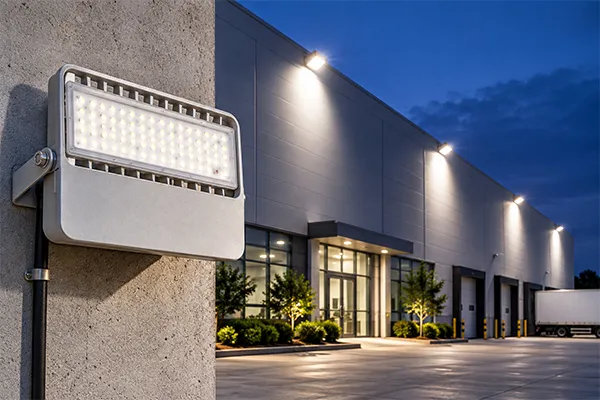
At Upward Lighting, we have seen that the strongest procurement decisions start with better questions. A floodlight for a warehouse loading yard, a building façade, a sports area, or a retail exterior may look similar, but each application creates different requirements. The sections below explain how we help buyers compare LED flood-light options with more confidence.
How Should Businesses Define Their LED Flood Lights Requirements?
Businesses often begin with a simple request: “We need a 100W or 200W floodlight.” That approach can create problems because wattage does not describe the actual lighting task1. We encourage buyers to start with the area, installation location, and desired effect before they compare product specifications.
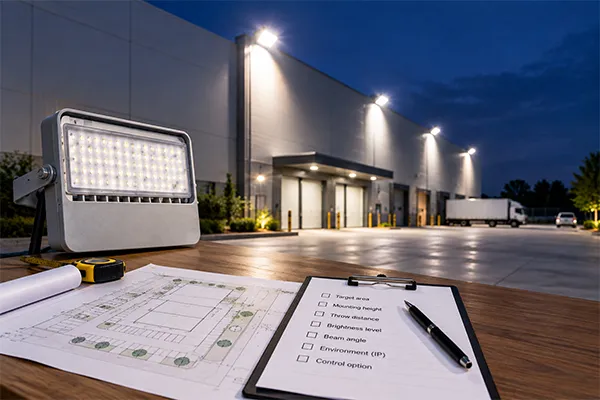
Businesses should define LED flood lights by identifying what must be illuminated, the size of the target area, mounting height, throw distance, desired brightness level, and operating environment. These factors help determine a suitable output range, beam distribution, housing configuration, and control option for the project or resale market.
Start With the Lighting Task, Not the Wattage
When we receive a floodlight inquiry, our team usually asks several clarification questions before preparing a quotation. These questions help us avoid treating a technical lighting decision as a simple price comparison.
We typically ask:
-
What is the application?
Is the product intended for a car park, factory yard, warehouse entrance, advertising board, façade, sports area, security zone, or construction site? -
What area needs illumination?
Buyers should provide approximate length, width, and shape. A narrow driveway needs a different distribution from a broad open yard. -
What is the mounting height?
A fixture installed at 3 meters behaves differently from one installed at 10 meters or 20 meters. Higher mounting positions usually require careful optical planning to place useful light on the target area.2 -
What is the distance between the fixture and the target?
This is especially important for wall washing, signage, perimeter lighting, and façade projects. -
What lighting effect is required?
The project may need broad general illumination, focused accent light, uniform working light, or a visually dramatic architectural effect. -
What market and compliance documents are required?
Product documentation, labeling, electrical requirements, and market-entry rules vary by country and project.
Why the Same Area Can Need Different Solutions
Two 500-square-meter outdoor areas can require very different LED flood lights. A contractor lighting a loading zone may need clearer visibility around vehicles and entrances. A distributor supplying floodlights for residential compounds may prioritize visual comfort, compact designs, and stock-friendly specifications. A brand owner may need a customized housing color, logo, color temperature, or packaging format.
We have often received messages asking only, “What wattage do I need?” In practice, we need to understand the installation height and target area before that question has a meaningful answer.
The table below shows why application context matters.
| Buying Factor | Example Question | Why It Matters |
|---|---|---|
| Target area | Is the area 10 × 10 meters or 30 × 50 meters? | Area size affects how much light and how many fixtures may be needed. |
| Mounting height | Will the fixture be mounted at 4 meters or 12 meters? | Mounting height affects light spread, glare risk, and usable illumination.3 |
| Throw distance | How far is the fixture from the wall, sign, or work zone? | Distance affects beam-angle selection and output requirements. |
| Lighting objective | Is the goal security, work visibility, or façade appearance? | Different objectives require different optical and visual-comfort priorities. |
| Operating environment | Is the location covered, exposed, coastal, dusty, or humid? | Exposure affects housing, sealing, installation, and maintenance considerations. |
| Sales channel | Is the product for one project or a distributor’s stock range? | Stock products and project products may need different specifications and packaging. |
We recommend that buyers collect these basics before requesting pricing. This process makes quotations more comparable. It also helps suppliers identify where a standard model may work and where OEM or ODM adjustment could be appropriate.
Why Are Lumens and Wattage Not Enough for LED Flood Lights?
Buyers often assume that a higher wattage or higher lumen claim will always deliver better results. This assumption can lead to over-lighting, uncomfortable glare, uneven coverage, or energy use that does not improve the site. Brightness matters, but useful light on the target area matters more.
Lumens and wattage are only part of an LED flood lights evaluation. Buyers should also consider beam angle, light distribution, mounting height, fixture position, glare control, color temperature, and the proportion of light that reaches the intended task area rather than spilling into unwanted spaces.
Wattage Describes Power, Not Lighting Success
Wattage measures electrical power consumption.4 It does not independently confirm how effectively a floodlight illuminates a real project area. LED efficiency, driver design, LED source configuration, optical design, and thermal management all influence product performance.5
A buyer can use wattage as a starting point when comparing similar products, but wattage should not become the entire buying standard. We encourage customers to review the full configuration, including:
- Rated wattage
- Stated luminous flux
- LED source and driver information, where available
- Beam angle or optical distribution
- Color temperature
- Color Rendering Index (CRI)
- Input voltage range
- Housing material and heat-sink design
- Surge-protection configuration, where specified
- Installation accessories and mounting options
Beam Angle Changes Where the Light Goes
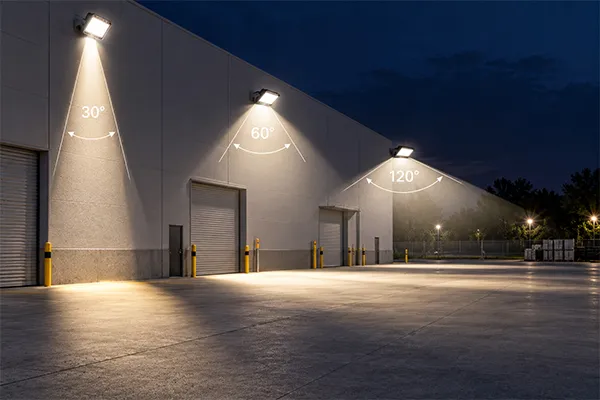
Beam angle is one of the most important but overlooked LED flood-light specifications. A wide beam spreads light over a larger area. A narrower beam concentrates light more tightly6 and may better suit longer throw distances or focused applications.
However, a narrow beam is not automatically better. It may create bright hot spots and dark surrounding areas when used incorrectly.7 A wide beam may produce insufficient light at distance if the fixture is mounted too far from the target.
| Beam Distribution Consideration | Potential Effect on the Project |
|---|---|
| Wide distribution | Can support broader-area coverage at suitable mounting heights, but may increase spill light. |
| Narrower distribution | Can concentrate light toward a distant or defined target, but may create unevenness if poorly positioned. |
| Adjustable bracket angle | Allows installers to direct the fixture, but incorrect aiming can increase glare and reduce useful coverage. |
| Multiple fixtures | May improve uniformity in some layouts compared with relying on one high-output fixture. |
| Fixture spacing | Influences overlap, shadowing, dark zones, and overall consistency. |
Useful Light Is Better Than Headline Brightness
We have spoken with buyers who compare two products solely by a lumen figure on a specification sheet. That figure is relevant, but it does not answer every procurement question. Buyers should ask whether the stated value is documented consistently across product labels, datasheets, samples, and quotations. They should also ask how the beam pattern fits the intended installation.
For example, a building-material distributor might select a general-purpose range for common exterior uses. That range should balance market demand, cost, practical mounting options, and clear labeling. In contrast, a project contractor may need a product configured around a specific layout and lighting calculation prepared by qualified lighting professionals.
We do not treat a manufacturer-side specification as a substitute for site-specific design. We recommend that contractors and project teams verify installation conditions, electrical safety, photometric requirements, and applicable local rules with qualified professionals for the specific project.
How Should Buyers Evaluate IP Ratings and Outdoor Conditions for LED Flood Lights?
Outdoor projects create understandable concern about water, dust, humidity, and weather exposure. Many buyers respond by requesting the highest IP rating available. Yet an IP rating is one input in a broader environmental assessment. It does not guarantee that any fixture will suit every outdoor location or installation method.
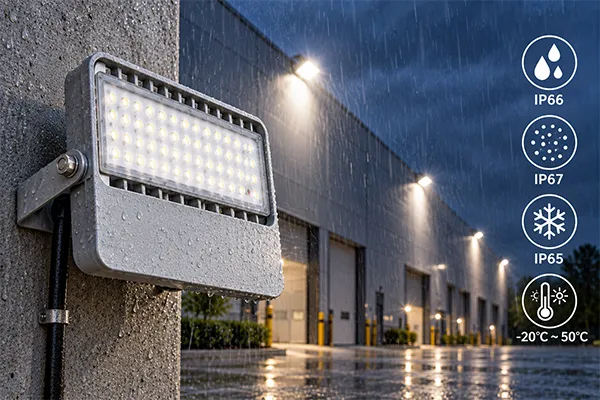
An IP rating helps buyers understand a product’s stated resistance to ingress of solids and water under defined test conditions, but LED flood lights also need suitable installation design, thermal management, cable entry protection, mounting position, maintenance planning, and application-specific evaluation for the actual outdoor environment.
What an IP Rating Can and Cannot Tell You
IP stands for Ingress Protection. The first digit generally relates to protection against solid objects and dust. The second digit relates to protection against water under defined conditions.8 Buyers should review the exact product documentation rather than assuming that a broad statement such as “waterproof” provides enough detail.
For outdoor LED flood lights, buyers may consider IP-rated designs as part of their specification review. Still, they should avoid treating an IP rating as universal evidence of product quality, permanent weather resistance, or suitability for every installation environment.
An outdoor installation can introduce many factors beyond the product label:
- Direct rain, wind-driven rain, or water pooling
- Sun exposure and high ambient temperature
- Salt-laden air in coastal locations
- Dust, sand, industrial particles, or insects
- Vibration from machinery or traffic
- Cable routing and gland installation
- Bracket angle and drainage
- Local electrical installation standards
- Cleaning and maintenance access
Installation Design Influences Real-World Risk
A fixture with a stated IP rating can still face avoidable risk if cable connections are poorly protected, if water collects around the installation point, or if the mounting angle creates unsuitable exposure. The luminaire is only one part of the final installed system.
We have seen customers request a higher IP rating because they assume it solves all outdoor concerns. We usually respond by asking more questions:
- Will the fixture be installed in an open yard or under a canopy?
- Is the environment near the sea, a roadway, or a dusty industrial process?
- Will the power connection be protected?
- Is the product exposed to direct rain or splash conditions?
- Will the fixture run for long periods in high-temperature conditions?
- Does the project require specific third-party test reports or market documentation?
Review Housing and Thermal Design Too
Heat management deserves attention because LED components and drivers operate within temperature conditions that affect their working environment.9 A floodlight housing typically supports heat dissipation as well as mechanical protection. Buyers can compare housing material, fin design, driver arrangement, stated operating conditions, and physical construction.
At Upward Lighting, we use aluminum-based housing configurations across relevant product designs and conduct a 100% aging test before shipment, typically lasting 4 to 8 hours depending on the product arrangement. This is a manufacturer-side quality-control process intended to identify issues before dispatch. It is not a replacement for independent laboratory validation, application-specific testing, or proof of long-term installed performance.
Buyers should request and verify the documents relevant to their market and project. Where CE, RoHS, or other documents are required, purchasers should check that the documents correspond to the exact model, product configuration, and destination-market requirements.
How Can Businesses Compare LED Flood Lights Suppliers Beyond Price?
Low pricing can be attractive, especially for wholesalers, importers, and competitive tender projects. However, the lowest quoted LED flood light may create higher procurement risk if specifications are unclear, samples differ from production goods, communication is slow, or quality processes cannot be explained.
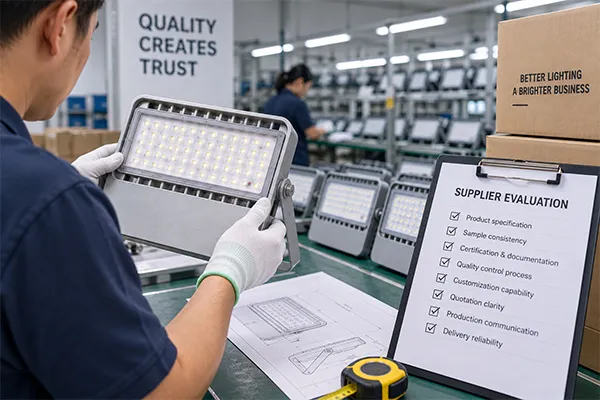
Businesses should compare LED flood lights suppliers by reviewing specification consistency, product samples, documentation, quality-control processes, customization capability, quotation clarity, production communication, and delivery reliability alongside unit price. A comparable quotation should describe the same configuration, terms, and supporting documents.
Compare Like With Like
A floodlight quotation can appear cheaper because the configuration is different. The wattage may be similar, but the driver, cable, LED source, surge-protection option, housing thickness, packaging, bracket, warranty terms, or documentation support may not be equivalent.
Before comparing supplier prices, we suggest buyers create a procurement checklist. This makes internal approvals easier and reduces the chance of comparing incomplete offers.
| Supplier Evaluation Area | What Buyers Should Ask |
|---|---|
| Product identity | What is the exact model number and revision? |
| Electrical specification | What are the rated wattage, voltage, frequency, and driver details? |
| Optical configuration | What color temperature, beam angle, CRI, and lumen information are stated? |
| Environmental design | What IP rating, housing material, cable specification, and operating conditions are documented? |
| Quality control | What inspection and aging processes does the supplier describe? |
| Documentation | Which reports, declarations, labels, and manuals can the supplier provide? |
| Sample process | Can the buyer review samples before larger production orders? |
| Customization | Can the supplier adjust wattage, CCT, beam angle, CRI, finish, branding, or packaging? |
| Commercial terms | What are the MOQ, lead time, payment terms, shipping terms, and warranty conditions? |
| Communication | How quickly and clearly does the supplier answer technical questions? |
Ask for Samples and Configuration Confirmation
A sample does not prove long-term field performance.10 Still, it can help buyers inspect build appearance, finish quality, bracket construction, cable arrangement, labeling, packaging, light color, and basic functionality before an order. Buyers should document what they approve and confirm that production units will follow the agreed configuration.
For branded projects, a written specification sheet is particularly useful. It should identify the product model, order quantity, customization details, packaging requirements, label artwork, and requested documents.
Assess Supplier Communication as a Procurement Control
Clear communication reduces risk. When a supplier asks detailed questions, that process may slow down the first quotation slightly, but it can prevent a costly mismatch later. We believe a responsible supplier should explain what information is missing rather than simply recommend the highest-wattage model.
Our team supports OEM and ODM requirements for parameters such as color temperature, wattage, beam angle, CRI, and surface finish colors. We also support small-batch orders where product arrangements and production planning allow. However, buyers should confirm feasibility, minimum order quantities, lead time, and technical details for each inquiry because customization requirements can affect all of these items.
In one recurring type of conversation, a buyer requests “the brightest model at the lowest price.” We first ask where the fixture will be installed and what the user needs to see. That discussion often leads to a more balanced and commercially workable specification.
For distributors and importers, supplier selection should support a long-term product range, not just one purchase order. Stable configuration control, practical documentation, responsive quotations, and repeatable communication can be as important as the opening unit price.
Frequently Asked Questions
How do I choose the right wattage for LED flood lights?
We recommend that buyers avoid choosing wattage alone. The suitable wattage depends on the target area, mounting height, beam angle, throw distance, ambient conditions, and lighting objective. A qualified lighting professional can assess application-specific requirements where a project needs formal calculations or compliance verification.
Are higher-lumen LED flood lights always better?
Higher lumen output is not always better because excess brightness can create glare, spill light, uneven coverage, and unnecessary energy use.11 Buyers should evaluate whether the fixture’s beam distribution and mounting position place useful light on the intended area. The best choice depends on the complete lighting layout.
Is an IP rating enough to confirm outdoor suitability?
No. An IP rating is an important documented characteristic, but it is not a blanket guarantee of outdoor suitability. Buyers should also consider direct exposure, cable connections, mounting design, heat, dust, corrosion risk, maintenance, and local installation requirements for the specific environment.
What should I ask an LED flood light supplier before ordering?
Buyers should ask for the exact model, electrical and optical specifications, IP rating, housing details, sample availability, quality-control process, documentation, customization options, MOQ, lead time, and warranty terms. Buyers should also confirm that the quoted configuration matches the intended project or resale market.
Can LED flood lights be customized for a local lighting brand?
Many manufacturers can support customization, subject to order volume and technical feasibility. At Upward Lighting, we can discuss adjustments to wattage, color temperature, beam angle, CRI, surface finish colors, and selected OEM or ODM requirements. Buyers should confirm each detail in writing before production.
Conclusion
Choosing LED flood lights for a business should involve more than selecting the highest wattage, brightest lumen claim, or highest IP number. We recommend that buyers begin with the lighting task, target area, mounting conditions, beam distribution, environmental exposure, and market requirements. They should then compare suppliers through samples, documentation, configuration consistency, and communication quality. If you are sourcing floodlights for a project, distribution range, or private-label program, contact Upward Lighting to discuss a specification that fits your actual procurement needs.
"LED Basics - Department of Energy", https://www.energy.gov/cmei/ssl/led-basics. Electrical wattage is a measure of power input rather than a direct measure of delivered illumination or lighting-task suitability; light output and layout must also be considered. Evidence role: definition; source type: government. Supports: Wattage measures electrical power consumption, whereas lumens and application-specific lighting design metrics are used to assess light output and illumination needs.. Scope note: This principle does not by itself determine the appropriate fixture size for a specific installation. ↩
"[PDF] Article 13 Regulation of Off-Site Impacts - Morgan County, GA", https://www.morgancountyga.gov/DocumentCenter/View/318. Lighting-design guidance recognizes mounting height, aiming, and luminaire distribution as determinants of the illuminance delivered to a target surface. Evidence role: mechanism; source type: institution. Supports: Illuminance on a surface depends on luminaire photometry, aiming, distance, and mounting geometry.. Scope note: The resulting performance depends on the specific luminaire photometry and site layout. ↩
"Eyes on the Ball - Illuminating Engineering Society", https://ies.org/lda/eyes-on-the-ball/. Outdoor-lighting guidance identifies mounting height and fixture aiming as factors affecting distribution, visual comfort, and glare. Evidence role: mechanism; source type: institution. Supports: Luminaire mounting height and aiming influence light distribution, visual comfort, and glare.. Scope note: Acceptable glare and illumination levels are application- and jurisdiction-specific. ↩
"NIST Study Suggests Universal Method for Measuring Light Power", https://www.nist.gov/news-events/news/2019/12/nist-study-suggests-universal-method-measuring-light-power. The watt is the unit of power; in electrical applications it expresses the rate at which electrical energy is consumed or converted. Evidence role: definition; source type: government. Supports: A watt is the SI-derived unit used to express power, including electrical power.. ↩
"[PDF] LED Luminaire Reliability: Impact of Color Shift - Department of Energy", https://www.energy.gov/sites/prod/files/2017/04/f34/lsrc_colorshift_apr2017.pdf. Research on LED luminaires shows that driver characteristics, LED operating conditions, thermal management, and optical systems jointly affect photometric and operational performance. Evidence role: mechanism; source type: research. Supports: LED luminaire output, efficiency, reliability, and light distribution are affected by thermal conditions, driver operation, LED characteristics, and optical design.. Scope note: The relative effect of each factor varies by luminaire design and test conditions. ↩
"ANSI/IES LS-1-25, Lighting Science: Nomenclature and Definitions ...", https://ies.org/standards/definitions/. Beam geometry determines the illuminated footprint: wider distributions cover broader areas, while narrower distributions direct light into a more confined field. Evidence role: mechanism; source type: education. Supports: For a given distance, a wider beam angle produces a larger illuminated footprint, while a narrower angle concentrates luminous flux over a smaller area.. Scope note: Actual site illumination also depends on distance, luminaire intensity distribution, aiming, and surface reflectance. ↩
"High Bay Beam Angle: Guide to Ceiling Height & Uniform ...", https://hi-hyperlite.com/blogs/comprehensive-guides/choose-high-bay-beam-angle-ceiling-height?srsltid=AU7gw4XiPvdbQ9mfNmTUPhdMacw3iNTiRWG1iK7KcRUr4Cta7XP0QMaZ. Photometric design principles show that unsuitable beam distributions or spacing can reduce illuminance uniformity and create localized bright areas. Evidence role: mechanism; source type: research. Supports: Luminaire distribution, aiming, and spacing affect illuminance uniformity and can create localized high-illuminance areas when poorly matched to a layout.. Scope note: Whether a particular installation produces objectionable hot spots requires a project-specific lighting calculation or measurement. ↩
"IP code", https://en.wikipedia.org/wiki/IP_code. IEC 60529 defines the IP Code, whose characteristic numerals classify specified levels of protection against solid-object ingress and water ingress under standardized tests. Evidence role: definition; source type: institution. Supports: IEC 60529 defines IP-code classifications for protection against access to hazardous parts and ingress of solid foreign objects and water.. Scope note: An IP classification addresses the tested ingress conditions and does not establish performance against all environmental, installation, or durability risks. ↩
"[PDF] LED Luminaire Reliability: Impact of Color Shift - Department of Energy", https://www.energy.gov/sites/prod/files/2017/04/f34/lsrc_colorshift_apr2017.pdf. LED research identifies thermal conditions as an important influence on light output, color stability, and lifetime, while electronic drivers likewise have temperature-dependent reliability characteristics. Evidence role: mechanism; source type: research. Supports: Elevated operating temperatures can affect LED light output, color characteristics, and component lifetime, making thermal design important in luminaires.. Scope note: Actual operating temperature and lifetime depend on the complete luminaire design, ambient environment, and duty cycle. ↩
"[PDF] A methodology for testing life-cycle performance of consumer products", https://nvlpubs.nist.gov/nistpubs/Legacy/IR/nbsir76-1157.pdf. A preproduction sample can document observable construction and initial operation, but long-term reliability requires evidence from appropriate endurance testing, reliability analysis, or field performance data. Evidence role: general_support; source type: research. Supports: Short-term sample inspection and functionality checks differ from reliability evaluation, which requires longer-duration testing, validated methods, or field data.. Scope note: The scope and predictive value of any test depend on its duration, sample size, operating conditions, and applicable standard. ↩
"Text-Alternative Version: Glare in LED Outdoor Lighting", https://www.energy.gov/cmei/ssl/text-alternative-version-glare-led-outdoor-lighting. Outdoor-lighting guidance supports using only the light needed for the task and controlling its distribution, because excessive or poorly directed light can increase glare, off-site spill, and energy consumption. Evidence role: general_support; source type: government. Supports: Outdoor-lighting guidance recommends matching light level, distribution, shielding, and controls to the task to limit glare, unwanted light, and excess energy use.. Scope note: Whether a given lumen level is excessive depends on the task, layout, local requirements, and photometric design. ↩