
An LED flood light warranty can look reassuring on a quotation, yet buyers often discover its limits only after a failure disrupts a project, distributor relationship, or end-user site. A stated number of years does not explain who responds, what is covered, or who absorbs the resulting costs. We recommend treating warranty terms as a procurement risk-control tool from the first supplier discussion.
An LED flood light warranty is valuable when it clearly defines covered failures, operating conditions, claim evidence, remedies, cost responsibilities, and replacement continuity. Buyers should evaluate the written warranty document alongside product specifications, quality-control records, and supplier response processes. The longest warranty period is not automatically the lowest-risk option if claim execution or cost allocation remains unclear.
When I discuss warranty requirements with importers, lighting brands, and project contractors, I encourage them to ask a different question. Instead of asking only, “How many years is the warranty?”, buyers should ask, “What happens if this floodlight fails in my actual installation?” That question leads to better documentation, clearer responsibilities, and fewer unexpected after-sales costs.
What Should an LED Flood Light Warranty Document Cover?
A vague LED flood light warranty creates uncertainty when a real failure occurs. A buyer may assume that a supplier covers every issue, while the supplier may consider surge damage, installation errors, or abnormal ambient conditions excluded. That gap can become expensive after goods have already been delivered. A written scope helps both sides avoid assumptions.
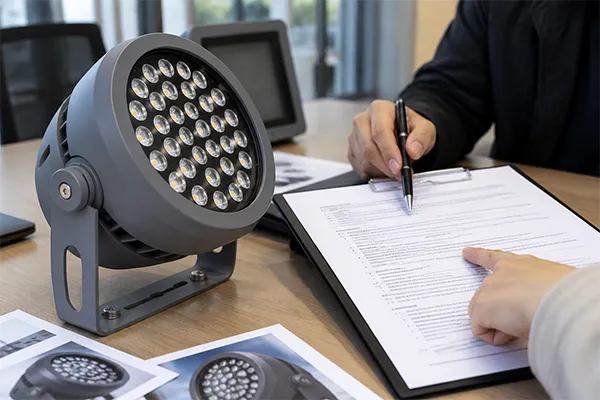
An LED flood light warranty document should identify the covered product models, components, failure types, exclusions, operating conditions, claim requirements, response procedure, remedies, and cost responsibilities. Buyers should request this document before confirming the order, especially for customized floodlights or project-specific specifications.
Define the Product Covered by the Warranty
The warranty should identify the exact product rather than using broad descriptions such as “outdoor floodlight.” This matters because one buyer may purchase several wattages, optics, finishes, input-voltage versions, or control options under the same purchase order.
The document should connect warranty coverage to identifiable information, such as:
- Product model number
- Wattage and input voltage
- Color temperature and beam angle
- Driver configuration
- Surge protection configuration, if specified
- IP rating stated for the product
- Production batch, date code, or order number
- Customized features, including branded labels or special finishes
At Upward Lighting, I find that pre-sales specification clarification is an important part of reducing later disagreements. For example, a 220–240V floodlight for one market may not be suitable for a 100–277V project requirement. If a buyer changes the voltage requirement after order confirmation, the written product record should show which version was ultimately approved.
Separate Components From Failure Types
Buyers should also ask whether the warranty addresses the full assembled fixture or individual components. An LED floodlight can include an LED light source, driver, housing, lens, gasket, cable, connector, mounting bracket, and surge-protection component where applicable. Each part can fail in different ways.
A useful warranty document may distinguish between issues such as:
| Item to Clarify | Buyer Question | Why It Matters |
|---|---|---|
| LED light source | Is abnormal light output decline covered under defined conditions? | Light performance can affect safety and project acceptance.1 |
| LED driver | Is driver failure covered? | Drivers are a common service consideration in LED luminaires.2 |
| Housing and lens | Are manufacturing defects in housing, coating, lens, or seals addressed? | Outdoor exposure can make mechanical integrity important. |
| Cable and connector | Are supplied cables and connectors included? | Site wiring interfaces can complicate fault diagnosis. |
| Mounting bracket | Is hardware coverage specified? | Bracket damage may result from product, transport, or installation factors. |
Buyers should avoid relying on verbal statements. The LED flood light warranty should state the relevant coverage in writing and should use language that both procurement and technical teams can understand.
Review Exclusions Before the Purchase Order
Exclusions are not automatically unreasonable. A manufacturer cannot responsibly promise coverage for every possible site condition, installation method, or electrical event. However, exclusions should be visible and understandable before the buyer places an order.
Buyers should ask whether the warranty excludes or limits claims related to:
- Incorrect input voltage or wiring
- Improper installation or inadequate mounting
- Water ingress caused by damaged cables, connectors, or site sealing
- Lightning, surge events, or unstable power supply3
- Use outside stated ambient-temperature conditions
- Chemical exposure, salt spray, corrosive environments, or extreme dust
- Physical impact, vandalism, or unauthorized modification
- Damage during storage, transport, or handling after delivery
- Use beyond stated operating conditions
A good procurement practice is to compare the exclusion list with the actual site environment. If the installation is near a coast, industrial facility, sports field, port, or high-surge area, the buyer should ask for application-specific clarification before production.
I have seen the value of this process in early specification discussions. A short conversation about mounting height, operating hours, power quality, and environmental exposure can reveal requirements that a basic quotation does not capture.
Why Do LED Flood Light Warranty Remedies Matter as Much as Duration?
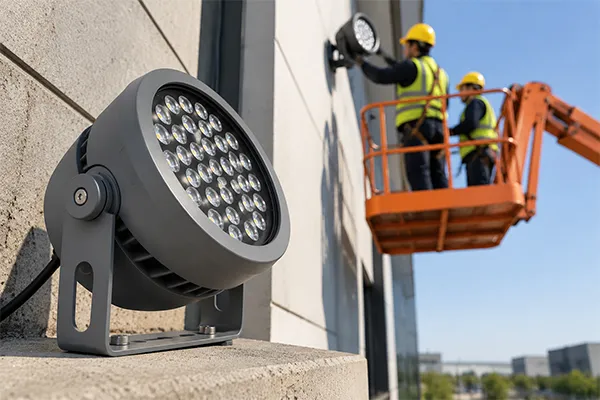
A long warranty sounds attractive, but it does not answer the practical question of how a claim will be resolved. If a floodlight fails at an elevated installation or an overseas job site, the replacement product may represent only part of the total cost. Labor, access equipment, freight, customs, and project delay can be more significant.
The remedy in an LED flood light warranty should state whether the supplier may repair, replace, provide spare parts, issue credit, or offer another agreed solution. Buyers should also confirm who pays for the product, shipping, customs, removal, installation, and on-site labor associated with a valid claim.
Compare Remedies Before a Failure Happens
Not every failure requires the same remedy. A failed driver in a serviceable fixture may call for a spare component. A product with a manufacturing defect may require replacement. A discontinued version may require an equivalent alternative subject to buyer approval.
The commercial solution should be documented rather than assumed.
| Possible Remedy | Suitable Situation | Buyer Verification Point |
|---|---|---|
| Repair | A fault can be diagnosed and repaired efficiently | Who performs the repair and where? |
| Spare parts | A replaceable driver, cable, or accessory is needed | Are parts compatible and available? |
| Replacement unit | A complete fixture failure requires a new product | Is the replacement identical or equivalent? |
| Credit or commercial adjustment | Replacement is impractical for a small or remote claim | How is the credit calculated and approved? |
| Future-order replacement | Both parties agree to combine replacement goods with future shipments | Does this timing meet the end customer’s needs? |
A supplier may reasonably use different remedies depending on the claim type, quantity, logistics route, and technical assessment. The important point is that buyers should understand the available options before they commit to a supplier.
Identify Every Cost Category
Many disputes arise because parties use the word “warranty” but attach different meanings to it. A supplier may agree to provide a replacement fixture, while the buyer expects reimbursement for field labor. Both positions may be commercially understandable, but they are not the same obligation.
Buyers should request a written allocation for these costs:
- Replacement product cost: Is the replacement product supplied without charge for an accepted claim?
- Outgoing freight: Who pays freight from the supplier or regional warehouse?
- Return freight: Must the buyer return failed units, and who pays?
- Customs duties and taxes: Who handles import duties, clearance costs, or local taxes?
- Testing and inspection: Who bears the cost of technical evaluation?
- Removal and reinstallation labor: Is field labor excluded, shared, or separately agreed?
- Access equipment: Are lift rentals, scaffolding, or traffic-control costs outside the warranty?
- Project delay consequences: Does the agreement exclude indirect losses or contractual penalties?
For large projects, I recommend that procurement teams involve their legal, technical, and commercial stakeholders before accepting warranty language. Application-specific decisions may require qualified professional review, especially when lighting affects public safety, construction schedules, or contractual performance obligations.
Establish a Claim Workflow
A warranty promise is more useful when the claim process is workable. Buyers should ask for a basic workflow that states how to report an issue, what evidence is required, who evaluates it, and how quickly the parties communicate.
A practical process may include:
- Buyer submits order information, product labels, installation photos, and a description of the issue.
- Buyer provides photos or video showing the failed unit and surrounding installation conditions.
- Supplier reviews the documentation and may request electrical measurements or additional evidence.
- Both parties determine whether the issue appears to be a product defect, installation issue, power-quality event, or another cause.
- Supplier proposes the applicable remedy under the written agreement.
- Buyer and supplier record the outcome for traceability.
I recommend setting expectations for response communication, even if the document does not promise a fixed claim-resolution time. Prompt communication can prevent a small defect report from becoming a broader relationship problem.
Which Operating Conditions Affect LED Flood Light Warranty Eligibility?
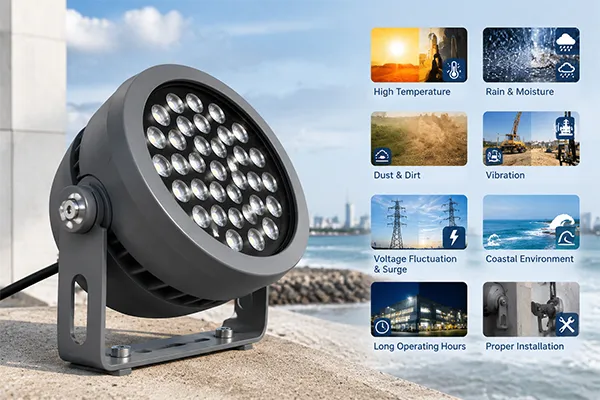
An outdoor floodlight may face heat, rain, dust, vibration, voltage fluctuation, coastal air, long daily operating hours, and poor installation practices4. If buyers do not document the intended application before production, they may receive a product that meets a general specification but does not align with the actual site risk.
LED flood light warranty eligibility often depends on using the product within agreed electrical, environmental, mounting, and operating conditions. Buyers should confirm voltage, surge expectations, operating hours, ambient environment, installation method, and customized specifications in writing before the supplier begins production.
Confirm Electrical Requirements
Electrical conditions should be part of the purchase specification, not an afterthought during claim handling. Buyers should confirm the local supply voltage, frequency, wiring arrangement, and expected power quality.
Important questions include:
- What input voltage range does the specified driver support?
- Does the site have frequent voltage fluctuation?
- Is external surge protection required by the project design?
- Does the buyer require a particular surge-protection level?
- Are photocells, sensors, dimming controls, or smart-control systems involved?
- Will multiple floodlights be switched at the same time?
Surge events can be particularly important in outdoor applications.5 However, buyers should not assume that an IP rating, CE document, RoHS document, aging test, or general product description means every surge event is covered6. The supplier and buyer should verify surge expectations and warranty exclusions in writing.
Match the Product to the Physical Environment
“Outdoor” describes a broad category, not a single operating condition. A parking lot, stadium façade, construction yard, coastal promenade, agricultural site, and industrial facility can create very different risks.
Before ordering, buyers should document:
| Site Factor | Questions to Confirm |
|---|---|
| Ambient temperature | What minimum and maximum temperatures are expected? |
| Humidity and rainfall | Will fixtures face persistent moisture, driving rain, or condensation? |
| Corrosion | Is the site coastal, chemical, industrial, or high-salinity? |
| Dust and debris | Is the site near mining, construction, agriculture, or traffic pollution? |
| Vibration | Is the fixture mounted on a structure subject to vibration? |
| Mounting position | Is the unit installed horizontally, vertically, or at a special angle? |
| Access difficulty | Can the fixture be serviced safely after installation? |
I often encourage buyers to share site photos, drawings, mounting heights, and application notes during the quotation stage. These materials help the supplier identify questions that may not appear on a basic product datasheet.
Record Customized Specifications
OEM and ODM projects need additional documentation because the supplied product may differ from the manufacturer’s standard version. A lighting brand may request a certain color temperature, wattage, beam angle, CRI, surface finish, label, packaging design, or cable length.
At Upward Lighting, we can customize specifications such as color temperature, wattage, beam angle, CRI, and surface finish colors. However, buyers should ensure that the final approved specification appears on the purchase order, drawing, datasheet, sample approval record, or another controlled document.
A buyer should retain:
- Approved product datasheet
- Quotation and purchase order
- Sample approval record, if applicable
- Product artwork and label approval
- Warranty terms
- Installation instructions
- Inspection and shipment records
- Batch or production traceability information where available
This record set supports clearer communication if a question arises months after delivery.
Can Aging Tests and Inspection Records Support an LED Flood Light Warranty Claim?
Buyers want evidence that the supplier has a quality-control process before shipment. Aging tests and inspections can provide useful process evidence, but they do not prove how every product will perform over its entire service life in every outdoor environment. Confusing factory testing with a warranty can create unrealistic expectations.
Aging tests and pre-shipment inspections can support verification of a supplier’s production process, but they are not a substitute for an LED flood light warranty. Buyers should request relevant test and inspection records while relying on written warranty terms to define post-sale responsibilities.
Understand What an Aging Test Can Show
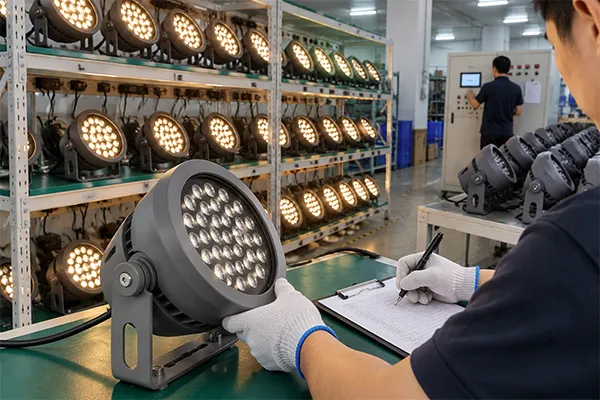
At Upward Lighting, every product undergoes a 100% aging test lasting between 4 and 8 hours before shipment. We also conduct pre-shipment inspection. From a buyer’s perspective, this process can help demonstrate that the supplier has a defined check before goods leave the factory.
A controlled aging process may help identify certain immediate issues, such as:
- Units that do not power on
- Obvious driver instability during the test period
- Visible flicker or inconsistent operation
- Assembly-related problems that appear under powered operation
- Basic functional issues before packing
However, buyers should use careful language when evaluating these records. A 4–8-hour aging test does not establish laboratory-grade lifetime performance. It does not guarantee field performance under every installation condition. It also does not replace a written obligation describing how claims will be handled.
Request Useful Quality-Control Evidence
The exact available documents will vary by order, product type, and supplier process. Buyers should request records that are relevant to their procurement decision rather than asking for generic “quality certificates.”
A buyer-facing checklist can include:
- Product datasheet with approved configuration
- Product photos or sample confirmation
- Aging-test procedure summary
- Pre-shipment inspection report or inspection checklist
- Quantity and packaging confirmation
- Product labels, carton labels, and batch identifiers
- CE and RoHS documents where required for the target market
- Warranty document
- Installation instructions
- Packing list and shipping documents
Buyers should verify the validity, scope, and market relevance of certification documents independently. CE and RoHS documentation may be relevant to market-entry or environmental requirements7, but these documents do not create a comprehensive warranty and do not independently prove service life in a specific project.
Use Inspection Before Shipment Strategically
Pre-shipment inspection is most valuable when the buyer defines the inspection criteria in advance.8 A third-party inspector, buyer representative, or supplier quality team cannot inspect against an undefined expectation.
For floodlight orders, buyers may consider verifying:
- Correct model, wattage, voltage, and color temperature
- Quantity and assortment by carton
- Appearance, finish, labels, and logo accuracy
- Mounting brackets and accessory completeness
- Packaging quality and carton markings
- Basic functional checks
- Dimensional requirements where relevant
- Documents included with the shipment
I have found that clear inspection requirements reduce subjective disputes. If a buyer wants a special cosmetic standard, specific packaging, or customized labeling, those requirements should be part of the inspection plan before production is complete.
How Can Buyers Protect Replacement Continuity Over Time?
A valid warranty claim can still be difficult if the original product has changed, components are no longer available, or the buyer needs to maintain visual consistency across a project. For importers, distributors, and brands, continuity is a separate risk from whether a single failed unit is technically covered.
LED flood light warranty continuity requires buyers to ask how the supplier will handle equivalent replacements, spare parts, product revisions, discontinued components, and specification consistency. Buyers should document what “equivalent” means for their market, project, or branded product line.
Define “Equivalent Replacement”
An equivalent replacement may not be identical in every detail. Component availability can change over time, and manufacturers may update drivers, LEDs, housing details, or packaging.9 These changes can be reasonable, but the buyer should understand how the supplier manages them.
For a project buyer, equivalence may mean the replacement should maintain:
- Required wattage and input-voltage compatibility
- Similar light distribution or beam angle
- Suitable color temperature consistency
- Comparable mounting interface
- Compatible physical dimensions
- Required protection rating and environmental suitability
- Acceptable visual appearance for the installation
For a lighting brand, equivalence may also include branding, labels, packaging, instructions, and compliance documentation. For a distributor, it may include matching product codes and channel expectations.
Ask About Version Control
Buyers should ask suppliers how they communicate material product changes. A revised driver or LED package may not be a problem, but unexpected changes can cause challenges for catalog management, project approvals, replacement stock, or future orders.
Useful questions include:
- Will the supplier notify us before making a material specification change?
- Which product characteristics are controlled for our approved model?
- Can the supplier provide a revised datasheet when components change?
- How will replacement units be identified against the original batch?
- Are spare drivers, brackets, cables, or other service parts available?
- Can we purchase contingency stock with the original order?
- What happens if an original component is discontinued?
I recommend that buyers of major projects consider ordering a reasonable quantity of agreed spare units or parts at the beginning. The appropriate quantity depends on project size, maintenance access, operating hours, and the buyer’s service obligations. A qualified project professional should determine the right maintenance strategy for the application.10
Plan for Brand and Channel Obligations
Importers and local lighting brands often carry obligations beyond the factory warranty. They may need to answer end-user questions, arrange local service, maintain replacement inventory, or protect their market reputation.
That is why a procurement team should assess the supplier’s after-sales communication process as well as the warranty text. Buyers can ask:
- Who is the after-sales contact?
- What information does the supplier need to assess a claim?
- Can the supplier provide technical documents quickly?
- Can the supplier support small-batch replacement orders?
- Can replacement goods be combined with a future shipment?
- How are customized labels or packaging handled for replacement products?
At Upward Lighting, we handle after-sales cases based on the available order, product, and installation information. I believe that anonymized case handling and documented communication are more useful than broad promises. Each claim has its own technical and commercial facts, so buyers should establish the process before an issue occurs.
Frequently Asked Questions
Is a longer LED flood light warranty always better?
No. A longer LED flood light warranty may be useful, but buyers should also evaluate coverage, exclusions, remedies, claim evidence, response process, and cost allocation. A shorter but clearly documented warranty can be easier to manage than a longer statement with unclear responsibilities.
What documents should I request from an LED floodlight supplier?
Buyers should request an approved datasheet, quotation, purchase order, warranty document, installation instructions, relevant certification documents, product labels, and quality-control or inspection records where available. Buyers should independently verify documents needed for their target market and application.
Does a 100% aging test guarantee floodlight lifetime?
No. A 100% aging test can support verification that products underwent a powered quality-control process before shipment. It does not guarantee lifetime performance in every field environment and does not replace written warranty terms, correct installation, or application-specific evaluation.
Who usually pays installation labor for a warranty claim?
The answer depends on the written agreement. Some warranty arrangements address only the replacement product, while labor, lift equipment, freight, customs, and local service costs may be excluded or separately negotiated.11 Buyers should confirm each cost category before placing the order.
Should I order spare LED floodlights with my project order?
Buyers may consider ordering agreed spare units or service parts, especially for remote, high-access, or time-sensitive installations. The suitable quantity depends on project scale, maintenance needs, replacement lead time, and contractual obligations to the end customer.
Conclusion
An LED flood light warranty should be evaluated as a practical agreement for managing post-sale risk, not as a simple number printed on a quotation. Buyers should verify coverage, exclusions, operating conditions, remedies, cost allocation, claim procedures, and replacement continuity before production begins. Aging tests, inspections, and certification documents can support supplier evaluation, but they do not replace written warranty obligations. If you are sourcing customized LED floodlights for distribution or project use, we invite you to share your application requirements so we can clarify specifications, documentation, and quality-control expectations before you place an order.
"Sec. 7.4, Outdoor Lighting", https://udo.durhamnc.gov/udo/7_04_Outdoor%20Lighting.htm. Outdoor-lighting guidance evaluates installations using maintained photometric criteria such as illuminance and uniformity, so significant loss of light output can affect whether an installation continues to meet its design requirements. Evidence role: general_support; source type: institution. Supports: Lighting standards or guidance showing that maintained illuminance, uniformity, and related photometric performance are relevant to outdoor lighting design and assessment.. Scope note: Whether reduced output affects safety or contractual acceptance depends on the applicable standard, the site, and the specified maintenance criteria. ↩
"LED Systems Reliability Consortium", https://www.energy.gov/cmei/ssl/led-systems-reliability-consortium. Reliability studies of LED lighting systems identify driver and power-electronics failures among material failure modes, supporting the need to specify driver coverage and service arrangements in luminaire warranties. Evidence role: general_support; source type: paper. Supports: Field or laboratory evidence that LED drivers and associated electronics are important reliability and maintenance considerations in LED lighting systems.. Scope note: Failure rates and dominant modes vary by driver design, thermal environment, operating profile, and installation conditions. ↩
"Update on a consumer-oriented guide for surge protection", https://www.nist.gov/document/updateguidepdf. Electrical-safety and power-quality guidance recognizes that transient overvoltages, including lightning-related surges, can damage or disrupt electronic equipment, supporting explicit treatment of surge exposure in product specifications and warranty exclusions. Evidence role: mechanism; source type: government. Supports: Authoritative guidance that transient overvoltages, including lightning-induced surges, can damage or disrupt electronic equipment and that power-quality conditions matter.. Scope note: The evidence does not establish that every field failure was caused by a surge; causal determination requires site-specific investigation. ↩
"Outdoor Lighting Challenges and Solution Pathways", https://betterbuildingssolutioncenter.energy.gov/sites/default/files/attachments/Outdoor%20Lighting%20Challenges%20and%20Solutions%20Pathways%20Paper.pdf. LED-system reliability depends on operating temperature, environmental exposure, electrical conditions, and installation-related factors, which supports documenting the intended application before evaluating warranty eligibility. Evidence role: general_support; source type: research. Supports: Technical research or official guidance that temperature, environmental exposure, operating conditions, and installation affect LED luminaire reliability or performance.. Scope note: The relative importance of these factors depends on the luminaire design, local environment, and actual installation. ↩
"CIMARRON LED", https://dublinohiousa.gov/dev/dev/wp-content/uploads/2019/01/C1_Lighting-Information.pdf. Surge-protection guidance treats exposure to transient overvoltages as an installation-specific risk, with outdoor circuits often requiring assessment of lightning and switching transients; this supports confirming surge expectations for outdoor floodlights. Evidence role: mechanism; source type: institution. Supports: Engineering guidance explaining why outdoor electrical installations can be exposed to lightning-induced or switching transient overvoltages and may require surge-risk assessment.. Scope note: Outdoor location alone does not determine the required protection level, which depends on the electrical installation and local lightning-risk assessment. ↩
"RoHS", https://en.wikipedia.org/wiki/RoHS. CE marking, RoHS restrictions, and IP classifications address distinct conformity, substance, or ingress-protection matters; none by itself defines a seller's contractual remedy for surge-related product failure. Evidence role: definition; source type: government. Supports: Official explanations that CE marking concerns conformity assessment, RoHS restricts specified hazardous substances, and IP codes classify protection against ingress, rather than defining private warranty remedies for surge damage.. Scope note: Applicable legal obligations and the evidentiary value of particular documents depend on the product, market, and governing contract. ↩
"CE marking - Internal Market, Industry, Entrepreneurship and ...", https://single-market-economy.ec.europa.eu/single-market/goods/ce-marking_en. European Union guidance describes CE marking as a conformity requirement for covered products placed on the EU market and RoHS as a restriction on specified hazardous substances in electrical and electronic equipment. Evidence role: definition; source type: government. Supports: European Commission material explaining CE marking requirements for covered products and RoHS restrictions on certain hazardous substances in electrical and electronic equipment.. Scope note: Whether a particular floodlight requires particular declarations, testing, or technical documentation depends on its classification and the market in which it is placed. ↩
"What kinds of Lot Acceptance Sampling Plans (LASPs) are ...", https://www.itl.nist.gov/div898/handbook/pmc/section2/pmc22.htm. Acceptance-sampling and inspection practice depend on defined lot characteristics, sampling plans, and acceptance criteria, supporting the use of agreed inspection requirements before pre-shipment evaluation. Evidence role: general_support; source type: institution. Supports: Quality-control standards or guidance showing that inspection requires specified characteristics, acceptance criteria, and sampling or evaluation procedures.. Scope note: Defined criteria improve consistency but do not eliminate the possibility that defects outside the inspection scope will escape detection. ↩
"Obsolescence and Life Cycle Management for Avionics", https://www.faa.gov/sites/faa.gov/files/aircraft/air_cert/design_approvals/air_software/TC-15-33.pdf. Electronics lifecycle-management guidance recognizes component obsolescence and design changes as recurring supply-chain risks, supporting advance planning for approved substitutions, spare parts, and replacement continuity. Evidence role: general_support; source type: government. Supports: Lifecycle-management guidance recognizing electronic-component obsolescence and the need to manage changes, substitutions, and replacement availability.. Scope note: The timing and effect of changes vary by component market, manufacturer controls, and the buyer's approved specification. ↩
"Purchasing Energy-Efficient Exterior Lighting", https://www.energy.gov/cmei/femp/purchasing-energy-efficient-exterior-lighting. Asset-management guidance frames maintenance planning as a risk- and context-based activity that considers asset criticality, operating conditions, access, and service objectives, supporting application-specific professional assessment of lighting-maintenance strategy. Evidence role: expert_consensus; source type: institution. Supports: Asset-management or maintenance guidance showing that maintenance strategies should account for asset criticality, access, risk, operating conditions, and service requirements.. Scope note: Such guidance does not prescribe a universal spare-stock quantity or maintenance plan for every lighting project. ↩
"2-719. Contractual Modification or Limitation of Remedy.", https://www.law.cornell.edu/ucc/2/2-719. Written-warranty guidance explains that warranty documents identify available remedies and limitations, so coverage of labor, transport, and other associated costs should be stated expressly rather than assumed. Evidence role: general_support; source type: government. Supports: Official warranty guidance explaining that written warranty terms specify remedies and may contain limitations or exclusions, subject to applicable law.. Scope note: The enforceability of exclusions and the rights of commercial buyers vary by jurisdiction, transaction type, and the governing contract. ↩