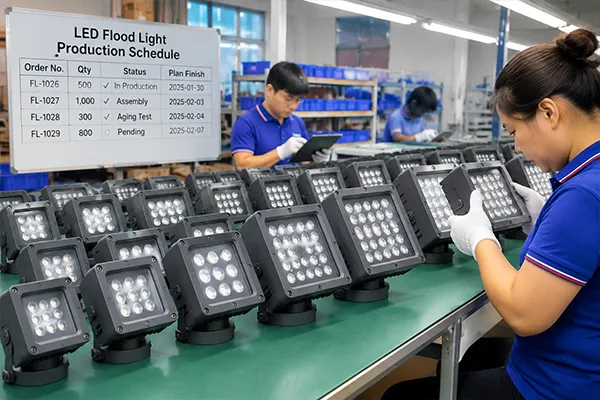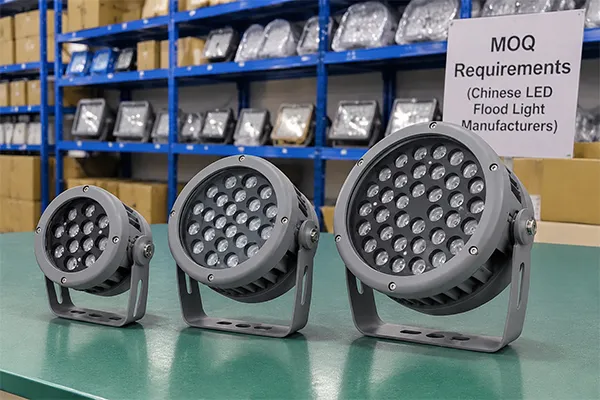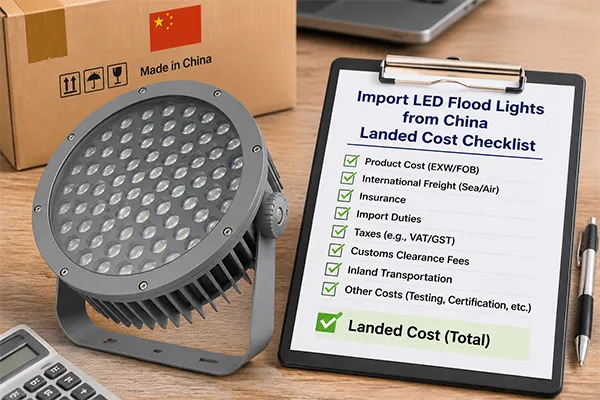

Choosing an LED flood light supplier can feel straightforward until a shipment arrives with unclear specifications, inconsistent performance, missing paperwork, or unexpected costs. A low quote may look attractive at first, but it can create expensive project delays later. I recommend treating supplier selection as a practical risk-control process based on evidence.
An LED flood light supplier should be evaluated by verifying model-specific specifications, sample-to-production controls, applicable compliance documents, commercial terms, and delivery capability. International buyers should request written evidence—not rely on catalog claims, attractive samples, or the lowest unit price—before approving a deposit or placing a bulk order.
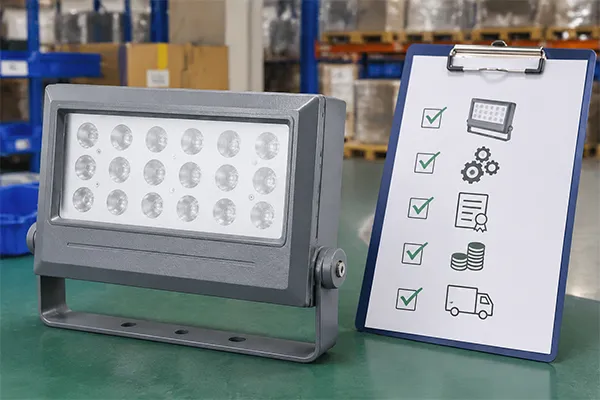
In our conversations with importers, contractors, and lighting brands, I often see the same issue: important details remain unconfirmed until after the buyer has approved a sample or paid a deposit. The following checklist focuses on the questions, records, and controls that can reduce those risks before production starts.
How Should You Verify an LED Flood Light Supplier’s Product Specification?
An LED flood light supplier may offer many wattages, housings, beam angles, and color temperatures under one product series. That variety can create confusion when the quotation, sample, datasheet, and purchase order do not describe the same configuration. A vague specification is one of the most common causes of later disputes.1
Buyers should verify an LED flood light supplier by requesting a model-matched datasheet, an agreed parameter sheet, product photos, and written confirmation of every customized requirement. The approved document should identify the exact model, wattage, voltage, CCT, beam angle, IP rating, finish, cable, mounting method, and packaging configuration.2
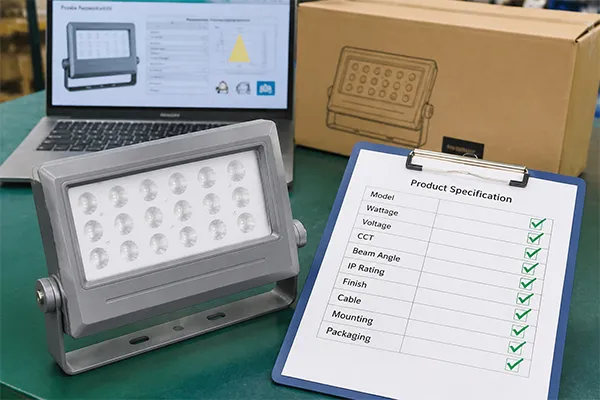
Start With an Approved Parameter Sheet
A catalog is useful for an initial review, but it is not a final purchasing document. Catalog pages often show a product family with several possible configurations. For example, a 100W LED floodlight may be available in 3000K, 4000K, 5000K, or 6500K; different input voltages; several beam distributions; and optional sensors, brackets, or cable lengths.
I recommend that buyers ask for a specification confirmation sheet before approving production. This document should connect every important requirement to one specific item code or product model.
| Specification item | Why it matters | Evidence to request |
|---|---|---|
| Product model | Prevents substitution within a product family | Model number on quotation and datasheet |
| Rated wattage | Affects energy use, driver selection, and thermal design | Approved parameter sheet |
| Input voltage and frequency | Must match the destination electrical system | Label artwork and datasheet |
| Color temperature | Affects project appearance and customer expectations | Written CCT confirmation |
| Beam angle or optical distribution | Influences coverage and glare | Lens or reflector specification |
| Housing finish | Matters for brand consistency and outdoor appearance | Color sample, RAL reference, or photo |
| Cable and connector | Affects installation compatibility | Cable length, plug type, and wire details |
| Mounting bracket | Affects installation method | Drawing, dimensions, and bracket photo |
| Packaging | Affects freight damage and retail presentation | Carton dimensions, marks, and packing list |
Confirm Customization in Writing
OEM and ODM requests create additional risk because they often involve changes that are not visible in general product photos. I have seen RFQs where a buyer requested a private label, a different housing color, or a specific cable length, but the request was only discussed in a chat message. That leaves too much room for misunderstanding.
For customized LED floodlight orders, I suggest confirming:
- Logo position, size, and printing method
- Brand label content and voltage markings
- Color temperature and tolerance expectations
- Wattage and driver configuration
- Surface finish or housing color
- Packaging artwork and carton marks
- Instruction manual language
- Barcode, SKU, or customer item number
- Required accessories, such as visors, mounting hardware, or connectors
At Upward Lighting, we normally treat these items as part of the order confirmation process. We can customize parameters such as CCT, wattage, beam angle, CRI, and surface finish. However, buyers should expect any manufacturer to document what is agreed. A verbal promise is not a stable production reference.
Ask What Is Not Included
A strong purchasing checklist also identifies exclusions. If a quotation says “100W LED floodlight,” buyers should ask whether the price includes the driver type, surge protection option, cable length, bracket, carton, logo label, test reports, and spare parts.
This approach is not distrustful. It is simply how procurement teams prevent assumptions from becoming costs.
Before I approve any floodlight specification, I would want every item that affects installation, appearance, compliance, or resale to appear in writing.
Can a Sample Prove LED Flood Light Supplier Batch Consistency?
A working sample can build confidence, but it cannot prove that an LED flood light supplier will deliver the same quality across a full container, a project batch, or repeat orders. Buyers can face problems when the sample uses one component set while later production uses another without clear approval or documented controls.
A sample does not prove mass-production reliability on its own.3 Buyers should ask an LED flood light supplier how it controls key materials, assembly, aging, outgoing inspection, and sample-to-production consistency. The supplier should be able to explain its process and provide inspection records or practical evidence appropriate to the order.
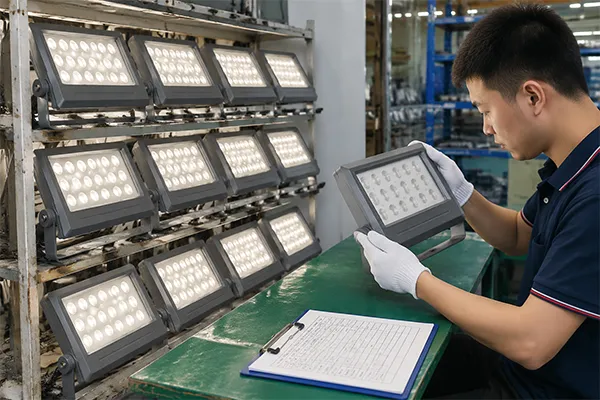
Look Beyond Brightness and Appearance
Most buyers first check whether a floodlight turns on, looks well-made, and produces a suitable light color. Those checks are useful, but they cover only part of the risk. A sample may perform well because it was carefully assembled, while a large batch introduces variation in components, assembly steps, labeling, packaging, or quality checks.4
The key question is not only, “Is this sample good?” The better question is, “What will keep the mass-production batch aligned with this approved sample?”
Ask the supplier to explain how it controls these areas:
-
Incoming materials
Which major components are checked before assembly? Buyers may ask about housings, LED light sources, drivers, lenses, cables, gaskets, screws, and packaging materials. -
Production identification
How does the factory identify the approved model, order number, or customized version during assembly? This matters when similar products are produced at the same time. -
Aging procedure
Does the supplier perform an aging test? If yes, for how long, under what process, and for which products? The answer should be specific rather than a broad statement such as “we test everything.” -
Outgoing inspection
What does the final inspection cover? Buyers can ask whether checks include appearance, power-on function, labeling, packaging, accessories, and carton marks. -
Defect handling
What happens if a defect is found during production or before shipment? The supplier should have a practical process for segregation, rework, replacement, or reporting.
Use the Approved Sample as a Controlled Reference
I recommend retaining an approved sample and attaching clear approval notes to it. The record can include:
- Approved model number
- Buyer’s SKU or project code
- CCT and wattage
- Housing color and finish
- Cable type and length
- Label and logo artwork
- Packaging requirements
- Date of approval
- Photos from multiple angles
For a larger or more sensitive order, buyers may also arrange a pre-shipment inspection through their own qualified inspection provider. The scope should match the product and commercial risk. An inspection provider can check selected samples from the finished lot against agreed specifications, packaging requirements, and visible workmanship criteria.5
What Responsible Manufacturers Should Be Able to Show
At our factory, every product undergoes a 100% aging test for approximately 4 to 8 hours before shipment. We use this as one part of our internal quality process, not as a claim that every floodlight in every market is automatically suitable for every application. We also use order-stage confirmations to help align customized specifications before production.
Other suppliers may use different processes. Therefore, buyers should not assume that a factory follows the same controls merely because it offers similar product photos or product descriptions. Ask for the process, ask for the records that are available, and match the level of verification to the size and importance of the order.
What Compliance Documents Should You Request From an LED Flood Light Supplier?
Compliance paperwork is important, but it is often misunderstood during international sourcing. Buyers may see CE or RoHS references in a catalog and assume that the product is automatically compliant in every destination market. That assumption can create problems because document applicability depends on the exact model, intended market, project requirements, and current regulations.
Buyers should request compliance documents that match the exact LED floodlight model and confirm whether they are relevant to the destination market and project. CE and RoHS documents should be reviewed as supporting records, not treated as blanket proof of universal compliance, legal suitability, or customer acceptance.6
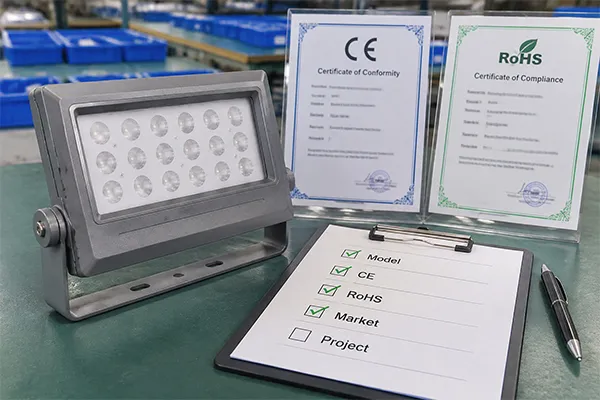
Match Documents to the Actual Product
An LED flood light supplier may offer several models that look alike but use different drivers, wattages, housings, or electrical configurations. A document for one model does not automatically apply to another.7 Buyers should compare the model number, rated voltage, wattage range, product description, manufacturer name, and issue date against the product being purchased.
Here is a practical document review table:
| Document or record | Procurement purpose | Buyer verification question |
|---|---|---|
| Datasheet | Confirms stated product parameters | Does the model number match the quotation? |
| Declaration or certificate reference | Supports claimed compliance status | Does it identify the exact model or covered series? |
| RoHS-related documentation | Supports restricted-substance requirements | Is the scope relevant to the product and market? |
| Product label artwork | Verifies markings before production | Does it show the correct brand, voltage, and model? |
| Test report, where requested | Provides technical evidence | Is the report current and applicable to this model? |
| Packaging artwork | Supports customs, retail, and project needs | Are required warnings and marks included? |
Treat Market Requirements as a Separate Verification Task
Country-specific electrical, safety, labeling, environmental, and project requirements can change.8 They can also differ between a retail sales channel, a construction project, and a government tender. I recommend that buyers verify these requirements with qualified local compliance professionals, testing organizations, project consultants, or legal advisers where appropriate.
A supplier can provide documents and technical information, but the buyer should not rely on a general certificate statement as a final regulatory conclusion. This is especially important when the buyer is selling under a private label or importing goods into a regulated market.
At Upward Lighting, our products hold certifications such as CE and RoHS. We provide these records as part of our product documentation process where applicable. However, we encourage buyers to verify that any document applies to the exact ordered model, destination, and project requirement.
Build Compliance Into the RFQ Stage
The best time to discuss required documents is before the supplier quotes. I have seen buyers ask for certificates only after production is complete. At that point, the selected configuration may not match the documentation needed for the project.
A better RFQ includes:
- Destination country or region
- Sales channel or project type
- Exact product model and input voltage
- Required product markings
- Documentation requested before order confirmation
- Whether third-party inspection or testing is required
- Any customer-specific technical specification
This information helps suppliers quote more accurately. It also helps buyers identify early if a proposed product is not suitable for the intended application.
How Do You Compare LED Flood Light Supplier Quotes Beyond Unit Price?
The lowest quoted unit price is not always the lowest procurement cost.9 A cheaper LED floodlight may involve longer lead times, lower packaging protection, unclear warranty responsibility, added tooling charges, or expensive replacement handling. These costs often become visible only when a project schedule or customer complaint puts pressure on the order.
Buyers should compare LED flood light supplier quotations using total procurement cost, not unit price alone. The comparison should include specification scope, packaging, customization charges, minimum order quantity, lead time, payment terms, shipping terms, warranty responsibilities, defect handling, and the cost of possible delays or replacements.
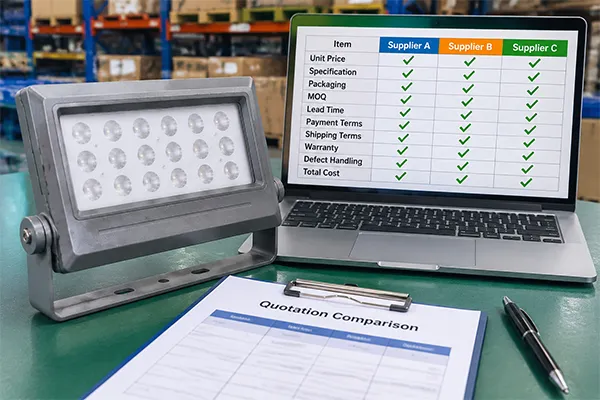
Build a Like-for-Like Quote Comparison
A quote comparison becomes meaningful only when all suppliers are pricing the same requirement.10 If one supplier quotes a standard product and another quotes a customized product with stronger packaging or different cable requirements, the lower number does not show which option is better.
I suggest using a supplier comparison sheet with commercial and technical columns.
| Evaluation area | Supplier A | Supplier B | Buyer question |
|---|---|---|---|
| Unit price | Is the specification identical? | ||
| Sample cost | Is it refundable against a bulk order? | ||
| MOQ | Does it fit expected demand? | ||
| Production lead time | Does it include customization approval? | ||
| Packaging standard | Is it suitable for the shipment method? | ||
| Branding/tooling cost | Is there a one-time or recurring charge? | ||
| Payment terms | What is due before shipment? | ||
| Incoterm | Who controls freight and insurance? | ||
| Warranty process | How are valid claims documented and resolved? | ||
| Defect allowance or claim process | What evidence is required after delivery? |
Clarify Delivery Dates and Dependencies
A supplier may quote a production lead time of 20 days, but buyers need to understand when that clock starts.11 Does it start after the deposit? After artwork approval? After sample confirmation? After all components arrive? Each condition can affect the actual shipment date.
When I handle RFQs, I find that lead times are more reliable when the order includes a clear approval schedule. Buyers should confirm:
- Deposit date
- Artwork approval deadline
- Pre-production sample requirement, if any
- Production completion date
- Inspection date
- Balance payment timing
- Booking deadline
- Port of loading
- Required shipping documents
This is particularly important for contractors with installation deadlines and distributors planning seasonal inventory.
Review Warranty and Defect Handling Before Ordering
Warranty statements can sound reassuring, but buyers should ask how the process works in practice. A useful discussion covers responsibility, evidence, response time, replacement method, and whether freight costs are addressed.
Questions I would ask include:
- What information is required for a defect claim?
- Are photos, videos, batch codes, or installation details needed?
- How does the supplier distinguish product defects from installation or application issues?
- Will the supplier provide replacement units, credit, parts, or another solution?
- How will the buyer handle claims after products have been installed or resold?
A clear process does not eliminate defects. It does reduce the chance that both sides interpret responsibilities differently after delivery.
Frequently Asked Questions
What is the first document I should request from an LED flood light supplier?
I recommend requesting a model-matched datasheet and an itemized quotation first. These documents should identify the exact model, wattage, voltage, CCT, beam angle, IP rating, cable, mounting method, and packaging. They provide a practical base for later sample approval and purchase order confirmation.
Is a CE certificate enough to import LED floodlights?
No. CE-related documents should not be treated as automatic proof that a floodlight is compliant for every country, customer, or project. Buyers should verify document applicability to the exact model and destination market, then obtain qualified local advice when application-specific regulatory requirements apply.
How long should LED floodlights be aged before shipment?
There is no single aging duration that proves universal quality or suitability. Buyers should ask the supplier whether it performs aging, how long the process lasts, what products it covers, and how failures are handled. At our factory, we conduct 100% aging tests for around 4 to 8 hours.
Should I arrange a third-party pre-shipment inspection?
A third-party inspection can be useful for higher-value, customized, project-sensitive, or first-time orders. Buyers should define the inspection scope in advance, including approved specifications, visible workmanship, labeling, packaging, quantity, and accessories. An inspection does not replace clear order documents, but it adds another control point.12
What should be included in an LED floodlight purchase order?
A purchase order should include the exact product model, technical specification, approved sample reference, quantity, unit price, total amount, packaging, labeling, delivery date, payment terms, shipping terms, documentation requirements, warranty terms, and agreed customization details. Attach approved artwork and parameter sheets whenever possible.
Conclusion
Selecting an LED flood light supplier is not simply about finding a factory with a competitive price. It is about reducing technical, commercial, compliance, and delivery risk before mass production begins. I recommend verifying the exact specification, confirming sample-to-production controls, reviewing model-specific documents, and comparing total procurement cost. If you are evaluating a floodlight order, we at Upward Lighting can provide quotations, customization confirmation, sample support, and documented order-stage communication for your review.
"Part 3 - Improper Business Practices and Personal ...", https://www.acquisition.gov/far/part-3. Procurement research and guidance recognize that clear, complete specifications reduce ambiguity between buyer and supplier and can help prevent disputes over delivered goods. Evidence role: general_support; source type: research. Supports: Evidence that ambiguous or incomplete technical specifications can create differing interpretations and increase procurement or contractual dispute risk.. Scope note: Such sources generally address procurement broadly rather than LED floodlights specifically. ↩
"GUIDE TO DEVELOPING SPECIFICATIONS", https://www.saltlakecounty.gov/globalassets/1-site-files/contracts/county-employees/training-resources/specifications.pdf. Technical procurement documentation should identify the product and its applicable performance, electrical, installation, and packaging requirements sufficiently to permit objective verification of what is supplied. Evidence role: general_support; source type: institution. Supports: Guidance or standards establishing the importance of unambiguous product identification and specified technical characteristics in procurement documentation.. Scope note: The exact list of fields is a procurement checklist and may vary by product, market, and contract. ↩
"6.2.1. What is Acceptance Sampling?", https://www.itl.nist.gov/div898/handbook/pmc/section2/pmc21.htm. Acceptance-sampling principles show that inspection of a sample provides evidence about a lot at a stated sampling plan and confidence level; it does not establish that every unit in mass production is conforming or reliable. Evidence role: mechanism; source type: government. Supports: Sampling and inspection principles showing that observations from a sample provide limited evidence about a production lot and do not guarantee every produced unit.. Scope note: The conclusion depends on the sampling plan, lot definition, and measured characteristic. ↩
"Design for tolerance of electro-mechanical assemblies", https://nvlpubs.nist.gov/nistpubs/Legacy/IR/nistir6223.pdf. Manufacturing-quality guidance explains that variation in incoming materials, assembly processes, measurement, and handling can produce differences among units even when a reference sample meets requirements. Evidence role: mechanism; source type: government. Supports: Evidence that variation in materials, processes, and inspection systems can affect consistency among manufactured units.. Scope note: This general mechanism does not demonstrate that variation occurred in any particular floodlight order. ↩
"ISO 3951-1:2005 - Sampling procedures for inspection by ...", https://www.iso.org/standard/34640.html. Conformity-assessment practice permits independent inspection bodies to examine sampled goods against defined contractual requirements, including product characteristics, marking, quantity, and packaging. Evidence role: general_support; source type: institution. Supports: Inspection-body practice under which product inspections may evaluate sampled goods against defined contractual specifications, labeling, packaging, and visible-condition criteria.. Scope note: An inspection result is limited to its agreed scope, sampling method, inspection date, and accessible characteristics. ↩
"CE marking – obtaining the certificate, EU requirements", https://europa.eu/youreurope/business/product-rules-compliance/general-product-compliance/ce-marking/index_en.htm. The European Commission states that CE marking is required only for products covered by applicable EU harmonisation legislation and that the manufacturer must assess conformity with the requirements applicable to the specific product before placing it on the EU market. Evidence role: definition; source type: government. Supports: Official explanation that CE marking concerns applicable EU harmonisation legislation and that RoHS obligations depend on product scope and applicable requirements.. Scope note: EU guidance does not determine import, certification, labeling, or customer-acceptance requirements in non-EU jurisdictions. ↩
"Children's Product Certificate", https://www.cpsc.gov/Business--Manufacturing/Testing-Certification/Childrens-Product-Certificate. EU conformity documentation is intended to identify the product for which conformity is declared and the legislation applied; whether a document covers a product variant depends on its stated scope and the relevant technical assessment. Evidence role: general_support; source type: government. Supports: Official requirements or guidance that conformity documentation must identify the product and applicable conformity assessment, making model and configuration matching relevant.. Scope note: Coverage of a product family can be valid when the declaration, report, and technical basis expressly encompass the relevant variant. ↩
"General Use Products: Certification and Testing", https://www.cpsc.gov/Business--Manufacturing/Testing-Certification/General-Use-Products-Certification-and-Testing. International trade and regulatory guidance notes that technical regulations, standards, and conformity-assessment procedures are set by jurisdictions and can be revised, requiring importers to verify current applicable requirements. Evidence role: historical_context; source type: institution. Supports: Evidence that technical regulations and conformity requirements are jurisdiction-specific and may be updated through legislative or regulatory amendment.. Scope note: A general regulatory source cannot identify all current obligations for a particular destination, product configuration, or project. ↩
"A data-driven life cycle cost model for tender evaluation ... - PMC", https://pmc.ncbi.nlm.nih.gov/articles/PMC12988185/. Public-procurement guidance distinguishes purchase price from total or lifecycle cost, which may include acquisition, transport, operation, maintenance, and end-of-life costs when relevant to the procurement. Evidence role: general_support; source type: institution. Supports: Procurement guidance recognizing that evaluation may include costs beyond purchase price, such as operation, maintenance, logistics, and other lifecycle costs.. Scope note: The cost categories and their relative importance depend on the contract terms, logistics arrangement, and intended use. ↩
"EVALUATING BIDS AND PROPOSALS - Public Documents", https://thedocs.worldbank.org/en/doc/9dcb7971706bf29b2732779c39922b77-0290012025/original/Evaluating-Bids-and-Proposals-with-Rated-Criteria-Feb-4-2025.pdf. Procurement evaluation guidance generally requires offers to be assessed against the same pre-disclosed requirements and criteria so that differences in price can be distinguished from differences in scope or technical compliance. Evidence role: general_support; source type: institution. Supports: Procurement guidance requiring bids to be evaluated against disclosed, common requirements and specifications.. Scope note: Formal public-procurement rules may not apply to private commercial purchasing, although the comparability principle remains relevant. ↩
"10. Fundamental Scheduling Procedures", https://www.cmu.edu/cee/projects/PMbook/10_Fundamental_Scheduling_Procedures.html. Operations-management literature treats lead time as a measured interval between defined process events; its duration can be affected by prerequisites such as order release, engineering approval, material availability, and production scheduling. Evidence role: mechanism; source type: education. Supports: Operations-management evidence that lead time is affected by defined process start points and dependencies such as approvals, materials, and production capacity.. Scope note: This principle does not validate a particular supplier's quoted lead time or guarantee delivery performance. ↩
"Part 46 - Quality Assurance", https://www.acquisition.gov/far/part-46. Inspection is a conformity-assessment activity performed against specified requirements; consequently, it can add independent verification but cannot resolve requirements that were not clearly defined in the purchase documentation. Evidence role: mechanism; source type: institution. Supports: Evidence that inspection evaluates conformity against defined criteria and therefore relies on clear specifications while providing a separate verification activity.. Scope note: The degree of assurance added depends on the inspection scope, sampling plan, inspector competence, and timing. ↩