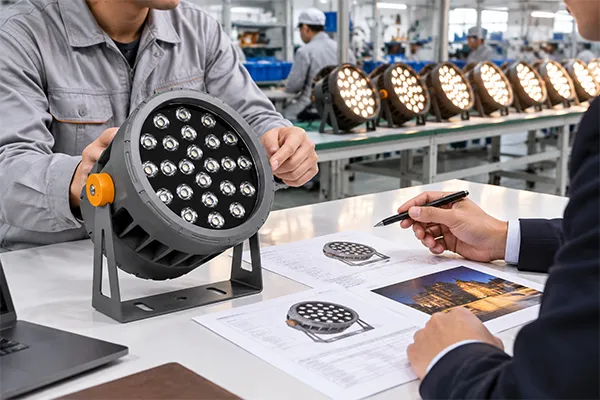

LED flood light solutions can become a project risk when contractors select them by wattage, stated lumens, or unit price alone. A poor match between the fixture, mounting position, target area, and project schedule can lead to rework, delayed installation, or avoidable maintenance discussions. We help contractors turn broad requirements into clearer procurement decisions.
LED flood light solutions for contractors should be selected from the application outward: define the area to be illuminated, mounting height and position, required light distribution, environmental conditions, specifications, quantity, and delivery date. Contractors should then compare suppliers based on specification clarity, quality-control process, documentation, customization capability, sample handling, and realistic production coordination—not only quoted price.

At Upward Lighting, we work with recurring contractor inquiries involving quotations, specification confirmation, customization, and production scheduling. In these discussions, we often see that the biggest procurement problems begin before an order is placed. A better briefing process helps make the product both quotable and manufacturable.
Why Do LED Flood Light Solutions Need to Start With the Application?
A contractor may receive a simple request for “100W floodlights” and assume that the requirement is complete. However, a wattage label does not explain what area needs light, where the fixture will sit, or how the light should be distributed1. That uncertainty can create problems after installation.
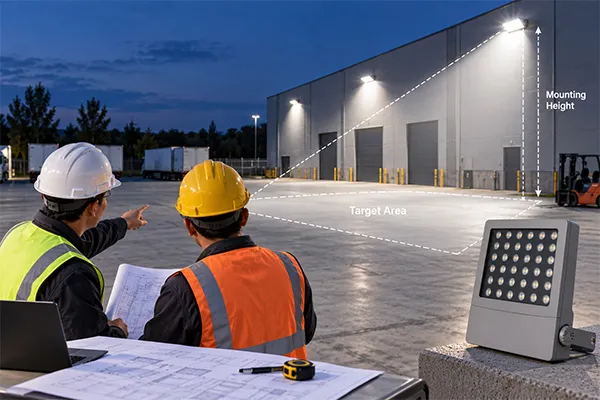
LED flood light solutions should begin with the lighting task and installation conditions, not with wattage alone. Contractors should identify the target area, mounting height, fixture location, coverage direction, operating environment, and project requirements before comparing specifications or supplier quotations.
The Same Wattage Can Produce Different Project Outcomes
Two LED floodlights with the same nominal wattage may not be equivalent for a project.2 Their actual performance and suitability can differ because of optical design, beam angle3, driver configuration, heat management, housing construction, and declared technical parameters.
For example, a wide beam can suit a low-mounted fixture covering a broad access area. A narrower distribution may be more appropriate when the contractor needs to direct light toward a defined yard, façade, gate, loading zone, or sports-related area. Neither choice is universally better. The project conditions determine which direction is worth assessing.
In recurring specification-confirmation discussions, we often ask questions that seem basic but prevent later confusion:
- What is the application: building exterior, parking area, loading bay, yard, warehouse perimeter, signage, or public walkway?
- What is the approximate mounting height?
- Where will each floodlight be installed?
- What direction should the light reach?
- Is the goal broad general illumination, focused coverage, security support, or architectural emphasis?
- Are there nearby windows, roads, neighboring properties, or sensitive areas where glare or spill light matters4?
- Will the fixtures operate in exposed outdoor conditions, dusty industrial spaces, or sheltered locations?
Build a Quote-Ready Project Brief
A short procurement brief can improve quotation accuracy and make supplier comparisons more meaningful. It also reduces the chance that one supplier quotes a standard product while another assumes customized requirements.
| Project item | Why it matters | Example of a useful brief |
|---|---|---|
| Application | Defines the lighting task | Exterior loading area |
| Mounting location | Affects installation and aiming | Steel canopy beam |
| Mounting height | Supports optical review | Approximately 6 m |
| Quantity | Drives pricing and scheduling | 80 units |
| Wattage range | Narrows the product selection | 100 W or approved equivalent |
| Color temperature | Affects visual appearance | 4000 K |
| Beam angle | Affects coverage pattern | Wide distribution requested |
| Housing finish | Supports visual coordination | Black or gray finish |
| Target delivery date | Helps assess production feasibility | Required before site installation phase |
We do not treat this brief as a replacement for lighting design, site assessment, installation engineering, or local compliance review. Qualified project professionals should evaluate those application-specific decisions. Still, a clear brief gives manufacturers and suppliers a sound basis for preparing an accurate commercial and technical response.
How Should Contractors Compare LED Flood Light Solutions Beyond Price?
The cheapest quote can look attractive during tendering or early budgeting. Yet the lowest unit price may carry higher total project cost5 if specifications remain unclear, products require replacement, documents do not match the market requirement, or delivery coordination fails. Contractors need a wider comparison framework.
When comparing LED flood light solutions, contractors should assess total project risk rather than purchase price alone. A useful comparison includes specification fit, documentation, product consistency, quality-control steps, sample approval, supplier responsiveness, customization limits, packaging, production timing, and after-sales communication.

Evaluate Total Cost, Not Only the Unit Price
A floodlight purchase has several cost layers. The product price is visible, but many project costs appear only when a product is not aligned with the installation or the agreed specification.
Potential hidden costs can include:
- Requotation and approval delays when the initial specification is incomplete.
- Site labor disruption when delivered fittings do not suit the installation plan.
- Replacement administration when inconsistent products create inspection concerns.
- Freight changes when order confirmation happens too late.
- Maintenance exposure when an inappropriate product is selected for the environment.
- Brand and contractor reputation risk when the finished project does not meet stakeholder expectations.
In our experience as a manufacturer, the quality of the supplier’s questions often reveals as much as the price. A supplier that simply accepts an incomplete request without confirming key variables may be fast, but the quotation may not represent the final requirement.
Use a Structured Supplier Comparison
Contractors can score quotations using a simple internal matrix. The scores do not replace technical review, but they make trade-offs visible to purchasing teams, project managers, and technical leads.
| Evaluation factor | Questions to ask | Procurement relevance |
|---|---|---|
| Specification alignment | Does the quote clearly state wattage, CCT, beam angle, input voltage, and finish? | Prevents assumption gaps |
| Product documentation | Can the supplier provide relevant technical documents for review? | Supports project records |
| Certification documents | Are CE, RoHS, or other claimed documents6 available for verification? | Supports market-entry review |
| Quality-control process | What testing occurs before shipment? | Indicates process discipline |
| Sample process | Can a sample be reviewed before volume production where needed? | Reduces approval risk |
| Customization capability | Can the supplier confirm feasible changes in writing? | Supports project-specific requirements |
| Lead-time clarity | Is production timing linked to final specification confirmation? | Supports scheduling |
| Communication speed | Are questions answered clearly and consistently? | Helps resolve changes quickly |
At Upward Lighting, every product undergoes a 100% aging test before shipment, generally lasting 4 to 8 hours. Buyers should still define their own acceptance criteria and verify that offered documentation and product specifications fit their destination market and project requirements. Certifications are documents buyers should review, not assumptions to rely on without verification.
Which Specifications Should Be Confirmed Before Ordering Floodlights?
A vague floodlight request may be enough to start a conversation, but it is not enough for reliable procurement. If key choices remain open until late in the process, the quotation, sample, packaging plan, and production schedule may all need adjustment. Early confirmation protects both budget control and delivery planning.
Before ordering LED flood light solutions, contractors should confirm the required wattage, color temperature, beam angle, CRI where relevant, voltage, housing finish, mounting arrangement, quantity, packaging needs, documentation, and required delivery date. Any project-specific customization should be confirmed in writing before production is scheduled.

Core Technical and Commercial Details
The following checklist gives contractors a practical starting point. Not every project requires every option, but each item should be consciously confirmed, marked as not applicable, or escalated for technical review.
| Specification | What contractors should confirm |
|---|---|
| Wattage | Required power range and any permitted alternatives |
| Lumen output | Declared output and basis for comparison |
| Color temperature | Such as 3000 K, 4000 K, 5000 K, or project-specific requirement |
| Beam angle or optical distribution | Coverage needs, aiming needs, and glare considerations |
| CRI | Whether color rendering is relevant to the task |
| Input voltage | Compatibility with the planned electrical system |
| Housing material and finish | Durability needs and preferred appearance |
| Ingress protection7 | Suitability for exposure conditions, subject to project review |
| Mounting bracket | Installation method and adjustment requirements |
| Quantity | Total units, phased quantities, and spare requirements |
| Branding or labeling | OEM marks, labels, barcode, or neutral packaging |
| Delivery requirement | Required arrival date, destination, and shipping arrangement |
Why Color Temperature and Beam Angle Need Attention
Color temperature is often treated as a visual preference, but it can also influence consistency across a site.8 A contractor installing floodlights beside existing exterior fixtures should confirm whether the project requires a coordinated appearance. The same point applies to the housing finish. A black, gray, white, or custom finish can affect visual integration with a façade, canopy, pole, or landscape element.
Beam angle requires equally careful consideration. It affects where light is directed and how broadly it spreads. We recommend that contractors avoid selecting an optical arrangement only because it was used on a previous project. The mounting position and target area may be different.
A personal note from our day-to-day quotation work: I have seen many inquiries become much easier once the buyer shares a simple marked-up site image, elevation, or installation sketch. It does not need to be a formal lighting design. It simply helps us understand the intended mounting arrangement and identify what still needs confirmation.
Confirm What Is Fixed and What Is Flexible
Not every specification carries the same level of importance. Contractors can separate requirements into three groups:
- Fixed requirements: mandatory specifications, required documents, approved finish, installation deadline.
- Preferred requirements: desired CCT, packaging style, branding format, or target price range.
- Flexible items: features that can be adjusted if lead time, quantity, or budget changes.
This approach makes supplier communication more efficient. It also helps prevent an avoidable situation where a supplier spends time pricing a product configuration that the project team later changes.
When Should Samples and Customization Be Planned?
Customization can help contractors meet project-specific needs, but it should not be treated as a last-minute request. A different finish, CCT, beam option, label, package, or branding format may require confirmation across materials, production, quality checks, and logistics. Late changes can affect the accuracy of both the quote and the delivery plan.
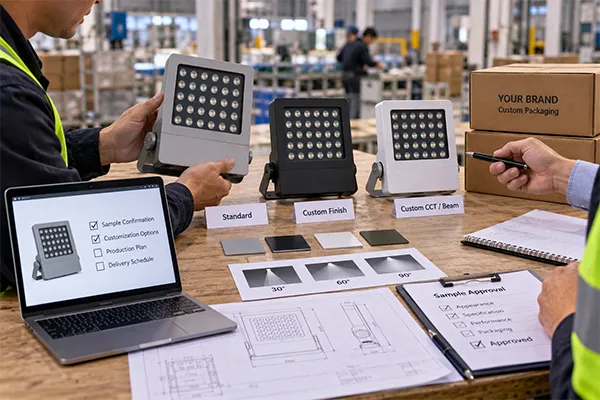
Contractors should plan floodlight samples and customization before production scheduling begins. Early sample approval and written specification confirmation help suppliers assess feasibility, prepare accurate quotations, reserve materials where appropriate, and communicate realistic delivery expectations for the final LED flood light solutions.
Samples Are Procurement Controls
A sample is not merely a sales item. For a contractor, it can be a procurement control that allows stakeholders to examine the product before a larger commitment. Depending on the project, sample review may cover:
- Physical dimensions and bracket arrangement
- Housing finish and general appearance
- Label content and branding format
- Color temperature preference
- Basic installation suitability
- Packaging presentation
- Alignment with the approved specification sheet
A sample does not prove every field outcome.9 It also does not replace application-specific engineering, photometric review, site testing, or local compliance checks. However, it can help the contractor identify visible or specification-related mismatches earlier, when changes are usually easier to manage.
Customization Has a Coordination Timeline
At Upward Lighting, we provide OEM/ODM support for parameters such as color temperature, wattage, beam angle, CRI, and surface finish colors. The feasibility of each request depends on the product platform, required quantity, component availability, confirmation timing, and production plan.
A sensible workflow is:
- Issue the initial project brief.
- Receive a quote with stated assumptions.
- Confirm fixed specifications and requested customizations.
- Review a sample when the project requires one.
- Approve final specification, artwork, labels, and packaging.
- Confirm quantity, commercial terms, and production timing.
- Coordinate shipment against the required site schedule.
Changes after step five may still be possible in some cases, but they should not be assumed to have no impact.10 A finish change, revised CCT, altered label, or different packaging request can affect materials and scheduling. We believe it is better to communicate that reality early than to promise an unrealistic timeline.
Keep Delivery Discussions Specific
“Fast delivery” means different things to different buyers. Contractors should ask for dates tied to concrete milestones:
- When is the final specification required?
- When can the supplier begin production?
- How long is the estimated production period after confirmation?
- Does the schedule include sample approval?
- What shipping method is assumed?
- When does the contractor need products available on site?
This distinction matters because a supplier may quote quickly while still needing time for technical confirmation and production coordination. Clear communication supports a more dependable procurement plan.
Frequently Asked Questions
What should contractors look for in an LED floodlight quote?
Contractors should look for a quote that clearly identifies wattage, color temperature, beam angle, voltage, finish, quantity, packaging, documentation, customization assumptions, and estimated lead time. A quote should make open points visible rather than hiding them behind a low unit price.
Are higher-wattage LED floodlights always better?
No. Higher wattage does not automatically create a better installation result.11 The appropriate selection depends on the target area, mounting height, light distribution, environmental conditions, and project requirements. Qualified professionals should assess application-specific lighting and compliance needs.
Why should I request a floodlight sample?
A sample can help contractors review physical appearance, bracket design, finish, labeling, packaging, and alignment with the agreed specification before volume production. It is especially useful when the project includes customization, brand requirements, or stakeholder approval steps.
Can LED floodlights be customized for contractor projects?
Many floodlight platforms can be customized in areas such as wattage, color temperature, beam angle, CRI, housing finish, labeling, and packaging. Contractors should confirm feasibility, minimum quantities, documentation, sample needs, and timing before finalizing the production plan.
How should buyers verify CE and RoHS claims?
Buyers should request relevant certification or compliance documents from the supplier and review them against their destination market, product model, and project requirements.12 Buyers should also consult qualified compliance professionals when local regulations or tender requirements require detailed interpretation.
Conclusion
Reliable LED flood light solutions begin with a clear project brief, not a quick comparison of wattage or price. Contractors can reduce procurement risk by confirming the application, mounting conditions, coverage needs, technical specifications, customization requirements, sample process, and delivery timeline early. At Upward Lighting, we support contractors with responsive quotations, OEM/ODM discussions, small-batch flexibility, and production coordination. Contact our team to turn your floodlight requirement into a clear, quote-ready specification.
"Purchasing Energy-Efficient Exterior Lighting", https://www.energy.gov/cmei/femp/purchasing-energy-efficient-exterior-lighting. U.S. Department of Energy guidance on outdoor lighting explains that lighting performance depends on delivered light, distribution, and application geometry, so wattage alone does not establish whether a fixture is suitable for a particular area. Evidence role: general_support; source type: government. Supports: Outdoor-lighting selection requires consideration of light output, distribution, mounting geometry, and the illuminated task rather than lamp or fixture wattage alone.. ↩
"LED Basics - Department of Energy", https://www.energy.gov/cmei/ssl/led-basics. Research on LED luminaires shows that input power is not a complete indicator of lighting performance because efficacy, thermal behavior, driver losses, and optical design affect the light delivered by a fixture. Evidence role: mechanism; source type: research. Supports: LED fixture performance at a given input power can vary with efficacy, thermal conditions, driver losses, and optical distribution.. ↩
"[PDF] CALiPER Application Summary Report 20: LED PAR38 Lamps", https://www1.eere.energy.gov/buildings/publications/pdfs/ssl/caliper_20_summary.pdf. Illuminating Engineering Society terminology defines beam angle as a measure of the angular spread of a beam, supporting its use as a specification for evaluating light coverage and aiming. Evidence role: definition; source type: institution. Supports: Beam angle describes the angular spread of a luminaire's beam and is related to the area over which its intensity is distributed.. ↩
"My neighbor's lighting: What can I do? - DarkSky.org", https://darksky.org/resources/what-is-light-pollution/light-pollution-solutions/lighting/my-neighbors-lighting/. Government guidance on artificial-light nuisance recognizes that exterior lighting can cause glare and light spill beyond the intended area, supporting early consideration of nearby properties and roads. Evidence role: general_support; source type: government. Supports: Poorly controlled exterior lighting can create glare and light spill or trespass that affects adjacent land uses and road users.. Scope note: Applicable legal thresholds and enforcement procedures vary by jurisdiction and project type. ↩
"Take Five: Life Cycle Costs for Acquisition - Department of Energy", https://www.energy.gov/cmei/femp/articles/take-five-life-cycle-costs-acquisition. OECD procurement guidance describes life-cycle costing as an approach that considers costs beyond the initial purchase price, including operation and maintenance, when evaluating procurement alternatives. Evidence role: general_support; source type: institution. Supports: Life-cycle costing evaluates costs incurred over acquisition, operation, maintenance, and end-of-life rather than relying only on initial purchase price.. Scope note: The specific cost categories and their relative importance depend on the contract, installation, and local procurement rules. ↩
"EU WEEE_RoHS", https://www.trade.gov/eu-weeerohs. European Commission guidance states that CE marking for applicable products requires conformity assessment and supporting technical documentation, while the RoHS framework sets substance-restriction requirements for electrical and electronic equipment. Evidence role: definition; source type: government. Supports: For applicable EU products, CE marking is supported by conformity assessment and technical documentation, while RoHS restricts specified hazardous substances in electrical and electronic equipment.. Scope note: Whether a particular floodlight, destination market, or tender requires these documents depends on the applicable legislation and product classification. ↩
"IP code", https://en.wikipedia.org/wiki/IP_code. IEC 60529 defines IP codes as classifications of enclosure protection against access, ingress of solid objects, and ingress of water, making the rating relevant to environmental suitability assessments. Evidence role: definition; source type: institution. Supports: IEC 60529 IP codes classify the degrees of protection provided by enclosures against access, solid foreign objects, and water.. Scope note: An IP rating addresses specified ingress conditions and does not by itself establish resistance to all environmental, chemical, mechanical, or installation-related hazards. ↩
"Color and Spectrum | Department of Energy", https://www.energy.gov/cmei/ssl/color-and-spectrum. U.S. Department of Energy lighting guidance describes correlated color temperature as a measure associated with the apparent warm or cool appearance of white light, supporting its relevance when a coordinated visual appearance is desired. Evidence role: definition; source type: government. Supports: Correlated color temperature characterizes the apparent warm-to-cool color appearance of white light sources.. Scope note: Color appearance and perceived fixture matching can also be influenced by spectral distribution, surrounding materials, and viewing conditions. ↩
"Conformance Testing - NIST", https://www.nist.gov/itl/ai/applied-ai-research-group/conformance-testing. Conformity-assessment guidance distinguishes product inspection and sampling from broader verification of performance under specified conditions, supporting the view that a sample cannot establish every field outcome. Evidence role: general_support; source type: institution. Supports: Sampling and inspection provide evidence about examined items or defined characteristics but do not alone establish every aspect of field performance or conformity.. Scope note: The evidential value of a sample depends on the inspection method, sample representativeness, test scope, and applicable acceptance criteria. ↩
"GAO-08-925, Information Technology: Agencies Need to Establish ...", https://www.gao.gov/assets/a279194.html. U.S. Government Accountability Office project-management guidance identifies requirements changes as a source of cost and schedule risk, supporting the need to assess the effects of late specification changes. Evidence role: general_support; source type: government. Supports: Uncontrolled or late changes to requirements can create cost and schedule consequences and require formal change management.. Scope note: The actual impact of a change depends on the production stage, supplier capacity, inventory position, and contract terms. ↩
"Purchasing Energy-Efficient Commercial and Industrial LED ...", https://www.energy.gov/cmei/femp/purchasing-energy-efficient-commercial-and-industrial-led-luminaires. University lighting-design instruction explains that suitable illumination is determined by task requirements, fixture distribution, mounting geometry, and glare control; consequently, higher wattage alone does not establish a better installation outcome. Evidence role: expert_consensus; source type: education. Supports: Lighting design evaluates task needs, illuminance, luminaire distribution, mounting conditions, and glare rather than treating wattage as a standalone measure of adequacy.. Scope note: A project-specific determination still requires applicable photometric data, site conditions, and any governing code or design criteria. ↩
"EU - Import Requirements and Documentation", https://www.trade.gov/country-commercial-guides/eu-import-requirements-and-documentation. European Commission product-compliance guidance explains that applicable conformity obligations and technical documentation depend on the relevant product legislation and the market where the product is made available. Evidence role: general_support; source type: government. Supports: Product compliance obligations and supporting documentation are tied to the applicable legal framework, product category, and market in which a product is placed.. Scope note: This general principle is not a legal determination for any particular floodlight, jurisdiction, or procurement contract. ↩