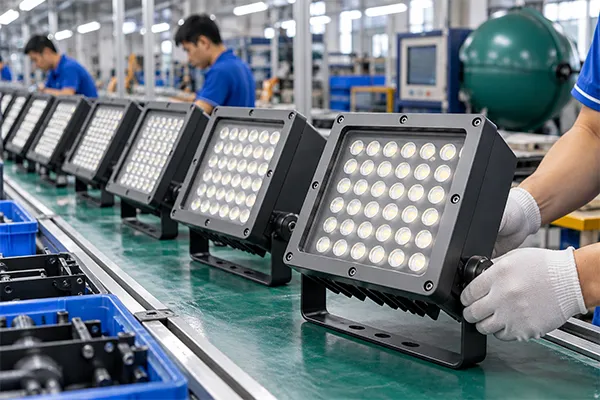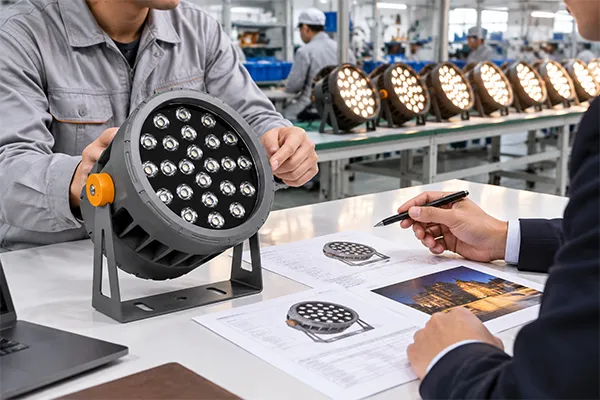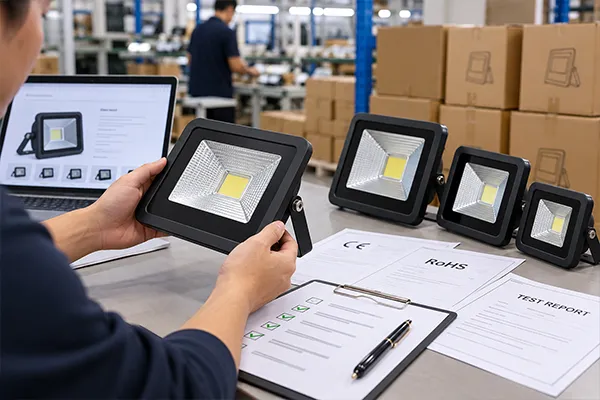
LED flood light manufacturers in China can appear similar when buyers compare online catalogs, price lists, and headline specifications. However, a low quote or high wattage can create expensive problems if the fixture does not fit the installation environment, project documents, or local market requirements. I recommend treating supplier selection as a structured risk-management process, not a quick price comparison.
Choosing among LED flood light manufacturers in China starts with the application, then moves to specification confirmation, sample review, document verification, and production controls. Buyers should assess whether a supplier can define the correct lighting solution, customize it responsibly, match certifications to the exact product and market, and maintain agreed requirements from sample approval through shipment.

In my work with contractors, importers, distributors, and lighting brands, I often see the same issue: a buyer asks for “a 100W floodlight,” but the real project needs more information. Mounting height, target area, glare limits, cable entry, voltage, beam distribution, and destination market can all change the right product choice.
How Should Buyers Compare LED Flood Light Manufacturers in China?
Buyers often receive several quotations that look comparable on paper. The problem is that quotations may use different drivers, LED packages, housings, surge protection levels, cable specifications, or testing assumptions. This can make an apparently lower price difficult to evaluate fairly. I recommend comparing confirmed specifications before comparing unit prices.
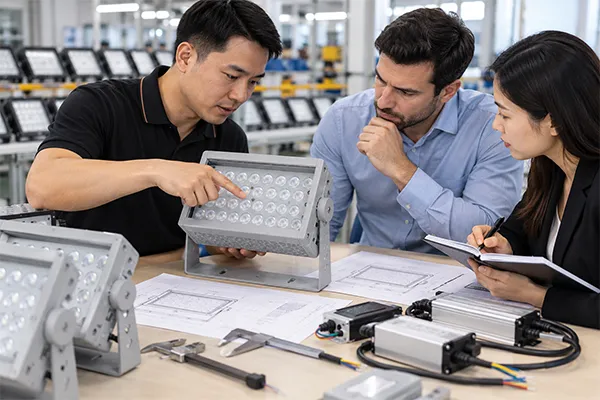
Buyers should compare LED flood light manufacturers in China by reviewing their ability to understand the application, provide a complete specification, explain customization limits, control production, and support clear order confirmation. A useful comparison includes product construction, electrical configuration, documentation, sample process, quality checks, delivery communication, and commercial terms—not only wattage and price.
Compare like-for-like product configurations
I have seen buyers request quotations from several factories using only a wattage and an IP rating. That is understandable at an early sourcing stage, but it does not create a reliable comparison. A 100W LED floodlight is not a single universal product category. Its performance and cost can vary significantly based on the selected components and required controls.
For example, two floodlights may both be described as 100W, IP661, and 5,000K. Yet they may differ in:
- LED chip type and operating current
- Driver brand, input-voltage range, and power factor
- Surge protection device (SPD) configuration
- Heat-sink weight and housing design
- Lens material and beam angle
- Cable length, plug type, and cable-entry sealing
- Glass thickness and gasket design
- Dimming protocol, such as 0–10V, DALI, or PWM2
- Surface finish, corrosion-resistance expectations, and mounting bracket
- Packing method and export carton strength
A buyer should ask each supplier to quote against the same written requirement sheet. This sheet does not need to be complex. It should identify the required product version well enough for every factory to respond to the same request.
| Comparison item | Why it matters | Buyer verification question |
|---|---|---|
| Application | Determines practical specification | Where will the floodlight be installed and what must it illuminate? |
| Wattage and lumen target | Helps evaluate output and energy use | Is the stated lumen output measured or a nominal claim? |
| Beam angle | Affects coverage and glare | What beam distribution is proposed for the mounting height? |
| Input voltage | Must match site conditions | Is the fixture designed for 220–240V, 100–277V, or another range? |
| Driver configuration | Affects electrical compatibility | Which driver model is used, and can it be identified in the approval file? |
| IP rating | Relates to ingress protection design | Which exact product version does the IP documentation cover? |
| Surge protection | Can matter in exposed installations | Is SPD included, optional, or external? |
| Finish and corrosion context | Important for outdoor exposure | What coating and material options are available for the environment? |
Ask what the supplier actually controls
Not every supplier needs to manufacture every component internally. A smaller, well-organized factory can sometimes provide consistent results when it has stable component sourcing, clear assembly controls, and disciplined communication. A larger factory can also be a good fit, but size alone does not demonstrate suitability.
I suggest asking practical questions:
- Which processes do you perform in-house?
- Which components are sourced externally?
- How do you approve alternative components if a supply issue occurs?
- What specifications are recorded on the production order?
- Who confirms technical changes before mass production?
- Can you provide a sample that reflects the proposed mass-production configuration?
At Upward Lighting, I focus on clarifying these details before an order moves forward. We provide OEM/ODM options for parameters such as color temperature, wattage, beam angle, CRI, and surface finish colors. Still, every customization request needs a feasibility review. A requested change may affect lead time, minimum order quantity, packaging, electrical performance, or documentation requirements.
A clear supplier is not the one that says “yes” to every request immediately. A useful supplier explains what can be done, what needs confirmation, and what may introduce additional risk.
What LED Flood Light Specification Should Be Confirmed First?
Many procurement delays begin because the initial inquiry is too general. Buyers may ask for the “best” LED floodlight without defining the lighting task. This creates back-and-forth communication, inaccurate quotations, and sample revisions. I find that a few application details can improve the quality of supplier recommendations from the start.
The first LED flood light specification should be based on the application: installation location, mounting height, illuminated area, desired brightness, beam control, electrical supply, environmental exposure, and project requirements. Wattage should be selected after these factors are understood, because the correct output depends on the task rather than a single universal product rating.

Start with the lighting task, not the catalog page
An LED floodlight for a warehouse loading yard is different from a fixture for a sports area, building façade, parking zone, billboard, construction site, or residential gate. Each application can require a different balance of brightness, coverage, glare control, durability, and operating schedule.
When I receive an inquiry, the most helpful information is usually not the requested wattage. It is the installation context. For example, one contractor may need fixtures mounted at 6 meters for a small vehicle entrance. Another may need fixtures installed at 12 meters around a storage yard. Both may initially request 100W units, but the preferred beam angle and quantity may be very different.
A buyer should prepare a simple application brief:
- Installation type: Pole, wall, bracket, ceiling, façade, or temporary structure
- Mounting height: In meters or feet
- Target area: Length, width, orientation, and key zones
- Lighting objective: Security, work visibility, signage, landscape emphasis, or general outdoor illumination
- Operating hours: Short evening use, overnight operation, motion-controlled use, or continuous operation
- Environmental conditions: Rain, dust, coastal air, high ambient temperature, vibration, or wind exposure
- Electrical details: Input voltage, frequency, wiring method, control system, and grounding requirements
- Visual requirements: CCT, CRI, glare concerns, housing color, and fixture appearance
- Market and project documents: Destination country, consultant specifications, tender requirements, and requested certificates
Understand the relationship between wattage, lumens, and beam angle
Wattage indicates electrical power consumption. It does not independently confirm useful illumination on the target surface.3 Lumen output describes total light output, but it also does not show where the light goes. Beam angle and mounting geometry influence how that output is distributed.4
A narrower beam can concentrate light over a smaller area. A wider beam can cover more area, but illumination may become lower at the edges. Therefore, buyers should avoid assuming that a higher wattage or higher claimed lumen figure automatically solves an application problem.
| Project question | Why it changes the specification |
|---|---|
| How high is the fixture installed? | Higher mounting can require different output and beam control5 |
| How large is the target area? | Larger areas may need multiple fixtures rather than one high-power unit |
| Is glare a concern? | Beam direction, shielding, and aiming become more important |
| Does the project use lighting calculations? | Photometric data should be reviewed against the actual layout |
| Is the area exposed to voltage events? | Surge protection and electrical design may require review |
| Is the site near saltwater or industrial pollutants? | Housing, coating, and installation conditions should be assessed |
For application-specific lighting design, I recommend working with a qualified lighting professional or project engineer. A manufacturer can provide product data and configuration options, but site layout, local rules, installation quality, and operating conditions all influence the final result.
How Can Buyers Verify Quality From LED Flood Light Manufacturers in China?
Product images and specification tables can make every floodlight look suitable. The concern is that quality is not one visible feature. It is a combination of design choices, incoming materials, assembly consistency, inspection methods, packaging, and change control. Buyers need evidence that the factory follows repeatable processes.
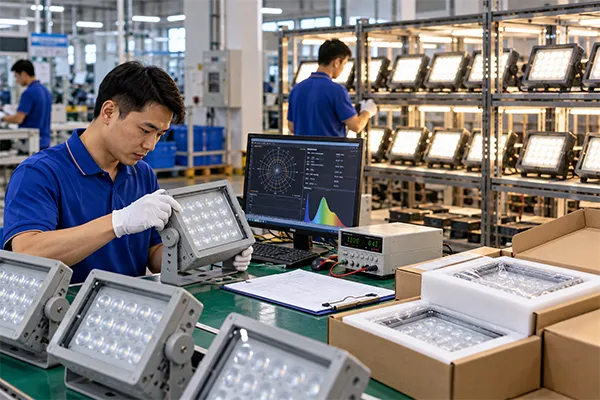
Buyers can verify LED flood light manufacturers in China by reviewing sample configuration, production specifications, inspection steps, aging procedures, component traceability, packaging controls, and shipment checks. These measures can reduce procurement risk, but they should be evaluated alongside third-party testing, project requirements, and application-specific professional judgment.
A sample is an important checkpoint, not final proof
A working sample helps a buyer inspect appearance, basic function, mounting details, light color, cable arrangement, and packaging. It can also reveal misunderstandings early. However, I do not consider a successful sample alone to be proof that every mass-production unit will perform identically over its full field life.
The key step is what happens after sample approval. Buyers should convert the approved sample into a documented production reference. This is often called requirement freezing, sample confirmation, or a golden-sample process.
The approval record should include:
- Product model and revision
- Rated wattage and input voltage
- CCT, CRI, and beam angle
- Driver model or agreed driver requirements
- LED configuration where relevant
- Housing color, logo, label, and marking details
- Cable specification, length, plug, and wiring requirements
- Mounting bracket and accessory details
- Packaging artwork, carton marks, and inner protection
- Required documents and acceptance criteria
- Approved sample photos, ideally from several angles
I remember a recurring situation where a buyer approved a black housing sample but later expected a custom gray finish for mass production. The issue was not technical difficulty. The issue was that the color code and finish expectation were not clearly recorded. A simple confirmation file could have prevented confusion.
Review the quality process in practical terms
At Upward Lighting, every product undergoes a 100% aging test before shipment, generally lasting 4 to 8 hours. This process helps us identify certain early electrical or assembly issues before dispatch. However, buyers should understand the limits of aging tests. A 4- to 8-hour aging process does not guarantee long-term performance under every field condition6, installation method, voltage environment, or climate.
A buyer can ask a supplier to explain its controls in plain language:
| Quality checkpoint | What it can help verify | What it cannot prove by itself |
|---|---|---|
| Incoming material inspection | Basic conformity of received components | Long-term reliability in all environments |
| Assembly inspection | Visible workmanship and correct assembly | Future site installation quality |
| Functional testing | Basic operation at the test stage | Lifetime performance |
| Aging test | Early failures or instability may be identified | Zero failures after installation |
| Final inspection | Appearance, labeling, packing, and order conformity | Compliance with every local rule |
| Pre-shipment review | Quantity and shipment readiness | Performance after uncontrolled handling or installation |
Consider independent verification for higher-risk projects
For larger tenders, sensitive applications, or regulated markets, buyers may choose additional steps such as:
- Third-party pre-shipment inspection
- Random sampling based on an agreed AQL approach7
- Photometric file review
- Electrical safety document review
- Packaging drop-test review where relevant
- Component verification against the approved bill of materials
- Pilot installation before full rollout
These steps add time and cost, but they can be justified when the cost of field replacement, project delay, or reputational damage is high.
How Should Buyers Check Certifications and Product Documents?
Certificates can create false confidence when buyers only look for familiar logos. The risk is that a document may relate to a different model, a previous revision, another voltage range, or a product with different components. Regulatory and project requirements also vary by destination market and installation category.
Buyers should check that certifications and test documents match the exact LED floodlight model, configuration, destination market, and project requirement. CE and RoHS documents may be relevant for certain market-entry or customer requirements8, but buyers should verify their scope and should not treat them as universal proof of compliance in every country or application.

Match the document to the product version
The first question is simple: Does this document apply to the product I am buying? Buyers should compare the model number, product description, electrical rating, and date of issue against the supplier’s quotation and approval sheet.
I recommend requesting documents early, especially when a project has a fixed delivery schedule. Document mismatches are much easier to resolve before production than after goods are packed.
A practical document review checklist includes:
- Product model identification: Does the report name the same model or model family?
- Electrical rating: Does the voltage, frequency, and wattage range align with the ordered product?
- Product description: Does the report describe a floodlight rather than a different lighting category?
- Report issuer: Is the laboratory or issuing organization identifiable?
- Date and revision: Is the document current enough for the project’s requirements?
- Scope: Does the document address the requested standard or only part of it?
- Customization impact: Could changes to the driver, cable, LED board, housing, or control method affect document relevance?
- Destination market: Does the buyer’s country or project require additional documentation beyond what is provided?
At Upward Lighting, our products hold CE and RoHS certifications. These documents support common market-entry, safety, and environmental requirements in relevant contexts. Still, I encourage every buyer to verify the document scope for the exact product version and target market. Importers and project teams may also need to consult qualified compliance professionals, local authorities, or their own testing partners.
Do not confuse IP rating with total outdoor suitability9
An IP rating addresses protection against ingress of solids and water under defined test conditions. It is important, but it is not a complete assessment of outdoor durability. A project near the sea, in a hot desert, near heavy traffic, or in an industrial zone may present additional considerations.
Buyers should also discuss:
- Expected ambient temperature
- UV exposure
- Salt spray or coastal conditions10
- Chemical pollutants
- Mounting orientation and drainage
- Cable gland installation
- External surge environment
- Maintenance access
- Local electrical installation practices
This is why documentation review should connect to the real application. A floodlight can have acceptable documents and still be unsuitable if it is installed in an environment outside the assumptions behind the product selection.
What Should Be Locked Before Mass Production Begins?
Mass production can go wrong when a buyer and supplier both assume that “the same as the sample” means the same thing. Small details can become major issues at shipment: a different cable length, revised carton mark, missing dimming wire, unapproved driver substitution, or a finish variation that affects a brand’s product line.
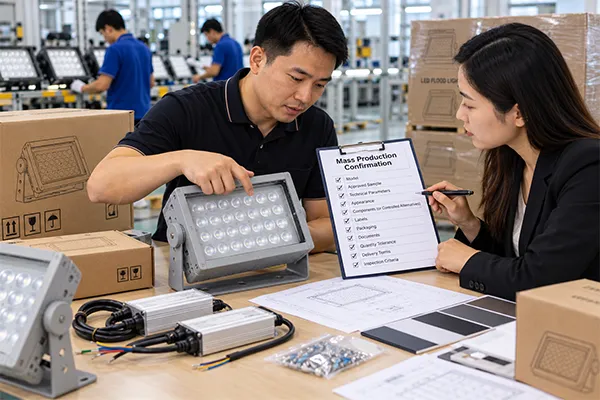
Before mass production, buyers should lock the LED flood light model, approved sample, technical parameters, appearance, components or controlled alternatives, labels, packaging, documents, quantity tolerance, delivery terms, and inspection criteria. A written confirmation process helps reduce avoidable disputes between the sample stage and final shipment.
Create one controlled order-confirmation file
I advise buyers to avoid spreading final requirements across emails, chat messages, screenshots, and verbal calls. These channels are useful for discussion, but the final order needs a single controlled reference. This may be a purchase order attachment, specification sheet, approved drawing, or product confirmation file.
A strong confirmation file should answer the questions that matter on the production floor:
| Category | Details to freeze before production |
|---|---|
| Product identity | Model number, revision, photos, approved sample reference |
| Electrical configuration | Voltage, wattage, driver, dimming, surge protection requirement |
| Optical configuration | CCT, CRI, beam angle, lens type, lumen requirement if applicable |
| Mechanical details | Housing finish, bracket, cable, connector, dimensions |
| Branding | Logo position, label artwork, carton artwork, barcode |
| Packaging | Inner box, master carton, quantity per carton, pallet requirement |
| Quality criteria | Inspection points, cosmetic standards, functional checks |
| Documents | Required declarations, reports, manuals, labels, packing list |
| Commercial terms | Quantity, lead time, payment terms, shipment method, Incoterms |
Manage changes formally
Supply chains can change. A component may become unavailable, a customer may revise packaging, or a project may request a last-minute label update. These changes do not always create a problem, but they should not be handled casually.
I recommend an agreed rule: no material change should move into production without buyer confirmation11. The supplier should explain the proposed change, its reason, any cost or lead-time effect, and whether it affects product documents or sample consistency.
For example, an alternative driver might fit physically and provide similar rated power, but it could change dimming behavior, labeling, or document applicability. A buyer needs the opportunity to review that impact.
At Upward Lighting, we support small-batch orders and customized specifications, but customization works best when the buyer provides a stable final requirement before materials are committed. Quick quotation and fast communication can help procurement move faster. Clear confirmation is what helps the order remain controlled after it moves into production.
How Can Buyers Build a Reliable Long-Term Supplier Relationship?
A one-time transaction may focus heavily on price. A long-term sourcing relationship requires more. Importers, distributors, and local lighting brands need predictable communication, repeatable quality controls, manageable customization, and a supplier that can explain problems before they become shipment delays.
A reliable long-term relationship with LED flood light manufacturers in China depends on transparent communication, documented specifications, realistic delivery planning, consistent quality checkpoints, and a clear process for handling changes or claims. Buyers should begin with a manageable order or pilot project, then expand after evaluating operational consistency over time.

Evaluate communication quality before the order grows
In my experience, communication quality is often visible during pre-sales. A supplier that asks specific questions about voltage, installation, packaging, market, and target quantity is usually trying to reduce ambiguity. A supplier that provides only a price with no technical confirmation may leave too many decisions unresolved.
Buyers can evaluate communication through simple checkpoints:
- Does the supplier respond to technical questions clearly?
- Does the quotation identify assumptions and exclusions?
- Does the supplier explain the difference between standard and customized versions?
- Does the supplier identify unclear requirements rather than guessing?
- Does the supplier provide revision-controlled drawings, photos, or specification sheets?
- Does the supplier report schedule risks early?
- Does the supplier have a process for addressing quality feedback?
I have found that buyers often value a fast quote, but a fast quote is most useful when it is based on enough information. An incomplete quotation may look efficient at first and create delays later when specifications must be corrected.
Use a staged sourcing approach
For a new supplier relationship, I recommend a staged approach rather than immediately placing the largest possible order.
- Initial technical review: Confirm product fit, basic documents, communication ability, and commercial terms.
- Sample evaluation: Review the physical fixture, finish, wiring, mounting, packaging, and basic operation.
- Approval documentation: Freeze the agreed product version and acceptance criteria.
- Pilot order: Evaluate production communication, packing quality, delivery accuracy, and product consistency.
- Post-delivery review: Record defects, customer feedback, document gaps, and improvement actions.
- Scale-up decision: Increase order volume only after the supplier demonstrates repeatable operational performance.
This approach does not eliminate risk. No supplier, sample, inspection, or aging test can guarantee zero field issues.12 However, it helps buyers find problems earlier, when changes are less costly.
For OEM/ODM brands, the staged process is especially important. Brand-specific finishes, labels, wattages, color temperatures, and packaging need a stronger approval trail than standard catalog products. The goal is not simply to buy floodlights from China. The goal is to build a supply process that your sales team, installers, and end customers can rely on.
Frequently Asked Questions
What should I ask LED flood light manufacturers in China before requesting a quote?
I suggest providing the installation location, mounting height, target area, input voltage, required wattage range, CCT, beam angle preference, destination market, quantity, branding needs, and packaging requirements. These details help a manufacturer propose a more relevant configuration and reduce quotation revisions.
Is a higher-wattage LED floodlight always better?
No. A higher-wattage LED floodlight may provide more electrical power and potentially more light output, but it may also create glare, waste energy, or distribute light poorly for the target area. Buyers should select wattage after reviewing mounting height, beam angle, coverage needs, and lighting calculations where appropriate.
Does an approved sample guarantee mass-production quality?
No. An approved sample is a valuable checkpoint, but it does not guarantee mass-production consistency or long-term field performance. Buyers should use the approved sample as part of a documented specification package that controls components, appearance, labels, packaging, and acceptance criteria for production.
Are CE and RoHS certificates enough for every export market?
No. CE and RoHS documents may be relevant to certain products and markets, but they are not universal proof of compliance for every country, project, or product configuration. Buyers should verify that documents match the exact model, electrical rating, destination market, and customer requirements.
What does a 100% aging test mean for LED floodlights?
A 100% aging test means each unit is operated for a defined period before shipment. It can help identify certain early electrical or assembly issues. However, it does not prove lifetime performance or guarantee that fixtures will operate without failure in every installation environment.
Conclusion
Selecting LED flood light manufacturers in China is fundamentally a sourcing and risk-control decision. I recommend starting with the lighting application instead of a headline wattage or lowest price. Then, compare suppliers using complete specifications, verify documentation in context, approve samples carefully, and freeze every important requirement before mass production. At Upward Lighting, we support global buyers with outdoor LED lighting, OEM/ODM customization, small-batch flexibility, responsive quotations, and 100% aging tests before shipment. Contact us to discuss your floodlight application and request a specification-based quotation.
"IP code", https://en.wikipedia.org/wiki/IP_code. IEC 60529 defines the IP code; IP66 denotes dust-tight enclosure protection and protection against powerful water jets under the standard's prescribed test conditions. Evidence role: definition; source type: institution. Supports: IEC 60529 defines IP66 as dust-tight protection and protection against powerful water jets under specified test conditions.. Scope note: The designation describes enclosure-ingress tests, not overall fixture reliability or suitability for every outdoor environment. ↩
"LED Dimming: What you need to know", https://www1.eere.energy.gov/buildings/publications/pdfs/ssl/dimming_webcast_12-10-2012.pdf. Lighting-control references distinguish DALI's standardized digital interface from 0–10 V and PWM dimming methods, whose compatibility depends on the driver and control architecture. Evidence role: definition; source type: institution. Supports: DALI is a standardized digital lighting-control protocol, while 0–10 V and PWM are different analog or signal-based dimming methods.. Scope note: A general control-method description does not verify compatibility for a particular driver, controller, or installation. ↩
"NIST Study Suggests Universal Method for Measuring ...", https://www.nist.gov/news-events/news/2019/12/nist-study-suggests-universal-method-measuring-light-power. Photometric standards distinguish electrical power (watts), total luminous flux (lumens), and illuminance received on a surface (lux); wattage alone therefore does not establish task-plane illumination. Evidence role: definition; source type: government. Supports: Radiometric and photometric references distinguish electrical power in watts from luminous flux in lumens and illuminance on a surface in lux.. Scope note: Actual useful illumination also depends on fixture photometry, aiming, mounting geometry, reflectance, and obstructions. ↩
"cdot-lighting-design-guideline.pdf", https://www.codot.gov/safety/traffic-safety/assets/documents/cdot-lighting-design-guideline.pdf. Lighting-design guidance calculates surface illuminance from a luminaire's photometric distribution together with mounting height, location, orientation, and aiming. Evidence role: mechanism; source type: education. Supports: Lighting-design principles use luminaire intensity distribution, mounting position, and aiming geometry to calculate illuminance across a surface.. Scope note: A beam-angle label alone is an incomplete predictor of field performance because the full intensity distribution and site geometry are required. ↩
"Experiencing the Inverse Square Law With Light", https://www.nasa.gov/stem-content/classroom-combo-experiencing-the-inverse-square-law-with-light/. Basic lighting calculations apply the inverse-square and cosine relationships, showing why increased mounting distance and changed aiming geometry can alter the output and distribution needed at the target surface. Evidence role: mechanism; source type: education. Supports: For a point-source approximation, illuminance changes with distance according to the inverse-square relationship, while angle of incidence also affects the illuminated plane.. Scope note: Real floodlights are extended optical systems, so final design should use the fixture's photometric data rather than a point-source approximation alone. ↩
"Cardiac Device Reliability", https://www.nist.gov/programs-projects/cardiac-device-reliability. Reliability literature describes burn-in as a screening method for some early-life failures; it does not by itself demonstrate long-term reliability across all operational and environmental stresses. Evidence role: mechanism; source type: research. Supports: Burn-in is used to screen some early-life failures, whereas reliability over service life requires evidence across relevant stresses and operating conditions.. Scope note: The effectiveness of a particular aging duration depends on the product design, test load, failure mechanisms, and test protocol. ↩
"What kinds of Lot Acceptance Sampling Plans (LASPs) are ...", https://www.itl.nist.gov/div898/handbook/pmc/section2/pmc22.htm. Acceptance-sampling guidance explains that AQL-based plans use sample inspection and defined acceptance criteria to make lot decisions, rather than inspecting every unit or certifying a defect-free lot. Evidence role: definition; source type: government. Supports: Acceptance sampling plans use a sample from a lot and specified acceptance criteria to determine whether the lot is accepted or rejected.. Scope note: The protection provided depends on the selected sampling plan, lot size, inspection level, and proper execution of the inspection. ↩
"EU WEEE_RoHS", https://www.trade.gov/eu-weeerohs. European Commission guidance states that CE marking is required for products covered by applicable EU harmonisation legislation, while the RoHS framework restricts specified hazardous substances in electrical and electronic equipment. Evidence role: historical_context; source type: government. Supports: The European Commission explains that CE marking applies to product categories covered by relevant EU rules and that RoHS restricts specified hazardous substances in electrical and electronic equipment.. Scope note: Whether a specific floodlight requires particular declarations, tests, or markings depends on its product classification, applicable legislation, and the destination market. ↩
"IP code", https://en.wikipedia.org/wiki/IP_code. IEC 60529 classifies protection provided by enclosures against access, solid foreign bodies, and water under defined tests; the code does not by itself establish resistance to corrosion, ultraviolet exposure, chemical pollutants, or all climatic conditions. Evidence role: definition; source type: institution. Supports: IEC 60529 specifies enclosure protection against access, solid foreign objects, and water; it does not serve as a comprehensive environmental-durability classification.. Scope note: Additional environmental tests and material assessments may be needed for a particular installation. ↩
"Marine Atmospheric Corrosion of Carbon Steel: A Review - PMC", https://pmc.ncbi.nlm.nih.gov/articles/PMC5506973/. Atmospheric-corrosion research identifies chloride-containing marine aerosols as an important environmental factor that can accelerate corrosion of susceptible metals and protective coatings. Evidence role: mechanism; source type: institution. Supports: Atmospheric-corrosion standards and research identify chloride deposition and marine exposure as factors that can increase corrosion of susceptible materials and coatings.. Scope note: Actual corrosion performance depends on material, coating system, design, maintenance, local climate, and installation exposure. ↩
"ISO 9001:2015 - Quality management systems", https://www.iso.org/standard/62085.html. ISO 9001 includes requirements for controlled changes in production and service provision, supporting documented review of changes that could affect product conformity. Evidence role: expert_consensus; source type: institution. Supports: ISO 9001 quality-management guidance requires organizations to review and control changes to production or service provision to maintain conformity.. Scope note: ISO 9001 certification or use of change-control procedures does not by itself prove that every individual change has been correctly assessed. ↩
"Metrological Traceability: Frequently Asked Questions and ...", https://www.nist.gov/metrology/metrological-traceability. Quality and reliability methods can reduce uncertainty by detecting defects and characterising performance under specified conditions, but they cannot demonstrate zero future failures across all units, installations, and service environments. Evidence role: general_support; source type: research. Supports: Quality inspection and reliability testing provide evidence about sampled units and tested conditions but cannot establish failure-free performance under every future field condition.. Scope note: The residual risk depends on sampling coverage, test representativeness, manufacturing variation, installation, and actual operating conditions. ↩