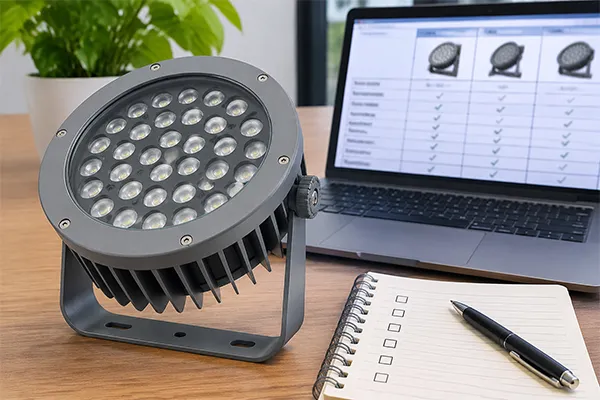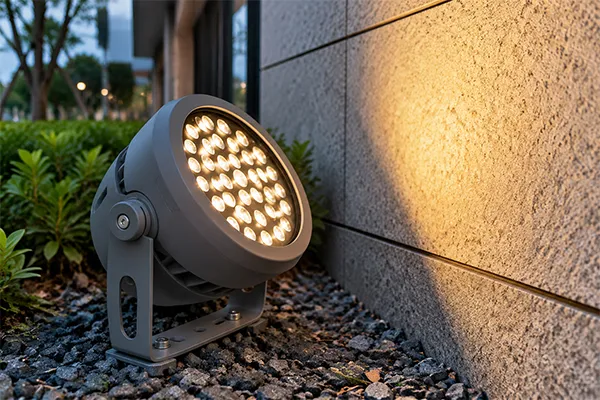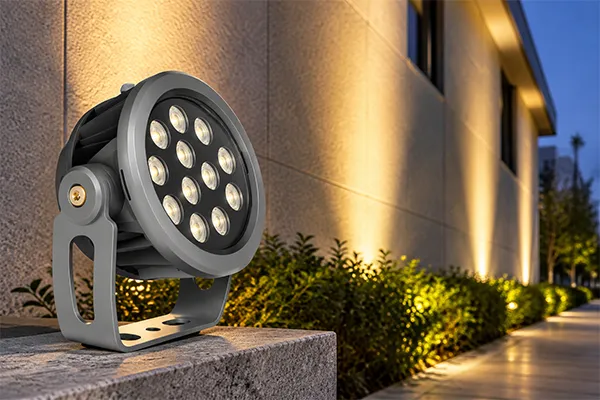

LED flood light failure causes and solutions matter because a dark, flickering, or dim fixture can stop work, create safety concerns, and trigger costly callbacks. I know how tempting it is to blame the LED chips immediately. However, that assumption can lead to unnecessary replacements when the actual issue is power quality, wiring, water ingress, heat, or installation conditions.
LED flood light failure causes and solutions begin with a structured inspection: check the incoming power supply, wiring, connectors, mounting conditions, and moisture exposure before evaluating the driver or LED module. Most visible symptoms have several possible causes, so qualified site checks are essential for a safe and accurate conclusion.
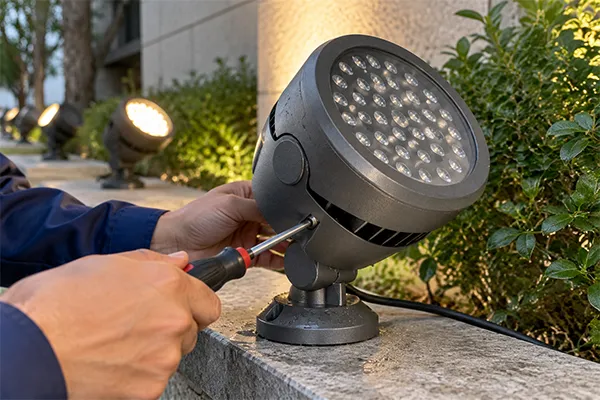
From our work as an LED floodlight manufacturer, I have reviewed production inspections, aging-test observations, returned fixtures, and feedback from project sites. I have learned that a failure symptom is not the same as a confirmed root cause. A practical diagnosis follows the evidence, starting outside the fixture and moving inward only when it is safe and necessary.
What Causes an LED Flood Light to Stop Working Completely?
A floodlight that shows no light at all can look like a total product failure. That can frustrate contractors and facility owners, especially when the installation is new. However, I have found that a dead LED floodlight may be caused by a simple supply or connection issue rather than a failed LED board.
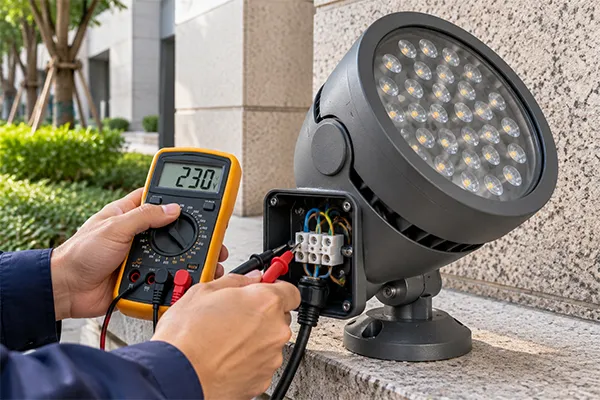
When an LED flood light does not turn on, a qualified electrician should first verify supply voltage, circuit protection, switch or control operation, wiring polarity where applicable, terminal connections, and cable damage. Only after these external checks should the driver, LED module, or internal wiring be considered as possible causes.
Start With the Power Source
The first step in any LED flood light failure assessment is to confirm that the fixture is receiving the correct electrical supply. A floodlight cannot operate properly if the circuit has no power, the breaker has tripped, or the voltage does not match the fixture specification.
I recommend that buyers and installers document the following before making a warranty or quality claim:
- Rated input voltage shown on the product label
- Actual voltage measured at the fixture by a qualified professional
- Circuit breaker and fuse status
- Photocell, timer, sensor, contactor, or smart control status
- Wiring continuity between the power source and the floodlight
- Signs of damaged, crushed, cut, or overheated cable
For example, a 220–240 V AC floodlight installed on an unsuitable supply may not start, may operate inconsistently, or may suffer premature component stress. Likewise, a low-voltage issue on a long cable run can produce symptoms that appear to be an internal fixture problem.
Check Connections and Installation Work
Loose terminals, poorly crimped connectors, and incomplete cable gland tightening can all interrupt power. In returned-product reviews, I have sometimes seen fixtures that appear intact internally while the external cable connection shows heat marks, corrosion, or insufficient strain relief.
A qualified installer should inspect the junction box and cable entry area for:
- Loose line, neutral, or earth connections
- Incorrect conductor stripping length
- Damaged insulation near the terminal block
- Corrosion at connectors
- Cable glands that do not grip the cable sheath
- Unsupported cable weight pulling on the fixture connection
I do not recommend that unqualified users open mains-powered LED floodlights. Any inspection involving live circuits, exposed conductors, burn marks, or water-damaged wiring should be handled by a qualified electrician.
When the Driver or LED Module May Be Involved
If power, wiring, and controls have been verified, the driver becomes a reasonable next area for evaluation. The driver converts incoming power into the controlled current required by the LED module.1 A failed driver can result in no output even when the LED chips themselves remain functional.
Possible internal causes include:
| Possible cause | Typical visible symptom | Recommended action |
|---|---|---|
| Driver failure | No output, correct incoming supply | Supplier or qualified technician evaluation |
| Internal wire damage | No output or intermittent operation | Inspect only after power isolation |
| Burned terminal or connector | No output, heat discoloration | Replace damaged parts and identify cause |
| LED module circuit fault | No output with a functioning driver | Manufacturer or service assessment |
| Surge-related component damage2 | Sudden failure after storms or switching events | Review surge protection and replace fixture if needed |
A remote photograph can help a supplier understand the situation, but it cannot confirm the root cause. I encourage project teams to provide installation photos, supply measurements, fixture labels, failure timing, and details of nearby electrical events.
Why Is My LED Flood Light Flickering?
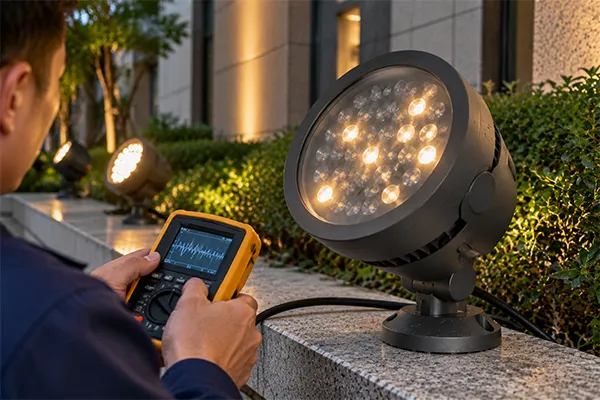
Flickering is one of the most common LED flood light complaints, but it does not automatically mean the LEDs are defective. The visible flicker may come from unstable voltage, incompatible dimming or control equipment, loose connections, driver degradation, or an unsuitable installation environment.3
An LED flood light usually flickers because of unstable input power, loose wiring, incompatible controls, a failing driver, or moisture and heat affecting electrical components. A qualified electrician should check the circuit and connected controls before the fixture is removed or replaced.
Separate Constant Flicker From Intermittent Flicker
The timing of the flicker provides useful diagnostic information. I ask customers to describe exactly when the problem occurs because this often narrows the investigation.
| Flicker pattern | Potential causes to investigate |
|---|---|
| Flickers immediately after switch-on | Driver issue, control incompatibility, low supply voltage |
| Flickers only after several minutes | Heat buildup, driver thermal stress, poor ventilation |
| Flickers during rain or humid weather | Moisture ingress, condensation, corroded connections |
| Flickers when large equipment starts | Voltage disturbance, shared circuit loading, power quality |
| Flickers with a timer or photocell | Control device compatibility or wiring issue |
| Random intermittent flicker | Loose connection, cable damage, driver instability |
This symptom-based method is useful for distributors and contractors handling after-sales cases. It helps them collect evidence before assuming a manufacturing defect.
Consider Controls, Dimmers, and Shared Circuits
Some floodlight installations include photocells, motion sensors, timers, dimmers, contactors, or building-management controls. These devices can improve energy management, but they can also introduce compatibility issues if they are not selected for the load and electrical characteristics of the floodlight.
For example, an old control device may not work consistently with a modern LED driver. A circuit that shares power with motors, pumps, compressors, or other high-load equipment may also experience switching disturbances.4 I have seen project feedback where the floodlight performed normally during a bench test but flickered on a site with unstable power conditions.
When reviewing a flicker claim, I suggest asking:
- Does the fixture flicker on a separate, known-stable circuit?
- Does the issue affect one floodlight or every fixture on the same line?
- Did the problem begin after adding a photocell, timer, or other equipment?
- Does the flicker occur at a predictable time of day?
- Is heavy machinery operating when the flicker occurs?
- Is the floodlight connected to a compatible dimming system, if dimming is used?
Avoid Repeated Switching as a “Test”
Some users repeatedly switch a flickering fixture on and off to test it. That approach rarely identifies the cause and may place more stress on an already unstable driver or control circuit. It is better to isolate the circuit safely, record the symptom pattern, and have a qualified professional evaluate the installation.
At Upward Lighting, we conduct 100% aging tests before shipment, generally lasting 4 to 8 hours depending on the product and order requirements. This process helps us identify certain early-life issues before delivery. However, an aging test cannot reproduce every site condition, such as unstable utility power, improper control wiring, poor drainage, lightning exposure, or enclosed mounting conditions.
What Causes LED Flood Light Dimming and Reduced Brightness?
A floodlight that still works but produces less light can be difficult to evaluate. The fixture may appear dim because of normal optical contamination, voltage conditions, heat, driver output changes, LED aging, or an incorrect product selection for the application. I avoid treating lumen loss as proof that the LED chips have failed.
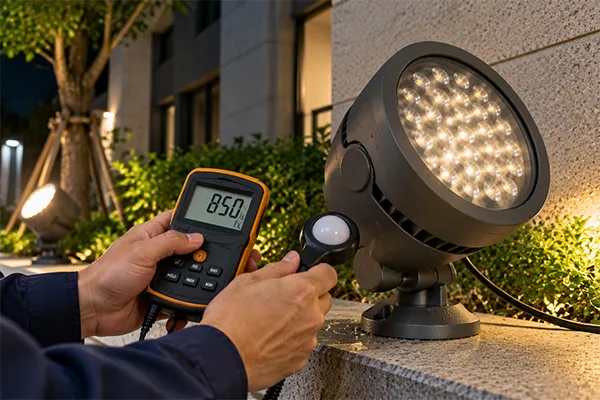
LED flood light dimming can result from dirt on the lens, reduced driver output, low or unstable voltage, excessive operating temperature, LED aging, or a lighting design that does not provide enough illumination for the space. The correct response depends on measured conditions, not visual impressions alone.
Check the Optical Surface First
Outdoor floodlights operate in environments with dust, insects, pollution, salt residue, tree sap, and other debris. A dirty lens can reduce useful light output even when the electrical parts are operating normally.5
I recommend a safe visual check for:
- Dust accumulation on the lens
- Mud splashes or paint overspray
- Yellowing, cracking, or hazing of the lens material
- Water marks inside the optical chamber
- Insect buildup around the front cover
- Physical damage from impact or vandalism
A cleaning plan should match the environment. A floodlight installed near a road, industrial yard, coastal area, or construction site may need more frequent maintenance than a fixture installed in a sheltered location.
Heat Is a Design and Installation Issue
Wattage is not simply a brightness number. Higher wattage often means more heat must be managed by the fixture housing, driver, thermal interface materials, and surrounding installation space. If heat cannot dissipate effectively, electrical components may operate under greater stress.6
This is why I encourage buyers to evaluate the full application rather than selecting floodlights by wattage alone.
| Selection factor | Why it affects performance |
|---|---|
| Fixture wattage | Higher power can increase thermal load |
| Housing design | Aluminum heat dissipation area affects heat transfer |
| Mounting clearance | Restricted airflow can trap heat |
| Ambient temperature | Hot climates increase component operating temperature |
| Operating hours | Long nightly operation increases accumulated stress |
| Surge environment | Electrical events can affect driver reliability |
| Required illumination | Prevents over- or under-specification |
For a warehouse yard, façade, sports area, construction zone, or parking area, a qualified lighting professional can assess mounting height, beam angle, target illuminance, spacing, glare control, and environmental exposure. This assessment is more reliable than replacing a dim fixture with a higher-wattage model without reviewing the cause.
Distinguish Perceived Brightness From Measured Performance
Human perception can be misleading. A clean new floodlight beside an older, dirty fixture will look much brighter even if the older product remains within an acceptable range for its service life. Similarly, changes in surrounding surfaces, landscaping, wall colors, or competing light sources can make the same fixture appear dimmer.
For larger projects, I recommend documenting light levels with suitable measurement equipment and comparing the results with the project lighting design. Any exact lumen-maintenance target, lifetime claim, or photometric requirement should be verified against the product documentation, applicable standards, and the specific project specification before publication or procurement approval.
How Do Water, Condensation, and Corrosion Affect LED Flood Lights?
Water-related failure is a major concern in outdoor lighting, especially in coastal, rainy, humid, or frequently washed-down environments. Many buyers focus on the IP rating printed on the label. That rating is important, but it is not a complete guarantee against every field condition or maintenance issue.
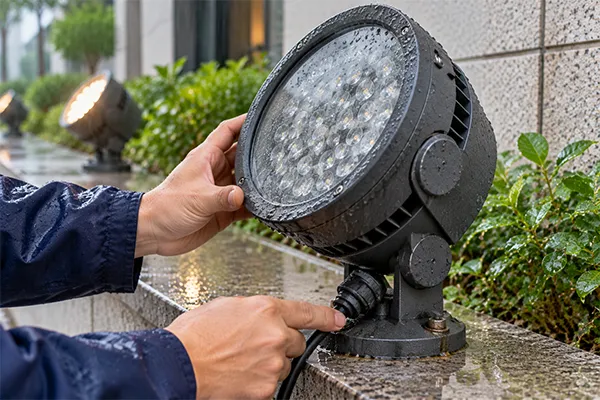
Water and corrosion can affect LED floodlights through damaged seals, poorly tightened cable glands, incorrect mounting orientation, cracked housings, condensation, and corroded external connections. An IP rating should be verified in product documentation, but it does not remove the need for correct installation and periodic inspection.
Why an IP Rating Is Only One Part of the Evaluation
An IP rating describes a product’s level of protection under defined test conditions.7 Buyers should verify the applicable rating, test documentation, and intended installation conditions with the supplier. However, real sites introduce factors that are not fully represented by a simple label.
These factors include:
- Cable entries facing upward or exposed to standing water
- Incorrect cable diameter for the gland size
- Missing or damaged sealing rings
- Cracked tempered glass or housing damage
- Reopened fixtures that are not resealed correctly
- Salt spray and airborne corrosive contaminants
- Pressure washing at close range
- Persistent condensation caused by temperature changes8
- Water collecting around junction boxes or conduit entries
I have seen site feedback where the fixture body remained in reasonable condition, while the connection point or external junction box had significant corrosion. In that situation, replacing only the floodlight may not solve the underlying problem.
Mounting Orientation Matters
A correctly selected floodlight can still encounter problems when it is installed in an unsuitable orientation. The cable entry should be positioned and sealed according to the manufacturer’s installation instructions. The mounting bracket should secure the fixture without deforming the housing or creating unnecessary strain on the cable.
Installers should also consider drainage. Water should not pool around cable connections, mounting surfaces, or junction boxes. In exposed locations, a practical drip loop can help reduce the chance of water tracking along the cable toward the connection point9, where permitted by local installation practice.
What to Do When Water Ingress Is Suspected
Water ingress can create electrical hazards.10 If a fixture has visible water inside, corrosion around terminals, burn marks, repeated tripping, or an electrical smell, I recommend isolating the circuit and contacting a qualified electrician.
For a supplier investigation, useful evidence includes:
- Clear photographs of the entire installation
- Close-up photos of the cable gland, bracket, lens, and junction box
- Product label and batch information
- The installation date and approximate operating hours
- Local weather or wash-down conditions
- Details of any storm, flooding, or physical impact
- Notes on whether other fixtures on the same site show similar symptoms
This information helps separate possible product issues from installation, environmental, and power-system factors. It also supports a fairer warranty review for contractors, distributors, and end users.
How Can Buyers Prevent Repeated LED Flood Light Failures?
Repeated failures can create serious commercial problems. Contractors may face callbacks, distributors may receive warranty complaints, and facility owners may experience safety and security gaps. The best prevention strategy is not simply buying the highest wattage or lowest-priced floodlight. It is matching the fixture, supplier, installation method, and site conditions.
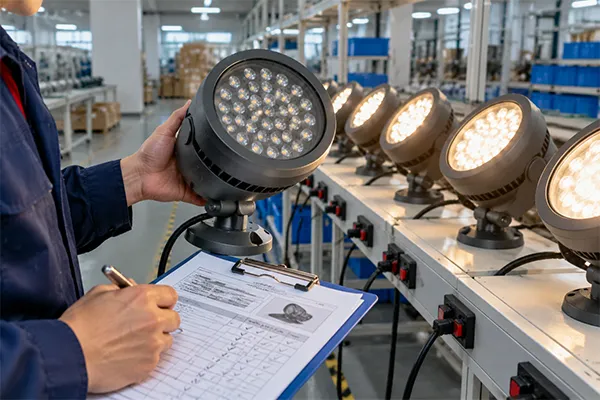
The best way to prevent repeat LED flood light failure is to select products based on electrical compatibility, thermal design, environmental exposure, surge risk, certification documents, and supplier quality processes.11 Correct installation and maintenance are equally important because factory testing cannot control site-side conditions.
Use a Procurement Checklist
For importers, lighting brands, and project managers, I recommend evaluating floodlights with a written checklist rather than relying only on catalog images or wattage claims.
| Procurement question | What buyers should verify |
|---|---|
| Is the input voltage suitable? | Product label, datasheet, local supply requirements |
| Is the wattage appropriate? | Lighting design, mounting height, thermal conditions |
| Is the beam angle suitable? | Coverage area, glare control, spacing |
| Is the environment demanding? | Rain, humidity, salt, dust, temperature, vibration |
| Are certifications available? | Current documents relevant to the destination market |
| Is surge protection needed? | Site electrical risk assessment by qualified professionals |
| Can the supplier customize? | CCT, wattage, beam angle, CRI, finish, labeling |
| Is quality control documented? | Aging, inspection, packing, traceability processes |
| Is after-sales support clear? | Warranty terms, evidence requirements, response process |
At Upward Lighting, we provide OEM and ODM options for parameters such as color temperature, wattage, beam angle, CRI, and surface finish. We also support small-batch orders for buyers who need to validate a product before wider rollout. I believe sample evaluation is valuable because it lets buyers review construction, light distribution, labeling, packaging, and compatibility with their intended installation method.
Review Quality Control Without Overpromising
Factory quality control is important, but it should be understood realistically. Our 100% aging tests and shipment inspections can help identify certain issues before products leave the factory. They do not eliminate every risk caused by power surges, damaged cables, incorrect installation, blocked airflow, coastal corrosion, or severe weather.
A responsible supplier should be prepared to discuss:
- Product specifications and tolerances
- Inspection and aging-test procedures
- Available certification documents, such as CE and RoHS where relevant
- Packaging methods for transport protection
- Traceability information where available
- Warranty terms and claim evidence requirements
- Recommended installation conditions
Buyers should verify all certification documents and market-entry requirements independently for their destination country and project. Certification needs can vary by market, customer specification, and application.12
Know When to Repair, Replace, or Escalate
The correct action depends on the risk level and the evidence available.
Inspection may be appropriate when:
- The issue affects only one fixture
- The site has accessible, documented wiring
- There are no signs of water damage or overheating
- A qualified electrician can safely verify supply conditions
Replacement may be appropriate when:
- The housing, lens, cable, or terminals show physical damage
- The fixture has sustained confirmed water ingress
- There are burn marks or severe corrosion
- The cost and safety risk of repair exceed replacement value
Escalation is essential when:
- A circuit breaker repeatedly trips
- Multiple fixtures fail on the same circuit
- There has been a lightning or surge event
- There is visible burning, smoke, odor, or melted insulation
- Water is present inside the fixture
- Mains-powered work is required
In my experience, the fastest way to reduce repeat failures is to treat the first incident as a learning opportunity. The project team should document the failure pattern, review the installation, and improve the specification or site practice before replacing a larger quantity of fixtures.
Frequently Asked Questions
Can a bad LED driver cause a floodlight to stop working?
Yes. A failed LED driver can prevent a floodlight from producing light even when the LED module is still functional. However, a qualified electrician should first confirm correct supply voltage, wiring integrity, and control-device operation before the driver is identified as the cause.
Does flickering always mean an LED floodlight needs replacement?
No. Flickering can be caused by loose wiring, unstable voltage, incompatible photocells or timers, dimming issues, heat, moisture, or driver problems. The fixture may need replacement, but the decision should follow safe site checks rather than the symptom alone.
Are IP-rated LED floodlights fully waterproof?
No. An IP rating indicates protection under specific test conditions and should be verified in the product documentation. Real-world performance also depends on cable glands, seals, mounting direction, installation quality, housing condition, condensation, corrosion, and maintenance.
Why do high-wattage LED floodlights fail sooner in some installations?
Higher wattage can increase thermal and electrical stress if the fixture has inadequate heat dissipation, restricted airflow, high ambient temperatures, unstable power, or insufficient surge protection. Buyers should select wattage based on lighting design and installation conditions, not brightness expectations alone.
What information should I send a supplier for an LED floodlight warranty claim?
Send the product label, purchase details, installation photos, close-ups of cables and connectors, a description of the symptom, supply-voltage information from a qualified professional, and details of rain, surge, impact, or control-device events. This evidence helps the supplier assess the claim fairly.
Conclusion
LED flood light failure causes and solutions require a methodical approach rather than a quick assumption about LED chips. I recommend starting with input power, wiring, controls, cable connections, and environmental conditions before considering the driver or LED module. Water exposure, heat buildup, surge risk, and mounting details can all influence performance. For contractors, distributors, and lighting brands, careful supplier selection and documented site checks can reduce callbacks and improve long-term results. If you need OEM/ODM LED floodlights with responsive technical support and inspection-focused production, contact Upward Lighting to discuss your project requirements.
"LED Dimming: What you need to know", https://www1.eere.energy.gov/buildings/publications/pdfs/ssl/dimming_webcast_12-10-2012.pdf. LED drivers provide regulated electrical output for LEDs, whose light output and safe operation depend on controlled current rather than direct connection to an unmanaged supply. Evidence role: mechanism; source type: government. Supports: LED drivers regulate electrical power, commonly current, for LED light sources.. ↩
"Protecting computer systems against power transients", https://www.nist.gov/document/protectcomputerspdf. Electrical transients associated with lightning and switching operations can impose overvoltage stress on electronic equipment; the extent of damage depends on the transient, installation, and protective measures present. Evidence role: mechanism; source type: government. Supports: Transient overvoltages caused by lightning and switching can stress or damage electronic equipment.. Scope note: This evidence establishes the general risk of transient damage and does not determine the cause of failure in an individual floodlight. ↩
"Retail Lamps Study 3.1: Dimming, Flicker, and Power ...", https://energy.gov/sites/prod/files/2015/01/f19/caliper_retail-study_3-1.pdf. Research on LED temporal light modulation identifies driver design, control compatibility, and input-power variation as factors that can produce or worsen visible flicker. Evidence role: mechanism; source type: research. Supports: LED flicker can be influenced by driver behavior, dimming compatibility, and fluctuations in the electrical supply.. Scope note: A general flicker mechanism does not by itself establish which factor is responsible at a particular installation. ↩
"Monitoring power quality", https://www.nist.gov/document/monitoringpqpdf. The starting and switching of motor-driven loads can produce voltage variations and transients on a shared electrical system, which may affect sensitive connected equipment. Evidence role: mechanism; source type: institution. Supports: Motor starting and switching can cause voltage sags or other power-quality disturbances on electrical systems.. Scope note: The magnitude of any disturbance depends on circuit impedance, load characteristics, and installation design. ↩
"Luminaire Dirt Depreciation (LDD): Field Data from Several ...", https://www.energy.gov/sites/default/files/2021-05/ssl-davis-etal-2018-LEUKOS-luminaire-dirt-depreciation.pdf. Lighting-maintenance guidance recognizes luminaire dirt depreciation: contamination of optical surfaces can reduce the light delivered to the task area without an electrical failure of the source. Evidence role: mechanism; source type: institution. Supports: Dirt accumulation on luminaire optical surfaces reduces transmitted and delivered light.. Scope note: The amount of reduction varies with the contaminant, optical design, environment, and cleaning history. ↩
"High Operating Temperature Interconnects for LED ...", https://energy.gov/sites/prod/files/2015/02/f19/bhatkal_interconnects_sanfrancisco2015.pdf. LED-system reliability is temperature-dependent: inadequate thermal management raises operating temperatures and can accelerate degradation of LEDs, drivers, and other electronic components. Evidence role: mechanism; source type: research. Supports: Higher operating temperatures and poor thermal management can adversely affect LED-system performance and reliability.. Scope note: Thermal stress is one reliability factor and does not prove that overheating caused a particular field failure. ↩
"IEC 60529", https://en.wikipedia.org/?title=IEC_60529&redirect=no. IEC 60529 defines the IP Code, which classifies degrees of enclosure protection against access, solid foreign objects, and water under prescribed test conditions. Evidence role: definition; source type: institution. Supports: The IEC IP Code classifies enclosure protection against access, solid objects, and water under specified test procedures.. Scope note: An IP classification does not by itself demonstrate performance after damage, incorrect installation, aging, or exposure outside the relevant test conditions. ↩
"What Is Humidity? | NESDIS - NOAA", https://www.nesdis.noaa.gov/about/k-12-education/atmosphere/what-humidity. Condensation occurs when air is cooled to its dew-point temperature, allowing water vapor to become liquid on cooler surfaces or within susceptible enclosures. Evidence role: mechanism; source type: government. Supports: Condensation forms when a surface or enclosed air volume is cooled to the dew point.. Scope note: This physical mechanism does not establish that condensation entered or damaged a specific lighting fixture. ↩
"Wire, Cables, and Harnesses | Caltrans - CA.gov", https://dot.ca.gov/programs/equipment/electrical/wires-cable-harness. Electrical safety guidance commonly describes a drip loop as a downward cable loop that helps water shed from the cable before it can reach an electrical connection. Evidence role: general_support; source type: education. Supports: A drip loop is a cable-routing practice intended to let water drip off before reaching a connection.. Scope note: Use of a drip loop must remain consistent with the fixture instructions, applicable wiring rules, and the specific enclosure arrangement. ↩
"Electrical Hazards in Construction Student Workbook.pdf", https://www.osha.gov/sites/default/files/2022-01/Electrical%20Hazards%20in%20Construction%20Student%20Workbook.pdf. Electrical-safety guidance identifies water and moisture as shock and fault hazards because they can compromise insulation, create conductive paths, and damage electrical equipment. Evidence role: general_support; source type: government. Supports: Water exposure increases the risk of electrical shock, short circuits, and equipment damage.. Scope note: The precise hazard level depends on whether energized parts are exposed and on the condition of the equipment and installation. ↩
"LED Luminaire Reliability: Impact of Color Shift", https://www.energy.gov/sites/prod/files/2017/04/f34/lsrc_colorshift_apr2017.pdf. LED-luminaire reliability depends on system-level factors including driver and electrical conditions, thermal management, environmental exposure, and the suitability of the installation. Evidence role: general_support; source type: research. Supports: LED-luminaire reliability is influenced by electrical, thermal, environmental, and installation-related factors in addition to the light source itself.. Scope note: This general reliability framework cannot rank the importance of each factor for every product, site, or failure mode. ↩
"2-CE Marking | BETA - International Trade Administration", https://beta.trade.gov/article?id=CE-Marking. Market-access requirements for electrical products are set by the laws, regulations, and conformity-assessment rules of the destination jurisdiction and may differ by product category and intended use. Evidence role: general_support; source type: government. Supports: Electrical-product conformity obligations are determined by the destination market and applicable product rules.. Scope note: A general market-access source does not identify the complete compliance obligations for a particular floodlight or project. ↩