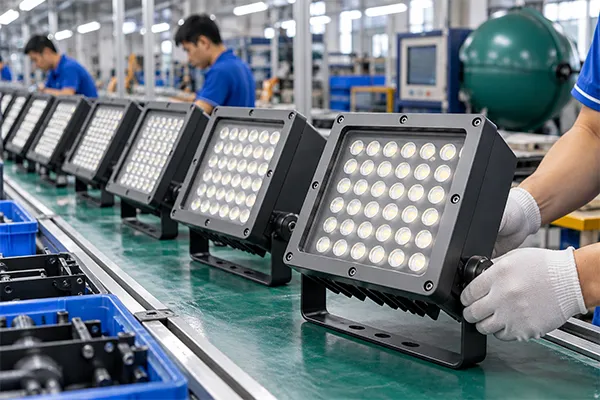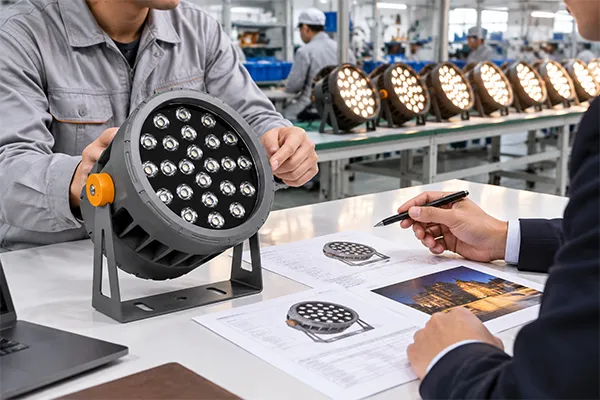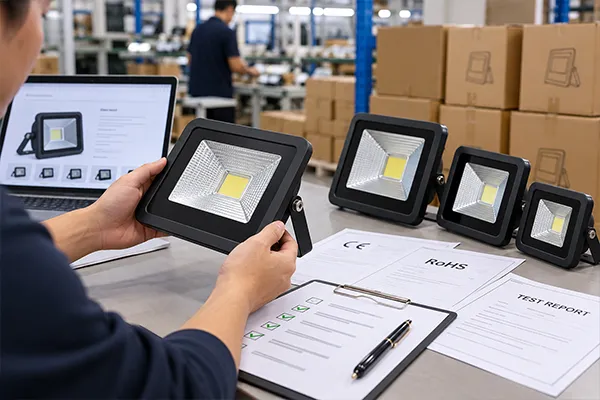

LED flood light factory vs trading company is a common sourcing question, but the wrong comparison can create costly problems. Buyers may focus only on unit price, then face unclear specifications, delayed samples, inconsistent batches, or confusion about who should resolve an issue. The better choice depends on how your order is structured and managed.
A LED flood light factory vs trading company decision should be based on your sourcing needs, not assumptions about who is “better.” A factory may be suitable for customized floodlights, repeat orders, and direct manufacturing communication. A trading company may be useful when you need multiple product categories, supplier coordination, or one purchasing contact. Buyers should compare technical specifications, total landed cost, delivery responsibility, and after-sales accountability before selecting a supplier.
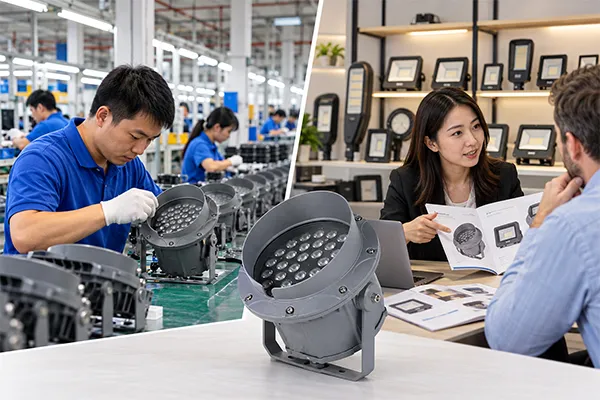
I have handled many floodlight inquiries from contractors, importers, distributors, and local lighting brands. In our manufacturing-side discussions, the most successful buyers do not begin with “Who has the lowest price?” They begin by defining the project, product configuration, approval process, and responsibility chain behind the order.
How Should LED Flood Light Factory vs Trading Company Be Framed?
Buyers often see a factory as the direct option and a trading company as an extra layer. That view can be too simple. If your purchasing team chooses a supplier based only on business type, it may overlook the actual work required to deliver the right LED floodlights.
The LED flood light factory vs trading company comparison should focus on order complexity. A factory may provide stronger access to production, engineering, and OEM/ODM discussions. A trading company may simplify mixed-category procurement by coordinating several factories. The right supplier is the one that can clearly manage your specifications, samples, delivery, and issue resolution.

Start With the Buyer’s Actual Order Structure
I recommend that buyers classify their purchasing requirement before requesting quotations. This step sounds basic, but it prevents many pricing and specification misunderstandings.
A project contractor ordering 300 floodlights for a stadium perimeter has a different need from a distributor building a regular inventory program. A lighting brand developing a private-label range also has different requirements from an importer consolidating floodlights, wall lights, street lights, and indoor fixtures into one container.
Here are four common sourcing situations:
| Buyer situation | Often requires | Supplier capability to evaluate |
|---|---|---|
| Project-specific floodlight order | Clear technical confirmation and sample approval | Application review, configuration control, production consistency |
| Repeat stock program | Stable specifications and replenishment planning | Repeatability, material continuity, packaging consistency |
| Private-label LED floodlight development | Custom branding and defined product parameters | OEM/ODM communication, artwork confirmation, sample management |
| Mixed lighting category sourcing | Coordination across different products and factories | Consolidation, purchasing coordination, delivery visibility |
A Factory Can Be Valuable When Manufacturing Control Matters
A factory may be a strong fit when your order requires a direct discussion around product construction, performance expectations, or customization. For example, a buyer may need to define:
- Wattage and input voltage
- Color temperature, such as 3000K, 4000K, 5000K, or 6500K
- Beam angle for area lighting, facade lighting, or security lighting
- IP rating requirement for outdoor exposure
- Driver brand or driver performance expectations
- Housing finish color and private-label markings
- Mounting bracket, spigot, or other installation method
- Packaging and carton labeling requirements
In our own quotations, I find that the clearer these details are at the beginning, the easier it is to quote a technically comparable product. A factory can often involve its sales, engineering, purchasing, and production teams in that process. However, buyers should still verify the actual communication process, sample approval procedure, and production controls rather than assuming every factory operates the same way.
A Trading Company Can Be Valuable When Coordination Matters
A capable trading company may add value when a buyer needs more than one product category. For example, an importer may want floodlights, outdoor wall lights, inground lights, and street lights shipped together. Managing separate quotations, samples, payments, inspections, and delivery schedules can consume significant time.
In that situation, one accountable coordination point can be useful. The buyer should ask whether the trading company has enough product knowledge to confirm technical details and whether it can clearly identify which factory is responsible for each product line.
The key question is not whether an intermediary exists. The key question is whether responsibility remains clear.
I encourage buyers to ask: “If the approved sample and production batch differ, who will investigate, communicate, and provide a corrective action?” The answer often reveals more than a price list.
When Is an LED Flood Light Factory vs Trading Company Better for Customization?
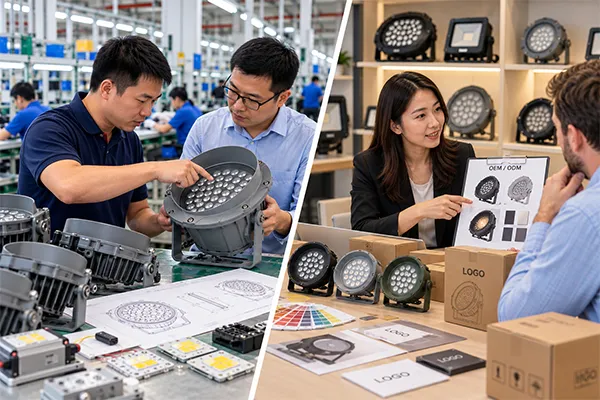
Customization can create commercial opportunities, but it can also increase execution risk. Buyers may request a logo, special color temperature, different wattage, or branded packaging without confirming how each change affects sampling, component selection, production planning, and approval responsibility.
For customized orders, an LED flood light factory vs trading company choice should depend on who can control the approved configuration. A factory may be more suitable when changes affect product design, components, labeling, or performance. A trading company can still be suitable if it manages factory communication, sample approval, and revision records in a disciplined way.
Why Custom Floodlight Quotes Need More Than Wattage
A 100W LED floodlight is not automatically comparable with another 100W LED floodlight.1 Equal wattage labels do not prove equal optical design, heat dissipation, driver quality, housing construction, surge protection, lumen output, or expected operating conditions.2
This issue appears regularly in pre-sales conversations. A buyer may ask for a “200W waterproof floodlight” and expect a firm price immediately. Yet several practical details may remain undefined.
For a more meaningful quote comparison, I suggest confirming the following items:
- Application: Is the floodlight for a warehouse yard, parking area, building facade, sports area, construction site, or security lighting?
- Installation height: A fitting mounted at 4 meters may require a different optical approach than one mounted at 12 meters.3
- Beam angle: A broad beam can improve area coverage, while a narrower beam can concentrate light where needed.4
- Ingress protection requirement: Buyers should define the environmental exposure and verify the stated IP rating documentation.5
- Color temperature: Warm white, neutral white, and cool white create different visual results6 and may be specified by local project requirements.
- Driver and electrical requirements: Input voltage, driver configuration, surge protection expectations, and dimming needs should be stated.
- Mounting method: Bracket mounting, pole mounting, wall installation, or custom brackets may affect the final configuration.
- Certification documentation: Buyers should request the applicable documents and verify whether they match the exact model and destination market.
OEM and ODM Require Documented Approval
A private-label program involves more than adding a logo. The buyer and supplier should create a practical approval record. This record can include product photos, a specification sheet, artwork files, packaging layout, carton marks, and the approved sample reference.
At Upward Lighting, we provide OEM/ODM options for parameters such as color temperature, wattage, beam angle, CRI, and surface finish colors. We also support small-batch orders where feasible. Still, I believe small quantity does not remove the need for clear documentation. In fact, small orders can become more sensitive because setup costs, custom materials, and production timing may have a larger impact.
A useful sample approval checklist includes:
| Approval item | Why it matters |
|---|---|
| Product model number | Prevents confusion between similar housings or wattages |
| Rated wattage and voltage | Confirms electrical configuration |
| Color temperature | Avoids visible variation across installed fixtures |
| Beam angle or optical requirement | Supports project lighting intent |
| Driver details | Helps buyers compare electrical components |
| Housing color and logo | Confirms private-label appearance |
| Packaging artwork | Prevents labeling and market-entry errors |
| Test and certification documents | Supports buyer verification for the applicable market |
Buyers should retain the final approved configuration as the reference for production. This gives both parties a clearer basis for confirming batch consistency later.
How Can Buyers Compare LED Flood Light Factory vs Trading Company Quotes Fairly?
The lowest quotation can look attractive at first, especially in a competitive tender or distribution market. However, a low number can be misleading if the quoted floodlights are not technically equivalent. The real procurement risk often comes from comparing incomplete specifications rather than comparing suppliers fairly.7
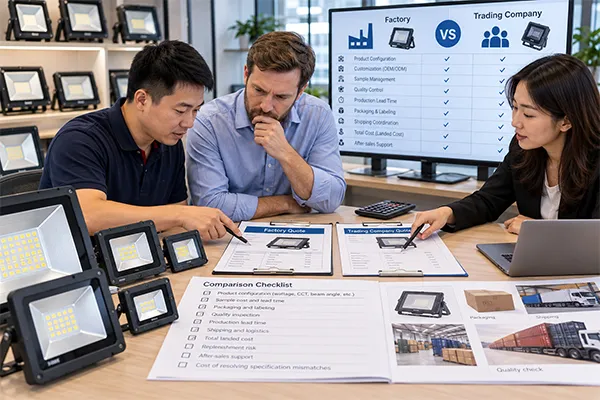
To compare a LED flood light factory vs trading company quotation fairly, buyers should request technically equivalent offers and calculate total cost. The evaluation should include product configuration, sample cost, packaging, quality checks, lead-time commitments, shipping coordination, replenishment risk, and the cost of resolving specification mismatches.
Compare the Approved Configuration, Not the Product Name
Terms such as “LED floodlight,” “IP66 floodlight,” or “high-lumen floodlight” are broad descriptions. They do not provide enough information for a direct commercial comparison.
I have seen cases where buyers receive several quotations that appear similar because each supplier lists the same wattage. But the offers may use different drivers, LED packages, housing sizes, cable lengths, surge protection levels, or optical designs. Without a defined baseline, a purchasing manager may unintentionally compare different products.
A quote comparison sheet should include columns for:
- Model and product photos
- Rated wattage
- Input voltage and frequency
- Lumen claim and test condition
- Color temperature
- Beam angle
- IP rating and supporting documentation
- Driver specification
- Housing material and finish
- Mounting accessory
- Cable specification
- Packaging configuration
- Certification documents offered
- Sample lead time and mass-production lead time
- Warranty terms and exclusions
- MOQ for standard and customized versions
Evaluate Total Cost, Not Only EXW Unit Price
“Factory direct” does not automatically mean the lowest total cost.8 A direct factory price may be competitive for a defined, repeatable floodlight model. Yet a buyer may incur additional coordination costs when sourcing several categories from several factories.
On the other hand, a trading company may offer a convenient consolidated quotation, but the buyer should still verify whether the technical configuration and responsibility structure remain transparent.
The total sourcing cost can include more than the item price:
| Cost factor | Questions buyers should ask |
|---|---|
| Product price | Are all quotes based on the same technical specification? |
| Sample and revision cost | How many sample rounds may be required? |
| Quality verification | Who checks the production batch against the approved sample? |
| Delivery coordination | Who manages partial shipments or mixed containers? |
| Rework risk | What happens if mounting, CCT, labeling, or packaging is incorrect? |
| Replenishment | Can the same configuration be supplied later? |
| Communication time | Does the supplier respond clearly and document decisions? |
A lower unit price may lose value if it creates a specification mismatch that requires rework, replacement, or project delays.9 Buyers should assess this carefully, especially for installations where labor and site access costs are high.
Ask for Transparent Quote Assumptions
Every quotation should state its assumptions. If a price is based on a standard 6500K model, but the buyer requires 4000K, branded packaging, and a specific driver, the original price may no longer apply.
I recommend that buyers ask suppliers to identify:
- What is included in the quoted price?
- Which specifications are standard?
- Which requirements are custom?
- What documentation supports the configuration?
- What could change the price or lead time?
- Is the offer based on an approved sample or only a preliminary description?
These questions protect both the buyer and supplier from avoidable disputes.
Who Is Accountable After a LED Flood Light Factory vs Trading Company Order Is Placed?
Many supplier evaluations end too early. A buyer may compare samples and prices but fail to define what happens after the purchase order is issued. Problems often become harder to solve when sample approval, batch production, shipping, and claims are managed by different parties.
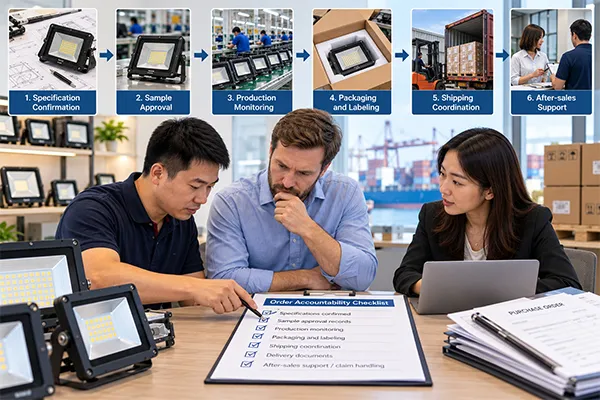
After a LED flood light factory vs trading company order is placed, buyers should confirm one clear accountability path. The supplier should define who confirms specifications, records sample approval, monitors production, coordinates shipping, and responds if the delivered batch differs from the agreed configuration. Clear ownership reduces delays and misunderstanding.10
Accountability Should Be Visible Before Production
A supplier relationship is stronger when roles are clear. Buyers should know whether they are communicating directly with the manufacturing team, through a sales contact, or through a trading company that coordinates several production sources.
Neither structure is automatically wrong. What matters is whether the supplier can provide a workable process.
Before placing an order, I suggest asking these questions:
- Who issues the final specification confirmation?
- Who keeps the approved sample record?
- Who confirms that production follows the approved version?
- Who provides production progress updates?
- Who coordinates inspection, packing, and shipment?
- Who handles a claim if products arrive with a mismatch?
- Who manages replacement or corrective-action discussions?
- For mixed orders, who is responsible for consolidation and delivery timing?
A professional answer should be specific. Buyers should be cautious if responsibility shifts between several contacts without a documented process.
Quality Control Requires Verification, Not Assumption
At Upward Lighting, every product undergoes a 100% aging test for approximately 4 to 8 hours before shipment. Our purpose is to support product reliability and confirm that lumen maintenance performance meets our internal and applicable industry expectations. However, I always believe that buyers should evaluate quality-control claims in the context of their own project requirements.
A stated aging test does not replace application-specific review, sample approval, incoming inspection, or verification of required documentation.11 The same principle applies to CE, RoHS, and other certifications.12 Buyers should request and verify relevant documents for the exact model, destination market, and project requirement.
For a higher-value project, buyers may consider adding:
- Pre-production sample approval
- Product photo confirmation before shipment
- Third-party inspection where appropriate
- Random functional checks
- Packaging and labeling inspection
- Documentation review for required market entry
- Retained reference samples for future batch comparison
Delivery Is Also Part of Supplier Performance
A good floodlight cannot help a project if it arrives late, arrives incomplete, or arrives with unclear labeling. Delivery performance involves production planning, packaging, export documentation, freight coordination, and communication.
For factory-direct sourcing, the buyer may need to coordinate freight forwarders, consolidation, and export timing independently. For a trading company, the buyer may expect support with multi-factory consolidation. Either arrangement can work when responsibilities are written clearly.
In my experience, quick quotation response is useful, but it should not replace careful confirmation. The best purchasing process balances speed with documented accuracy.
Frequently Asked Questions
Is a LED flood light factory always cheaper than a trading company?
No. A LED flood light factory may offer a competitive price for a defined product, especially for repeat orders or customized manufacturing. However, buyers should compare equivalent configurations and include coordination, shipping, inspection, and replenishment costs. A trading company may add value for consolidated, multi-category purchasing.
Should I buy LED floodlights directly from a China factory?
Direct factory purchasing can be suitable when you need product customization, technical discussions, private labeling, or repeat supply of a defined model. Buyers should still verify production capability, sample approval procedures, quality controls, certification documents, communication responsiveness, and delivery responsibilities before ordering.
What should I include in an LED floodlight RFQ?
An LED floodlight RFQ should include the application, wattage, input voltage, color temperature, beam angle, IP requirement, mounting method, required certifications, packaging needs, quantity, destination market, and requested delivery date. Buyers should also ask for sample availability and a detailed specification sheet.
How do I verify an LED floodlight supplier’s certifications?
Buyers should request copies of relevant certificates and test reports, then verify that the documents match the product model, intended market, and current requirements. Certifications should be treated as documents to review, not as automatic proof that every delivered batch meets a specific project’s needs.
Can a trading company manage OEM LED floodlight orders?
Yes, a trading company can manage OEM orders if it has a disciplined process for communicating with the factory, controlling artwork, confirming samples, and documenting revisions. Buyers should ask who owns each step and who will be accountable if the production batch differs from the approved sample.
Conclusion
The LED flood light factory vs trading company decision is not about choosing a universally superior supplier type. It is about selecting the sourcing structure that best matches your product requirements, order complexity, technical expectations, and internal purchasing resources. I recommend that buyers compare equivalent specifications, verify certificates and samples, calculate total cost, and confirm accountability before placing an order. If you need customized LED floodlights, small-batch support, or direct manufacturing discussion, contact Upward Lighting to request a clear, project-focused quotation.
"Purchasing Energy-Efficient Light Bulbs", https://www.energy.gov/cmei/femp/purchasing-energy-efficient-light-bulbs. U.S. Department of Energy guidance distinguishes input power from lumen output and efficacy, supporting the conclusion that equal wattage alone is insufficient for comparing LED luminaire performance. Evidence role: general_support; source type: government. Supports: That LED product wattage indicates electrical power consumption and does not by itself establish light output, efficacy, distribution, or other luminaire performance characteristics.. Scope note: This support addresses general LED-product comparison principles rather than the quality of any particular floodlight model. ↩
"2019 Solid-State Lighting R&D Opportunities", https://www.energy.gov/sites/prod/files/2020/01/f70/ssl-rd-opportunities2-jan2020.pdf. Technical literature on solid-state lighting describes optical, thermal, driver, and electrical-protection design as separate factors affecting luminaire performance and reliability; rated wattage alone does not characterize these factors. Evidence role: mechanism; source type: research. Supports: That LED luminaire performance and reliability are affected by optical, thermal, electrical-driver, and surge-protection design choices in addition to input wattage.. Scope note: The literature explains the design mechanism generally and does not verify the components or performance of the products described in the article. ↩
"7 Lighting Application | FHWA - Department of Transportation", https://highways.dot.gov/safety/other/visibility/fhwa-lighting-handbook-august-2012/7-lighting-application. Lighting-engineering guidance explains that mounting height and luminaire photometric distribution jointly determine illuminance and uniformity, so installations at substantially different heights may require different optical distributions. Evidence role: mechanism; source type: institution. Supports: That luminaire mounting height and photometric distribution affect illuminance, uniformity, glare, and the selection of outdoor lighting equipment.. Scope note: A site-specific lighting calculation remains necessary to select an actual beam angle or floodlight model. ↩
"Understanding Light Beam Angles", https://www.ledvance.com/en-us/professional-lighting/insights/blog/lighting-basics/light-beam-angle. Introductory lighting and photometry materials explain that beam spread determines how light is distributed across a surface: wider distributions cover larger areas, whereas narrower distributions concentrate light into a smaller target area. Evidence role: mechanism; source type: education. Supports: That wider and narrower beam distributions spread a given luminous flux over different areas and therefore change the concentration of illumination.. Scope note: Actual coverage also depends on mounting height, aiming, fixture photometry, obstructions, and the required illuminance level. ↩
"Degrees of protection provided by enclosures (IP Code)", https://tethys-engineering.pnnl.gov/publications/degrees-protection-provided-enclosures-ip-code. IEC 60529 defines the IP Code used to classify enclosure protection against solid-object ingress and water ingress, providing the technical basis for matching a stated IP rating to the intended environmental exposure. Evidence role: definition; source type: institution. Supports: That IP codes specified in IEC 60529 classify the protection provided by electrical enclosures against access, solid foreign objects, and water.. Scope note: An IP classification does not by itself establish overall product durability, installation suitability, or compliance with all destination-market requirements. ↩
"Understanding LED Color-Tunable Products", https://www.energy.gov/cmei/ssl/understanding-led-color-tunable-products. U.S. lighting guidance defines correlated color temperature as a descriptor of white-light appearance, with lower-CCT light appearing warmer and higher-CCT light appearing cooler. Evidence role: definition; source type: government. Supports: That correlated color temperature describes the apparent color of white light, with lower values generally perceived as warmer and higher values as cooler.. Scope note: Perceived appearance can also be influenced by surrounding colors, adaptation, spectral power distribution, and the viewing environment. ↩
"EVALUATING BIDS AND PROPOSALS - Public Documents", https://thedocs.worldbank.org/en/doc/9dcb7971706bf29b2732779c39922b77-0290012025/original/Evaluating-Bids-and-Proposals-with-Rated-Criteria-Feb-4-2025.pdf. Public-procurement guidance identifies clear technical specifications as necessary for suppliers to prepare responsive, comparable offers and for purchasers to evaluate bids consistently. Evidence role: general_support; source type: institution. Supports: That clear, nonrestrictive technical specifications are important for obtaining comparable bids and conducting transparent supplier evaluation.. Scope note: This evidence concerns procurement practice generally and does not quantify the risk for LED floodlight purchases specifically. ↩
"Supply Chain Management", https://www.nist.gov/mep/supply-chain. Procurement research on total cost of ownership finds that purchase price is only one component of sourcing cost and that logistics, transaction, quality, inventory, and failure costs can alter the lowest-cost supplier decision. Evidence role: general_support; source type: paper. Supports: That supplier selection based only on purchase price can omit transaction, logistics, quality, inventory, and failure-related costs considered in total-cost-of-ownership analysis.. Scope note: The relative size of these costs depends on the order volume, shipping terms, product complexity, and buyer capabilities. ↩
"Audit Report of the Department of Design and Construction's ...", https://comptroller.nyc.gov/reports/audit-report-of-the-department-of-design-and-constructions-mitigation-of-delays-and-cost-overruns-on-capital-construction-projects/?ref=vitalcitynyc.org. Research on project rework reports that errors, omissions, and nonconforming work can require corrective work and are associated with additional cost and schedule impacts. Evidence role: mechanism; source type: paper. Supports: That design or specification errors and nonconforming work are associated with rework and can contribute to increased project cost and schedule delay.. Scope note: The evidence is largely drawn from project and construction settings and does not establish the financial impact of any individual lighting procurement mismatch. ↩
"Identifying Causes of Project Delays and Management ...", https://www.asianinstituteofresearch.org/JEBarchives/identifying-causes-of-project-delays-and-management-recommendations-in-paper-machine-installation. Organizational and project-management research links role clarity and defined responsibility assignments with improved coordination and lower ambiguity among participants. Evidence role: general_support; source type: research. Supports: That role clarity and explicit responsibility assignment support coordination and reduce ambiguity in collaborative project work.. Scope note: Role clarity alone cannot prevent delays caused by capacity constraints, transport disruptions, technical failures, or other external factors. ↩
"Stress Testing of Organic Light-Emitting Diode Panels and ...", https://www.energy.gov/sites/prod/files/2018/05/f51/ssl_oled-stresstest_2018.pdf. Reliability-engineering literature describes burn-in as a screening method for certain early-life failures; it does not replace broader qualification testing, inspection, or verification against applicable requirements. Evidence role: mechanism; source type: research. Supports: That burn-in or aging tests can screen some early-life failures but are not a complete substitute for product qualification, application testing, inspection, or compliance assessment.. Scope note: The effectiveness of an aging test depends on its duration, loading conditions, sample coverage, failure criteria, and the particular product design. ↩
"CE marking – obtaining the certificate, EU requirements", https://europa.eu/youreurope/business/product-rules-compliance/general-product-compliance/ce-marking/index_en.htm. European Commission guidance explains that CE marking indicates a manufacturer's declaration of conformity with applicable EU requirements, while the RoHS framework concerns restrictions on specified hazardous substances in electrical and electronic equipment. Evidence role: definition; source type: government. Supports: That CE marking is based on conformity with applicable EU requirements and that RoHS separately restricts specified hazardous substances in electrical and electronic equipment.. Scope note: The applicable legal obligations depend on the product, intended use, and destination market; the presence of documentation does not independently demonstrate every batch's conformity. ↩