
LED flood light manufacturer certifications can look convincing at first glance, yet a document with a familiar logo may not support the exact product you plan to import, resell, or install1. That gap can create customs delays, tender rejection, and after-sales risk. We recommend a structured verification process that matches each proposed flood light to relevant, consistent evidence.
To verify LED flood light manufacturer certifications, buyers should match the exact flood light model, wattage, input voltage, product version, and destination-market requirements to the supplier’s test reports and compliance documents. Buyers should also separate product documents from factory credentials and internal quality-control records. Any OEM or ODM change—including branding, electrical parts, labels, or wattage—should trigger a document review before the purchase order is confirmed.
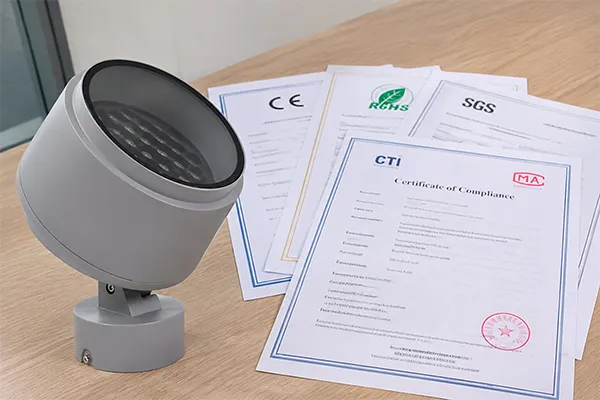
In our discussions with importers, contractors, lighting brands, and distributors, we often hear one simple question: “Do you have CE and RoHS?” That is a reasonable starting point, but it is not the final verification step. The better question is whether the available files apply to the exact flood light configuration, project, and market involved.
Why Are LED Flood Light Manufacturer Certifications Not Enough on Their Own?
A buyer may receive a certificate quickly and assume the compliance work is complete. The risk appears when the document covers a different model, a lower wattage, or an older product version. That mismatch can become expensive when goods reach customs, a consultant reviews a submittal, or an end customer asks for supporting files.
LED flood light manufacturer certifications are useful only when they are connected to the exact product being purchased and the relevant destination-market requirements. A certificate title, logo, or validity date does not automatically prove coverage for every model, wattage, batch, customization, or application offered by a supplier. Buyers should review the product details inside each document.
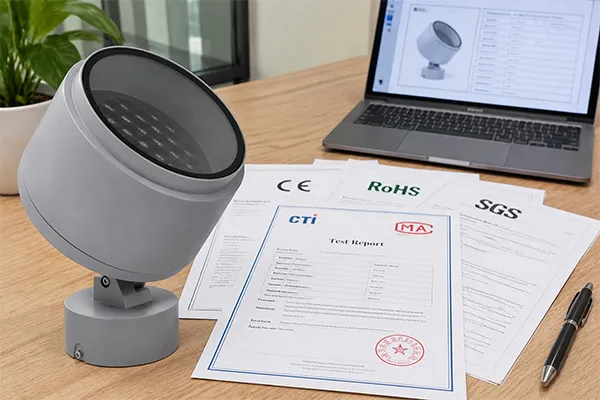
A document answers only a specific question
We encourage buyers to separate certification evidence into three practical categories. Each category reduces a different type of procurement risk.
| Proof category | Main buyer question | Typical evidence | What it does not prove alone |
|---|---|---|---|
| Product compliance documentation | Does this product version have relevant supporting evidence? | Test reports, declarations, certificates, technical files | That every product from the factory is identical |
| Manufacturer and business credentials | Is this supplier a real and reasonably established business? | Business registration, export records, audit information, factory profile | That a specific flood light meets market rules |
| Internal quality-control records | Does the supplier have process controls before shipment? | Aging records, inspection reports, incoming material checks | Third-party test results or legal compliance |
For example, a CE-related document may be relevant to a buyer serving a European market, but the buyer still needs to verify the actual standards, model references, electrical ratings, and product descriptions. A RoHS-related document may address restricted-substance requirements, but it does not automatically address electrical safety, electromagnetic compatibility, installation conditions, or project-specific specifications.2
The “same appearance” problem
We have seen flood lights that look almost identical on the outside but differ internally. One version may use a different driver, LED package, surge protection device, cable length, housing thickness, or input-voltage range. These changes can affect both product performance and whether an existing report still applies.3
A buyer should not rely on statements such as:
- “This is the same product.”
- “This certificate covers all wattages.”
- “The housing is unchanged.”
- “We can put your logo on it without any impact.”
- “Our factory has CE.”
These statements may be partly true, but they are not enough for a controlled procurement decision. We believe the buyer should ask for the evidence that connects the order specification to the documentation.
In one anonymized conversation, a distributor asked us whether a document for a 100W flood light could also support a 200W version with a different driver. We advised the buyer to compare the model number, electrical data, component configuration, and report scope before treating the file as applicable.
Internal aging tests have a different purpose
At Upward Lighting, we conduct a 100% aging test lasting approximately 4 to 8 hours before shipment4 as part of our internal quality-control process. This step helps us identify early functional issues and confirm product operation before dispatch.
However, we do not present aging tests as a substitute for accredited third-party testing, regulatory assessment, or local legal review. Aging records answer a manufacturing-control question. They do not independently establish that a product meets every requirement in every country or tender.5
How Do We Match LED Flood Light Manufacturer Certifications to the Exact Product?
Buyers often receive documents after they have already compared prices and selected a supplier. That timing creates pressure to accept whatever paperwork is available. We recommend moving document matching earlier, before the final purchase order, especially for projects, private-label programs, and regulated destination markets.
To match LED flood light manufacturer certifications to a product, buyers should compare the proposed model number, wattage, voltage, frequency, IP rating, electrical class, brand information, and technical configuration against each test report or certificate6. Any missing, inconsistent, or unclear detail should be resolved in writing before the order is released.

Start with a controlled product specification
We suggest creating a one-page product specification sheet for every flood light quotation. This document becomes the reference point for technical, commercial, and compliance discussions.
At minimum, the sheet should include:
- Supplier model number and buyer’s internal SKU, if applicable
- Rated wattage and actual input-power range
- Input voltage and frequency
- Driver brand, driver model, or driver performance requirements
- LED type and quantity where relevant
- Color temperature and tolerance
- Luminous flux target and efficacy expectation
- Beam angle
- CRI requirement
- IP rating and IK rating, where required
- Surge protection level
- Housing material and finish color
- Cable type, cable length, plug, and connector requirements
- Label content and branding details
- Target country, customer, project, or tender requirement
This level of detail is especially useful for OEM and ODM business. We can customize color temperature, wattage, beam angle, CRI, and surface finishes for different projects. Yet every requested adjustment should be evaluated against the document set rather than assumed to be automatically covered.
Cross-check the report, not just the cover page
A test report can contain more useful information than a certificate cover page. We recommend that buyers inspect the report scope and the pages that identify the sample.
Use this practical cross-check table:
| Product item to verify | Where to check | Why it matters |
|---|---|---|
| Model number | Certificate, report, product label, quotation | A similar model name may refer to a different product |
| Rated wattage | Test sample description, rating label, datasheet | A 50W report may not support a 150W version |
| Input voltage | Report data, driver label, technical specification | Voltage range affects application suitability |
| Product photos | Test report photographs, supplier sample photos | Photos can reveal housing, bracket, cable, and label differences |
| Applicable standard | Report standard page and destination-market requirements | Standards must relate to the buyer’s intended market and application |
| Brand name | Certificate holder, label artwork, declaration | Private labeling may require document review |
| Issue date and status | Certificate or report details | Older documents may need clarification, though age alone is not decisive |
| Test laboratory details | Laboratory identity and accreditation scope7 | Buyers may need to independently verify the laboratory |
Ask about the tested sample
We find that one of the strongest questions a buyer can ask is: “What exact sample was tested, and how does it compare with the product in our quotation?”
A responsible supplier should be able to explain whether the tested unit used:
- The same housing and mounting bracket
- The same driver or an equivalent documented driver configuration
- The same wattage range
- The same cable and terminal arrangement
- The same label layout or relevant product identification
- The same core electrical architecture
If the supplier cannot explain these points, the buyer should not assume the document applies. The buyer may need an updated report, a formal clarification, additional testing, or advice from a qualified local compliance professional.
What Happens to LED Flood Light Manufacturer Certifications After OEM or ODM Changes?
Private labeling creates commercial value, but it can also introduce documentation risk. A new logo, carton, wattage, driver, or label may look like a small change to a purchasing team. From a compliance perspective, the impact depends on the market, the document type, the applicable standard, and the nature of the modification.
OEM and ODM changes can affect whether LED flood light manufacturer certifications remain relevant. Buyers should review documentation whenever they change electrical components, wattage, input ratings, product labels, brand ownership, packaging claims, product configuration, or intended application. A supplier should confirm what evidence remains applicable and what may require additional review.
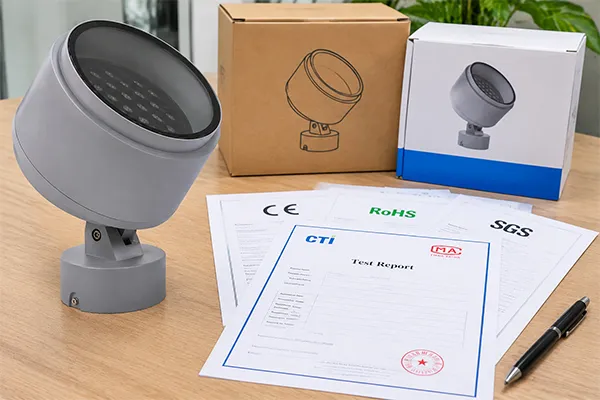
Not all changes carry the same risk
We recommend classifying requested changes before approving artwork or production. This approach keeps technical and commercial teams aligned.
| Change type | Typical examples | Documentation review priority |
|---|---|---|
| Cosmetic change | Housing paint color, logo position, carton artwork | Moderate; verify labeling and market requirements |
| Performance adjustment | CCT, beam angle, CRI target | Moderate to high; assess whether the configuration differs from tested scope |
| Electrical change | Wattage, driver, input voltage, surge protection | High; may affect safety and EMC evidence |
| Mechanical or environmental change | IP structure, cable gland, bracket, housing design | High; may affect ingress protection and mechanical performance |
| Market change | Selling the same product in a new country | High; local rules and customer requirements may differ |
For example, a buyer may ask us to add a private-label logo while keeping the same basic product. We can review the label artwork, package wording, and available documentation. However, we do not assume that a brand change is irrelevant in every market. Some destination markets, importers of record, and tender procedures may require a specific declaration format, responsible-party information, traceability label, or product registration process.8
Electrical changes deserve the closest attention
In our experience, the highest-risk requests usually involve electrical changes. A 100W flood light is not simply a 150W flood light with a different sticker.9 It may need a different driver, heat-management design, LED configuration, cable specification, or surge-protection approach.
Buyers should request clear answers to these questions:
- Does the requested wattage use the same model family named in the report?
- Does the requested unit use the same driver type and input rating?
- Does the existing report explicitly cover the new configuration?
- Has the product label changed to reflect the actual electrical parameters?
- Does the target project require an additional test, declaration, or approval?
- Who is responsible for confirming market-specific obligations: the supplier, importer, local representative, or brand owner?
We can support buyers by providing available product documentation, production specifications, label samples, and explanations of our configured product. Still, we encourage buyers to consult accredited testing bodies, local regulators, customs specialists, legal advisers, or qualified project consultants when an application has country-specific or tender-specific compliance requirements.
Keep branding files tied to the order
We suggest attaching the approved label artwork, carton artwork, product datasheet, document list, and revision notes to the purchase order. This creates a traceable record if a customer later asks why a product label differs from an earlier shipment.
That discipline matters for long-term lighting brands and distributors. It also helps prevent a common issue: the sales quotation refers to one version, the artwork refers to another, and the available report identifies a third version.
What Pre-Order Verification Workflow Should Buyers Use?
Many documentation issues can be avoided before production begins. The most reliable process is not complicated, but it requires teams to define their market, product, and evidence requirements before they negotiate only on price. A low unit cost can lose value quickly if goods cannot be accepted for their intended use.10
A practical pre-order workflow for LED flood light manufacturer certifications begins with the target market and product specification. Buyers should request relevant files, compare the proposed product against the document scope, identify gaps, obtain written clarification, and retain the approved document set with the purchase order and final product version.

A seven-step verification process
We use the following framework when discussing documentation with buyers. It helps purchasing teams move from a vague request for “certificates” to a more defensible procurement record.
-
Define the destination market and application
Identify where the flood lights will be imported, sold, or installed. Also identify whether they are for a warehouse exterior, sports area, façade, parking lot, industrial site, public project, or other application. Local rules and project specifications can differ.11 -
Freeze the core product configuration
Confirm model, wattage, voltage, CCT, beam angle, IP rating, cable, mounting method, driver, surge protection, branding, and packaging requirements. -
Request the relevant documentation set
Ask for available test reports, declarations, certificates, product datasheets, label artwork, factory credentials, and internal QC information. The required set depends on the market and project. -
Match each file to the actual quotation
Compare technical details carefully. We advise buyers to flag any mismatch in model naming, wattage, voltage, product photos, brand name, or test standard. -
Ask for written clarification on gaps
A supplier should explain whether a difference is administrative, cosmetic, or technically meaningful. Buyers should keep these clarifications in writing. -
Obtain qualified external advice where needed
Customs authorities, regulators, tender consultants, accredited laboratories, and legal advisers may be necessary for complex imports or high-value projects. We do not consider supplier statements a replacement for these parties. -
Attach the approved files to the order record
The final purchase order should identify the exact product version and document revision. Buyers should retain the file set for future imports, tenders, inspections, and after-sales support.
Build a simple document-control checklist
A checklist can prevent different departments from working from different information. We have seen purchasing teams approve a product based on a price sheet while technical teams review a different datasheet weeks later.
| Checklist item | Buyer confirmation |
|---|---|
| Target market and intended application are defined | Yes / No |
| Exact model and wattage are confirmed | Yes / No |
| Input voltage and frequency match the order | Yes / No |
| Product label artwork is approved | Yes / No |
| Product photos align with the proposed design | Yes / No |
| Relevant standards and project requirements are reviewed | Yes / No |
| OEM/ODM changes are documented | Yes / No |
| Gaps are clarified in writing | Yes / No |
| Document set is linked to the purchase order | Yes / No |
| Local professional review is obtained where necessary | Yes / No |
Consider supplier responsiveness as part of the evaluation
Documentation quality is not only about how many files a supplier sends. It is also about whether the supplier can answer specific questions quickly and consistently.
At Upward Lighting, we support OEM/ODM buyers with rapid quotation response, small-batch order support, and product customization. We also aim to provide relevant available documentation and help customers compare it with the proposed product configuration. We believe this communication process is important because it reveals whether a supplier understands the difference between a general document request and a product-specific verification task.
A careful buyer should evaluate:
- Response time to detailed technical questions
- Consistency between sales, engineering, and quality teams
- Willingness to share product-specific evidence
- Ability to explain document scope without overpromising
- Traceability from quotation to label, sample, production, and shipment
- Openness about when external verification is needed
Frequently Asked Questions
Does a CE document cover every LED flood light model from one factory?
No. A CE-related document or declaration should not be assumed to cover every model, wattage, configuration, or future product version from the same factory.12 Buyers should compare the exact product model, rated electrical parameters, applicable standards, and product configuration with the available supporting documentation.
Can we use the same compliance paperwork after adding our private-label logo?
Possibly, but buyers should not assume this automatically. A private-label change may affect label content, responsible-party information, declarations, packaging claims, and market-entry obligations. We recommend reviewing the target market’s requirements and confirming how the final branded product relates to the existing documents.
Is a 100% aging test the same as third-party certification testing?
No. A 100% aging test is an internal manufacturing quality-control process that helps identify early product failures before shipment. Third-party certification testing evaluates a product against defined standards through a separate assessment process. Both can be valuable, but they address different risks.
What should we check in an LED flood light test report?
Buyers should check the tested model number, wattage, voltage, frequency, product photos, label information, applicable standards, laboratory details, and report scope. Buyers should also compare these details with the final quotation, sample, purchase order, and any OEM or ODM modifications.
Who is responsible for verifying import and local compliance requirements?
Responsibilities vary by destination market, contract terms, importer-of-record arrangement, and local regulations. Suppliers can provide available product information and documents, but buyers should verify country-specific requirements with qualified local regulators, customs specialists, legal counsel, accredited laboratories, or project consultants.
Conclusion
Verifying LED flood light manufacturer certifications means proving that the documents support the exact product you intend to buy, brand, import, or install. We recommend matching model numbers, wattage, voltage, labels, product versions, standards, and customization details before production begins. Buyers should also separate product evidence from factory credentials and internal QC records. If you are sourcing LED flood lights for a project, private-label range, or distribution program, contact Upward Lighting to discuss your required configuration and available pre-order documentation.
"Compliance FAQs: CE Marking", https://www.nist.gov/standardsgov/compliance-faqs-ce-marking. European Commission guidance states that conformity assessment and technical documentation must support the compliance of the product placed on the Union market, rather than serving as a generic assurance for superficially similar products. Evidence role: general_support; source type: government. Supports: EU conformity guidance explains that technical documentation and conformity assessment must demonstrate compliance of the product placed on the market.. Scope note: This support concerns EU product-compliance principles and does not determine documentation requirements in every non-EU destination market. ↩
"European Union Reduction of Hazardous Substances ...", https://www.waru.edu/artifact/european-union-reduction-hazardous-substances-rohs-and-waste-electrical-and-electronic. Directive 2011/65/EU (RoHS) regulates restrictions on specified hazardous substances in electrical and electronic equipment; electrical-safety and electromagnetic-compatibility obligations arise under separate regulatory frameworks. Evidence role: definition; source type: government. Supports: The RoHS Directive restricts specified hazardous substances in electrical and electronic equipment, while other EU instruments address electrical safety and electromagnetic compatibility.. Scope note: Project specifications and installation rules may impose additional requirements beyond the EU directives cited. ↩
"Understanding conformity assessment", https://www.iec.ch/blog/understanding-conformity-assessment. Conformity-assessment guidance recognizes that changes to a product's design, components, or manufacturing arrangements may require review to establish whether existing certification or test evidence remains applicable. Evidence role: general_support; source type: institution. Supports: Conformity-assessment systems require review when certified or tested products are modified because changes can affect continued compliance.. Scope note: The need for retesting or recertification depends on the governing scheme, the nature of the change, and the applicable standard. ↩
"ISO 9001 and 9002 Requirements by Section", https://faculty-web.msoe.edu/tritt/be4xx/iso9000sum.html. ISO 9001 quality-management principles emphasize documented monitoring, measurement, and release controls; records such as aging-test logs are the appropriate evidence for a manufacturer's stated pre-shipment testing practice. Evidence role: general_support; source type: institution. Supports: Quality-management systems use documented monitoring and verification records to substantiate production-control activities.. Scope note: A quality-management standard does not independently verify that this manufacturer tests every unit for four to eight hours. ↩
"ABC's of Conformity Assessment", https://nvlpubs.nist.gov/nistpubs/SpecialPublications/NIST.SP.2000-01.pdf. ISO conformity-assessment terminology distinguishes a supplier's internal controls from independent testing, inspection, certification, and other conformity-assessment activities; internal production records alone do not establish compliance with every applicable external requirement. Evidence role: mechanism; source type: institution. Supports: Internal production controls and records are distinct from conformity-assessment procedures used to substantiate compliance with applicable requirements.. Scope note: Some legal regimes permit supplier self-declaration for specified products, subject to the applicable legislation and supporting technical documentation. ↩
"CE Marking Explained: EU Compliance Guide", https://squidink.com/ce-marking-explained-what-manufacturers-need-to-know-about-eu-product-compliance/. The European Commission's Blue Guide explains that technical documentation should identify the product and contain information needed to assess conformity, supporting comparison of the marketed configuration with the underlying evidence. Evidence role: general_support; source type: government. Supports: EU technical-documentation guidance requires product identification and information sufficient to assess conformity with applicable requirements.. Scope note: The precise identifiers and technical parameters required vary by product legislation, standard, and destination market. ↩
"ILAC Mutual Recognition Arrangement: Scope and ...", https://www.nist.gov/document/ilacp5062022. ILAC explains that laboratory accreditation attests competence for specific testing activities within an approved scope; accreditation should therefore be checked against the particular test or measurement reported. Evidence role: definition; source type: institution. Supports: Laboratory accreditation is granted for defined activities within a stated scope, so users should verify that the relevant test falls within that scope.. Scope note: Accreditation supports confidence in laboratory competence but does not itself prove that a particular product complies with all applicable legal requirements. ↩
"EU Consumer Goods General Product Safety Regulation ...", https://www.trade.gov/market-intelligence/eu-consumer-goods-general-product-safety-regulation-gpsr. European Commission product-compliance guidance describes traceability and economic-operator obligations, including identification information and, where applicable, declarations of conformity for products placed on the EU market. Evidence role: general_support; source type: government. Supports: EU product-law guidance describes obligations concerning economic operators, product traceability, declarations of conformity, and identification information.. Scope note: Registration duties, declaration formats, and responsible-party rules differ across jurisdictions, product categories, and procurement procedures. ↩
"Impact of Thermal Dissipation on the Lighting Performance ...", https://pmc.ncbi.nlm.nih.gov/articles/PMC8776062/. Research on LED luminaires shows that electrical loading, driver characteristics, and thermal design are interdependent factors affecting LED system performance and reliability, so a higher-power configuration may not be technically equivalent to a lower-power version. Evidence role: mechanism; source type: research. Supports: LED-luminaire research describes how electrical power, driver operation, and thermal management interact and can affect system performance and reliability.. Scope note: This general engineering evidence does not establish the design differences of any particular 100 W or 150 W flood-light model. ↩
"New EU Product Recall Requirements under the General ...", https://www.nortonrosefulbright.com/en-us/knowledge/publications/5d7816ab/new-eu-product-recall-requirements-under-the-general-product-safety-regulation. EU market-surveillance rules authorize corrective action, withdrawal, and recall for noncompliant products, illustrating how inadequate compliance evidence can result in costs and prevent products from remaining available for their intended market. Evidence role: general_support; source type: government. Supports: Market-surveillance rules provide for corrective measures, withdrawal, or recall where products are noncompliant or present risk.. Scope note: The financial impact of noncompliance varies with the jurisdiction, contract, product risk, and enforcement outcome. ↩
"11-1 CHAPTER 11 TECHNICAL BARRIERS TO TRADE ...", https://ustr.gov/sites/default/files/files/agreements/FTA/USMCA/Text/11_Technical_Barriers_to_Trade.pdf. The World Trade Organization's Agreement on Technical Barriers to Trade addresses national technical regulations, standards, and conformity-assessment procedures, reflecting that market-access requirements can differ between jurisdictions. Evidence role: general_support; source type: institution. Supports: International trade guidance recognizes that technical regulations, standards, and conformity-assessment procedures differ among markets.. Scope note: The agreement does not identify the specific lighting requirements applicable to an individual country or tender. ↩
"CE marking", https://en.wikipedia.org/wiki/CE_marking. EU harmonised-product legislation requires an EU declaration of conformity to identify the product for which conformity is declared; a declaration should therefore be assessed against the particular model and configuration being placed on the market. Evidence role: definition; source type: government. Supports: EU declarations of conformity are product-specific documents that identify the product to which the declaration applies.. Scope note: Whether multiple variants may be covered by one declaration depends on the applicable legislation and whether the manufacturer can substantiate their conformity. ↩