
Large LED projects can become expensive when a factory’s initial quote looks complete but its production controls are unclear. I have seen procurement teams lose time resolving specification gaps, inconsistent batches, and delivery changes after approval. I recommend selecting a factory by verifying how it manages specifications, materials, testing, and schedules at scale.
A factory for large LED projects should be selected through evidence, not price alone. Buyers should compare like-for-like quotations, approve a clear product specification, verify relevant model-level certifications, review quality-control and traceability processes, and test whether the supplier can plan materials and production around the required delivery window. A good sample is important, but repeatable batch execution is the real project test.
I work with project buyers from the RFQ stage through specification confirmation, production coordination, and shipment planning. From this perspective, the best supplier choice is rarely based on one document or one meeting. It comes from connecting the commercial offer to the factory’s operating process.
Why Is Quote Comparability Important for Large LED Projects?
A low unit price can appear attractive when budgets are tight. However, large LED projects often face hidden cost when quotations cover different technical configurations, testing levels, packaging, or delivery terms. I encourage buyers to question any quote that cannot be compared line by line.
Quote comparability means every supplier prices the same approved product scope, including LED source, driver, housing, optical performance, protection rating, testing, packaging, certifications, and commercial terms. For large LED projects, a comparable quote helps buyers identify whether a lower price reflects real efficiency or missing requirements that may create cost, delay, or technical disputes later.
Build a Specification-Based RFQ
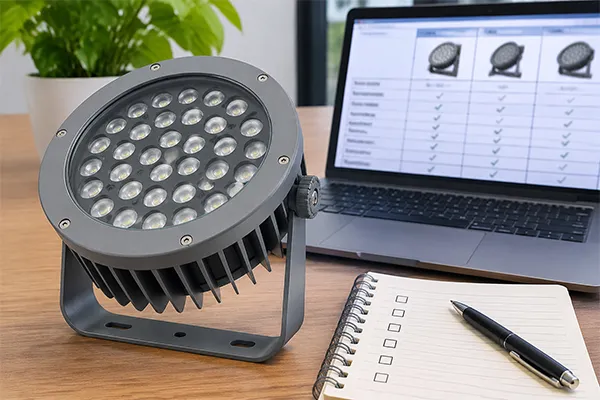
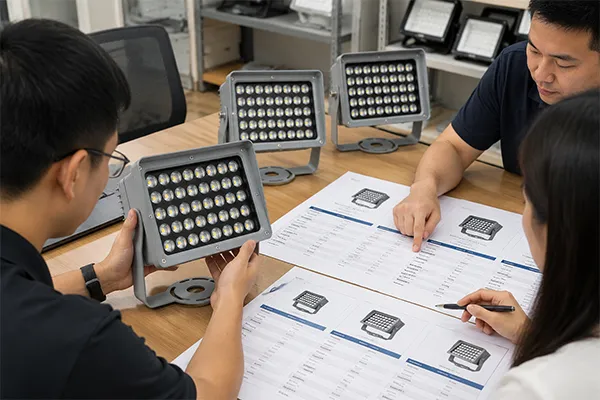
I recommend starting with a structured RFQ rather than only a product image and wattage request. “100 W LED floodlight” is not a complete buying specification. Two products with the same rated wattage may differ in light output, driver quality, thermal design, cable type, surge protection, lens material, and enclosure construction.1
For each lighting item, I suggest that buyers define the following points:
- Product type and installation method
- Rated wattage and permitted tolerance
- Input voltage and frequency
- Required color temperature, such as 3000 K, 4000 K, or 5700 K
- Beam angle and optical distribution
- Target lumen output or efficacy requirement
- CRI requirement
- IP rating and, where relevant, impact-resistance expectations
- Housing finish and corrosion-resistance requirement
- LED chip and driver preferences, if the project specifies them
- Cable length, connector, mounting accessories, and packaging
- Quantity by model and requested shipment date
- Target-market compliance requirements
A factory can quote more accurately when the RFQ includes these details. I have found that vague RFQs often lead to vague offers. The risk is not that a lower-priced supplier is automatically unsuitable. The risk is that its scope may differ from the scope assumed by the buyer.
Compare the Total Commercial Scope
A buyer should also compare commercial conditions, not only product pricing. For example, one quote may include project-specific packaging, while another may assume standard cartons. One supplier may price an agreed driver brand, while another may offer a technically different configuration.
| Quote Item | What Buyers Should Compare | Why It Matters |
|---|---|---|
| Product configuration | LED source, driver, housing, lens, cable | Determines performance consistency and serviceability |
| Testing scope | Aging test, functional inspection, visual inspection | Influences batch release confidence |
| Accessories | Brackets, screws, connectors, installation parts | Avoids omissions during site installation |
| Packaging | Inner protection, carton strength, palletization | Reduces transit and handling risk |
| Delivery terms | Incoterms, port, lead-time basis, split shipments | Clarifies logistics responsibility |
| Documentation | Datasheet, test records, certification documents | Supports technical review and market entry checks |
I treat a quote as the first version of a project-control document. If it is unclear at the beginning, the production discussion will usually become harder later.
For our own OEM/ODM conversations at Upward Lighting, I try to confirm parameters such as wattage, color temperature, beam angle, CRI, and surface finish before production planning begins. Buyers should expect this same level of detail from any shortlisted factory.
Can a Good Sample Prove a Factory Can Deliver Large LED Projects?
A good sample can create confidence, but it cannot prove that a factory will reproduce the same result across a full project order.2 Sample approval is an essential checkpoint, yet large LED projects require buyers to evaluate repeatability, process control, inspection criteria, and component consistency before issuing a final purchase order.
A sample proves that a factory can produce one approved unit under a defined condition. It does not, by itself, prove stable batch production. Buyers should ask how the approved sample becomes a controlled production standard, how incoming materials are checked, how finished products are tested, and how the factory records deviations or component changes.
Turn the Sample Into a Production Reference
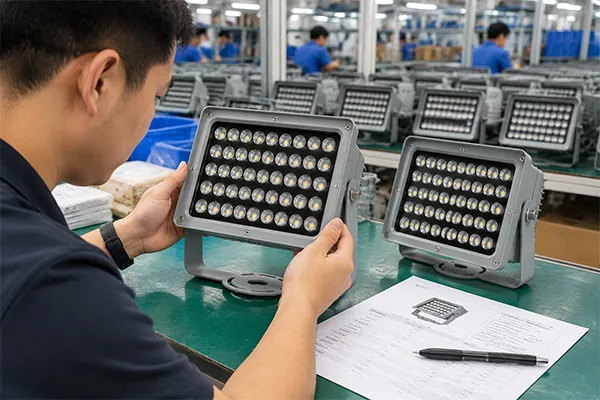
I recommend that project buyers approve more than the visual appearance of a sample. The approved sample should connect to an agreed specification sheet, bill of materials where appropriate, product labels, packaging requirements, and inspection criteria.3
A practical sample-approval package can include:
- Approved technical datasheet with electrical, optical, and mechanical parameters.
- Product photographs showing housing color, bracket, cable exit, connector, and label position.
- Approved material or component references for important parts, such as the driver, LED package, lens, and cable.
- Packaging requirements including artwork, carton markings, and project labels.
- Inspection criteria covering appearance, function, dimensions, labeling, and packing.
- Change-control expectations stating that the factory must communicate proposed changes before implementation.
This does not eliminate all project risks. However, it gives both parties a shared baseline. Without a baseline, a buyer may receive products that look generally similar to the sample but differ in details that affect installation, performance, or acceptance.
Ask About Repeatability, Not Just Appearance
When I review a project inquiry, I expect technical buyers to ask how the factory manages repeated production. These questions are useful because they reveal whether the supplier has a working process behind the sample:
- How is the approved specification issued to production and quality teams?
- Which components are treated as key materials?
- How are incoming LED drivers, housings, lenses, and cables checked?
- What happens if a specified component becomes unavailable?
- Is a pre-production sample or first-article confirmation available for larger orders?
- What records are retained for finished-product inspection?
- How are serial numbers, batch codes, or production dates managed where required?
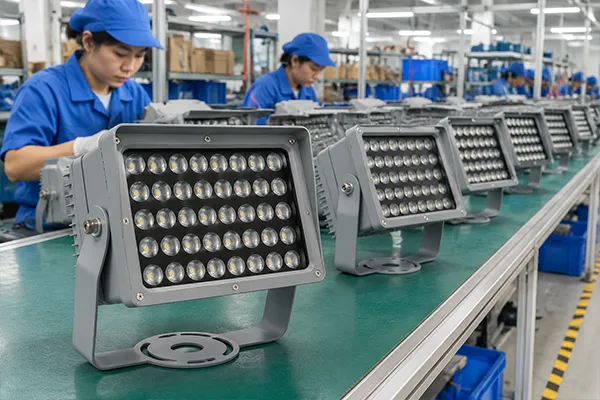
At Upward Lighting, every product undergoes a 100% aging test before shipment, generally lasting 4 to 8 hours depending on the product arrangement. I present this as one part of our process, not as a substitute for project-specific verification. Buyers should still clarify the applicable inspection standard, sample quantity, acceptance criteria, and any third-party inspection requirements.
What Quality Evidence Should Buyers Request for Large LED Projects?
Quality claims can sound similar across supplier presentations. The more useful question is whether the factory can provide records and process explanations that relate directly to the proposed product. For large LED projects, I recommend asking for evidence that connects quality controls to the approved model and order.
Buyers should request quality evidence that is specific, reviewable, and relevant to the proposed LED product. Useful evidence includes approved specifications, inspection plans, aging-test arrangements, incoming-material controls, finished-goods inspection records, batch identification methods, and sample documentation. These records help buyers assess whether quality checks are repeatable rather than purely descriptive.

Review the Control Points That Affect Project Risk
I find that quality evaluation becomes more practical when buyers focus on critical control points. Each product category has different risks. For example, LED inground lights and underwater lights may require closer attention to sealing structure, cable entry, and application-specific installation conditions. LED floodlights may require review of bracket construction, thermal management, driver configuration, and outdoor exposure requirements.
A buyer can request an explanation of the factory’s controls across these stages:
| Production Stage | Buyer Questions | Evidence to Request |
|---|---|---|
| Incoming materials | How are key components checked before assembly? | Incoming inspection procedure or records |
| Assembly | How are wiring, fasteners, sealing, and labels controlled? | Work instructions or process flow |
| Aging test | Is aging applied to all units or sampled units? What is the duration? | Test arrangement and production records |
| Final inspection | Which visual, functional, and packing checks are completed? | Final inspection checklist |
| Shipment release | Who confirms the order meets the agreed specification? | Release record or quality report |
Understand What Testing Does and Does Not Demonstrate
An aging test can help identify certain early failures before shipment.4 It does not automatically prove lifetime performance in every operating environment.5 Similarly, an IP rating listed on a datasheet should be evaluated in relation to the exact product configuration, installation method, and application conditions.6
I recommend that buyers avoid broad questions such as “Do you have quality control?” Instead, buyers should ask specific questions such as:
- Is the proposed model subjected to a finished-product functional test?
- How is color temperature consistency managed within the order?
- Can the factory provide product labels and carton labels matching the approved artwork?
- How are nonconforming units isolated and recorded?
- Can the buyer arrange a pre-shipment inspection based on agreed criteria?
For critical applications, I recommend qualified professional evaluation of the lighting design, electrical installation, local code requirements, and environmental exposure. A factory’s documents support procurement review, but they do not replace application-specific engineering judgment.
How Should Buyers Verify Certifications for Large LED Projects?
Certification documents can be important for market access and project approval, but they should never be treated as a generic supplier badge. Large LED projects require buyers to verify whether the document applies to the exact model, configuration, standard, and destination market involved.
Buyers should verify certifications by matching the certificate holder, product model, applicable standard, issue date, test scope, and target-market requirement with the proposed LED product. A CE, RoHS, or other document may be relevant, but it does not automatically cover every wattage, driver option, product revision, or installation application.7

Match Documents to the Product You Are Buying
In my experience, certification questions are most useful when they are asked early, before a purchase order is released. Buyers should request a document list for the exact models under review and then compare that list with the project specification.
I suggest checking:
- The legal name of the certificate holder or responsible entity
- The product model number shown in the document
- Whether the proposed wattage and configuration are included
- The test standard and its relevance to the target market
- The report or certificate date and revision status
- Whether product labeling aligns with the documentation
- Any declarations or technical files required by the destination market
At Upward Lighting, our products hold CE and RoHS certifications. I encourage buyers to verify the relevant documents for the product model and intended market rather than assuming one document applies to every variation. This approach protects both the buyer and supplier from incorrect compliance assumptions.
Treat Compliance as a Procurement Workstream
Certification review should sit alongside technical review, not after it.8 A product may meet a buyer’s preferred visual and pricing requirements but still need different documentation or configuration for a particular market.
For larger tenders, I recommend creating a simple compliance matrix:
| Requirement | Project Requirement | Factory Evidence | Buyer Verification Status |
|---|---|---|---|
| Safety documentation | Defined by destination market | Certificate or report for proposed model | Pending / Verified |
| Environmental declaration | Defined by market or buyer policy | RoHS declaration or supporting file | Pending / Verified |
| Product marking | Required label format | Label artwork and product photo | Pending / Verified |
| Technical file | Datasheet and product details | Controlled specification documents | Pending / Verified |
This matrix makes gaps visible before production. It also creates a clearer record if the project team, consultant, importer, or local authority asks for supporting information later.
Can a Factory’s Delivery Promise Be Trusted for Large LED Projects?
A stated lead time is useful, but it is not enough to assess delivery reliability. In large LED projects, buyers should look for operational evidence that the factory can lock specifications, plan key materials, reserve production capacity, arrange testing, and communicate changes before they affect the agreed schedule.
A delivery promise is more credible when it is supported by a documented production path. Buyers should ask when specifications will be frozen, which materials require advance planning, when production will start, how aging and final inspection fit into the schedule, and how the factory will communicate material shortages, design changes, or shipment risks.
Review the Full Production Timeline
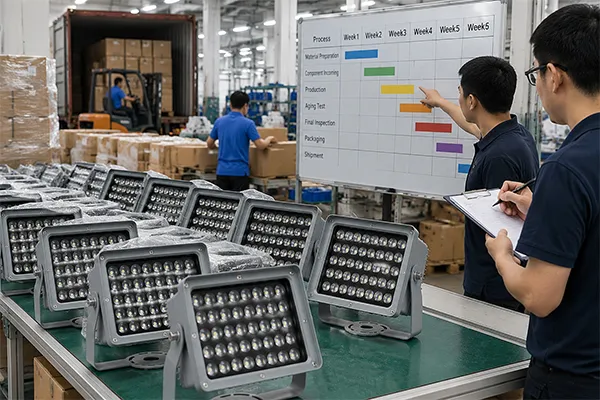
A quoted lead time may only describe assembly time.9 However, an actual project timeline can include engineering confirmation, sample approval, material purchasing, incoming inspection, assembly, aging, final inspection, packing, booking, and export documentation.
I recommend that buyers ask for a milestone schedule after the product specification is confirmed. A basic schedule might include:
- Specification and artwork confirmation
- Sample or pre-production approval, if required
- Key material ordering
- Production start
- Aging test and final inspection
- Packing and buyer inspection, if applicable
- Shipment booking and document release
The schedule does not guarantee that no delay will occur. It does show whether the factory has considered the steps that influence delivery.
Evaluate Change Management
Changes are common in project procurement. A project team may revise quantities, color temperatures, labels, packaging, or delivery destinations. I believe the important question is not whether changes happen. The important question is whether the factory communicates the impact quickly and clearly.
A dependable supplier should be able to explain:
- Which changes can be absorbed before production starts
- Which changes affect materials, cost, certification review, or lead time
- Who approves a revised specification
- How revised documents are controlled
- When the buyer will receive a confirmed updated schedule
For our project discussions, I aim to respond quickly to RFQs and specification questions because unresolved details can delay the entire chain. Buyers should evaluate response quality as well as response speed. A fast answer without technical clarity does not reduce project risk.10
Frequently Asked Questions
What is the most important factor when selecting a factory for a large LED project?
I consider specification control the most important factor. A factory should be able to convert the approved product requirements into controlled materials, production instructions, testing, inspection, and shipment documents. Price matters, but it should be compared only after buyers confirm that quotes cover the same scope.
Should I choose the factory with the lowest LED lighting quotation?
I do not recommend choosing only by the lowest quotation. A lower price can be valid if the product scope is genuinely equivalent. Buyers should compare technical configuration, accessories, test arrangements, packaging, documentation, Incoterms, and lead-time assumptions before making a commercial decision.
How can I verify LED product certifications?
I recommend matching the certification or report to the exact product model, configuration, standard, and destination market. Buyers should review the certificate holder, issue date, model list, and applicable requirements. They should also seek qualified local advice where project or market rules require it.
Is a 100% aging test enough to guarantee LED product quality?
No. A 100% aging test can be a valuable production control, but it does not guarantee every aspect of long-term field performance or application suitability.11 Buyers should also review specifications, material controls, finished-product inspection, installation conditions, and project-specific acceptance requirements.
What should I ask a factory about delivery time?
I recommend asking for a milestone plan that covers specification approval, material ordering, production, aging, final inspection, packing, and shipment booking. Buyers should also ask how the factory communicates changes, shortages, or schedule risks before the agreed delivery date is affected.
Conclusion
Selecting a factory for large LED projects requires more than approving a sample or comparing unit prices. I recommend comparing complete quotations, locking the technical specification, reviewing repeatable quality controls, verifying model-specific certification evidence, and checking the operational basis behind delivery promises. These steps help buyers identify risks before they become site, budget, or schedule problems. If you are sourcing outdoor LED lighting with OEM/ODM requirements, I invite you to send Upward Lighting your RFQ and specification for a clear, project-focused evaluation.
"Energy Efficiency of LEDs", https://www1.eere.energy.gov/buildings/publications/pdfs/ssl/led_energy_efficiency.pdf. Technical guidance on LED lighting explains that rated wattage alone does not determine luminaire output or quality, because optical, thermal, electrical-driver, and component-design choices affect delivered performance. Evidence role: mechanism; source type: government. Supports: LED luminaire performance depends on factors including optical design, driver characteristics, thermal management, and component selection, rather than rated input wattage alone.. Scope note: The source should establish the general engineering principle; it cannot determine differences between any two specific supplier products without model-level test data. ↩
"Statistical Process Monitoring for Autocorrelated Data", https://www.nist.gov/programs-projects/statistical-process-monitoring-autocorrelated-data. Quality-management guidance distinguishes approval of an initial item from continuing control of the production process, since production variation can affect conformity across a batch. Evidence role: general_support; source type: institution. Supports: Quality assurance requires controlled processes and ongoing verification because a sample or first article is not, by itself, evidence of consistency across mass production.. Scope note: This supports the general quality-management principle rather than proving that a particular factory will vary from its approved sample. ↩
"production system engineering integration standards", https://nvlpubs.nist.gov/nistpubs/Legacy/IR/nistir6019.pdf. Configuration-management and quality-assurance practice relies on controlled specifications, defined product components, and documented inspection criteria to preserve an approved product configuration through production. Evidence role: general_support; source type: institution. Supports: Configuration and quality controls use documented product requirements, component definitions, and inspection criteria to maintain conformity during production.. Scope note: The appropriate documents and level of detail depend on the product, contract, and applicable regulatory requirements. ↩
"A Methodology for Testing - Life-Cycfe Performance of", https://nvlpubs.nist.gov/nistpubs/Legacy/IR/nbsir76-1157.pdf. Reliability literature describes burn-in testing as a screening method that can expose certain early-life failures in electronic components and assemblies before field use. Evidence role: mechanism; source type: research. Supports: Burn-in or aging tests are used to screen for some early-life failures in electronic products.. Scope note: Burn-in screens only some failure mechanisms and does not establish the full service life or reliability of a luminaire in every operating environment. ↩
"LED Luminaire Reliability: Impact of Color Shift", https://www.energy.gov/sites/prod/files/2017/04/f34/lsrc_colorshift_apr2017.pdf. LED reliability guidance notes that lifetime performance depends on operating conditions, component behavior, and thermal environment; a short production test therefore cannot by itself demonstrate lifetime performance in all applications. Evidence role: general_support; source type: government. Supports: LED product lifetime and reliability are influenced by operating conditions and cannot be inferred solely from a short production aging test.. Scope note: The exact relationship between a test regime and field life must be evaluated for the specific product, test conditions, and intended installation. ↩
"IP code", https://en.wikipedia.org/wiki/IP_code. IEC 60529 defines IP codes as classifications of enclosure protection under specified test conditions, so the rating should be interpreted for the tested product configuration and intended use rather than as an unrestricted suitability claim. Evidence role: definition; source type: institution. Supports: IEC 60529 classifies the degree of protection provided by enclosures against access, solids, and water under specified test conditions.. Scope note: An IP classification addresses ingress protection; it does not by itself establish durability, corrosion resistance, electrical-system compatibility, or suitability for every installation. ↩
"CE marking – obtaining the certificate, EU requirements", https://europa.eu/youreurope/business/product-rules-compliance/general-product-compliance/ce-marking/index_en.htm. European Commission guidance states that CE marking and supporting technical documentation are tied to demonstrating conformity of the product placed on the market with applicable EU requirements, requiring review of the relevant product version and legal scope. Evidence role: general_support; source type: government. Supports: EU conformity assessment and technical documentation apply to products placed on the market and must demonstrate compliance with the legislation applicable to the product concerned.. Scope note: Whether a specific wattage, driver option, or revision is covered depends on the applicable legislation, technical documentation, and conformity assessment for that product. ↩
"CE marking – obtaining the certificate, EU requirements", https://europa.eu/youreurope/business/product-rules-compliance/general-product-compliance/ce-marking/index_en.htm. Official product-compliance guidance requires manufacturers to identify applicable requirements and assemble supporting conformity documentation before market placement, supporting integration of compliance review with technical specification work. Evidence role: general_support; source type: government. Supports: Product suppliers must identify applicable legal and technical requirements before placing products on the market and compiling conformity documentation.. Scope note: The timing and content of review vary by destination market, product category, and the role of the economic operator. ↩
"ISSS: Integrated Supply chain Simulation System", https://nvlpubs.nist.gov/nistpubs/Legacy/IR/nistir7180.pdf. Supply-chain and operations-management references distinguish manufacturing or assembly time from total order lead time, which can also include material procurement, quality activities, packing, and transportation. Evidence role: definition; source type: education. Supports: Total order lead time can include procurement, production, inspection, handling, and transport activities in addition to assembly.. Scope note: Which stages are included in a supplier's quoted lead time is contractual and must be confirmed for the individual quotation. ↩
"How Small Manufacturers Can Develop Risk Management ...", https://www.nist.gov/feature-stories/how-small-manufacturers-can-develop-risk-management-strategies-their-supply-chains. Project and quality-management guidance treats clear requirements and controlled change processes as core risk controls, indicating that prompt communication alone does not resolve technical ambiguity. Evidence role: general_support; source type: institution. Supports: Clear requirements and controlled changes are important project-risk controls; communication speed does not substitute for requirement definition.. Scope note: The effect of communication practices on a particular project's outcome also depends on contract terms, technical complexity, and the parties' execution. ↩
"A Methodology for Testing - Life-Cycfe Performance of", https://nvlpubs.nist.gov/nistpubs/Legacy/IR/nbsir76-1157.pdf. Reliability engineering distinguishes production screening from qualification and field-performance assessment: screening may identify selected defects, but it cannot guarantee long-term reliability or suitability under all service conditions. Evidence role: mechanism; source type: research. Supports: Production screening can detect selected defects, whereas long-term field reliability and application suitability require broader evaluation of design and operating conditions.. Scope note: The value of a 100% aging test depends on its duration, load, environmental conditions, failure criteria, and the product's known failure mechanisms. ↩