
An LED flood light quote can be difficult to compare when an inquiry includes only wattage, quantity, and a request for the lowest price. That approach can lead to unsuitable optics, missing compliance documents, or unrealistic delivery expectations. I recommend defining the application and purchasing requirements before asking suppliers to quote.
A professional LED flood light quote should be based on the lighting task, installation conditions, product specification, compliance needs, quantity, destination, and delivery expectations. I find that buyers receive more accurate and comparable offers when they explain what the flood light must achieve instead of requesting only a wattage and unit price.
A detailed inquiry does not need to be complicated. It simply needs to give suppliers enough information to assess suitability and feasibility. In my experience as a manufacturer representative, the right questions at the quotation stage often prevent costly misunderstandings later.
What Details Should an LED Flood Light Quote Include?
A vague inquiry creates uncertainty for both the buyer and supplier. When I receive a request for “100W flood lights, please quote,” I still need to understand the intended use before I can prepare a meaningful offer. A few extra details can make the LED flood light quote more accurate from the start.
A professional quotation request should include the application, installation height, lighting area, mounting position, required quantity, destination country, voltage, target delivery date, and any compliance or customization requirements. I also recommend asking the supplier to confirm assumptions that are not yet final.
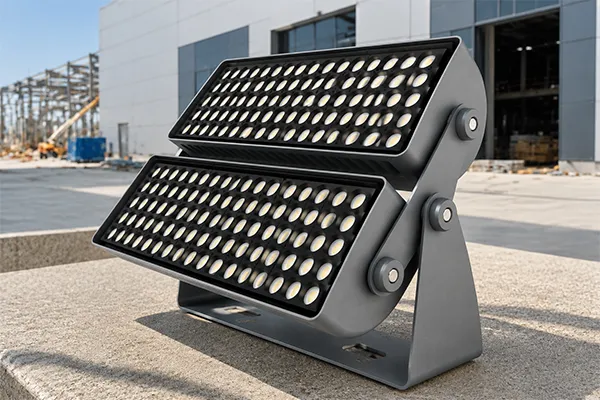
Start With the Lighting Task
I encourage buyers to describe the result they need, not only the product they think they need. A flood light for a warehouse loading bay has different requirements from a flood light for a building façade, sports area, parking lot, construction site, or outdoor advertising sign.
Useful application details include:
- Installation height: For example, 3 meters, 6 meters, 10 meters, or higher.
- Mounting position: Wall-mounted, pole-mounted, ground-mounted, truss-mounted, or bracket-mounted.
- Target area size: Length, width, and approximate distance from the fixture to the illuminated surface.
- Lighting purpose: Security, general area lighting, façade accenting, work lighting, signage, or project illumination.
- Operating hours: A fixture used several hours per night may require a different commercial evaluation from one used continuously.
- Environmental exposure: Rain, dust, salt spray, high ambient temperature, vibration, or coastal conditions can affect product selection.1
I often see buyers begin with wattage because it is familiar and easy to compare. However, wattage only describes electrical input power2. It does not independently confirm light distribution, fixture efficiency, optical control, thermal design, or application suitability.
Provide a Shared Specification Baseline
I recommend creating one written specification baseline and sending it to every shortlisted supplier. This process helps me compare offers fairly because every supplier is responding to the same requirements.
| Specification Item | What I Recommend Including | Why It Matters |
|---|---|---|
| Product type | LED flood light, slim flood light, modular flood light, etc. | Product construction and price may differ |
| Wattage range | Example: 50W, 100W, 150W, or acceptable alternatives | Supports initial product selection |
| Color temperature | 3000K, 4000K, 5000K, 5700K, or 6500K | Affects visual appearance and project requirements |
| Beam angle3 | Narrow, medium, wide, or a stated degree range | Determines light coverage and throw |
| Input voltage | 100–277V AC, 220–240V AC, 12V/24V DC, etc. | Must match local electrical conditions |
| Protection level | Required IP rating and environmental conditions | Helps assess housing suitability |
| Housing finish | Black, gray, white, custom color, or branded finish | Affects appearance and OEM planning |
| Quantity | Sample, trial order, or full order quantity | Influences pricing, packing, and lead time |
A clear LED flood light quote request does not guarantee that every supplier can meet every condition. However, it gives each supplier a fair opportunity to identify gaps, suggest alternatives, or confirm what is practical.
How Do Site Conditions Affect an LED Flood Light Quote?
A flood light can look similar on a specification sheet while performing differently in a real installation. If site conditions are unclear, a low-priced product may appear attractive but fail to match the intended lighting task. I therefore ask questions about location, mounting, exposure, and electrical conditions before confirming an LED flood light quote.
Site conditions affect the recommended beam angle, housing construction, mounting method, input voltage4, cable arrangement, surge-protection expectations, and heat-management needs. I suggest that buyers share photos, drawings, or basic site dimensions whenever available.
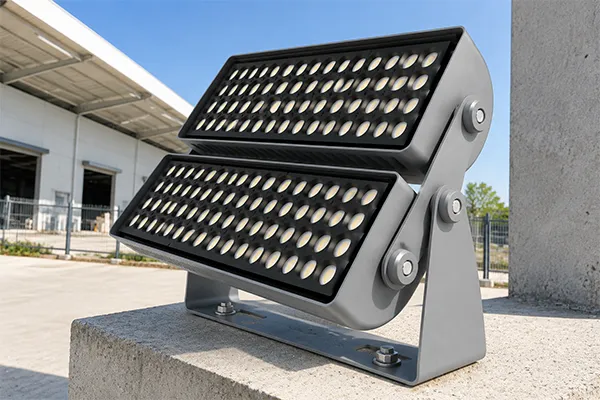
Why Wattage, Lumens, and IP Rating Are Not Enough
I regularly receive inquiries that list only three items: wattage, lumen output, and IP rating. These are useful starting points, but they do not establish that two products are equivalent.
For example, two 100W LED flood lights may differ in:
- Beam angle and optical distribution
- LED configuration and driver design
- Heat-sink size and thermal pathway
- Housing thickness and coating quality
- Glass, lens, gasket, and cable construction
- Bracket strength and adjustment range
- Input-voltage options
- Surge-protection configuration
- Ambient-temperature suitability
- Photometric documentation availability
An IP rating addresses protection against ingress under defined test conditions.5 It does not independently confirm long-term performance in a coastal environment, under extreme heat, or in a high-vibration installation.6 I recommend that buyers treat any stated rating as one part of a larger technical review.
I consider a product suitable only after the intended application, installation method, operating environment, and required documentation are reviewed together.
Ask About the Installation Environment
The environment often changes the quotation more than buyers expect. A standard outdoor location may have different needs from a port, chemical area, farm, coastal promenade, factory yard, or high-temperature region.
I recommend including the following questions in an LED flood light quote request:
- Will the fixture be installed indoors or outdoors?
- Will it face direct rain, dust, strong wind, or salt-laden air?
- What is the expected ambient temperature range?
- Is the project near the sea or in an industrial area?
- Does the installation require a specific cable length or connector?
- Is local voltage stable, or should the supplier discuss surge protection?
- Does the mounting structure create vibration or mechanical stress?
I do not position myself as a site-engineering authority. For demanding installations, I recommend that buyers obtain evaluation from a qualified lighting designer, electrical engineer, or other appropriate professional. I can then use that information to help identify product options and commercial feasibility.
Which Commercial Details Make an LED Flood Light Quote Actionable?
A technically suitable product still needs to fit the buyer’s purchasing plan. An incomplete commercial brief can create confusion around price, packaging, samples, labeling, lead time, and delivery terms. I find that an actionable LED flood light quote combines technical requirements with clear purchasing constraints.
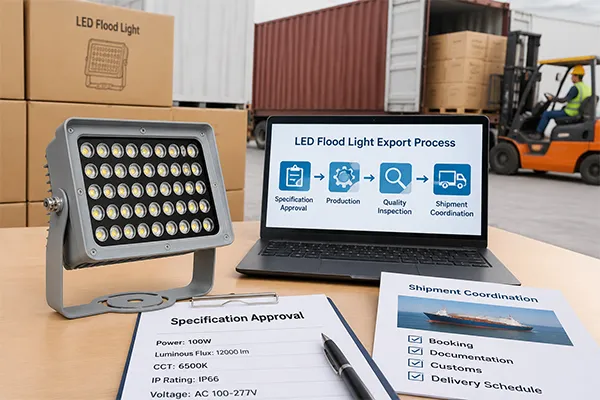
Buyers should state quantity, destination market, required delivery date, preferred trade terms, sample needs, packaging expectations, warranty requirements, and branding or OEM/ODM requests. These factors can change the unit price, minimum order quantity, production schedule, and shipping arrangement.
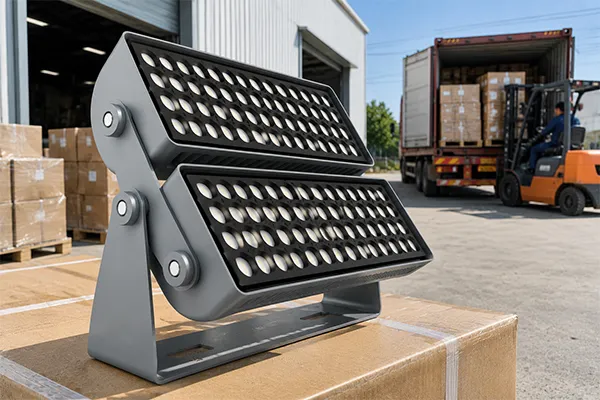
Quantity Changes More Than the Unit Price
Quantity affects material purchasing, production planning, carton configuration, inspection arrangements, and shipping options. I recommend that buyers separate their needs into realistic stages where possible:
- Sample quantity: For physical review, internal approval, or laboratory testing.
- Trial order quantity: For market validation or a limited project phase.
- Regular order quantity: For distribution, stock, or ongoing project supply.
- Forecast quantity: For annual planning and longer-term sourcing discussions.
A supplier may support small-batch orders, but that does not mean every customization is practical at a very low quantity. Custom housings, special finishes, private labels, packaging artwork, nonstandard drivers, and dedicated molds can involve different minimum order quantities or preparation times.
At Upward Lighting, I can discuss OEM/ODM options such as color temperature, wattage, beam angle, CRI, and surface finish colors based on project requirements. I still need to review the requested configuration, order volume, and schedule before confirming feasibility.
State Destination and Documentation Requirements Early
The destination market matters because product labeling, input voltage, documentation, and compliance expectations may vary. I recommend telling suppliers where the goods will be sold or installed, not only where the goods will be shipped.
For example, a buyer may request:
- CE-related documentation for a European market7
- RoHS-related documentation for environmental compliance requirements8
- Product labels with local importer information
- Specific plug, cable, or voltage configurations
- English, multilingual, or private-label cartons
- Required test reports or declarations for internal review
I advise buyers to verify certifications and supporting documents directly against their market-entry requirements. A certificate name on a quotation is not, by itself, proof that a particular product configuration meets every applicable requirement.9 I also recommend checking whether the document applies to the exact model, electrical configuration, and intended market.
Clarify Delivery Terms and Warranty Expectations
A quote should state whether the price is EXW, FOB, CIF, DDP10, or another agreed Incoterm. I also recommend confirming whether freight, insurance, duties, destination handling, and local taxes are included or excluded.
Warranty language needs similar care. Buyers should ask what the warranty covers, what evidence may be required for a claim, how replacement parts are handled, and whether the warranty differs by product configuration or operating environment.
Can an LED Flood Light Quote Help Screen Suppliers?
A quotation process is also a supplier-screening process. A supplier that immediately offers the lowest number against an incomplete request may not be helping the buyer evaluate risk. I use clarification questions to prepare a more responsible LED flood light quote, even when the buyer has limited initial information.
A reliable supplier should ask about missing variables, explain what affects price, identify uncertain assumptions, and confirm feasible specifications before making firm commitments. I believe this approach is more valuable than issuing a fast but poorly matched price.
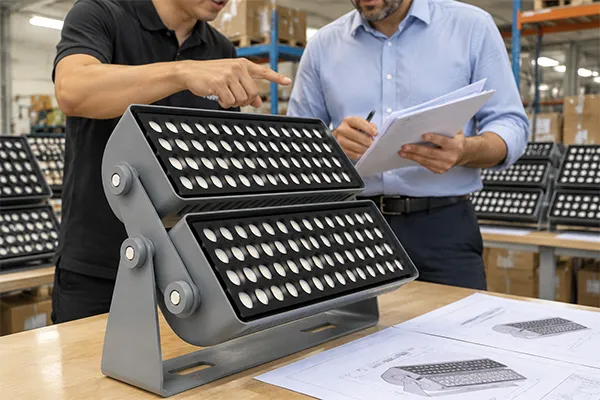
Questions I Expect a Capable Supplier to Ask
When I review a new flood-light inquiry, I normally want to clarify several points before finalizing product selection. Buyers can use the same questions to assess supplier responsiveness.
| Supplier Question | What It Reveals |
|---|---|
| What is the installation height and target area? | Whether the supplier considers optical suitability |
| Which market is the product for? | Whether the supplier recognizes compliance and voltage needs |
| Do you need a sample before the order? | Whether the supplier supports validation planning |
| Is a specific beam angle required? | Whether the supplier distinguishes coverage from wattage |
| What is the required delivery date? | Whether production timing is being assessed |
| Do you need branding or custom packaging? | Whether OEM/ODM requirements are being understood |
| Are there required documents or test reports? | Whether documentation is addressed early |
I do not believe that more questions automatically mean a supplier is better. However, relevant questions usually show that the supplier is trying to define the scope rather than guess.
Review Manufacturing and Quality-Control Practices
I recommend that procurement teams ask suppliers how they manage routine quality control. The answer should be specific enough to support a practical review.
At Upward Lighting, every product undergoes a 100% aging test before shipment, typically lasting 4 to 8 hours. I present this as part of our internal manufacturing process, not as a substitute for a buyer’s own inspection plan or application-specific assessment.
Buyers may also ask about:
- Incoming material checks
- Assembly inspection points
- Aging-test procedures
- Final appearance and functional inspections
- Carton drop or packaging checks, where applicable
- Product traceability practices
- Pre-shipment inspection support
- Sample approval procedures
For larger orders, I recommend that buyers establish clear acceptance criteria before production begins. This may include approved samples, product photographs, label artwork, packaging details, inspection standards, and required documents.
How Should Buyers Compare LED Flood Light Quotes?
Comparing quotations only by unit price can create a false sense of savings. A lower-priced offer may have a different driver, beam angle, warranty scope, packaging standard, delivery term, or documentation package. I recommend comparing every LED flood light quote against a single written baseline.
Buyers should use a comparison table that includes technical specifications, documentation, commercial terms, quality-validation steps, and supplier communication quality. The best quote is the offer that most clearly meets the defined requirement at an acceptable total procurement cost and risk level.
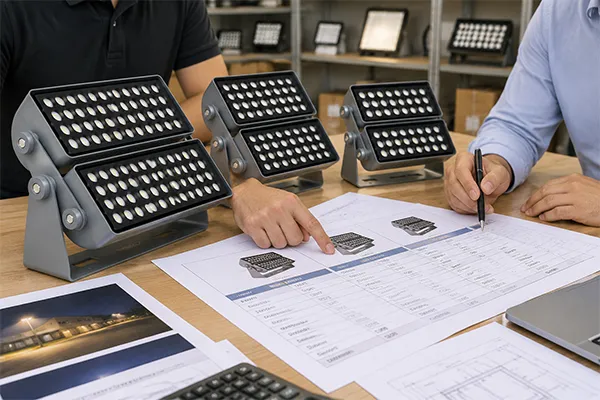
Build a Like-for-Like Comparison Sheet
I recommend using a simple scorecard rather than relying on email impressions or headline pricing. The table below provides a practical framework.
| Comparison Area | Supplier A | Supplier B | What I Would Check |
|---|---|---|---|
| Exact model and wattage | Confirm equivalent product configuration | ||
| Beam angle and light distribution | Check whether application coverage is comparable | ||
| Input voltage and driver | Confirm compatibility with the destination market | ||
| Color temperature and CRI | Confirm project or brand requirements | ||
| IP rating and housing details | Review environmental suitability | ||
| Compliance documents | Verify relevance to the model and market | ||
| Sample availability | Confirm cost, timing, and approval process | ||
| Warranty terms | Compare conditions, exclusions, and support | ||
| Packaging and branding | Check cartons, labels, manuals, and private-label needs | ||
| Lead time and Incoterm | Compare total delivery commitments | ||
| Unit price and total landed cost11 | Include freight and other known costs |
Look Beyond the Quoted Number
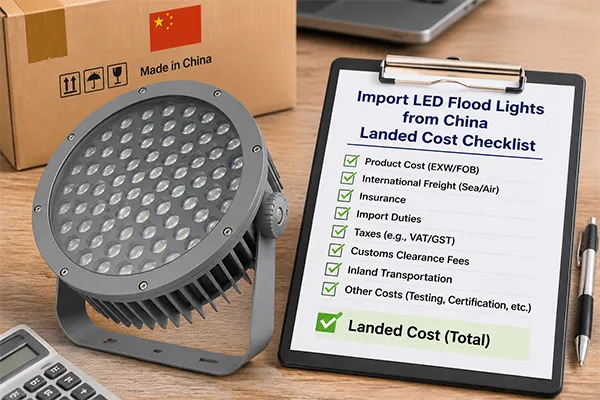
I suggest that buyers calculate the likely total landed cost, not just the product price. This can include sample cost, packaging changes, tooling or artwork charges, freight, customs duties, inspection cost, replacement risk, and local handling.
A supplier’s communication also matters. I look for whether the supplier:
- Answers technical questions clearly
- Identifies assumptions instead of hiding them
- Provides consistent product information
- States lead times carefully
- Explains whether customization is feasible
- Shares documents for buyer verification
- Responds promptly without making unsupported promises
I have seen that the strongest procurement decisions come from a balanced review. Buyers need competitive pricing, but they also need a product that fits the task, documentation that supports market requirements, and a supplier that can communicate reliably through production and delivery.
Frequently Asked Questions
What should I include in an LED flood light quote request?
I recommend including the application, mounting height, illuminated area, quantity, wattage preference, beam angle, color temperature, voltage, IP requirement, destination market, delivery date, certifications or documents needed, packaging needs, and any branding or customization requests.
Is a 100W LED flood light quote enough to compare suppliers?
No. I do not consider a 100W description enough for a fair comparison. Buyers should also compare beam angle, optical distribution, driver, voltage, housing construction, environmental suitability, documentation, warranty terms, packaging, lead time, and Incoterms.
Should I request samples before placing a bulk flood light order?
I generally recommend samples when the product is new to your business, the application is demanding, or branding and packaging are customized. A sample helps buyers review appearance, dimensions, mounting, labeling, and basic product configuration before approving larger production.12
How do I verify CE or RoHS documents for LED flood lights?
I recommend asking for documents that correspond to the exact product model and relevant configuration. Buyers should then verify whether the documents satisfy their destination market’s requirements. For application-specific or regulatory decisions, I suggest consulting a qualified compliance professional.
Can suppliers customize LED flood lights for private-label sales?
Some suppliers can offer OEM/ODM support, but feasibility depends on the requested changes, technical requirements, quantity, materials, and delivery schedule. I recommend confirming color temperature, wattage, beam angle, finish, logo, labels, packaging, and minimum order quantity before committing.
Conclusion
A professional LED flood light quote begins with the required lighting outcome, not just a wattage and target price. I recommend defining the site conditions, optical needs, environmental exposure, compliance documents, quantity, packaging, delivery terms, and quality-validation expectations before comparing suppliers. This approach helps buyers avoid false like-for-like comparisons and assess real procurement risk. If you need a clearer quotation for a project, private-label range, or distribution order, I invite you to send us your application details and specification baseline for review.
"Outdoor Lighting Challenges and Solution Pathways", https://betterbuildingssolutioncenter.energy.gov/sites/default/files/attachments/Outdoor%20Lighting%20Challenges%20and%20Solutions%20Pathways%20Paper.pdf. Research and technical guidance on outdoor LED luminaires identify ambient temperature, moisture, contaminants, corrosion, and mechanical stress as environmental factors relevant to reliability and component selection. Evidence role: general_support; source type: research. Supports: Environmental conditions can affect the reliability, materials, and performance requirements of outdoor LED luminaires.. Scope note: The relative importance of each exposure depends on the luminaire design, site severity, and applicable test methods. ↩
"Energy Efficiency of LEDs", https://www1.eere.energy.gov/buildings/publications/pdfs/ssl/led_energy_efficiency.pdf. U.S. Department of Energy lighting guidance distinguishes input power in watts from light output in lumens and luminous efficacy, so wattage alone does not characterize a luminaire's delivered lighting performance. Evidence role: definition; source type: government. Supports: Electrical wattage is a measure of power consumption, while lumens and efficacy describe light output and conversion efficiency.. Scope note: The source does not evaluate the suitability of any specific flood-light model or installation. ↩
"CALiPER Application Summary Report 20: LED PAR38 Lamps", https://www1.eere.energy.gov/buildings/publications/pdfs/ssl/caliper_20_summary.pdf. Lighting-industry guidance defines beam angle as the angular spread of a beam at a specified intensity level; this distribution characteristic affects coverage and beam concentration at a given mounting distance. Evidence role: mechanism; source type: institution. Supports: Beam angle describes the angular spread of a luminaire's beam and affects the distribution of illuminance over a target area.. Scope note: Actual coverage also depends on mounting geometry, photometric distribution, and the illumination criterion selected. ↩
"Determining voltage ratings for electrical insulating ...", http://www.osha.gov/laws-regs/standardinterpretations/2005-09-27. Electrical-safety guidance requires equipment to be suitable for the circuit and operating conditions in which it is used, supporting verification that a luminaire's voltage rating is compatible with the local supply. Evidence role: general_support; source type: government. Supports: Electrical equipment must be used within its rated voltage conditions and according to applicable installation requirements.. Scope note: Applicable voltage tolerances and installation rules vary by jurisdiction and product classification. ↩
"IP code", https://en.wikipedia.org/wiki/IP_code. IEC 60529 defines the IP Code as a classification of enclosure protection against access to hazardous parts, ingress of solid foreign objects, and ingress of water under prescribed test conditions. Evidence role: definition; source type: institution. Supports: IEC 60529 classifies degrees of protection provided by enclosures against access, solid foreign objects, and water under specified test conditions.. ↩
"IEC 60529 Ingress Protection (IP Code) Certification Testing", https://keystonecompliance.com/iec-60529/. IEC 60529 specifies enclosure protection against access, solid objects, and water; consequently, an IP classification alone is not a direct test of corrosion resistance, thermal endurance, or vibration durability. Evidence role: mechanism; source type: institution. Supports: The scope of IEC 60529 ingress testing is limited and does not itself constitute qualification for every environmental stressor.. Scope note: Additional environmental tests and applicable product standards are needed to assess those conditions for a particular luminaire. ↩
"CE marking – obtaining the certificate, EU requirements", https://europa.eu/youreurope/business/product-rules-compliance/general-product-compliance/ce-marking/index_en.htm. European Commission guidance explains that CE marking applies only to products covered by relevant EU harmonisation legislation and is supported by conformity assessment, technical documentation, and an EU declaration of conformity where required. Evidence role: general_support; source type: government. Supports: Where applicable EU harmonisation legislation requires CE marking, manufacturers prepare technical documentation and an EU declaration of conformity.. Scope note: Whether a particular flood light requires CE marking depends on the applicable legislation, product configuration, and route to market. ↩
"Directive - 2011/65 - EN - rohs 2 - EUR-Lex - European Union", https://eur-lex.europa.eu/eli/dir/2011/65/oj/eng. Directive 2011/65/EU restricts specified hazardous substances in electrical and electronic equipment placed on the EU market, providing the regulatory context for requesting RoHS-related compliance documentation. Evidence role: general_support; source type: government. Supports: The EU RoHS Directive restricts specified hazardous substances in electrical and electronic equipment and includes compliance obligations for covered products.. Scope note: Coverage, exemptions, and documentation duties must be assessed for the specific product and market. ↩
"CE marking - Internal Market, Industry, Entrepreneurship and ...", https://single-market-economy.ec.europa.eu/single-market/goods/ce-marking_en. European Commission CE-marking guidance bases conformity on applicable legal requirements, the appropriate conformity-assessment procedure, and supporting technical documentation; a certificate reference alone does not establish compliance for every product variant or market. Evidence role: expert_consensus; source type: government. Supports: Conformity claims depend on the applicable legislation, conformity assessment, technical documentation, and the product placed on the market.. Scope note: This principle is stated in the EU regulatory context and may not describe documentary requirements in non-EU markets. ↩
"Know Your Incoterms", https://www.trade.gov/know-your-incoterms. ICC Incoterms rules define standardized delivery terms that allocate transport-related obligations, costs, and risk between seller and buyer, including EXW, FOB, CIF, and DDP. Evidence role: definition; source type: institution. Supports: Incoterms rules define parties' delivery obligations and allocation of costs and risks in international sales contracts.. Scope note: Incoterms do not by themselves determine all contract issues, such as payment terms, transfer of title, or product warranty. ↩
"Determine Total Export Price", https://www.trade.gov/determine-total-export-price. International-trade guidance treats the cost of imported goods as extending beyond the invoice price to transportation, insurance, customs duties, taxes, and other import-related charges, supporting a landed-cost comparison. Evidence role: definition; source type: government. Supports: Import cost assessment includes costs beyond the supplier's unit price, such as transport, insurance, duties, taxes, and related charges.. Scope note: The specific cost elements and their amounts depend on the shipment terms, tariff classification, origin, and destination jurisdiction. ↩
"First Article Inspection Requirement Report Generation from ...", https://tsapps.nist.gov/publication/get_pdf.cfm?pub_id=919140. Quality-assurance guidance on first-article inspection describes examination of an initial production item against specified requirements before full production, supporting the use of samples to check agreed product attributes and configuration. Evidence role: general_support; source type: government. Supports: First-article or pre-production inspection is used to verify that an initial production item conforms to specified requirements before broader production proceeds.. Scope note: A sample review does not by itself demonstrate continuing conformity across an entire production lot. ↩