LED flood light project risks often begin long before installation, when buyers select a product based on wattage, price, or a general “outdoor” label. Those shortcuts can lead to poor beam coverage, approval disputes, delivery issues, or costly replacements. I reduce uncertainty by turning real project conditions into a clear, verifiable specification before ordering.
To reduce LED flood light project risks, buyers should define the installation environment, lighting task, required beam effect, target-market documentation, sample acceptance criteria, and delivery plan before mass production. Wattage, lumen output, IP rating, certifications, and aging tests each address only part of the decision. A locked specification and documented approval process give contractors, importers, and project teams a stronger basis for purchasing and site acceptance.
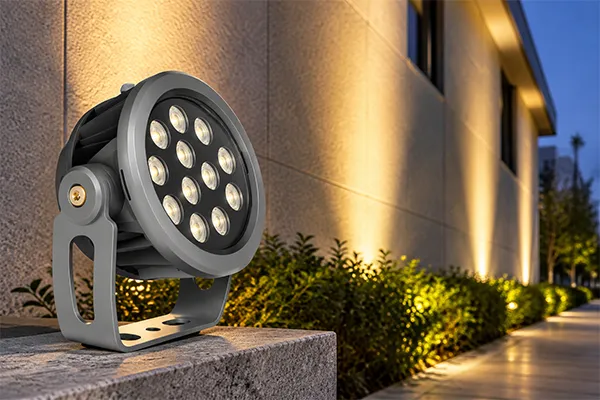
In my pre-sales discussions, I see the same pattern repeatedly: a buyer asks for a “high-power outdoor floodlight,” but the project team has not yet confirmed mounting height, beam angle, corrosion exposure, or the expected visual effect. Those missing inputs can create risk even when the product itself is manufactured correctly. The following process helps buyers ask the right questions earlier.
How Can Buyers Define LED Flood Light Project Risks Before Choosing a Model?
LED flood light project risks become harder to control when a product is chosen before the lighting task is understood. A floodlight can deliver high output and still produce uneven coverage, unwanted glare, or insufficient illumination on the intended surface.1 The solution is to start with site and task inputs, not a wattage request alone.
Buyers can reduce early LED flood light project risks by documenting the mounting position, installation height, throw distance, target area, desired lighting effect, beam angle, glare tolerance, color temperature, CRI, electrical supply, and visual expectations. These inputs help the supplier quote a suitable configuration, but a qualified lighting professional should verify application-specific calculations and final design decisions.
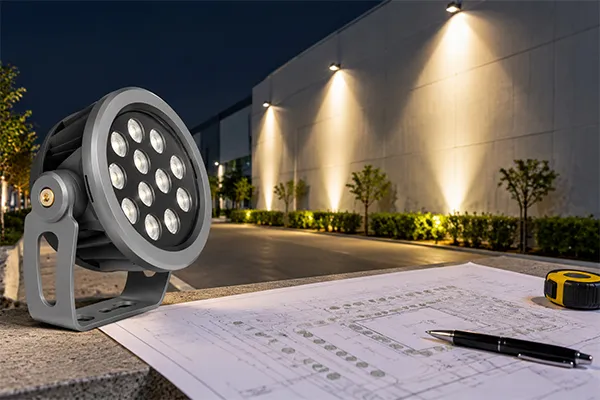
Start With the Lighting Task, Not the Product Label
A floodlight is not selected in isolation. It must serve a specific task. That task may be illuminating a building façade, loading area, sports perimeter, parking zone, signage, yard, warehouse exterior, or security boundary. Each application creates different expectations for light direction, uniformity, glare, color appearance, and maintenance access.
In our discussions with contractors and importers, the first request is often simply “100 W,” “200 W,” or “the brightest option.” I understand why. Wattage is easy to compare. However, wattage does not explain where the light will land or whether the beam pattern suits the site.2
I encourage buyers to collect the following information before requesting a final quotation:
- Application area: What surface, zone, or object needs lighting?
- Mounting height: How high will the fixture be installed?
- Throw distance: How far must the beam reach?
- Mounting direction: Will the fixture face downward, across an area, upward, or at an angle?
- Target effect: Is the priority broad coverage, focused illumination, façade washing, security visibility, or accent lighting?
- Beam angle requirement: Does the site need a narrow, medium, wide, or asymmetric distribution?
- Glare sensitivity: Are drivers, pedestrians, nearby residents, workers, or cameras likely to face the fixture?
- Color temperature: Is warm white, neutral white, or cool white expected for the project?
- CRI requirement: Does the task require more accurate color appearance?
- Power conditions: What voltage, frequency, and surge conditions apply at the installation site?
Why Output Alone Can Create a Selection Error
A technically high-output LED floodlight can still be unsuitable if its optical distribution does not fit the task. For example, a wide beam may spread light too broadly when a buyer needs long throw. A narrow beam may create bright spots and dark edges in an area that requires broad coverage.3 A poorly aimed fixture can also cause glare even when the product specification is otherwise correct.
I treat lumen output as one procurement input, not a final answer to lighting performance.
A project team should also define what “acceptable” looks like. That could include the perceived brightness on a sign, the coverage of a walkway, the appearance of a façade, or the avoidance of direct glare toward a road. These expectations should be written into the project confirmation rather than left as informal conversations.
This approach does not replace professional photometric design. It does help a supplier, buyer, and installer avoid starting with an incomplete request. It also creates a clearer audit trail if questions arise during sample review or final acceptance.
How Should Outdoor Conditions Shape LED Flood Light Project Risk Control?
Outdoor projects face conditions that a generic product description cannot fully capture. Heat, humidity, dust, rain, salt exposure, installation angle, wiring quality, and maintenance access can all affect the practical suitability of a fixture. The solution is to assess the full exposure condition instead of relying on an IP rating alone.
To control environmental LED flood light project risks, project teams should confirm water exposure, dust level, ambient temperature, humidity, corrosive conditions, mounting orientation, electrical quality, and access for maintenance. An IP rating addresses defined ingress-protection conditions, but it does not independently confirm suitability for every outdoor environment, installation method, or local requirement.
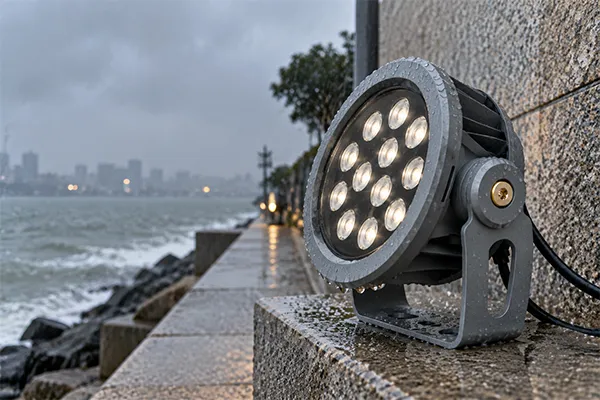
IP Rating Is Important but Limited
Buyers often ask for an “IP65 floodlight” as if that answer closes the environmental discussion. An IP rating is valuable because it provides a defined classification for protection against solids and water under specified test conditions.4 However, the rating should be reviewed as one document and one product characteristic within a broader site assessment.
For example, the following conditions require separate consideration:
| Site condition | Why it matters | Questions the project team should confirm |
|---|---|---|
| Heavy rain exposure | Water direction and installation angle can affect practical exposure | Will the fixture face upward, downward, or horizontally? |
| Coastal or industrial atmosphere | Salt, chemicals, and pollutants may increase corrosion risk5 | Is the site near the sea, chemical processing, or heavy traffic? |
| High ambient temperature | Heat may affect system operating conditions6 | What are the expected local temperature ranges and enclosure conditions? |
| Dusty environment | Dust accumulation may affect heat dissipation and cleaning needs | Is the site near construction, mining, agriculture, or logistics activity? |
| High humidity | Condensation risk may differ from direct rainfall | Does the installation experience repeated temperature swings? |
| Unstable electrical supply | Voltage fluctuation or surge events can affect the system | Are surge protection and local electrical protections specified? |
| Limited access | Difficult replacement increases maintenance consequences | Can technicians safely inspect and replace the fixture later? |
Installation Position Changes the Exposure
A floodlight under a canopy does not face the same exposure as a floodlight mounted on an open pole. A product installed near the ground may encounter splashing, impact, debris, or cleaning chemicals. A fixture near the coast may need a different surface-treatment discussion than one used in a sheltered inland location.
I have seen specification conversations improve once the buyer shares simple site photos, mounting drawings, or a basic exposure description. These materials do not replace technical site verification, but they make it easier to identify questions before production begins.
The buyer should also avoid assuming that a certification document resolves local compliance. CE and RoHS documents may be relevant to specific market-entry or environmental requirements7, depending on the product and destination. Buyers should verify the applicability, validity, scope, and local regulatory requirements for their own target market. A project may also require additional documentation, labeling, electrical approvals, or testing that a supplier cannot determine without the project context.
For applications with unusual exposure, critical safety requirements, or strict local rules, I recommend that the project team consult a qualified electrical professional, lighting designer, or local compliance specialist. This is especially important because the supplier does not control site wiring, installation workmanship, local regulations, or final on-site acceptance.
Why Is Sample Approval Essential for Reducing LED Flood Light Project Risks?
A sample can reveal whether a product generally matches expectations, but vague sample approval can create false confidence. Buyers may approve a unit without documenting optics, finish, packaging, labels, or acceptance criteria. The solution is to use sample approval as a specification-control process before bulk production starts.
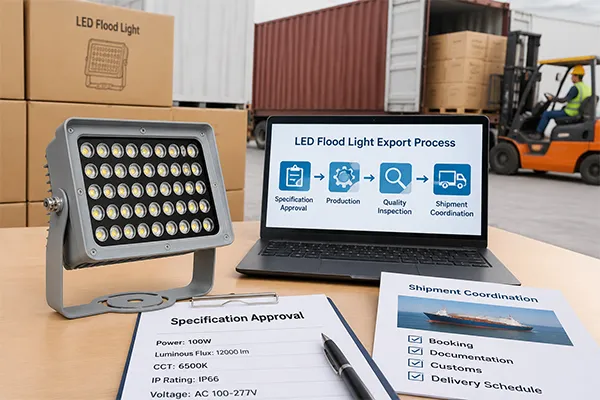
Sample approval reduces LED flood light project risks when buyers and suppliers document exactly what was approved, including model, wattage, CCT, CRI, beam angle, housing finish, driver arrangement, labels, packaging, required documents, lead time, and inspection criteria. A passed sample supports alignment, but it does not automatically guarantee risk-free bulk delivery or on-site performance.8
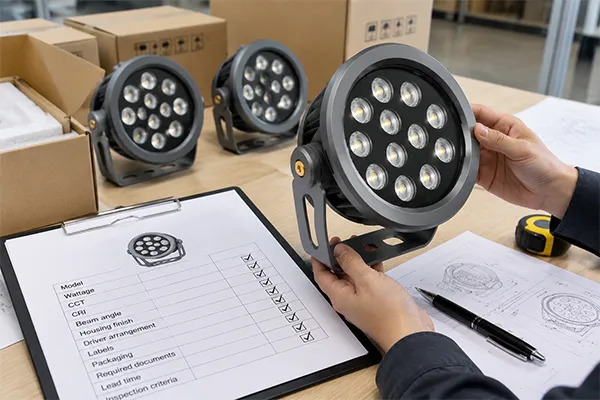
Turn the Sample Into a Reference Standard
In our factory communication, a sample should be more than a single physical item sent for visual review. It should become a reference point for the production order. That means the buyer, supplier, and relevant project stakeholders should confirm the details that matter before the purchase order proceeds.
A practical sample approval record can include:
-
Product identity
- Model number
- Rated wattage
- Input voltage and frequency
- Quantity and project reference
-
Lighting parameters
- Color temperature
- CRI requirement
- Beam angle or optical option
- Dimming or control requirement, if applicable
-
Physical configuration
- Housing color and surface finish
- Bracket or mounting arrangement
- Cable length and connector requirements
- Label artwork and branding details
-
Commercial and logistics requirements
- Packaging method
- Carton marks
- Required documents
- Production lead time
- Shipment inspection method
-
Acceptance criteria
- Which parameters will be checked?
- Who will approve production?
- How will deviations be reported?
- What records will support shipment release?
A Common Re-Selection Situation
In recurring pre-sales discussions, I have seen buyers revise their selection after reviewing the installation height and expected beam effect more carefully. The initial request may focus on a higher wattage unit, while the later discussion identifies that a different optic, mounting approach, or color temperature better fits the intended area.
This is not necessarily a product defect. It is a specification correction. The earlier it happens, the lower the risk of rework, dispute, or delayed installation.
At Upward Lighting, we can support OEM/ODM discussions around parameters such as color temperature, wattage, beam angle, CRI, and surface finish. However, customization should be connected to a documented project need. A customized product with unclear acceptance criteria may be harder to reallocate or replace if the project team changes its requirements late.
Keep Mass Production Aligned With the Approved Version
Sample approval should be followed by a production confirmation. Buyers should check that the approved sample configuration appears clearly in the proforma invoice, purchase order, specification sheet, artwork confirmation, and packing requirements.
| Control point | Risk if omitted | Recommended buyer action |
|---|---|---|
| Approved specification sheet | Different assumptions about configuration | Confirm every key parameter in writing |
| Sample photos and records | Appearance disputes | Keep dated approval files |
| Label and carton artwork | Customs, channel, or branding problems | Approve artwork before printing |
| Production lead time | Project schedule pressure | Confirm the production window and shipping plan |
| Inspection criteria | Different definitions of “acceptable” | Agree on checks before shipment |
| Change-control process | Unapproved substitutions | Require written confirmation for changes |
This documentation does not eliminate every LED flood light project risk. It does reduce ambiguity, which is often the source of commercial disputes.
How Do Quality Control and Delivery Planning Reduce LED Flood Light Project Risks?
Low unit price can look attractive during sourcing, but it does not show the full cost of a project problem. Incorrect selection, inconsistent batches, production delays, rework, replacement freight, and acceptance disputes can cost more than an initial price difference.9 The solution is to evaluate total project risk alongside quoted pricing.
Buyers can reduce LED flood light project risks by comparing suppliers on specification control, documented quality checks, production capacity, communication speed, lead-time clarity, packaging, shipment inspection, and change management—not only unit price. Factory aging tests and inspections can support shipment consistency, but they do not guarantee field performance, local code compliance, or correct installation.10
Separate Three Different Types of Assurance
Procurement teams should distinguish between compliance documentation, factory quality control, and project success. These categories overlap, but they are not interchangeable.
| Area | What it can help address | What it does not replace |
|---|---|---|
| Compliance documents | Evidence relevant to stated market-entry or environmental requirements | Destination-market verification and local legal review |
| Factory aging test | Early screening for certain product issues before shipment | Long-term field performance under every site condition |
| Pre-shipment inspection | Confirmation against agreed production and packing criteria | On-site commissioning and acceptance |
| Sample approval | Alignment on selected configuration | Control of all bulk-production and installation variables |
| Lighting design review | Better alignment of optics and task | Proper installation, wiring, and maintenance |
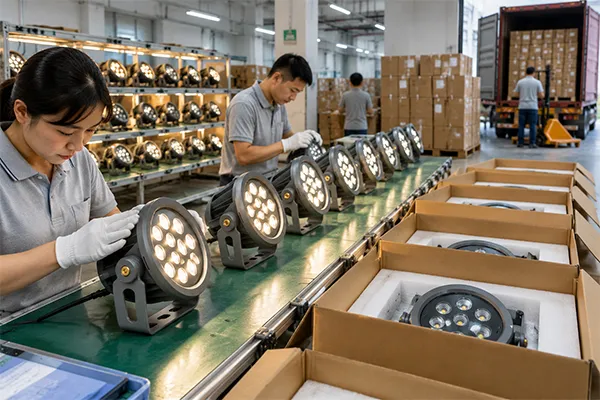
At Upward Lighting, we conduct a 100% aging test before shipment, typically lasting 4 to 8 hours, as part of our internal production process. This process is intended to support product consistency and identify certain issues before goods leave the factory. We also use shipment inspections as part of order control.
However, I believe buyers should use careful language around these steps. Aging tests and inspections are valuable controls, but they are not universal proof of field performance. They cannot guarantee that local wiring is correct, that surge conditions are managed, that fixtures are aimed properly, or that the installed project meets all local codes and visual expectations.
Evaluate Total Cost of Risk
A low quotation may not be the lowest-risk option. Buyers should compare the consequences of a product mismatch or supplier delay. This is especially important for projects with fixed opening dates, difficult access, international freight, or high replacement costs.
When evaluating suppliers, I suggest asking:
- How quickly can the supplier clarify technical questions?
- Can the supplier provide a written quotation with the requested parameters?
- Can the supplier support small-batch orders or a pilot order where appropriate?
- What is the stated production lead time after confirmation?
- What inspection records or shipment checks are available?
- How are specification changes handled after approval?
- What documents can the supplier provide, and what must the buyer verify locally?
- Does the supplier communicate limitations clearly rather than making broad promises?
A reliable delivery plan also needs realistic timing for sample review, artwork approval, mass production, inspection, booking, transit, customs clearance, and site installation. I have found that early confirmation reduces pressure later. Fast quotation support is useful, but rushed decisions without confirmed specifications can create more risk than they solve.
Frequently Asked Questions
What is the biggest LED flood light project risk?
The biggest risk is usually an incomplete specification. A buyer may choose a floodlight based on wattage or price without confirming mounting height, beam angle, target area, glare tolerance, environmental exposure, and acceptance criteria. This can lead to a product that is functional but unsuitable for the actual site task.
Is a higher-wattage LED floodlight always better?
No. A higher-wattage floodlight may provide more output, but it may not produce the right beam distribution or visual result for the installation. Buyers should evaluate wattage together with mounting height, throw distance, optic choice, target coverage, glare control, and the intended lighting effect.
Does an IP rating prove a floodlight is suitable for every outdoor project?
No. An IP rating addresses specific protection against ingress of solids and water under defined conditions. It does not independently confirm suitability for coastal corrosion, extreme heat, high humidity, dust accumulation, electrical instability, installation orientation, or local compliance requirements.11
What should buyers approve before LED floodlight mass production?
Buyers should approve the model, wattage, CCT, CRI, beam angle, housing finish, mounting arrangement, cable and connector details, labels, packaging, required documentation, lead time, inspection criteria, and change-control process. The approved sample and written specification should align with the purchase order.
Do factory aging tests guarantee long-term field performance?
No. Factory aging tests can help identify certain issues and support consistency before shipment. They do not guarantee long-term field performance because site temperature, wiring, surge events, installation quality, maintenance, environmental exposure, and local operating conditions remain outside the factory’s control.12
Conclusion
Reducing LED flood light project risks requires more than selecting the highest wattage, lowest price, or most familiar certification. I recommend that buyers define the real lighting task, assess site exposure, lock the approved sample specification, verify applicable documents, and plan quality control and delivery in advance. At Upward Lighting, we support contractors, importers, brands, and distributors with responsive quotations, OEM/ODM parameter discussions, small-batch support, aging tests, and production confirmation. Share your project requirements with us so we can help you turn them into a clearer procurement specification.
"Examining Perceptual Luminance Uniformity of Simulated ...", https://www.energy.gov/eere/ssl/articles/examining-perceptual-luminance-uniformity-simulated-luminaire-patterns. Lighting-design guidance explains that illuminance distribution and glare depend on luminaire photometry, aiming, mounting geometry, and the visual task, rather than on total light output alone. Evidence role: mechanism; source type: institution. Supports: Photometric distribution and luminaire placement affect illuminance uniformity and glare, so lumen output alone is not a complete measure of application performance.. Scope note: The source supports the general lighting principle; a site-specific photometric calculation is required to determine performance for a particular installation. ↩
"National Institute of Standards and Technology Detector– ...", https://www.nist.gov/document/ao32-16pdf. Standard lighting terminology distinguishes electrical power in watts from luminous flux in lumens and from the directional intensity distribution used to predict where a luminaire delivers light. Evidence role: definition; source type: government. Supports: Watts measure electrical power, while lumens and photometric distribution describe light output and where that light is directed.. Scope note: These definitions do not by themselves establish whether a specific fixture will meet a particular site's illumination requirements. ↩
"Chapter 11 - Street Lighting", https://www.intrans.iastate.edu/wp-content/uploads/sites/15/2020/03/Chapter_11.pdf. Illumination-engineering materials describe how a luminaire's beam distribution and mounting geometry affect coverage area and uniformity, with narrower distributions concentrating light into smaller areas. Evidence role: mechanism; source type: education. Supports: Beam spread and mounting geometry determine the area covered by a luminaire and influence illumination uniformity.. Scope note: Actual bright and dark areas depend on the luminaire photometry, aiming, mounting height, and the geometry of the target surface. ↩
"46 CFR 111.01-9 -- Degrees of protection.", https://www.ecfr.gov/current/title-46/chapter-I/subchapter-J/part-111/subpart-111.01/section-111.01-9. IEC 60529 defines the IP Code as a classification system for the degree of protection provided by electrical enclosures against access, ingress of solid foreign objects, and ingress of water under specified test methods. Evidence role: definition; source type: institution. Supports: IEC 60529 defines the IP Code classification for protection provided by enclosures against access, solid foreign objects, and water.. Scope note: An IP classification addresses the conditions covered by its code and tests; it is not a comprehensive durability or site-suitability certification. ↩
"Effective Anti-Icing Program - Federal Highway Administration", https://www.fhwa.dot.gov/reports/mopeap/mop0296a.htm. Corrosion guidance identifies chloride deposition, moisture, and atmospheric contaminants as environmental factors that can accelerate corrosion of exposed metallic materials and protective coatings. Evidence role: mechanism; source type: government. Supports: Chlorides, humidity, and atmospheric pollutants are recognized environmental factors that can accelerate corrosion of exposed materials.. Scope note: The corrosion rate for a specific floodlight depends on its materials, coating system, design details, maintenance, and the measured severity of the local environment. ↩
"LED Luminaire Reliability: Impact of Color Shift", https://www.energy.gov/sites/prod/files/2017/04/f34/lsrc_colorshift_apr2017.pdf. Technical guidance on solid-state lighting reports that thermal management and operating temperature influence LED optical performance and the reliability and lifetime of LED-system components. Evidence role: mechanism; source type: government. Supports: Thermal conditions influence LED light output, color behavior, driver operation, and component lifetime.. Scope note: The magnitude of the effect depends on the specific LED package, driver, heat-sink design, enclosure, duty cycle, and ambient conditions. ↩
"CE marking – obtaining the certificate, EU requirements", https://europa.eu/youreurope/business/product-rules-compliance/general-product-compliance/ce-marking/index_en.htm. European Union guidance states that CE marking applies to products covered by relevant EU harmonisation legislation, while the RoHS framework restricts specified hazardous substances in electrical and electronic equipment within its scope. Evidence role: general_support; source type: government. Supports: EU guidance describes CE marking as applicable to product categories covered by harmonized rules and RoHS as restricting specified hazardous substances in electrical and electronic equipment.. Scope note: Applicability depends on the product, destination, economic operator, and current legal requirements; the presence of a document alone does not establish compliance. ↩
"Acceptance sampling by variables, with ...", https://nvlpubs.nist.gov/nistpubs/jres/39/jresv39n3p271_A1b.pdf. Quality-control guidance treats acceptance sampling as an inspection method based on a subset of units; it can support an acceptance decision but does not provide assurance that every produced or installed unit will perform identically. Evidence role: general_support; source type: government. Supports: Sample inspection is a decision tool based on limited observations and does not replace process control or establish the quality of every unit.. Scope note: The relevance of sampling results depends on the sampling plan, defect criteria, production stability, and the conditions under which the products are used. ↩
"P-120, Public Building", https://www.gsa.gov/directives/files?file=2023-06%2FFinal%20Directive_PBS%20Cost%20and%20Schedul%20Management.pdf. Public procurement and life-cycle-cost guidance evaluates alternatives using costs beyond the purchase price, including installation, operation, maintenance, replacement, and end-of-life costs. Evidence role: general_support; source type: government. Supports: Life-cycle-cost analysis considers costs beyond acquisition, including operation, maintenance, replacement, and other costs incurred over an asset's service life.. Scope note: Whether these costs exceed an initial price difference in a particular project requires project-specific assumptions about failure rates, access, labor, freight, and schedule impacts. ↩
"A Methodology for Testing - Life-Cycfe Performance of", https://nvlpubs.nist.gov/nistpubs/Legacy/IR/nbsir76-1157.pdf. Reliability and product-testing literature notes that controlled tests provide evidence under specified conditions, whereas field performance is also affected by installation, operating environment, maintenance, and use conditions. Evidence role: general_support; source type: research. Supports: Laboratory or factory tests evaluate defined conditions and cannot reproduce all service environments, installation variables, or jurisdiction-specific compliance obligations.. Scope note: The evidentiary value of a particular aging test depends on its duration, load, temperature, electrical stress, test protocol, and documented pass criteria. ↩
"What Is IEC 60529? A Practical Guide to the IP Code ... - Yongu", https://www.yg-enclosure.com/article/what-is-iec-60529-a-practical-guide-to-the-ip-code-for-electronic-enclosures.html. The IEC 60529 IP Code specifies enclosure-protection classifications for access, solid foreign objects, and water; its scope does not constitute a general certification of corrosion resistance, thermal endurance, electrical-system resilience, or legal compliance. Evidence role: definition; source type: institution. Supports: The scope of IEC 60529 is enclosure protection against access, solid foreign objects, and water, rather than comprehensive environmental durability or product compliance.. Scope note: Additional standards, material evaluations, electrical protection measures, and destination-market assessments may be needed depending on the application. ↩
"ATTACHMENT B LED Street Lighting Performance ...", https://betterbuildingssolutioncenter.energy.gov/sites/default/files/2012-08_CO_DOT.pdf. Electrical and lighting-industry guidance identifies surge exposure, installation practices, environmental stresses, and maintenance as factors that can affect the reliability and service life of lighting systems. Evidence role: mechanism; source type: institution. Supports: Outdoor lighting-system reliability can be influenced by surge exposure, electrical installation, ambient environment, and maintenance conditions in addition to product manufacturing.. Scope note: The relative contribution of each factor varies by site electrical infrastructure, fixture design, local climate, installation quality, and maintenance regime. ↩