Choosing an LED flood light supplier can feel simple when every quotation lists similar wattage, lumens, and low unit prices. Yet a cheap first order can become expensive when later batches vary, replenishment is delayed, or product documents do not fit your market. I recommend evaluating repeat-order risk before comparing price alone.
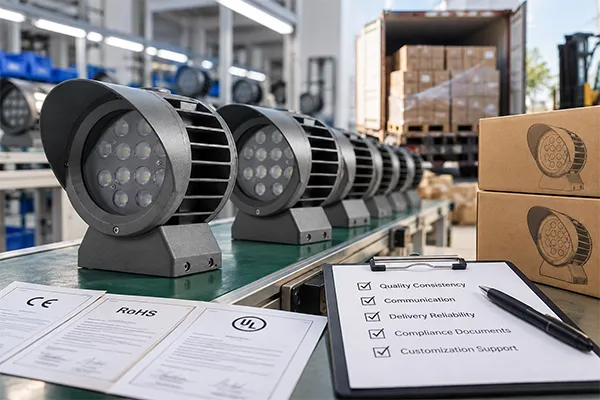
The best LED flood light supplier for wholesale business is a partner you can verify for consistent batch quality, clear communication, dependable delivery, relevant compliance documentation, and realistic customization support. A working sample and a low quotation are useful starting points, but they do not prove that the supplier can support repeat bulk orders, private-label programs, or project-based demand over time.
From my experience working with importers, distributors, contractors, and local lighting brands, the real supplier decision is about protecting margin and reputation. A floodlight that performs well in one sample box is not automatically a stable product line. The sections below explain what I believe wholesale buyers should verify before committing to a supplier relationship.
Why Is Unit Price Not Enough When Choosing an LED Flood Light Supplier?
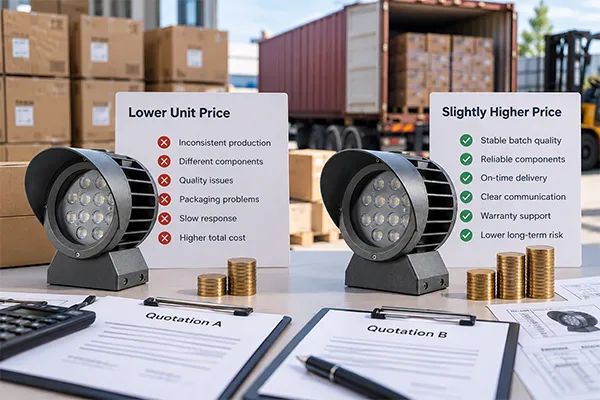
A low quote from an LED flood light supplier can look attractive, especially when buyers need to protect resale margins. However, a small saving per unit can disappear quickly if the next shipment has different components, inconsistent light output, packaging failures, or slow issue resolution. I encourage buyers to consider the full cost of repeat-order reliability.
Unit price is only one part of wholesale LED floodlight sourcing. Buyers should compare the total risk of inconsistent production, delayed replenishment, warranty claims, freight disruption, and corrective action. A supplier with a slightly higher initial quote may offer better long-term value if its quality controls, communication, and delivery process are more dependable.
Think in Terms of Total Repeat-Order Risk
When I speak with wholesale buyers, I often see the same pattern. The buyer first asks for a 50 W, 100 W, 150 W, or 200 W LED floodlight price. This is a reasonable opening question. Still, I believe the better question is: What could make this product difficult to sell after the first shipment?
The purchase price does not show every cost that may affect your business. A low-cost floodlight can create additional expenses through:1
- Product returns from installers or end users
- Rework, relabeling, or repacking at your warehouse
- Emergency air freight for replacement stock
- Lost project deadlines due to late replenishment
- Discounting inventory that does not match the approved sample
- Staff time spent answering technical and warranty complaints
- Damage to your brand reputation or distributor relationship
For example, a buyer may save $0.80 per unit on a 1,000-piece order. That appears to save $800. However, if even 5% of the shipment creates claims, the cost of replacement products, shipping, labor, and customer dissatisfaction may exceed that saving.2 The exact risk depends on the application, sales channel, and local service model, but the commercial principle remains the same.
Compare Quotes on a Like-for-Like Basis
I advise buyers to make a comparison table before selecting an LED flood light supplier. This prevents suppliers from appearing cheaper simply because they quoted a different specification.
| Evaluation point | What buyers should compare | Wholesale risk if unclear |
|---|---|---|
| Wattage | Actual rated input power and tolerance | Product may not match catalog claims |
| Light output | Lumen target, test basis, and consistency | End users may see weaker performance |
| LED source | Brand, binning policy, and availability | Future batches may look different |
| Driver | Driver specification and surge protection | Failure rates may rise in demanding sites |
| Housing | Material, finish, heat dissipation design | Corrosion or overheating concerns |
| IP rating | Product design and applicable test records3 | Outdoor suitability may be overstated |
| Cable and plug | Cable length, regional plug, conductor details | Installation may require extra work |
| Packaging | Inner box, carton strength, labeling | Transit damage and warehouse confusion |
| Lead time | Production period and shipping terms | Stockouts can affect customer commitments |
| Warranty process | Claim evidence, response process, remedy | Disputes can become costly |
I do not view the lowest quotation as a problem by itself. I view an unexplained low quotation as a reason to ask more questions.
A responsible supplier should be able to clarify the specification basis behind its quote. If a supplier avoids clear answers, changes details frequently, or only repeats marketing language, I would treat that as a commercial risk signal.
How Can You Verify LED Flood Light Supplier Batch Consistency?
A sample can create confidence, but it also creates a common sourcing mistake. Buyers may assume that a successful sample proves mass-production quality. In reality, the important question is whether the LED flood light supplier can maintain the same agreed standard across future batches, models, and replenishment orders.
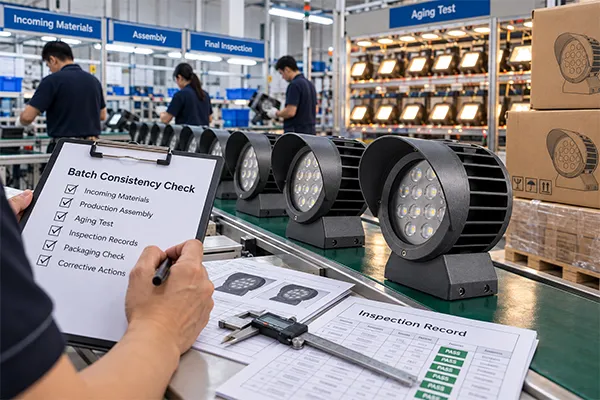
To verify batch consistency, buyers should ask how the supplier controls incoming materials, production assembly, aging tests, inspection records, packaging checks, and corrective actions. A sample confirms that one unit works at one moment; documented production practices and repeat-order performance provide stronger evidence of consistent wholesale supply.4
Move Beyond the Approved Sample
I have seen buyers spend substantial time approving a sample but very little time discussing the production process behind it. A sample is still valuable. It allows you to inspect appearance, installation details, beam distribution, perceived brightness, packaging, labeling, and basic workmanship.
However, a sample may not answer important questions, such as:
- Will the same LED and driver configuration be available for the next order?
- How does the supplier prevent component substitution?
- Does the factory record production lot information?
- What happens when an inspection issue is found?
- Who confirms changes in materials, finish, cable, or packaging?
- Can the supplier maintain the same color temperature across replenishment batches?
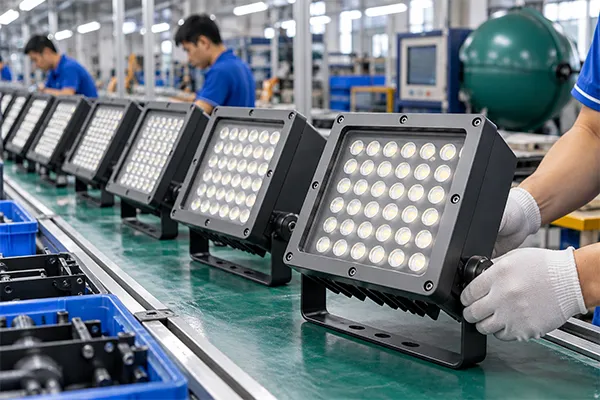
At Upward Lighting, we use a 100% aging test lasting between 4 and 8 hours before shipment as part of our own operating practice. I present this as one piece of evidence, not as universal proof that every unit will perform perfectly in every application. Buyers should still ask what the aging process covers, how exceptions are handled, and what inspection steps occur before packing.
Questions I Recommend Asking About Quality Control
A useful supplier conversation should move from claims to process. Instead of asking, “Do you have quality control?” I suggest asking questions that require specific answers:
-
Which components are controlled for the approved model?
Ask about the LED source, driver, lens, housing, cable, screws, gasket, and packaging. -
How are production changes communicated?
A reliable supplier should explain whether it seeks written approval before material or specification changes.5 -
What inspections happen before shipment?
Ask whether the supplier checks appearance, wiring, function, labeling, packing quantity, and aging performance. -
Can you provide batch or production records?
The level of documentation varies by supplier and order type, but traceability matters when an issue arises. -
How do you handle nonconforming products?
Listen for a practical process, not only a promise that defects “never happen.” -
Can a third-party inspection be arranged?
Independent pre-shipment inspection may be appropriate for larger or higher-risk orders.6
Use a Pilot Order to Test the System
A pilot order often gives more meaningful information than a single sample. For example, an importer might begin with a small mixed-wattage order for warehouse inspection and local market feedback. This approach can test:
- Quotation accuracy
- Production lead time
- Carton quality
- Label consistency
- Product appearance across multiple units
- Supplier responsiveness during order execution
- Shipping-document accuracy
I would not assume that a large factory automatically handles these details well. Likewise, I would not reject a smaller supplier automatically. The key point is whether the supplier can show a repeatable process that matches your volume, product range, and market expectations.
What Should a Reliable LED Flood Light Supplier Ask Before Quoting?
Some suppliers reply to every inquiry with an immediate price list. Fast quotations are helpful, but I believe a reliable LED flood light supplier should also ask enough questions to understand the application. A price without context can lead to the wrong driver, beam angle, cable, color temperature, or compliance pathway.
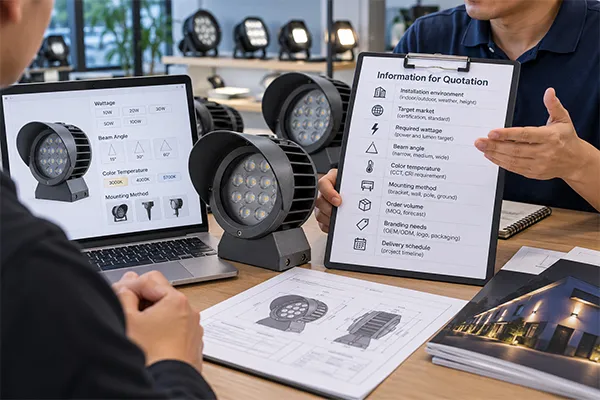
A capable LED flood light supplier should ask about the installation environment, target market, required wattage, beam angle, color temperature, mounting method, order volume, branding needs, and delivery schedule.7 These questions show whether the supplier is defining a suitable product rather than simply selling the cheapest available configuration.
Factory Status Is Not a Complete Qualification
Many buyers search for an “LED floodlight factory” because direct manufacturing can offer benefits. It may reduce layers in communication, support customization, and improve control over specifications. Yet the word factory does not automatically prove quality, service, capacity, delivery discipline, or after-sales support.
Similarly, “OEM/ODM available” is a starting claim, not evidence of actual customization capability. I suggest testing the supplier through a structured inquiry.
A useful supplier should ask questions such as:
| Buyer requirement | Why the supplier should ask | Risk of skipping the question |
|---|---|---|
| Installation location | Indoor, outdoor, coastal, industrial, or sports use affects product selection8 | Premature corrosion or unsuitable protection level |
| Target market | Market rules and customer expectations vary | Documents may not fit the sales channel |
| Voltage and plug | Electrical requirements differ by region | Installation delays or product incompatibility |
| Beam angle | Narrow and wide beams serve different lighting layouts | Poor coverage or glare complaints |
| CCT and CRI | Visual expectations vary by application | Product line may not meet buyer preference |
| Mounting method | Bracket, pole, trunnion, or other mounting can differ | Extra site work or missing accessories |
| Branding | Logo, label, carton, manual, and color box requirements | Weak private-label presentation |
| Forecast volume | Volume affects component planning and lead time | Replenishment instability |
| Target price | The supplier can align a realistic configuration | Hidden specification downgrades |
Test Communication Before You Place an Order
In my view, early communication is one of the best supplier tests because it predicts how the relationship may work when a problem occurs. Buyers should observe whether the supplier:
- Answers technical questions directly
- Confirms key details in writing
- Identifies unclear requirements rather than guessing
- Provides a realistic quotation timeline
- Explains customization limits honestly
- Updates the buyer when a specification or lead-time issue appears
- Uses clear product drawings, datasheets, photos, or approval samples
I remember one early discussion where a customer requested a private-label floodlight but had not yet confirmed the destination market, cable requirement, or packaging language. We paused the final quote until those points were clearer. That delay may seem less convenient than sending an instant number, but it reduced the risk of quoting the wrong product.
Define Customization Boundaries Early
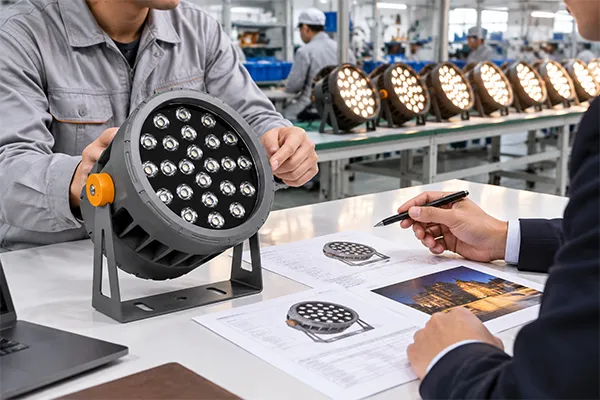
OEM and ODM work can include color temperature, wattage, beam angle, CRI, surface finish color, logo, label, packaging, and selected accessories. However, each change may affect minimum order quantities, tooling, lead times, component availability, and compliance documentation.
I encourage buyers to request a written customization summary that includes:
- Approved product model and revision
- Electrical and optical specifications
- Exterior color and branding artwork
- Packaging layout and carton marks
- Required documents
- Sample approval process
- Minimum order quantity by variation
- Estimated production schedule
- Change-control process for future orders
This document does not replace a formal contract or technical review. However, it gives both sides a clearer basis for repeat supply.
How Should You Check Compliance and Delivery Readiness for Wholesale Orders?
Compliance and logistics can become major obstacles after a product is already manufactured. Buyers may find that a certificate does not match the exact model, the destination market requires additional documentation, or cartons do not meet channel requirements. I recommend checking compliance and delivery readiness before confirming a large purchase order.
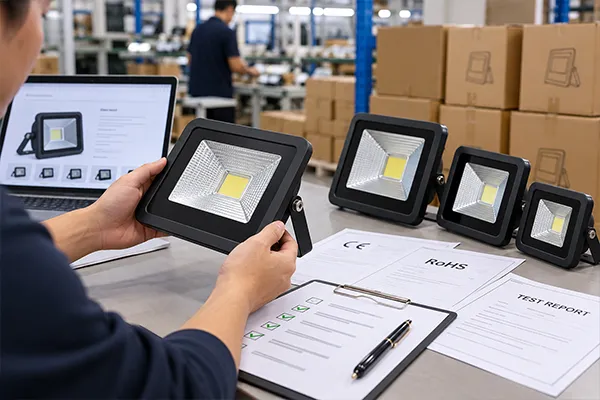
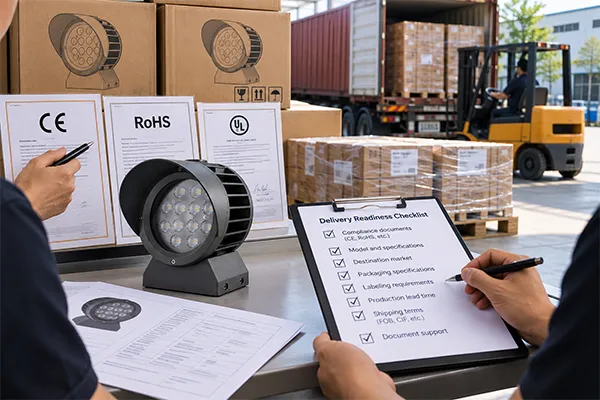
Buyers should verify that compliance documents relate to the specific LED floodlight model, destination market, and sales channel. They should also confirm production lead time, packaging specifications, shipping terms, labeling, and document support. CE, RoHS, and similar documents should be reviewed for applicability rather than treated as universal approval.9
Verify Documents in Context
At Upward Lighting, our products hold certifications such as CE and RoHS. These documents can be relevant to many customers and markets, but I never suggest that any certificate is a universal passport for every product, every country, or every channel.
A buyer should verify:
- The certificate or report references the correct product model or product family10
- The document is current and issued by an appropriate organization
- The listed specifications match the product being ordered
- The destination market accepts the document type for the intended sales channel
- Any additional national, regional, project, or customer requirements are addressed
- Product labels, manuals, and declarations align with the agreed documentation
Requirements can differ significantly across markets. A distributor selling through a retail channel may face different expectations from a contractor supplying a project. A floodlight for a public installation may require more project-specific review than a unit intended for general wholesale resale.
I recommend that buyers consult qualified compliance professionals, local authorities, testing bodies, or customers’ technical teams where application-specific requirements are unclear. This step is particularly important when products are used in regulated projects or sold under a local brand.
Delivery Reliability Is More Than a Lead-Time Promise
A supplier may quote “20 days” or “30 days,” but buyers should understand what that period means. Does it start after deposit receipt, artwork approval, sample confirmation, or component arrival? Does it include aging, inspection, packing, and booking preparation?
I suggest confirming the following points before issuing a purchase order:
- Production lead time: Confirm the trigger date and whether peak-season capacity may affect the schedule.
- Order split: Clarify whether mixed wattages, colors, or package designs will extend lead time.
- Packaging details: Confirm carton dimensions, gross weight, pallet needs, and container loading estimates.
- Shipping terms: Specify Incoterms, port, freight responsibility, insurance, and customs documentation.11
- Labeling: Confirm barcode, model number, voltage, importer information, warning labels, and carton marks.
- Pre-shipment approval: Decide whether you need photos, video, inspection reports, or third-party inspection.
- Issue handling: Set expectations for shortages, transit damage, quality claims, and replacement discussions.
A supplier’s supply-chain management matters greatly here. Floodlight production depends on multiple items, including LEDs, drivers, die-cast housings, lenses, cables, connectors, screws, gaskets, and packaging.12 I believe buyers should ask how the supplier plans materials for repeat orders and how it communicates when a key component becomes unavailable.
Frequently Asked Questions
How do I find a genuine LED flood light manufacturer in China?
I recommend looking beyond the manufacturer label. Ask for product documentation, production-process explanations, sample arrangements, factory communication, and references to actual order handling. A genuine manufacturer may still have weaknesses, so you should assess quality consistency, responsiveness, customization ability, and delivery performance before placing bulk orders.
Is a sample enough to approve an LED flood light supplier?
No. A sample confirms that one product meets your expectations at one point in time. You should also ask about component control, batch inspection, aging procedures, change management, production records, and claim handling. A pilot order can provide a more realistic test of mass-production and delivery capability.
What certifications should wholesale LED floodlights have?
The necessary documents depend on your destination market, sales channel, product model, and customer requirements. CE and RoHS may be relevant in some situations, but buyers should verify that documents apply to the exact product and market. Qualified local compliance advice is sensible for application-specific decisions.
Can an LED flood light supplier support private-label wholesale orders?
Many suppliers can offer private-label options such as logos, labels, cartons, color finishes, and selected specifications. You should confirm minimum order quantities, artwork approval, lead times, packaging requirements, and the process for future repeat orders. Written specification confirmation helps reduce misunderstandings.
What is the best way to compare LED floodlight quotations?
Compare quotations on an equal specification basis. Review wattage, light output, LED source, driver, surge protection, IP design, cable, packaging, warranty process, documents, lead time, and shipping terms. The cheapest offer may not be the lowest total-cost option when quality claims or delays occur.
Conclusion
The right LED flood light supplier helps wholesale buyers protect their margins, customer relationships, and product reputation across repeat orders. I recommend evaluating more than unit price or a successful sample. Review batch consistency, production checks, communication quality, customization boundaries, relevant compliance documents, and delivery planning. At Upward Lighting, we work with buyers on specification confirmation, OEM/ODM requirements, small-batch opportunities, and order coordination. Contact us to discuss a floodlight sourcing plan that fits your target market and wholesale goals.
"8 Ways to Improve Your Supplier Selection Process", https://www.nist.gov/blogs/manufacturing-innovation-blog/8-ways-improve-your-supplier-selection-process. Research on total cost of ownership in purchasing treats supplier price as only one cost element and includes quality failures, logistics, administration, and post-purchase service costs in supplier evaluation. Evidence role: general_support; source type: research. Supports: Total-cost-of-ownership approaches to procurement include acquisition price together with quality, logistics, service, and failure-related costs.. Scope note: The size of these costs varies by product, contract, freight mode, and the buyer’s service model. ↩
"(PDF) Case study: Warranty costs estimation according to a ...", https://www.academia.edu/81301676/Case_study_Warranty_costs_estimation_according_to_a_defined_lifetime_distribution_of_deliverables. Cost-of-quality research identifies external failure costs—including warranty claims, returns, replacement, and customer support—as potentially material costs beyond the original purchase price. Evidence role: general_support; source type: paper. Supports: Cost-of-quality literature recognizes warranty, returns, replacement, and customer-service costs as consequences of product failures.. Scope note: This does not establish that a 5% claim rate or any particular LED-floodlight order would exceed an $800 saving; those outcomes require order-specific cost data. ↩
"IP code", https://en.wikipedia.org/wiki/IP_code. IEC 60529 defines IP codes as classifications of enclosure protection against access, solid foreign objects, and water, making the applicable test basis relevant when an IP rating is used to support outdoor-use claims. Evidence role: definition; source type: institution. Supports: IEC 60529 defines IP codes for degrees of protection provided by electrical enclosures against access, solid foreign objects, and water.. Scope note: An IP classification does not by itself establish resistance to corrosion, ultraviolet exposure, installation errors, or all site-specific environmental conditions. ↩
"NIST Quality Manual for Measurement Services, NIST-QM-I", https://www.nist.gov/document/nistqm-i-v11controlledandsigned. ISO 9001 guidance describes process control, documented information, and performance evaluation as elements of consistent quality management; an approved individual sample is therefore not, by itself, evidence of continuing production conformity. Evidence role: general_support; source type: institution. Supports: Quality-management systems emphasize controlled processes, documented information, and monitoring rather than reliance on an individual product sample alone.. Scope note: ISO 9001 does not specifically evaluate LED floodlight suppliers or guarantee the quality of any future batch. ↩
"Documents, Change Control and Records", https://www.fda.gov/media/118202/download. Quality-system guidance on change control requires changes affecting product requirements or quality to be documented, reviewed, and approved, supporting the use of written supplier approval processes for material or specification changes. Evidence role: mechanism; source type: government. Supports: Formal change-control systems document, review, approve, and assess changes that may affect product requirements or quality.. Scope note: The precise change-control obligations depend on the applicable industry, contract, and regulatory framework; not all lighting suppliers are subject to the same rules. ↩
"Pre-shipment inspection", https://en.wikipedia.org/wiki/Pre-shipment_inspection. ISO acceptance-sampling standards describe methods for inspecting lots against specified acceptance criteria, providing a basis for using independent pre-shipment inspection as an additional control on higher-consequence orders. Evidence role: general_support; source type: institution. Supports: Acceptance-inspection methods use defined sampling plans and acceptance criteria to evaluate production lots before acceptance or shipment.. Scope note: Inspection samples reduce but do not eliminate the chance that nonconforming units remain in an accepted shipment. ↩
"Purchasing Energy-Efficient Exterior Lighting", https://www.energy.gov/cmei/femp/purchasing-energy-efficient-exterior-lighting. Lighting-design guidance identifies application conditions, mounting geometry, optical distribution, electrical requirements, and environmental exposure as relevant factors in selecting outdoor luminaires. Evidence role: general_support; source type: institution. Supports: Lighting-design guidance treats the application, installation geometry, optical distribution, electrical conditions, and environmental exposure as relevant inputs to luminaire selection.. Scope note: Such guidance supports defining requirements before selection but does not prescribe one universal floodlight configuration for every project or market. ↩
"ISO12944", https://international.brand.akzonobel.com/m/5f44067b30402a97/original/ISO12944_UK_LR.pdf. ISO 12944 classifies atmospheric corrosivity, including industrial and coastal environments, because these exposures can require different corrosion-protection measures for metal products and assemblies. Evidence role: mechanism; source type: institution. Supports: Atmospheric corrosivity classifications distinguish environments such as industrial and coastal areas because exposure conditions influence corrosion protection requirements.. Scope note: Corrosivity classification alone does not determine whether a particular floodlight is suitable; construction, coating system, sealing, mounting, and local conditions also matter. ↩
"European Union Reduction of Hazardous Substances ...", https://www.waru.edu/artifact/european-union-reduction-hazardous-substances-rohs-and-waste-electrical-and-electronic. European Commission guidance states that CE marking is required only for products covered by applicable EU harmonisation legislation, and the RoHS Directive has a defined scope for electrical and electronic equipment; these documents are therefore not universal market approvals. Evidence role: definition; source type: government. Supports: CE marking applies only to products covered by relevant EU harmonisation legislation, while RoHS is a specific EU restriction-of-hazardous-substances regime for electrical and electronic equipment within its scope.. Scope note: This support addresses EU regulatory scope and does not determine the import, certification, or customer requirements of a particular non-EU destination. ↩
"Accreditation Scheme for Conformity Assessment (ASCA)", https://www.fda.gov/medical-devices/division-standards-and-conformity-assessment/accreditation-scheme-conformity-assessment-asca. European Commission conformity-assessment guidance requires technical documentation and a declaration of conformity to identify the product concerned and support compliance with applicable legislation, which makes model or product-family coverage material when reviewing documents. Evidence role: mechanism; source type: government. Supports: EU conformity assessment requires technical documentation and an EU declaration of conformity that identify the product and demonstrate conformity with applicable requirements.. Scope note: Whether a report may validly cover a product family depends on the applicable standard, the tested configuration, and the certification body’s rules. ↩
"Know Your Incoterms", https://www.trade.gov/know-your-incoterms. The ICC Incoterms rules define standard allocations of delivery obligations, costs, and risk between buyer and seller, supporting the need to state the chosen rule and named place clearly in an international purchase arrangement. Evidence role: definition; source type: institution. Supports: Incoterms rules allocate specified delivery obligations, costs, risks, and transport-related responsibilities between sellers and buyers.. Scope note: Incoterms rules do not by themselves settle product quality, payment, title transfer, or every documentation obligation; these matters require contract terms and applicable law. ↩
"2019 Solid-State Lighting R&D Opportunities", https://www.energy.gov/sites/prod/files/2020/01/f70/ssl-rd-opportunities2-jan2020.pdf. U.S. Department of Energy technical material on LED luminaires describes the LED package or module, driver, optics, thermal-management system, housing, and electrical interconnections as key elements of luminaire design and performance. Evidence role: general_support; source type: government. Supports: Technical descriptions of LED luminaires identify LEDs, drivers, optics, thermal-management structures, housings, wiring, and related mechanical components as interdependent parts of luminaire performance.. Scope note: The exact bill of materials varies by floodlight design; the source does not verify the component sourcing practices of a particular supplier. ↩