
LED flood light suppliers can appear similar when buyers compare catalogs, samples, and quotations. The real risk begins after an order is confirmed: the delivered product may not match the intended application, compliance documents, approved configuration, or project deadline. We recommend evaluating evidence, process control, and accountability—not just price.
To evaluate LED flood light suppliers, buyers should confirm that the supplier can document the exact product specification, link approved samples to mass production, provide order-specific compliance evidence, explain quality-control procedures, and commit to a realistic delivery process. A low quotation or bright sample can start the discussion, but repeatable proof reduces procurement risk.
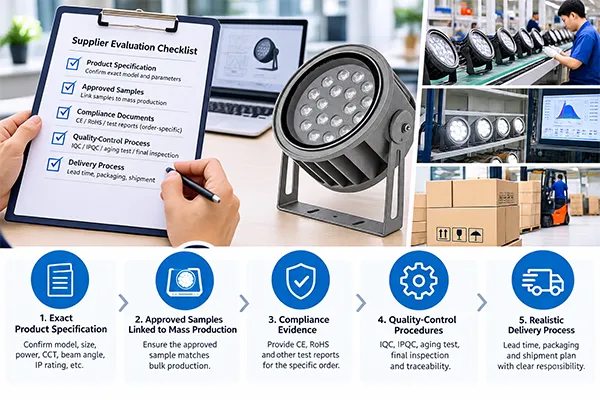
In our experience as a China-based LED lighting manufacturer, the best supplier conversations become more detailed before a quotation becomes final. We see responsible buyers ask how wattage, beam angle, color temperature, packaging, testing, and shipment timing will be controlled across the full order—not only in one sample.
Why Should Buyers Look Beyond a Low Quotation From LED Flood Light Suppliers?
A low price from LED flood light suppliers can make a purchasing decision feel simple. However, a quotation may hide unanswered questions about LED chips, drivers, housing materials, production tolerances, packaging, certifications, or delivery assumptions. If those gaps appear later, buyers may face rework, delays, or unexpected cost.
Buyers should treat a low LED flood light quotation as a commercial starting point, not proof of supplier reliability. A useful quotation identifies the exact model, key technical parameters, trade terms, MOQ, packaging, lead time, and validity period. Buyers should also ask what assumptions support the price and what changes could affect it.
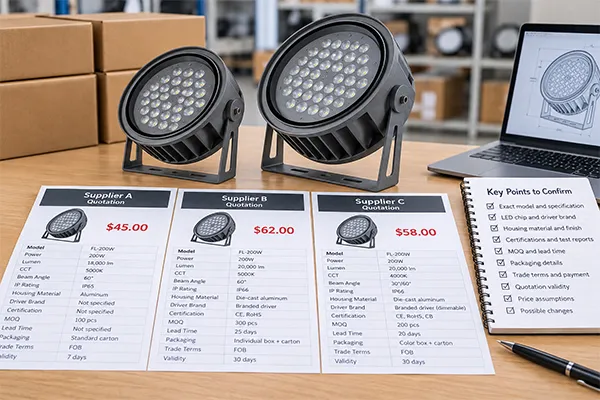
A quotation needs a technical basis
We have handled many overseas inquiries where the first request simply says, “Please quote a 100W flood light.” That description is not enough for a responsible final price because a 100W LED floodlight can vary significantly in configuration and intended use1.
For example, buyers may need different combinations of:
- Input voltage, such as 100–277V AC or 220–240V AC
- Color temperature, including 3000K, 4000K, 5000K, or 6500K
- Beam angle for facade lighting, area lighting, yards, sports areas, or construction sites
- CRI requirement, often standard CRI or a higher requirement for color-sensitive applications
- IP rating and enclosure design based on the installation environment
- Driver specification and surge-protection expectations
- Housing finish, branded color, logo, label, and carton requirements
- Order quantity and required shipment date
A supplier can quote aggressively by selecting a basic configuration, using a different driver class, reducing packaging protection, or excluding options that the buyer expects2. This does not automatically make the quote unsuitable. It means the buyer needs to compare it on equal terms.
Compare quotations line by line
We suggest using a comparison table that makes differences visible before negotiating a final price.
| Evaluation point | Supplier A | Supplier B | What buyers should confirm |
|---|---|---|---|
| Model number | Is the model tied to a datasheet and drawing? | ||
| Rated wattage | Is input wattage clearly stated? | ||
| CCT and CRI | Are tolerances or approved options defined? | ||
| Driver brand/specification | Is the driver identified for the order? | ||
| IP rating | Does it fit the intended installation? | ||
| Beam angle | Is it suitable for the lighting layout? | ||
| Packaging | Are inner box, master carton, and markings defined? | ||
| MOQ | Does it fit the purchasing plan? | ||
| Production lead time | Does it begin after deposit, artwork, or approval? | ||
| Trade term | Are freight and destination responsibilities clear? |
We do not believe fast replies or competitive pricing should be ignored. They are useful signals of commercial responsiveness. Still, buyers should ask whether the supplier can explain the price with an order-specific bill of requirements. That conversation often reveals more than the number itself.
How Can Buyers Verify That an LED Flood Light Sample Matches Mass Production?
A good-looking sample can create confidence quickly. Yet a sample may be assembled under special attention, while the mass order depends on component availability, production instructions, inspection controls, and approved tolerances3. Buyers need to know how the sample becomes a repeatable production reference.
Buyers should approve a LED flood light sample together with a written specification and acceptance criteria4. The supplier should explain how the approved sample, bill of materials, production order, labels, packaging, and quality checks are connected. This creates a clearer basis for evaluating mass-production consistency.
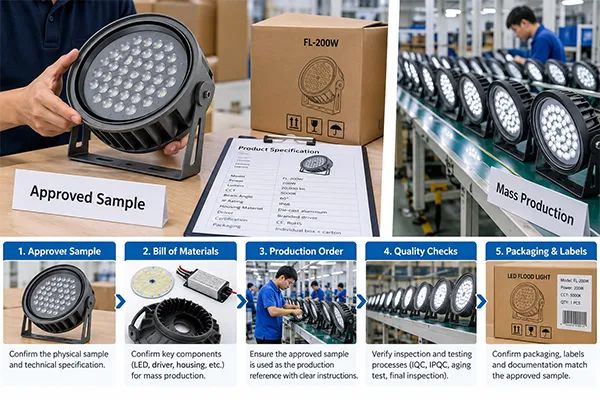
Define what the sample actually approves
We encourage buyers to avoid approving a sample only by saying, “Looks good.” A stronger approval process identifies precisely what the sample represents.
For a floodlight order, this may include:
- Product model and rated wattage
- CCT, CRI, and visual appearance
- Beam angle or optical distribution
- Input voltage and plug, cable, or terminal arrangement
- Housing color and surface finish
- Bracket design and mounting dimensions
- Label content, barcode, and brand logo
- Inner-box and carton artwork
- Required documents and market-specific requirements
- Inspection and acceptance criteria
The buyer does not always need to approve every item physically. However, the final purchase order and specification sheet should make clear which items are fixed and which are permitted options.
In our own operating process, we find that a written confirmation before production reduces avoidable back-and-forth. It gives our sales, engineering, purchasing, production, and quality teams the same reference point.
Ask how production changes are managed
A supplier should be able to explain what happens if a component becomes unavailable or a customer requests a late adjustment. This is especially important for OEM and ODM floodlight projects, where customized packaging, private labels, different color temperatures, or special finishes may involve multiple internal and external parties.
Buyers can ask practical questions such as:
- Will the supplier notify us before changing a driver, LED source, cable, or packaging material5?
- Who approves substitutions or specification changes?
- Can the supplier provide a revised specification sheet and updated quotation?
- Does the production team receive the same approved documentation as the sales team?
- Is there a final inspection record or shipment checklist tied to the order?
At Upward Lighting, we coordinate specification confirmation before production and use the approved requirements as a reference during execution. We also conduct a 100% aging test lasting approximately 4 to 8 hours before shipment as part of our own operating practice. This process is intended to identify certain early functional issues before dispatch, but it should not be interpreted as a universal guarantee of lifetime performance in every installation.
Evaluate the sample-to-order trail
A reliable procurement decision depends on traceability. Buyers should be able to follow a logical trail:
Inquiry → quotation → specification confirmation → sample approval → purchase order → production → inspection → shipment
If the supplier cannot clearly explain this trail, the buyer may have difficulty resolving disputes later. The goal is not to create unnecessary paperwork. The goal is to make sure both sides define the same product before large-scale production begins.
What Customization Details Should LED Flood Light Suppliers Confirm in Writing?
Many LED flood light suppliers say that they offer OEM or ODM customization. That capability can be valuable, particularly for importers, lighting brands, distributors, and project contractors. However, “customizable” is too broad to support a purchasing decision unless the requested changes are defined, priced, approved, and scheduled.
Buyers should ask LED flood light suppliers to convert customization promises into a documented scope. The document should identify each requested parameter, the MOQ, sample requirement, tooling or artwork needs, approval steps, added cost, and expected lead time. Clear documentation helps buyers judge whether customization is practical for the actual order.
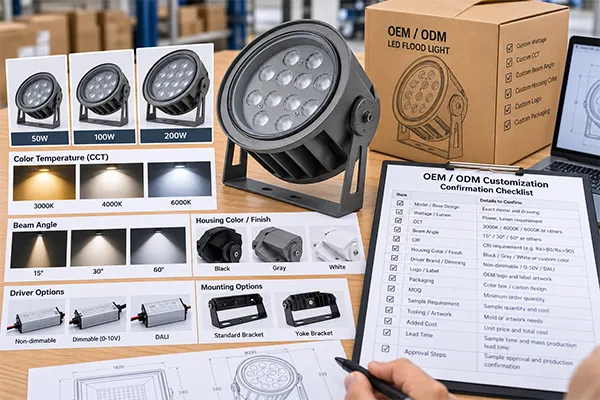
Separate product customization from commercial customization
We often see buyers combine several requests in one message: custom wattage, special CCT, branded packaging, a different housing color, a logo, and a small first order. Each request may have a different effect on feasibility.
| Customization area | Typical details to define | Buyer evaluation question |
|---|---|---|
| Electrical parameters | Wattage, voltage, driver, surge protection | Does the configuration suit the installation? |
| Light output characteristics | CCT, CRI, beam angle | Is the target performance documented? |
| Mechanical design | Bracket, cable length, connector, finish | Does it fit the mounting environment? |
| Branding | Logo, label, manual, carton artwork | Who approves final artwork? |
| Packaging | Inner box, master carton, pallet method | Does it protect goods during shipment? |
| Commercial terms | MOQ, sample fee, lead time | Is the project volume commercially workable? |
A buyer should not assume that every change can be applied at the same cost or within the same lead time. A logo label may be straightforward. A new die-cast housing, custom optical design, or special compliance requirement may require more engineering review, samples, testing, or volume commitment.
Ask application-first questions
We believe that customization should begin with the application, not with a catalog code. Before we quote an outdoor floodlight project, we try to clarify questions such as:
- Where will the floodlights be installed?
- What mounting height and lighting area are involved?
- Does the customer need wide-area illumination, narrow-beam accent lighting, or facade lighting?
- What local voltage, plug, cable, or wiring method is required?
- Is the site exposed to heavy rain, dust, salt air, vibration, or high ambient temperatures?
- What documents does the buyer need for the destination market?
- Does the project have a fixed delivery milestone?
These questions do not replace professional lighting design, electrical design, or local regulatory review.6 For application-specific decisions, we recommend that buyers consult qualified project, electrical, or lighting professionals.
Confirm approvals before production starts
Custom orders often fail when buyers approve product appearance but overlook carton marks, user instructions, label language, or the final technical configuration. We recommend a simple approval matrix for larger or repeat orders.
| Item | Buyer approval needed? | Supplier record |
|---|---|---|
| Technical specification | Yes | Approved specification sheet |
| Sample appearance | Usually | Photos, sample reference, or sign-off |
| Label and logo | Yes for private label | Artwork approval |
| Packaging artwork | Yes for branded orders | Final print file |
| Carton marks | Usually | Carton layout confirmation |
| Shipment schedule | Yes | Production plan and trade terms |
In our experience, this documented approach makes small-batch OEM orders easier to manage as well. It also gives both sides a clear basis when a requested change arrives after the original confirmation.
How Should Buyers Check Certificates, Quality Controls, and Delivery Readiness?
Certificates, inspection claims, and factory images can help buyers conduct initial screening. Still, none of these items alone proves that a specific LED floodlight model will meet every market, project, or contractual requirement7. Buyers should examine whether the evidence applies to the exact product and destination.
Buyers should verify certificates and quality evidence against the exact LED flood light model, configuration, destination market, and project requirement. They should also ask how the supplier controls incoming materials, production checks, aging, final inspection, packaging, and shipment timing for the specific order.
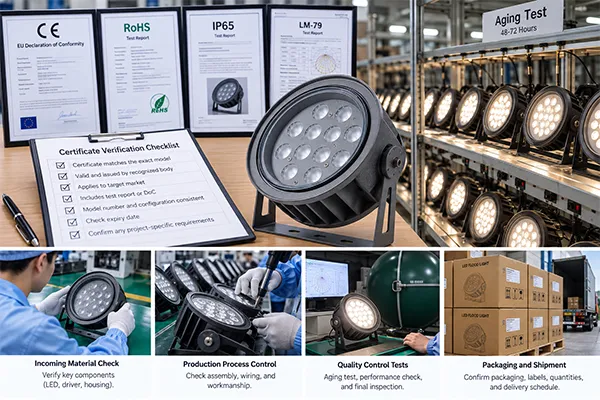
Verify documents against the actual order
At Upward Lighting, our products hold documents such as CE and RoHS for relevant product lines. However, we always encourage buyers to verify that any certificate or declaration corresponds to the correct model and their target market requirements. A document associated with one product version may not automatically apply to a different wattage, driver, voltage, or customized configuration.
Buyers should check:
- Product model number and revision
- Rated voltage and frequency
- Wattage range covered
- Manufacturer name and address
- Test report or certificate issue date
- Applicable standard or directive named in the document
- Whether the destination market requires additional documentation
- Whether the project specification has separate requirements
For example, CE and RoHS are commonly requested in many procurement discussions8, but buyers should not assume they automatically satisfy every country, tender, customer, or installation condition. Importers and project teams should confirm applicable requirements with qualified compliance professionals, local authorities, or project consultants when needed.
Review the supplier’s quality-control sequence
We believe buyers should ask about controls at several stages, rather than only asking whether the factory has “quality inspection.”
A useful production-control discussion may cover:
- Incoming material checks: How does the supplier verify key purchased components?
- In-process checks: What does the team inspect during assembly?
- Electrical and functional testing: What checks occur before final packing?
- Aging process: How long are products operated, and what is the purpose of the test?
- Final inspection: Are appearance, labeling, quantity, packaging, and function reviewed?
- Shipment release: Who confirms that goods match the approved order?
Our own process includes a 100% aging test of approximately 4–8 hours before shipment9. We use this practice to support pre-shipment functional screening and to review product operation before goods leave our facility. The appropriate test plan, inspection level, and acceptance criteria should still be agreed according to the product, application, and buyer’s risk tolerance.
Assess delivery reliability through planning, not promises
A supplier’s stated lead time is only useful when the assumptions are clear. Buyers should ask whether lead time starts after deposit receipt, artwork approval, sample confirmation, or material arrival. They should also ask whether production capacity, component lead times, and shipping arrangements have been considered.
For project procurement, we recommend tracking these dates:
- Final specification approval
- Deposit or purchase order release
- Artwork approval, if applicable
- Sample approval, if required
- Production start and estimated completion
- Inspection window
- Booking deadline
- Vessel, air freight, or courier schedule
A supplier that communicates constraints early may be more valuable than one that gives an unrealistically short promise.10 In international trade, clear planning gives buyers more room to protect project schedules.
Frequently Asked Questions
What should I ask LED flood light suppliers before requesting a quotation?
We recommend providing the intended application, wattage, voltage, CCT, beam angle, CRI, IP requirement, order quantity, destination market, packaging needs, and target delivery date. Buyers should also ask what assumptions are included in the quotation and whether the model has relevant order-specific documentation.
Is a LED flood light sample enough to approve a supplier?
A sample is useful, but it is not enough by itself. Buyers should confirm how the sample specification will be transferred into mass production, including components, labels, packaging, inspection criteria, and change-control procedures. Written approval reduces ambiguity before production begins.
How can I verify CE or RoHS documents for LED floodlights?
Buyers should compare the certificate, declaration, or test report with the exact product model, electrical configuration, and destination-market requirement. CE or RoHS documents should be reviewed as order-related evidence, not assumed to cover every version or project requirement automatically.
What is a reasonable aging test for LED floodlights?
The suitable aging process depends on the product, application, buyer requirements, and supplier’s quality system. In our own operations, we perform a 100% aging test for approximately 4–8 hours before shipment. Buyers should ask what the test covers and what acceptance criteria apply.
Can I order customized LED floodlights in small quantities?
Small-batch customization may be possible, but feasibility depends on the requested changes. Simple label, packaging, CCT, or finish adjustments may differ from a new housing, optical design, or electrical configuration. Buyers should confirm MOQ, sample needs, cost impact, artwork approval, and lead time in writing.
Conclusion
Evaluating LED flood light suppliers requires more than comparing catalogs, samples, and unit prices. We recommend that buyers assess the supplier’s ability to document specifications, connect sample approval to mass production, define customization clearly, verify relevant order-specific documents, and explain quality and delivery controls. At Upward Lighting, we support floodlight buyers with OEM/ODM discussions, specification confirmation, responsive quotations, small-batch support, and pre-shipment aging practices. Contact us with your application and purchasing requirements, and we can help you build a clearer evaluation basis before ordering.
"CALiPER Application Summary Report 20: LED PAR38 Lamps", https://www1.eere.energy.gov/buildings/publications/pdfs/ssl/caliper_20_summary.pdf. Technical lighting guidance describes input power as only one luminaire characteristic; photometric distribution, light output, electrical properties, and environmental design are also relevant to determining application suitability. Evidence role: general_support; source type: government. Supports: Technical guidance should establish that luminaire evaluation requires parameters such as light output, distribution, electrical characteristics, and environmental suitability in addition to input power.. Scope note: This supports the general principle and does not compare particular 100 W floodlight models. ↩
"Design Considerations for a Surface Disinfection Device ...", https://nvlpubs.nist.gov/nistpubs/jres/126/jres.126.045.pdf. Public-procurement guidance emphasizes that bids should be evaluated against defined specifications and requirements, because price comparisons alone may not capture differences in technical compliance or scope. Evidence role: general_support; source type: government. Supports: Procurement guidance should support comparing bids against clear technical specifications and stated requirements rather than price alone.. Scope note: The guidance concerns procurement generally and does not assess the relative importance of any particular floodlight component or packaging feature. ↩
"Quality and Consistency of Machined Components and ...", https://www.nist.gov/system/files/documents/oles/2-Donmez-Alkan-Manufacturing-2012-07-10-MSSFFA.pdf. Quality-management guidance treats controlled production, documented requirements, and management of production changes as mechanisms for maintaining conformity beyond an initial sample or first article. Evidence role: mechanism; source type: institution. Supports: Quality-management standards should support the need for controlled production conditions, documented information, and control of changes to maintain conformity in serial production.. Scope note: Such guidance explains process-control principles; it cannot demonstrate that a particular supplier’s mass production will match a particular sample. ↩
"Defining requirements for integrating information between ...", https://www.nist.gov/publications/defining-requirements-integrating-information-between-design-manufacturing-and. Quality-management guidance supports documenting product requirements and criteria for acceptance so that conformity can be evaluated using an agreed and repeatable basis. Evidence role: expert_consensus; source type: institution. Supports: Quality-management guidance should support defining documented product requirements and criteria for acceptance or release.. Scope note: The guidance does not prescribe a single approval document or acceptance format for all lighting purchases. ↩
"Quality Management Systems: 2021 Virtual Conference", https://www.fda.gov/media/156345/download. Manufacturing quality-system guidance identifies change control as a process for evaluating, documenting, and implementing changes that could affect product requirements or conformity. Evidence role: mechanism; source type: government. Supports: Manufacturing quality-system guidance should support evaluating, documenting, and controlling changes that may affect product conformity.. Scope note: The exact notification and approval obligations between buyer and supplier are contractual matters not established by general quality-system guidance. ↩
"Purchasing Energy-Efficient Exterior Lighting", https://www.energy.gov/cmei/femp/purchasing-energy-efficient-exterior-lighting. Lighting and electrical practice guidance indicates that luminaire selection and installation should be assessed in relation to the application, lighting design, and applicable electrical or local code requirements. Evidence role: expert_consensus; source type: institution. Supports: Lighting and electrical authorities should support the role of application-specific design and compliance with applicable installation codes or regulations.. Scope note: Applicable rules and professional-qualification requirements vary by jurisdiction and project type. ↩
"Manufacturers - Internal Market, Industry, Entrepreneurship ...", https://single-market-economy.ec.europa.eu/single-market/goods/ce-marking/manufacturers_en. Official product-conformity guidance explains that compliance is assessed against applicable requirements for the relevant product and supporting technical documentation; possession of a generic document alone does not establish compliance for every configuration or use case. Evidence role: general_support; source type: government. Supports: Official conformity guidance should support that compliance obligations depend on the applicable product, legislation, documentation, and responsible economic operator rather than on a generic certificate alone.. Scope note: The precise evidentiary value of a certificate or report depends on the jurisdiction, product category, issuing body, and scope of the document. ↩
"CE marking – obtaining the certificate, EU requirements", https://europa.eu/youreurope/business/product-rules-compliance/general-product-compliance/ce-marking/index_en.htm. European Commission guidance identifies CE marking as an indication of conformity with applicable EU requirements and the RoHS Directive as restricting specified hazardous substances in relevant electrical and electronic equipment. Evidence role: historical_context; source type: government. Supports: European Commission sources should establish the roles of CE marking and the RoHS Directive in the EU regulatory framework for relevant electrical and electronic equipment.. Scope note: Not every LED floodlight configuration falls under identical requirements, and CE marking and RoHS compliance do not replace other destination-market or project-specific obligations. ↩
"Reliability technology for cardiac pacemakers III", http://nvlpubs.nist.gov/nistpubs/Legacy/SP/nbsspecialpublication400-50.pdf. Reliability literature describes burn-in or aging as a screening method that can expose some early-life failures under specified operating conditions before shipment or deployment. Evidence role: mechanism; source type: research. Supports: Reliability research should support that burn-in or aging can be used to screen some early-life failures, while test duration and conditions determine the screening value.. Scope note: This does not validate a four-to-eight-hour test for any particular floodlight design and does not establish field lifetime performance. ↩
"Get Ready for the Next Supply Disruption", https://sloanreview.mit.edu/article/get-ready-for-the-next-supply-disruption/. Supply-chain risk research associates visibility into constraints and timely communication of disruption risks with improved planning and mitigation of schedule impacts. Evidence role: general_support; source type: research. Supports: Supply-chain research should support that visibility into constraints and early risk communication improve planning and mitigation of delivery disruption.. Scope note: This supports a planning principle and does not prove that any individual supplier will deliver more reliably than another. ↩