LED flood light manufacturers often quote products that look similar on a spreadsheet but differ in actual output, durability, included components, and delivery scope. We have seen buyers focus on the lowest unit price, only to later discover that the offers were not technically comparable. We can reduce that risk by normalizing every quotation before ranking suppliers.
To compare quotations from different LED flood light manufacturers, we should first standardize the technical specification, quality evidence, and commercial scope of each offer. We should compare lumen output, efficacy, beam angle, color temperature, input voltage, IP design, mounting hardware, certifications, warranty terms, packaging, MOQ, and lead time—not wattage or unit price alone. The best quotation is the one that meets the project requirement with the lowest overall procurement risk.
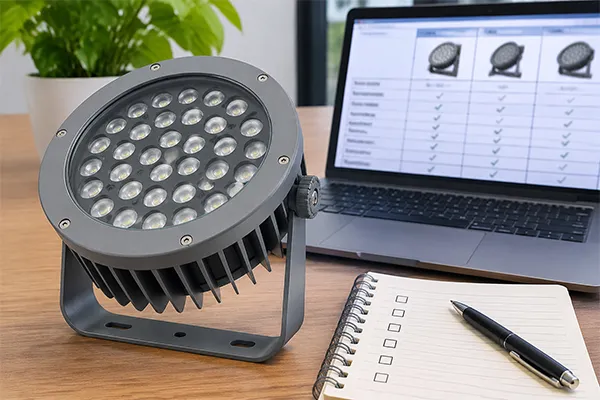
In our quotation discussions, we often find that the first offer comparison is incomplete. A buyer may receive three “100W LED floodlight” prices, but each supplier may be quoting a different optical design, driver configuration, cable length, bracket, or warranty scope. The sections below show how we can make each offer genuinely comparable.
What Should We Normalize Before Comparing LED Flood Light Manufacturers?
When we compare LED flood light manufacturers, inconsistent specifications can make a low price look more attractive than it really is. The problem is not necessarily that one quotation is wrong. The problem is that the quotations may cover different products. We should align the scope before we compare commercial value.
We should normalize every LED flood light quotation into one shared comparison sheet before evaluating price. At a minimum, we should align wattage, lumen output, efficacy, beam angle, CCT, CRI, input voltage, IP rating, mounting method, cable, accessories, packaging, warranty, MOQ, and lead time. This process turns separate supplier offers into comparable procurement options.
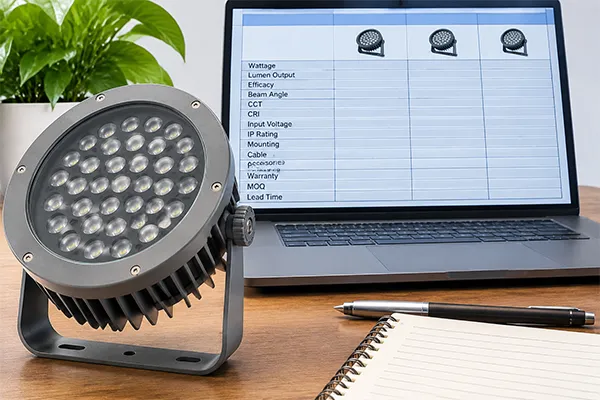
Start with the application, not the wattage
A floodlight is selected for a lighting task, not simply for its rated power. We should first define whether the fixture is intended for a façade, parking area, warehouse yard, sports perimeter, signage, construction site, or general outdoor security lighting.
Each application may require a different balance of:
- Light output and illumination level
- Beam angle and light distribution
- Glare control
- Color temperature
- Mounting height and aiming direction
- Input voltage and surge environment
- Corrosion resistance for the installation location
For example, two 100W products may have different claimed lumen outputs and beam angles. One may suit broad-area illumination, while another may concentrate light in a narrower zone. We should not assume that equal wattage creates equal light on the target surface.
Use a quotation normalization table
We recommend that purchasing teams place every supplier response into one table. This approach helps us identify omissions quickly and gives technical, purchasing, and project teams a shared review document.
| Comparison item | Supplier A | Supplier B | Supplier C | Buyer action |
|---|---|---|---|---|
| Rated wattage | 100W | 100W | 100W | Confirm tolerance and actual configuration |
| Claimed lumen output | — | — | — | Request value and test basis |
| Luminous efficacy | — | — | — | Compare only under equivalent conditions |
| Beam angle | 90° | 120° | — | Confirm suitability for layout |
| Color temperature | 5000K | 6500K | 4000K | Match project specification |
| Input voltage | AC85–265V | AC220–240V | AC100–277V | Verify local power supply |
| IP rating | IP66 | IP65 | IP66 | Ask what design supports rating |
| Mounting bracket | Included | Included | Optional | Add missing scope cost |
| Cable length | 30 cm | 50 cm | 1 m | Confirm installation requirement |
| Warranty | 2 years | 3 years | 5 years | Read coverage and exclusions |
| Lead time | 25 days | 35 days | 20 days | Confirm order quantity basis |
In our experience as a China-based manufacturer, a buyer often sends us a competitor’s brief specification stating only “100W, IP66, 6500K.” We usually need to ask follow-up questions before we can quote responsibly. The customer may need a specific beam angle, a longer cable, an anti-glare visor, a custom bracket, or a particular input-voltage range. These details can affect both suitability and cost.
We should treat a quotation with missing technical fields as incomplete, not automatically as lower cost.
How Can We Compare Performance Claims From LED Flood Light Manufacturers?
Many buyers receive quotations from LED flood light manufacturers that list the same wattage but different lumen figures—or no lumen figure at all. This creates uncertainty because wattage measures electrical input, while the project outcome depends on delivered light, distribution, and fixture suitability1.
We should compare LED flood light performance through a combined review of lumen output, luminous efficacy, beam angle, color temperature, CRI, electrical input, and mounting position. Equal wattage does not confirm equal brightness, equal light distribution, or equal application fit. We should ask each supplier to confirm the quoted configuration and the basis of its performance claims.
Compare lumens and efficacy together
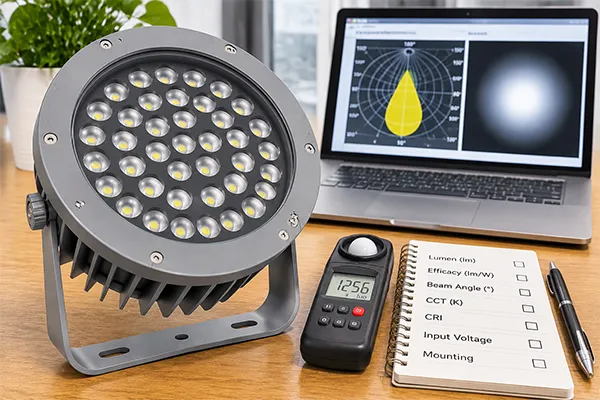
Lumen output describes the amount of visible light claimed by the fixture. Luminous efficacy expresses light output relative to power consumption, usually in lumens per watt (lm/W).2 We should consider both figures, but we should also make sure that suppliers are discussing similar product configurations.
A simple calculation is:
Luminous efficacy = claimed lumens ÷ rated watts
For example, a supplier may quote a 100W fixture at 12,000 lumens, while another may quote 15,000 lumens. That difference may reflect LED selection, driver settings, optical losses, thermal design, or simply differences in how the claim is presented.3 We should ask suppliers to clarify the conditions behind the stated figures rather than treating one number as conclusive proof.
Useful questions include:
- Is the lumen figure for the complete fixture or the LED source?
- Is the stated wattage the nominal system power?
- What color temperature applies to the lumen claim?
- Does the quoted model use the same driver and LED configuration for bulk production?
- Can the supplier provide a photometric or test document relevant to the quoted model?
- Is the fixture designed for the required ambient temperature and operating environment?
Beam angle changes project results
A broad beam spreads light over a larger area. A narrow beam concentrates light more tightly.4 Therefore, two fixtures with the same claimed lumen output may perform differently in a real installation.
| Factor | Wider beam angle | Narrower beam angle |
|---|---|---|
| Light coverage | Covers a broader area | Focuses light on a smaller area |
| Perceived intensity | May appear lower at distance | May appear stronger in target zone |
| Typical evaluation need | Uniformity and spill-light review | Aim, distance, and glare review |
| Procurement question | Is coverage sufficient? | Is the beam too concentrated? |
We recommend that project buyers review a lighting layout or consult a qualified lighting professional when the application has defined lux levels, glare limitations, safety requirements, or high mounting heights. A quotation alone cannot replace an application-specific lighting calculation.5
Do not overlook CCT, CRI, and electrical compatibility
Color temperature affects visual appearance. A 3000K floodlight produces warmer light, while 4000K, 5000K, and 6500K options appear progressively cooler.6 We should confirm the required CCT rather than accepting a supplier’s standard option.
Color Rendering Index, or CRI, may also matter where color recognition is important.7 A higher CRI option can affect product selection and price. Similarly, the local electrical supply determines whether an AC85–265V, AC100–277V, AC220–240V, or another input arrangement is appropriate.
At Upward Lighting, we can customize parameters such as wattage, CCT, beam angle, CRI, and surface finish for OEM/ODM requirements. However, we believe buyers should define these parameters in writing before they compare suppliers. This makes the comparison more accurate and helps reduce batch-to-batch misunderstanding.
How Should We Assess Durability and Quality Evidence From LED Flood Light Manufacturers?
Outdoor floodlights face rain, dust, heat, vibration, UV exposure, and installation-related stress.8 Buyers may see the same IP rating across quotations and assume equal durability. That assumption can create problems because an IP label alone does not explain the fixture’s material choices, sealing approach, thermal design, or warranty coverage.
We should assess durability by asking LED flood light manufacturers what supports the quoted IP rating and how the product is designed for its intended environment. We should review housing material, gasket design, cable entry, lens construction, heat dissipation, corrosion considerations, surge protection, aging procedures, and written warranty scope.
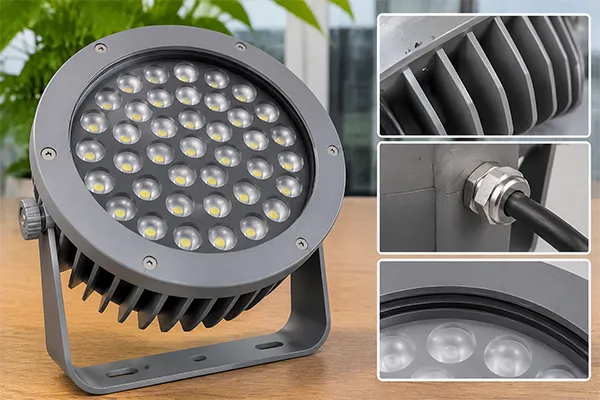
Ask what supports the IP rating
An IP rating addresses protection against ingress of solids and water under defined test conditions.9 It does not independently describe every aspect of outdoor service life. For that reason, we should ask practical design questions.
A buyer’s durability checklist can include:
- What is the housing material and surface treatment?
- What lens or cover material is used?
- How is the cable entry sealed?
- What gasket or sealing arrangement is used?
- Is the mounting bracket included, and what material is it?
- What is the operating temperature range stated by the supplier?
- Is surge protection included, optional, or application-dependent?
- What corrosion-resistance evidence is available for the target environment?
- What does the warranty cover, and what exclusions apply?
For coastal, industrial, high-humidity, or high-temperature applications, we recommend that buyers provide environmental details early. A standard outdoor product may not be the appropriate choice for every location. We should ask the supplier to confirm whether the proposed configuration is intended for that environment, while recognizing that final suitability may require qualified professional evaluation.
Review quality control as evidence, not a slogan
Quality claims are more useful when they describe a repeatable process. Buyers can ask how the supplier controls incoming materials, assembly, electrical testing, aging, visual inspection, packaging, and lot identification.
At Upward Lighting, we conduct a 100% aging test lasting 4 to 8 hours before shipment10 as part of our stated quality process. This process is intended to identify issues before products leave our facility and to support expected lumen-maintenance performance.11 We encourage buyers to ask us, or any supplier, to clarify what testing is included for the exact quoted model and order.
We should also ask how the supplier manages component changes. A sample can be acceptable while a later production batch differs in driver, LED package, cable, or bracket. Batch consistency is especially important for distributors and local lighting brands that need repeat supply over time.
Compare warranties by scope
A longer warranty period may be meaningful, but only if we understand the terms behind it. We should compare:
| Warranty question | Why it matters |
|---|---|
| What is the warranty duration? | Establishes the stated coverage period |
| Which components are covered? | Clarifies fixture, driver, LED, or other scope |
| What failures are excluded? | Identifies limits related to installation or environment |
| What evidence is needed for a claim? | Helps buyers plan records and traceability |
| What remedy is offered? | Clarifies replacement, credit, repair, or other process |
| Who handles freight or labor? | Reveals possible downstream cost |
We should not assume that every lower-priced quotation has weak quality or that every higher-priced quotation has superior quality. Instead, we should compare the evidence available and decide whether it matches the risk level of the intended procurement.
How Should We Compare Certificates, Delivery, and Commercial Scope?
A quotation can appear complete while hiding important differences in compliance documents, accessories, packaging, sampling, and delivery terms. These gaps may create extra cost after an order is placed. We should review the full commercial scope before we treat any price as final.
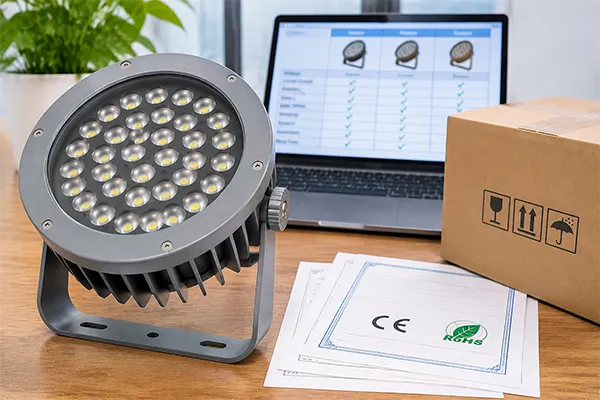
We should compare certificates, lead times, accessories, samples, MOQ, packaging, customization, and payment or shipping terms as part of every LED flood light quotation. We should verify that compliance documents relate to the quoted model and meet destination-market or project requirements. A certificate name alone does not confirm universal market acceptance.
Verify documents against the exact requirement
CE and RoHS are commonly requested in many lighting discussions.12 However, buyers should verify the relevant documents against the specific model, destination market, customer requirement, and project specification. A document for one model, configuration, or market requirement may not automatically apply to another.
We recommend that buyers check:
- The manufacturer or certificate holder name
- The product model reference
- The relevant test report or declaration details
- The issue date and document status
- The destination-country requirement
- The project consultant’s required standards
- Whether customized versions affect the documented configuration
At Upward Lighting, our products hold CE and RoHS documentation for applicable product and market-entry requirements. We encourage customers to review these documents carefully and verify suitability for their own market and project. Importers and contractors should seek qualified regulatory or technical advice where requirements are unclear.
Identify hidden scope differences
The “unit price” may not include the same components across quotations. For example, one offer may include a bracket and cable, while another may list these as options. One supplier may quote neutral cartons, while another includes branded packaging. These differences matter for distributors, importers, and private-label brands.
Use this commercial comparison checklist:
| Commercial item | What we should confirm |
|---|---|
| MOQ | Is the minimum quantity per model, color, wattage, or order? |
| Sample policy | Is the sample charged, credited back, or shipped separately? |
| Lead time | Does it start from deposit, artwork approval, or sample approval? |
| Customization | Which changes affect MOQ, tooling, price, or lead time? |
| Accessories | Are brackets, cables, connectors, visors, and screws included? |
| Packaging | What is the carton quantity, carton size, labeling, and protection level? |
| Branding | Are logo, manual, label, and carton artwork included? |
| Shipping term | Is the price EXW, FOB, CIF, DDP, or another agreed term? |
| Spare units | Are spare parts or replacement units available for project support? |
Evaluate supplier responsiveness and repeatability
In our experience, a fast and clear response does not prove product quality by itself. Still, quotation clarity may indicate how effectively a supplier manages specifications and commercial details. If a supplier avoids direct questions about lead time, warranty terms, component configuration, or documents, we should record those gaps before awarding the order.
We also recommend that buyers evaluate whether a manufacturer can support the expected order pattern. Some procurement programs need small-batch trial orders, while others require ongoing bulk supply. Upward Lighting supports small-batch orders and OEM/ODM customization, but we always recommend confirming the exact MOQ, production schedule, and approval process for the specific product configuration.
What Is a Practical Final Comparison Method?
Procurement teams can lose time when every supplier quotation uses different terminology, attachments, and assumptions. A structured decision process helps us avoid making a technically important decision based on a single price column. We should turn the comparison into a documented supplier evaluation.
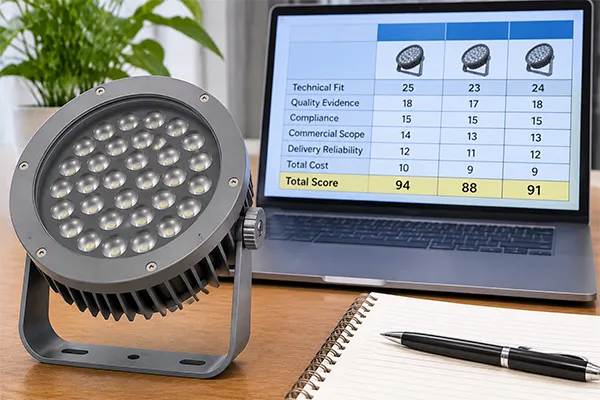
We can make a final decision by scoring normalized quotations across technical fit, quality evidence, compliance relevance, commercial scope, delivery reliability, and total landed cost. We should first eliminate offers that do not meet non-negotiable project requirements, then compare the remaining offers based on their documented value and supply risk.
Use a two-stage review
We recommend a simple two-stage process.
Stage 1: Pass/fail requirements
First, remove any quotation that does not meet the project’s essential requirements. These may include:
- Required wattage range and claimed output
- Required voltage and frequency
- Required beam angle or lighting layout
- Required IP level or environmental design
- Required mounting arrangement
- Required documentation for the destination market
- Required delivery deadline
- Required branding or packaging specification
Stage 2: Weighted supplier comparison
Then, score the quotations that remain. The weighting should reflect the project’s real risks.
| Evaluation category | Example weighting | Questions to ask |
|---|---|---|
| Technical fit | 30% | Does the configuration match the application? |
| Quality and durability evidence | 20% | Is the design and QC information clear? |
| Compliance relevance | 15% | Do documents match the model and market need? |
| Commercial scope | 15% | Are accessories, packaging, and warranty comparable? |
| Delivery and communication | 10% | Is the lead time clear and feasible? |
| Price and landed cost | 10% | What is the actual total procurement cost? |
The percentages above are examples, not universal rules. A contractor facing a strict project deadline may assign more weight to delivery. A brand importing under its own label may assign more weight to customization, packaging control, and batch consistency.
Confirm the production sample and approved specification
Before bulk production, we suggest that buyers maintain an approved specification sheet. This document should include the selected model, electrical data, CCT, beam angle, finish, branding, accessories, packaging, labels, and agreed commercial terms.
In a recent type of quotation clarification we often encounter, a buyer asks us to match a “100W IP66 floodlight” from another supplier. We cannot determine equivalence from that description alone. We need to clarify output, optical distribution, driver type, housing finish, cable, bracket, carton, and destination-market documents. Once those details are normalized, the buyer can compare the offers more fairly.
This process may take more time at the quotation stage, but it can reduce avoidable revisions after a purchase order is issued.
Frequently Asked Questions
Should we choose the cheapest LED flood light quotation?
We should not choose solely by the lowest unit price. We should first confirm that all quotations cover the same technical specification, accessories, warranty, documents, packaging, and delivery terms. A lower-priced offer may be appropriate if it meets the same defined requirements and acceptable supply-risk level.
Are two LED floodlights with the same wattage equivalent?
No, we should not assume equivalence from wattage alone. Two products with the same wattage may differ in claimed lumen output, beam angle, driver configuration, color temperature, heat dissipation, surge protection, bracket design, and warranty scope. We should compare the complete quoted configuration.
Does an IP66 rating guarantee long outdoor service life?
An IP66 rating does not guarantee identical outdoor durability across all products or environments. We should ask about housing materials, seals, cable entry, lens construction, thermal design, corrosion considerations, and warranty coverage. We should also verify suitability for demanding environments with qualified professionals where necessary.
How should we verify CE or RoHS documents for floodlights?
We should check whether the document identifies the quoted model, configuration, manufacturer, and relevant requirement. We should also verify destination-market and project-specific obligations. CE and RoHS documents may be relevant, but they should not be treated as automatic proof that every product configuration meets every country’s requirements.
What should a complete LED floodlight quotation include?
A complete quotation should include technical specifications, unit price, MOQ, lead time, included accessories, packaging, sample terms, customization details, warranty scope, shipping terms, and relevant compliance documents. We should request clarification in writing for any field that is missing or unclear.
Conclusion
Comparing LED flood light manufacturers is not a price-ranking exercise. We should normalize the actual product specification, quality evidence, compliance documents, and commercial scope before we judge value. Equal wattage, IP ratings, and certificate names do not automatically mean equal products. A clear comparison sheet, approved specification, and supplier scorecard can help us reduce lighting-performance mismatch, missing-scope costs, and bulk-supply uncertainty. If you are evaluating floodlight quotations, we invite you to send Upward Lighting your specification so we can provide a clear, comparable OEM/ODM quotation.
"Optical metrology for LEDs and solid state lighting", https://tsapps.nist.gov/publication/get_pdf.cfm?pub_id=840989. A watt denotes electrical power input, whereas the lumen denotes luminous flux; fixture photometry further determines how that flux is distributed over an illuminated area. Evidence role: definition; source type: institution. Supports: Definitions of watts as electrical power and lumens as luminous flux, and the role of photometric distribution in lighting performance.. Scope note: These definitions do not by themselves determine whether a particular floodlight is suitable for a specific installation. ↩
"Optical metrology for LEDs and solid state lighting", https://tsapps.nist.gov/publication/get_pdf.cfm?pub_id=840989. Luminous efficacy expresses luminous flux relative to power input and is commonly reported in lumens per watt (lm/W). Evidence role: definition; source type: government. Supports: The definition of luminous efficacy and its expression in lumens per watt.. ↩
"Energy Efficiency of LEDs", https://www1.eere.energy.gov/buildings/publications/pdfs/ssl/led_energy_efficiency.pdf. LED luminaire output depends on the interaction of LED operating conditions, driver performance, thermal management, and optical losses, so nominally similar fixtures can report different luminous-flux values. Evidence role: mechanism; source type: research. Supports: That LED junction temperature, optical losses, and driver operation can affect the light output of an LED luminaire.. Scope note: The evidence explains potential causes of variation but cannot determine whether any individual supplier's stated lumen value is accurate. ↩
"CALiPER Application Summary Report 20: LED PAR38 Lamps", https://www1.eere.energy.gov/buildings/publications/pdfs/ssl/caliper_20_summary.pdf. Beam angle describes the angular spread of a luminaire's intensity distribution; a wider distribution generally covers a larger area, while a narrower distribution concentrates light within a smaller target region. Evidence role: mechanism; source type: education. Supports: That a luminaire's beam angle and intensity distribution influence coverage area and illuminance on the target surface.. Scope note: Actual illuminance also depends on mounting height, aiming, distance, surrounding reflectance, and the complete photometric distribution. ↩
"The Impact of Circadian Lighting Design Strategies on ...", https://www.energy.gov/sites/default/files/2023-01/ssl-2023_circadian-lighting-design-strategies-office-space.pdf. Lighting-design guidance evaluates illuminance, uniformity, and glare using application-specific photometric calculations rather than relying on a fixture's catalogue or quotation data alone. Evidence role: expert_consensus; source type: institution. Supports: That lighting design uses photometric calculations to assess illuminance, uniformity, and glare for a particular installation.. Scope note: The required calculation method and acceptance criteria vary by application, jurisdiction, and project specification. ↩
"Understanding LED Color-Tunable Products", https://www.energy.gov/cmei/ssl/understanding-led-color-tunable-products. Correlated color temperature (CCT) describes the chromatic appearance of white light; lower-CCT sources are generally perceived as warmer and higher-CCT sources as cooler. Evidence role: definition; source type: government. Supports: That correlated color temperature characterizes the apparent warm or cool appearance of white light and that higher values generally appear cooler.. Scope note: Perceived appearance can also be influenced by surrounding colors, adaptation, and the source's spectral power distribution. ↩
"The Eye of the Beholder: How Lighting Affects Our Color ...", https://www.nist.gov/blogs/taking-measure/eye-beholder-how-lighting-affects-our-color-perception. Color-rendering measures, including CRI, characterize how illumination affects the appearance of object colors and are therefore relevant where color discrimination is an application requirement. Evidence role: general_support; source type: government. Supports: That color-rendering measures characterize how a light source affects the appearance and discrimination of object colors.. Scope note: CRI is not a complete predictor of color fidelity, and some applications may use additional metrics or project-specific criteria. ↩
"LED Site Lighting Performance Specifications", https://betterbuildingssolutioncenter.energy.gov/sites/default/files/attachments/led-site-lighting-performance-specification.pdf. Outdoor luminaires may experience moisture, particulate contamination, temperature variation, solar ultraviolet exposure, and mechanical stress, all of which can influence enclosure, optical, electrical, and mounting-system reliability. Evidence role: general_support; source type: research. Supports: That outdoor LED luminaires are subject to environmental stresses that can affect reliability and material performance.. Scope note: The severity and relevance of each exposure depend on the installation site, orientation, climate, and maintenance conditions. ↩
"IP code", https://en.wikipedia.org/wiki/IP_code. IEC 60529 defines the IP Code as a classification of enclosure protection against access to hazardous parts, ingress of solid foreign objects, and ingress of water under specified test conditions. Evidence role: definition; source type: institution. Supports: The IEC IP Code framework for classifying enclosure protection against solid-object ingress and water ingress under prescribed tests.. Scope note: An IP classification addresses the tested ingress conditions; it does not by itself establish overall product durability, corrosion resistance, or service life. ↩
"The Latest in LED Lighting Test Method and Standards", https://www.energystar.gov/sites/default/files/asset/document/Lighting_Test_Methods_and_Standards-Jiao.pdf. Documented production-inspection procedures and retained quality records are the appropriate evidence for verifying a manufacturer's stated pre-shipment aging or burn-in process. Evidence role: general_support; source type: institution. Supports: That a production test claim should be supported by documented quality-management and inspection records.. Scope note: A quality-management source cannot independently verify that Upward Lighting performs 100% testing or that the stated four-to-eight-hour duration applies to every shipment. ↩
"IESNA LM-80-08 and TM-21-11 - eere.energy.gov", https://www1.eere.energy.gov/buildings/publications/pdfs/ssl/msslc-sw2011_hodapp.pdf. IES lumen-maintenance methods use measured LED light-output data over extended operating periods and prescribed extrapolation procedures to estimate long-term lumen maintenance; a short pre-shipment burn-in may screen for early failures but is not equivalent to such evidence. Evidence role: mechanism; source type: institution. Supports: That long-term LED lumen-maintenance projections are based on standardized lumen-maintenance measurements and extrapolation methods such as IES LM-80 and TM-21.. Scope note: This does not show that a particular product will achieve a specified service life, because complete-luminaire performance also depends on drivers, thermal design, optics, and operating conditions. ↩
"RoHS", https://en.wikipedia.org/wiki/RoHS. European Commission guidance explains that CE marking applies where relevant EU harmonised legislation requires it, while the RoHS framework restricts specified hazardous substances in electrical and electronic equipment placed on the EU market. Evidence role: historical_context; source type: government. Supports: That CE marking may be required for products within applicable EU harmonized legislation and that the RoHS Directive restricts certain hazardous substances in electrical and electronic equipment.. Scope note: Applicability depends on the product, its configuration, the relevant legislation, and the market in which it is placed; CE marking and RoHS are not universal certifications for all countries. ↩