

Importing LED flood lights from China can look simple when buyers compare wattage, quantity, and unit price. However, an unsuitable beam angle, inconsistent driver, missing market document, or delayed customization can create costly problems after delivery. I recommend treating each purchase as a complete procurement decision, not a price-only comparison.
Importing LED flood lights from China requires buyers to confirm application fit, product construction, market compliance requirements, customization limits, and delivery conditions before comparing quotations. The best supplier is not automatically the lowest-priced supplier; it is the supplier that can provide a comparable specification, verifiable documents, consistent bulk production, and a realistic delivery plan for the intended project.
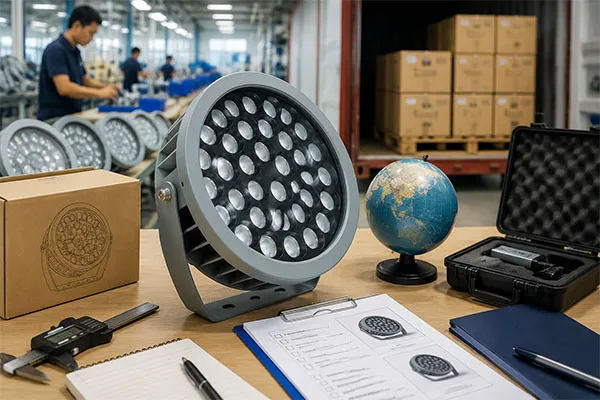
I have handled many overseas flood light inquiries where the first message includes only “200W, 500 pieces, best price.” That is a useful starting point, but it is not enough for an accurate recommendation. The questions that follow often decide whether the final product fits the site, budget, deadline, and local market.
Why Does Application Information Matter When Importing LED Flood Lights from China?
When importing LED flood lights from China, buyers often begin with a wattage request because wattage is easy to compare. Yet wattage alone cannot explain where the light will be installed, how far it must throw light, or whether the project requires glare control1. A low price can become expensive if the fixture does not perform appropriately on site.
Buyers should define the lighting task before requesting a flood light quotation. Key information includes installation height, target area dimensions, throw distance, required brightness, beam angle, mounting position, and glare expectations. These details help suppliers propose a more relevant LED flood light configuration, although final lighting design should be reviewed by a qualified professional when project requirements are critical.
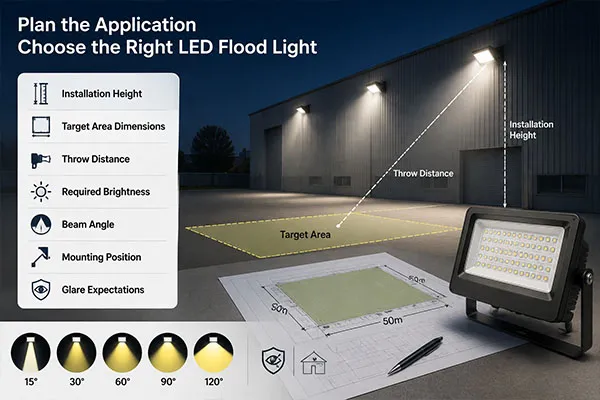
Start With the Lighting Geometry
A flood light is not selected only by its claimed wattage or lumen output. The same nominal power may be suitable for very different applications depending on where and how it is used.
For example, I often receive questions like:
“Can you quote 200W LED flood lights for a sports field?”
My first response is usually not a price. I ask several counter-questions:
- What sport will be played on the field?
- What are the field dimensions?
- What is the pole height?
- How many fixtures will be installed?
- What is the distance between poles?
- Is the goal general area lighting, training lighting, or competition-level lighting?
- Does the project require glare limitation?
- Does the buyer have a lighting calculation or photometric requirement?
A 200W fixture may be used in one project as a wall-mounted yard light and in another as part of a multi-fixture sports lighting layout. These are not comparable applications.
Match Beam Angle to the Site
Beam angle affects how light is distributed across the target area2. A narrow beam can project light farther, while a wider beam can cover a broader area at shorter distances3. Neither option is universally better.
| Application Factor | Procurement Question | Why It Matters |
|---|---|---|
| Installation height | How high will the fixture be mounted? | Height affects coverage and light distribution requirements. |
| Throw distance | How far is the target area from the fixture? | Longer distances may require different optics. |
| Coverage area | What width and length must be illuminated? | The area helps determine fixture quantity and beam pattern. |
| Mounting direction | Will the light face downward, outward, or across a site? | Orientation affects glare, shadows, and aiming needs. |
| Surrounding environment | Are there roads, homes, cameras, or neighboring buildings nearby? | Light spill and glare may need attention. |
Avoid “Same Wattage” Comparisons
When importing LED flood lights from China, I encourage buyers to compare like with like. Two 100W flood lights can look almost identical in photographs but have different internal designs and procurement risks4.
The differences may include:
- LED source configuration
- Driver brand, driver design, and input range
- Heat sink structure and material thickness
- Lens material and beam distribution
- Housing finish and corrosion resistance
- Cable specification and connector options
- Surge-protection arrangement, where applicable
- Assembly procedures
- Quality-control checkpoints
I do not consider any single specification a universal proof of site suitability. A listed wattage, a claimed lumen figure, or an IP rating should be reviewed together with the intended application, technical documents, samples, and applicable project requirements.
For larger projects, I recommend that buyers obtain a lighting layout from a qualified lighting designer or engineer. A supplier can support product data and sample evaluation, but an on-site installation and local design review remain important for application-specific decisions.
How Can Buyers Compare LED Flood Light Quality Beyond Unit Price?
A low quotation can be attractive, especially when buyers are managing tender budgets or competing in a price-sensitive market. However, a unit price does not show how a flood light is configured internally or how consistently it will be assembled in bulk. Buyers need a structured way to compare products before making a final decision.
LED flood light quality should be evaluated through the full product configuration: light source, driver, thermal design, optical system, housing material, cable, sealing structure, finish, and production control. Buyers should request a written specification and compare samples against the approved bulk-order standard rather than relying on product photos or wattage claims alone.
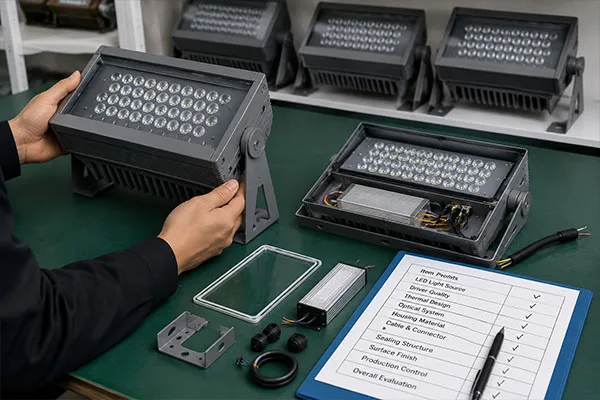
Review the Product as a System
An LED flood light works as a system5. The LED components, driver, heat dissipation structure, optics, seals, and assembly all interact. If one area is unsuitable for the project environment, overall reliability may be affected.
I have seen buyers compare only three figures:
- Wattage
- Lumen claim
- Unit price
Those figures are important, but they do not reveal the full configuration. I suggest asking suppliers for a specification sheet that identifies the critical construction details.
| Component Area | What Buyers Can Ask | Procurement Value |
|---|---|---|
| LED source | What LED package or source configuration is used? | Helps establish a more comparable product basis. |
| Driver | What input voltage range and driver configuration are offered? | Supports evaluation of grid compatibility and service expectations. |
| Heat sink | What is the housing material and thermal structure? | Helps assess suitability for operating conditions. |
| Optics | What beam angles or lens options are available? | Supports application-specific lighting planning. |
| Housing finish | What surface treatment is used? | Relevant for outdoor exposure and corrosion risk. |
| Cable and connector | What cable length, material, and plug options are supplied? | Reduces installation and market compatibility issues. |
| Markings | What labels are printed on the product and carton? | Helps coordinate buyer branding and market requirements. |
Ask for Sample-to-Bulk Consistency Controls
A good sample is useful, but the real procurement challenge is consistency across the bulk order6. This issue matters for importers, distributors, project contractors, and local lighting brands because a shipment may contain hundreds or thousands of fixtures.
At our factory, I treat the approved sample as a reference point that should be documented before bulk production. The purchase order should identify the confirmed configuration, such as:
- Model number
- Power rating
- Input voltage
- CCT
- Beam angle
- Housing color
- Cable length
- Branding requirements
- Packaging design
- Required labels
- Quantity and shipment schedule
We perform 100% aging tests before shipment, generally lasting 4 to 8 hours, as part of our manufacturing process. We also coordinate outgoing inspections before delivery. These practices can reduce manufacturing risk, but I do not present them as a guarantee of lifetime, site performance, or legal compliance in every market.
Buyers should still define their own inspection criteria. For a higher-value order, they may use an internal quality team or a qualified third-party inspection provider to check appearance, labeling, quantity, packaging, function, and agreed product specifications before shipment.
Request Evidence, Not Assumptions
Photos are useful for a first review, but they are not enough for technical procurement. I recommend requesting:
- Product data sheet
- Dimensional drawing
- Packaging details
- Product and carton label artwork
- Available test reports or compliance documents
- Sample photos and videos
- Production photos, where appropriate
- Inspection requirements
- Written warranty terms
- A clear Incoterm quotation
These documents help buyers create a file that can be reviewed by procurement, engineering, compliance, logistics, and sales teams.
What Market and Environmental Requirements Should Buyers Confirm?
Market requirements should be discussed before an order is placed, not after production is complete. Voltage, local grid conditions, outdoor exposure, corrosion risk, labels, and required documents can all affect product selection. A fixture that is acceptable for one market may require changes for another market or project.
When importing LED flood lights from China, buyers should confirm the destination market, voltage and frequency, outdoor environment, required ingress protection, corrosion exposure, labeling needs, and compliance documents before approving a sample. Buyers should verify whether CE, RoHS, or other documents are relevant and sufficient for their specific market, customer, or project7.
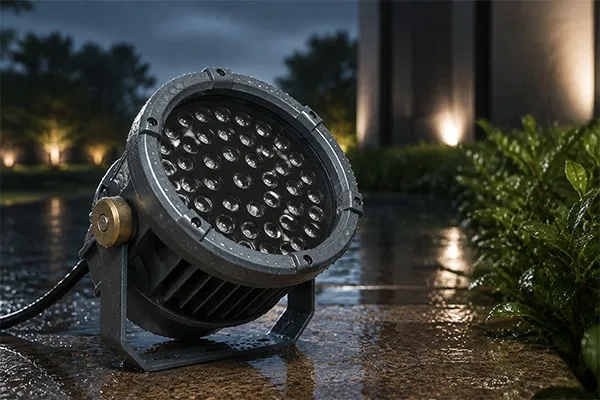
Confirm Electrical Conditions Early
Electrical requirements are not a minor detail. Buyers should confirm the target voltage and frequency at the quotation stage. They should also consider whether the local electrical environment has unstable grid conditions, frequent surges, or project-specific control systems.
Important questions include:
- What input voltage is required?
- What frequency applies in the destination market?
- Does the installation require a plug, terminal block, or hardwired connection?
- Is a specific cable length required?
- Does the project require compatibility with photocells, timers, or external controls?
- Does the buyer need a particular surge-protection arrangement?
A supplier can provide available product configurations, but the installer or qualified electrical professional should confirm local installation suitability.
Consider Outdoor Exposure Honestly
Outdoor flood lights may be installed in very different conditions: dry inland areas, humid coastal locations, dusty industrial yards, rainy regions, hot climates, or cold environments. Buyers should state these conditions clearly.
For example, a contractor sourcing lights for a coastal project should identify the salt-air and corrosion concerns early. A buyer sourcing for a warehouse exterior should explain whether the lights will face direct rain, dust, vibration, or chemical exposure.
The following information is useful:
| Environmental Condition | Buyer Information to Provide |
|---|---|
| Rain and water exposure | Is the fixture exposed directly to rain or mounted under cover? |
| Dust and particles | Is the site near construction, mining, factories, or roads? |
| Coastal conditions | Is the project near saltwater or in a high-humidity coastal area? |
| Ambient temperature | What temperature range is expected at the site? |
| Corrosive atmosphere | Are chemicals, fertilizer, industrial fumes, or cleaning agents present? |
| Physical exposure | Is there a risk of vibration, impact, or tampering? |
An IP rating can be relevant, but it is not a complete statement of suitability for every outdoor condition8. Buyers should review the rating, product construction, installation details, and actual environmental risks together.
Verify Compliance Documents for the Actual Market
Our products may be supplied with documents such as CE and RoHS, depending on the model and order requirements. However, I always recommend that buyers verify the relevance, scope, validity, and project acceptance of any document before purchase.
A document request should be specific:
- Which product model does the document cover?
- Does the document match the planned electrical configuration?
- Is the document current?
- Does the target market or project require additional testing?
- Does the buyer need a particular label, language, or importer information?
- Does a local authority, consultant, or customer need to review the documents?
Neither a certificate name nor a supplier statement should replace local regulatory review9. Importers and project buyers should consult qualified compliance professionals where the legal or contractual requirement is unclear.
How Do Customization and Delivery Terms Affect LED Flood Light Imports?
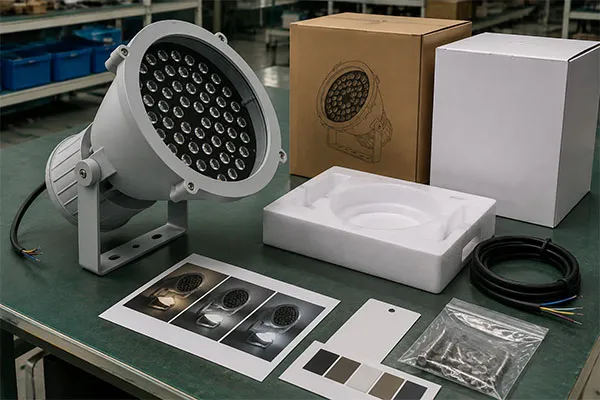
Customization can help a buyer build a differentiated local brand or meet a project requirement. Yet every change can affect minimum order quantity, material preparation, sample lead time, production scheduling, and delivery risk10. Buyers should make customization visible before they compare supplier lead times.
Customization for LED flood lights can include wattage, CCT, beam angle, housing finish, cable, packaging, labels, and branding. Buyers should confirm these requirements at the inquiry stage because custom specifications may change MOQ, sample approval steps, material availability, production time, and the final price when importing LED flood lights from China.
Define What Is Standard and What Is Custom
Some buyers assume that all catalog options are immediately available. In reality, the answer depends on the model, order quantity, component availability, and production schedule.
At our factory, buyers may request OEM or ODM adjustments such as:
- Different color temperatures
- Alternative wattages
- Beam angle or lens options
- Housing dimensions for selected product types
- Color rendering index requirements
- Powder-coating or housing finish colors
- Private labels
- Customized cartons
- Instruction manual changes
- Brand logos
Each request should be reviewed against the specific model. A small change in a label may be straightforward. A change in optics, housing dimensions, driver configuration, or custom packaging may require more preparation.
Protect the Approved Sample
The approved sample should not be treated as an informal reference. It should become part of the procurement record. I recommend keeping a documented sample approval process.
A practical sequence is:
- Confirm the technical specification.
- Request a quotation based on that specification.
- Approve artwork, labels, and packaging if branding is required.
- Order and evaluate a sample where appropriate.
- Record any changes in writing.
- Issue a purchase order with the final approved configuration.
- Confirm inspection requirements before mass production finishes.
- Check final packing marks and shipping documents before dispatch.
This process helps avoid a common problem: the buyer approves one sample but later changes several details through chat messages without updating the purchase order. Those gaps can create misunderstandings.
Plan the Delivery Backward From the Site Deadline
Delivery planning involves more than factory production time11. Buyers should work backward from the required arrival date and include:
- Sample confirmation time
- Artwork approval time
- Material preparation
- Production lead time
- Aging and outgoing inspection
- Booking time
- Sea, air, rail, or courier transit time
- Customs clearance
- Inland transport to the warehouse or project site
For urgent projects, I recommend that buyers identify the immovable deadline at the beginning. A supplier can then discuss whether standard stock, partial shipment, alternative freight, or a simplified customization plan may be realistic. No supplier should promise a delivery date without checking the product configuration and current production schedule.
What Should an RFQ Include When Importing LED Flood Lights from China?
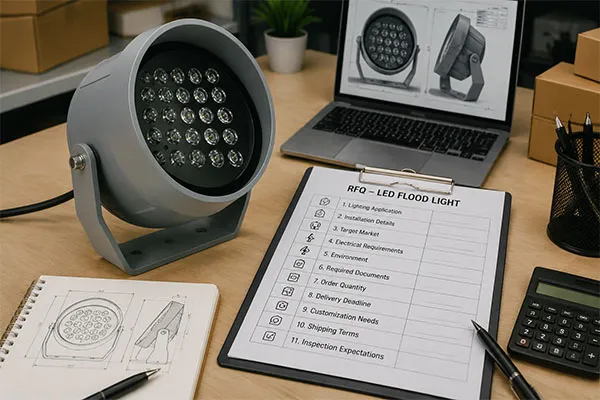
A detailed RFQ saves time for both buyers and suppliers. It gives the supplier enough information to recommend a more relevant configuration, prepare a clearer quotation, and identify risks before production starts. It also makes competitor quotations more comparable.
The best RFQ for importing LED flood lights from China includes the lighting application, installation details, target market, electrical requirements, environment, required documents, order quantity, deadline, customization needs, shipping terms, and inspection expectations. Buyers should compare price only after suppliers quote against the same confirmed technical and commercial conditions.
Use This Buyer-Ready RFQ Checklist
I suggest that buyers send the following information with their first inquiry.
1. Application and Lighting Geometry
- Application: yard, building façade, parking area, sports court, construction site, warehouse exterior, billboard, or other use
- Installation height
- Mounting location and direction
- Target area dimensions
- Throw distance
- Number of fixtures required
- Beam angle preference, if known
- Glare-control or light-spill concerns
- Lighting calculation or drawing, if available
2. Market and Technical Conditions
- Destination country or region
- Input voltage and frequency
- Required plug, cable, or terminal arrangement
- Weather exposure and installation environment
- Corrosion, humidity, dust, or temperature concerns
- Required labels
- Required compliance documents or test reports
- Any consultant, tender, or customer specification
3. Commercial Requirements
- Required quantity
- Sample quantity
- Target delivery date
- Preferred shipping method
- Destination port or delivery location
- Preferred Incoterm, such as EXW, FOB, CIF, or DDP where applicable
- Target price range, if the buyer wishes to share it
4. Customization Requirements
- Required wattage
- CCT
- Beam angle
- Housing color or surface finish
- Brand logo
- Private label details
- Customized packaging
- Instruction manual language
- Barcode, carton mark, or importer details
5. Quality and Consistency Requirements
- Sample approval process
- Required aging-test information
- Pre-shipment inspection requirement
- Third-party inspection arrangement, if needed
- Accepted appearance standard
- Packaging protection expectations
- Bulk goods consistency requirements
Compare Quotations on an Aligned Basis
A quotation comparison is meaningful only when the products and terms are aligned12. Buyers should avoid comparing Supplier A’s standard 100W model with Supplier B’s custom 100W model if the driver, voltage, optic, cable, packaging, compliance scope, and delivery terms are different.
I recommend building a simple comparison table before selecting a supplier:
| Comparison Item | Supplier A | Supplier B | Supplier C |
|---|---|---|---|
| Confirmed model and wattage | |||
| Input voltage | |||
| Beam angle | |||
| CCT and CRI | |||
| Driver configuration | |||
| Housing finish | |||
| Sample availability | |||
| Compliance documents provided | |||
| Packaging and branding | |||
| Aging and inspection process | |||
| Production lead time | |||
| Shipping term | |||
| Unit price | |||
| Total landed-cost estimate |
This method keeps the discussion practical. It also helps purchasing teams explain why the lowest unit quote may not be the lowest-risk option.
Frequently Asked Questions
Is it safe to import LED flood lights from China?
Importing LED flood lights from China can be a workable sourcing strategy when buyers conduct supplier due diligence, approve specifications, verify required documents, review samples, and define inspection requirements. Buyers should also confirm local regulatory obligations and use qualified professionals for application-specific electrical and lighting decisions.
What information should I send to an LED flood light supplier?
Buyers should provide the application, installation height, target coverage area, beam angle preference, voltage, destination market, environmental conditions, quantity, delivery deadline, required documents, and customization needs. This information helps a supplier prepare a more relevant quotation and reduces avoidable revisions later.
Are CE and RoHS documents enough for every LED flood light project?
No. CE and RoHS may be relevant for some products and markets, but buyers should verify whether these documents apply to the specific model, destination, project, and customer requirement. Local regulations, tender specifications, and importer obligations may require additional review or documentation.
Why do LED flood lights with the same wattage have different prices?
The price difference may relate to driver configuration, LED source, optical components, housing material, thermal structure, cable, finish, packaging, compliance-document support, quality controls, and order quantity. Buyers should compare written specifications and commercial terms instead of wattage and appearance alone.
Should I order a sample before placing a bulk LED flood light order?
A sample can help buyers review appearance, dimensions, mounting, light distribution, packaging, and selected specifications. However, buyers should document the approved sample configuration and make sure the bulk purchase order reflects it. Samples do not replace site validation, third-party testing, or regulatory review where required.
Conclusion
Importing LED flood lights from China is most successful when buyers start with the site requirement rather than the unit price. I recommend confirming lighting geometry, electrical conditions, environmental exposure, compliance-document needs, customization details, quality controls, and delivery timing before approving a quotation. A written RFQ and documented sample approval process can make supplier comparisons more accurate and reduce avoidable after-sales issues. If you are sourcing LED flood lights for a project, distribution program, or private-label brand, send us your application details and procurement requirements so we can prepare a clearer, more comparable proposal.
"CALiPER Application Summary Report 20: LED PAR38 Lamps", https://www1.eere.energy.gov/buildings/publications/pdfs/ssl/caliper_20_summary.pdf. Lighting guidance explains that luminaire selection requires photometric data, mounting conditions, target illuminance, and glare considerations; rated wattage alone does not establish application suitability. Evidence role: general_support; source type: institution. Supports: Lighting selection should be based on photometric performance and installation geometry, including illuminance distribution and glare, rather than wattage alone.. Scope note: The guidance supports the general design principle but does not determine the correct fixture for a particular site without a project-specific lighting calculation. ↩
"CALiPER Application Summary Report 20: LED PAR38 Lamps", https://www1.eere.energy.gov/buildings/publications/pdfs/ssl/caliper_20_summary.pdf. Lighting references define beam angle as the angular width of a beam at a specified intensity level, a property that directly affects the spread of light over a target surface. Evidence role: mechanism; source type: government. Supports: Beam angle describes the angular spread of a luminaire's emitted light and affects the area over which illuminance is distributed.. Scope note: Beam angle alone does not predict final site illuminance because mounting height, aiming, fixture output, and surrounding surfaces also affect results. ↩
"Chapter 11 - Street Lighting", https://www.intrans.iastate.edu/wp-content/uploads/sites/15/2020/03/Chapter_11.pdf. Photometric principles show that a narrower optical distribution concentrates light into a smaller solid angle, whereas a wider distribution spreads light across a broader area. Evidence role: mechanism; source type: education. Supports: For a given light output, narrower optical distributions concentrate luminous flux and wider distributions spread it across a larger angular area.. Scope note: The statement is a general optical relationship; actual throw distance and coverage must be verified from the luminaire's photometric file and installation geometry. ↩
"LED Luminaire Reliability: Impact of Color Shift", https://www.energy.gov/sites/prod/files/2017/04/f34/lsrc_colorshift_apr2017.pdf. Research on LED luminaires identifies drivers, thermal conditions, optical systems, and component integration as factors affecting performance and reliability beyond a product's nominal wattage. Evidence role: general_support; source type: research. Supports: LED luminaire performance and reliability depend on system-level design factors such as drivers, thermal management, optics, and construction, not solely on rated wattage.. Scope note: This supports the importance of configuration-level comparison but does not establish the quality of any particular 100 W product. ↩
"LED Luminaire Reliability: Impact of Color Shift", https://www.energy.gov/sites/prod/files/2017/04/f34/lsrc_colorshift_apr2017.pdf. LED-luminaire research characterizes the fixture as an integrated electrical, thermal, optical, and mechanical system in which component interactions influence output, temperature, and reliability. Evidence role: mechanism; source type: paper. Supports: LED luminaire operation is determined by interacting electrical, optical, thermal, and mechanical subsystems.. Scope note: System-level research does not substitute for testing the specific product model, operating environment, or installation. ↩
"Quality and Consistency of Machined Components and ...", https://www.nist.gov/system/files/documents/oles/2-Donmez-Alkan-Manufacturing-2012-07-10-MSSFFA.pdf. Quality-management guidance describes process control, documented requirements, and verification activities as mechanisms for maintaining conformity between specified products and serial production. Evidence role: general_support; source type: institution. Supports: Quality-management systems emphasize controlling production processes and verifying conformity so that manufactured goods consistently meet approved requirements.. Scope note: General quality-management principles do not demonstrate that a given supplier's bulk shipment will match an approved sample. ↩
"CE marking – obtaining the certificate, EU requirements", https://europa.eu/youreurope/business/product-rules-compliance/general-product-compliance/ce-marking/index_en.htm. European Commission guidance states that CE marking is required only for products covered by applicable EU harmonisation legislation, while RoHS compliance concerns substance restrictions for electrical and electronic equipment within the directive's scope. Evidence role: expert_consensus; source type: government. Supports: CE marking applies only where relevant EU harmonisation legislation requires it, while RoHS addresses restrictions on certain hazardous substances in covered electrical and electronic equipment.. Scope note: EU guidance does not establish compliance in non-EU markets or confirm that a particular supplier document is valid for a specific product configuration. ↩
"IP code", https://en.wikipedia.org/wiki/IP_code. IEC 60529 defines IP codes in terms of protection against access to hazardous parts and the ingress of solid objects and water; the classification does not, by itself, rate corrosion, ultraviolet exposure, chemical resistance, or all installation conditions. Evidence role: definition; source type: institution. Supports: IEC 60529 IP codes classify enclosure protection against access, solid foreign objects, and water ingress, rather than all environmental durability factors.. Scope note: Additional standards, material data, and project-specific assessment may be necessary to evaluate environmental durability. ↩
"Importers and distributors - Internal Market, Industry ...", https://single-market-economy.ec.europa.eu/single-market/goods/ce-marking/importers-and-distributors_en. Official product-compliance guidance assigns importers and other economic operators responsibilities to verify applicable conformity assessment, technical documentation, marking, and product information before placing products on the market. Evidence role: general_support; source type: government. Supports: Importers and other economic operators are responsible for checking applicable conformity information and ensuring that products placed on a market meet relevant requirements.. Scope note: The exact legal obligations vary by jurisdiction, product category, and supply-chain role. ↩
"Production Lead Time Research Papers", https://www.academia.edu/Documents/in/Production_Lead_Time. Operations-management research finds that product variation and engineering changes can introduce material, approval, and scheduling requirements that affect production lead times and delivery performance. Evidence role: mechanism; source type: paper. Supports: Engineering and customization changes can require new materials, process changes, approvals, and scheduling adjustments that influence manufacturing lead time.. Scope note: The magnitude of any impact depends on the specific product change, supplier capacity, inventory position, and transport conditions. ↩
"Know Your Incoterms", https://www.trade.gov/know-your-incoterms. International trade and logistics guidance identifies transport, port handling, customs and border procedures, and inland distribution as separate contributors to end-to-end delivery time. Evidence role: general_support; source type: institution. Supports: International delivery performance is affected by multiple logistics stages, including origin handling, transport, border procedures, and destination movement.. Scope note: Actual transit and clearance durations vary by route, carrier capacity, customs treatment, documentation quality, and destination conditions. ↩
"Standard Bid Evaluation Form Procurement of Goods or ...", https://thedocs.worldbank.org/en/doc/177561604346012659-0290021996/render/StandardBidEvaluationFormProcurementofGoodsorWorks1996.pdf. Procurement guidance recommends evaluating offers against common specifications and defined commercial criteria so that price, quality, delivery, and contractual terms can be compared on a consistent basis. Evidence role: general_support; source type: institution. Supports: Procurement evaluation requires bids to be assessed against stated and comparable technical, commercial, and delivery criteria rather than unit price in isolation.. Scope note: The appropriate evaluation criteria and weighting depend on the buyer's procurement rules, technical needs, and contract conditions. ↩