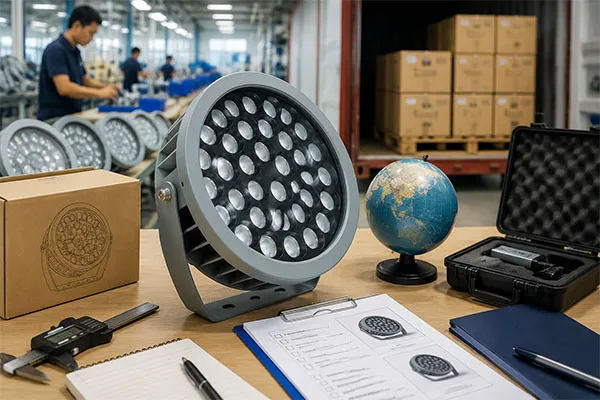

Choosing a reliable LED flood light manufacturer in China can feel difficult when many suppliers offer similar photos, wattages, and certificates. A wrong choice can lead to poor project fit, inconsistent batches, delayed installation, and expensive complaints. We recommend evaluating how a supplier turns real project requirements into documented, repeatable production.
A reliable LED flood light manufacturer in China is a supplier that confirms the application requirements, provides verifiable product and quality-control evidence, maintains consistency from approved sample to mass production, and communicates clearly about changes, lead times, and trade-offs. Buyers should compare more than price, wattage, certificates, or factory images before placing an order.
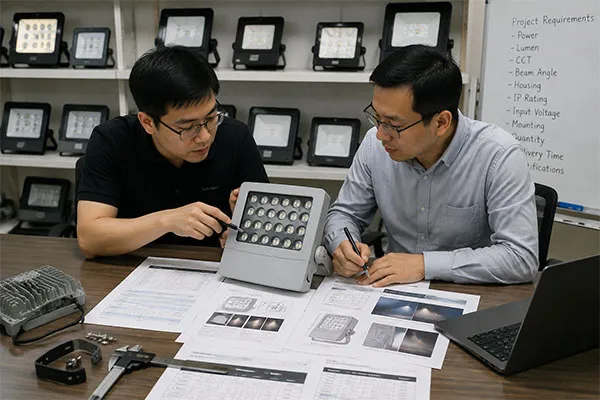
The best sourcing decision usually starts before buyers request a quote. In our experience, the most successful projects begin when contractors, importers, and distributors explain where the floodlights will be installed, what lighting result they expect, and which specifications cannot change.
Why Should You Evaluate Application Fit Before Comparing LED Flood Light Quotes?
A low quote can look attractive, especially when project budgets are tight. However, a floodlight that does not match the mounting height, beam angle, weather conditions, or illumination objective can create more cost after delivery. We encourage buyers to define the application before comparing supplier prices.
Buyers should evaluate LED flood lights against the actual installation environment and lighting target before comparing quotes. Key factors include mounting height, beam angle, glare control, required illumination, ingress protection, ambient temperature, corrosion exposure, and control requirements1. A lower-priced model may still be suitable, but buyers should confirm its configuration and limitations.
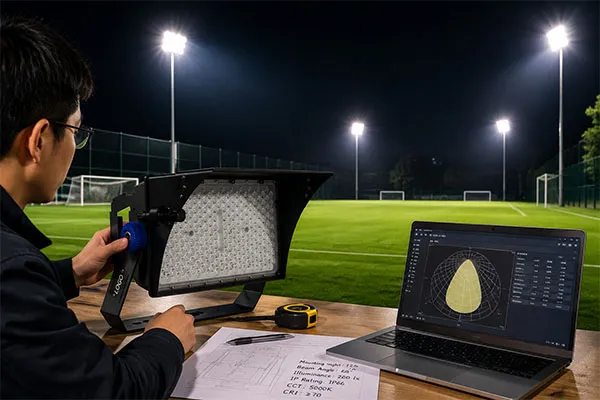
Start With the Lighting Task, Not the Nominal Wattage
Many sourcing inquiries begin with a short request such as, “Please quote your 200W LED floodlight.” We receive these inquiries often. The wattage is useful, but it does not tell us enough about the installation.
Two 200W LED floodlights can have different:
- LED packages and driver configurations
- Optical lenses and beam angles
- Heat-sink designs
- Surge-protection arrangements
- Housing coatings
- Input-voltage ranges
- Light distributions
- Photometric performance
- Intended operating conditions
A narrow beam may be appropriate for a tall mast or focused architectural feature. A wide beam may better suit a yard, facade, loading area, or sports perimeter. Yet a wide beam used from a high mounting position may reduce useful light on the target area. It may also increase spill light and glare.2
Questions We Recommend Buyers Answer First
Before requesting a flood light quotation from China, buyers should prepare a brief project description:
| Project question | Why it matters |
|---|---|
| What is the application? | Car parks, building facades, sports areas, warehouses, ports, and construction sites have different needs.3 |
| What is the mounting height? | Mounting height affects the suitable wattage, beam angle, and light distribution. |
| What area needs illumination? | The dimensions help suppliers recommend an appropriate optic. |
| Is glare a concern? | Roadside, sports, residential, and pedestrian-facing applications may need more careful optical selection. |
| Is the site coastal, humid, dusty, or hot? | Environmental exposure affects housing, gasket, coating, and durability considerations. |
| Is a lighting control system required? | Timers, photocells, DALI, 0–10V, motion sensors, or smart controls require early confirmation. |
| Which destination market applies? | Compliance documents and electrical requirements vary by market and model. |
We have seen projects where the buyer initially selected a floodlight based only on the wattage used in an earlier project. After discussing the new mounting height and installation angle, we found that the same nominal wattage would not create the same result. A few clarification questions before sampling can prevent an unsuitable selection later.
We believe the correct question is not “Which floodlight is cheapest?” It is “Which configuration is suitable for this task, and what evidence supports that choice?”
For critical applications, we recommend that buyers obtain a lighting layout or seek evaluation from a qualified lighting professional.4 A manufacturer can provide product information and recommendations, but site-specific lighting design should be reviewed against the project’s actual conditions and local requirements.
How Can You Assess a Reliable LED Flood Light Manufacturer in China Beyond Certificates?
Certificates and product photos can support supplier evaluation, but they do not prove that every production batch will match the sample. Buyers need evidence of how the supplier controls materials, assembly, aging, inspection, and nonconforming products during normal order execution.
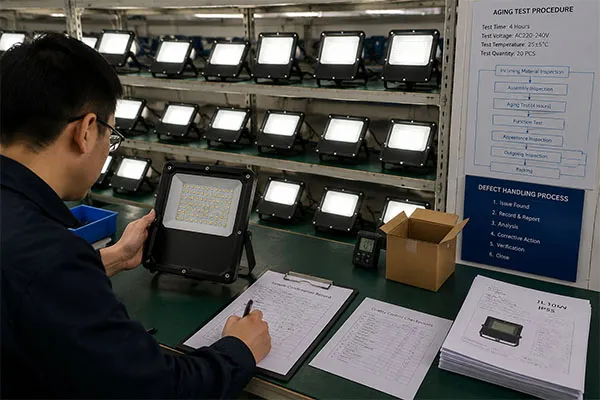
To assess a reliable LED flood light manufacturer in China, buyers should request evidence of order-level quality control rather than relying only on certificates or factory images. Useful evidence includes specification sheets, sample confirmation records, aging-test procedures, inspection checkpoints, outgoing inspection records, defect-handling processes, and documentation for the exact model and destination market.
Verify the Exact Model, Not Only the Company Name
Buyers should treat CE, RoHS, and other certificates as documents to verify for the exact product configuration and destination market. A certificate associated with one product family may not automatically apply to every wattage, driver, cable, plug, control option, or revised housing.5
At our company, we provide CE and RoHS documentation for applicable products, but we also encourage customers to check the documents carefully against their intended model and market. This is particularly important when a buyer requests customization, such as a different driver, color temperature, cable length, lens angle, or surface finish.
Buyers can ask suppliers:
- Does this document cover the exact floodlight model and wattage?
- Does it cover the requested driver and input voltage?
- Is it relevant to the destination market?
- Has the model changed since the document was issued?
- Can the supplier provide the datasheet, labeling details, and supporting records for review?
Look for Process Evidence
Factory size and showroom images may show business scale, but they do not explain what happens when a unit fails an inspection or when an order changes after deposit. We suggest asking practical questions that reveal the supplier’s working process.
| Area to verify | Evidence or question to request |
|---|---|
| Incoming materials | How are LEDs, drivers, housings, lenses, and cables checked before assembly? |
| Assembly control | Which steps are checked during production? |
| Aging test | How long are products aged, and what conditions are monitored? |
| Electrical checks | What tests are performed before packing? |
| Appearance inspection | How are coating defects, scratches, labeling, and assembly issues checked? |
| Outgoing inspection | Is there a pre-shipment check for each order? |
| Nonconforming units | What happens if products do not pass inspection? |
| Traceability | Can the supplier identify the production batch or order record? |
Our own products go through a 100% aging process before shipment, typically for 4 to 8 hours depending on the product and order requirements. We use this as one part of our production control process, not as a guarantee that a product will perform perfectly in every application or for every lifetime expectation. Buyers should ask any supplier what their aging process includes and how they document it.
A reliable supplier should be able to answer such questions directly. They should also explain where their process has limits. Clear answers are more useful than broad claims such as “premium quality” or “zero defect.”
Why Is an Approved Sample Only the Beginning of Floodlight Quality Control?
An approved sample confirms that a buyer has reviewed one unit or a small set of units. It does not automatically ensure that the mass-production batch will use the same key materials, settings, labels, or packaging.6 We advise buyers to convert sample approval into a written production reference.
An approved LED floodlight sample is only the starting point because mass production introduces material sourcing, assembly variation, labeling, packaging, and delivery variables. Buyers should confirm a final specification sheet, critical components, approved appearance, custom requirements, inspection standards, and acceptable tolerances before production begins.
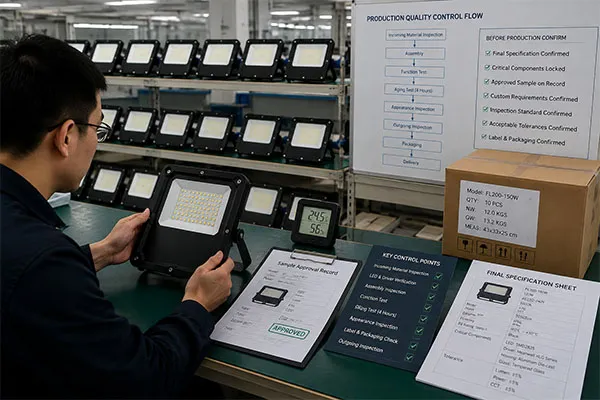
Define What Must Match the Sample
When we handle an OEM or ODM floodlight order, we try to separate preferences from critical requirements. For example, a buyer may want a specific color temperature, but the project may also require a particular beam angle and cable type. These details should not remain only in chat messages.
A useful production confirmation document can include:
- Product model and order quantity
- Nominal wattage and input voltage
- Color temperature and color-rendering requirement
- Beam angle or lens type
- LED and driver configuration, where agreed
- Housing color and surface treatment
- IP rating claim for the exact model
- Cable length, plug, connector, or terminal requirement
- Mounting bracket details
- Product label artwork and carton markings
- Inner and outer packaging details
- Required documents
- Target delivery date and shipping terms
Control Changes Before They Become Problems
In our experience, order changes are common. A customer may change the color temperature after approving the proforma invoice. A contractor may ask for a longer cable after confirming the sample. A distributor may need revised carton artwork because of local branding requirements.
These changes are manageable when they are documented early. They become risky when they are mentioned casually and not transferred into the production record.7
We recommend a simple change-control approach:
- Describe the requested change clearly.
- Confirm whether it affects price, lead time, compliance documents, or minimum order quantity.
- Issue a revised specification, drawing, artwork, or order confirmation.
- Obtain written approval before production continues.
- Check the change during inspection before shipment.
A sample is especially important when buyers require customized LED flood lights. However, the buyer should verify whether the sample used the same materials and configuration planned for mass production. If a sample contains a provisional driver, lens, or housing finish, the supplier should state that clearly.
Agree on Batch Consistency Checks
The buyer and supplier should agree on which characteristics matter most for the batch. These may include appearance, wattage labeling, color temperature range, beam angle, cable length, packaging, and operating checks.
For larger or higher-risk orders, buyers may also consider an independent pre-shipment inspection8. We see this as a normal procurement control, particularly for importers managing remote supply chains. An independent inspector does not replace the factory’s internal checks, but it can provide another layer of verification based on an agreed inspection standard.
How Does Communication Affect LED Flood Light Supplier Reliability?
Product reliability includes execution reliability. Even a well-designed floodlight can create procurement problems if the supplier misunderstands a requirement, gives an unrealistic lead time, fails to document a change, or responds poorly when an issue appears.
Communication affects LED flood light supplier reliability because clear specification confirmation, realistic quoting, documented changes, and responsive issue handling reduce avoidable order errors. Buyers should evaluate how a supplier asks questions, explains trade-offs, confirms commitments, and manages problems—not only how quickly they reply.
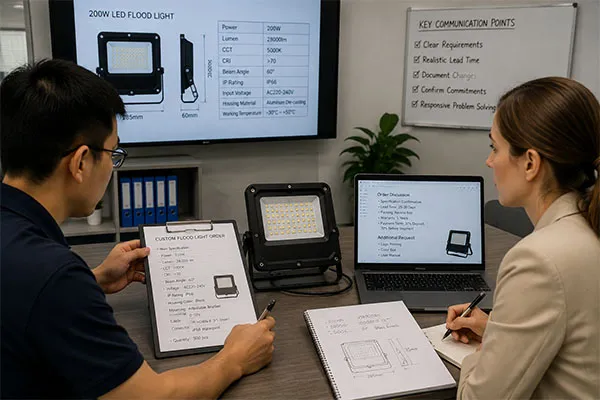
Fast Replies Are Helpful, but Clear Replies Matter More
We know that importers and contractors often work under time pressure. We aim to respond quickly, but we also believe that a quick answer without clarification can create trouble later.
For example, when a buyer asks for an “outdoor floodlight,” we need to understand whether the product is for a facade, a warehouse yard, a sports court, a billboard, or temporary construction lighting. Each situation may influence the recommended optic, power level, mounting method, and durability expectations.
A capable supplier should ask questions when the inquiry is vague. Buyers should see this as a positive sign, not as unnecessary delay.
Evaluate Quote Quality and Commitment Quality
A quotation should make the commercial and technical scope visible. It should not hide important assumptions. We recommend reviewing whether the supplier clearly identifies:
- Product model and configuration
- Unit price and currency
- MOQ, if applicable
- Sample cost and sample lead time
- Mass-production lead time
- Payment terms
- Packaging details
- Shipping terms, such as EXW, FOB, or CIF9
- Validity period for the quotation
- Customization charges or tooling implications
- Any assumptions that affect the price
Low pricing is not automatically a warning sign. Some suppliers have efficient supply chains, lower overhead, or a configuration that genuinely suits the requested budget. However, a significantly lower quote should lead to follow-up questions. Buyers should compare the exact driver, LEDs, housing, optic, cable, surge protection, packaging, warranty terms, and delivery conditions rather than comparing one total price alone.
Assess the Problem-Resolution Workflow
No manufacturer should promise that every international order will be free from unexpected issues. Freight damage, label misunderstandings, specification changes, and installation questions can occur. What matters is how the supplier handles the issue.
We recommend that buyers ask:
- Who is the contact person after the order is placed?
- How are production updates shared?
- What information does the supplier need if a problem is found?
- How are photos, videos, batch numbers, and quantities reviewed?
- What remedies may be available if responsibility is confirmed?
- How quickly does the supplier provide a documented response?
We have found that issue handling works best when both sides use evidence. Clear photos, installation details, product labels, quantities, and a description of the problem help us investigate faster. A supplier should not dismiss a complaint without reviewing facts, and a buyer should not rely only on broad descriptions when requesting support.
For project buyers, communication quality is often visible during sampling. If a supplier cannot organize sample details, explain a configuration difference, or confirm artwork clearly before an order, the same weakness may appear during mass production.
What Questions Should Buyers Ask Before Selecting an LED Flood Light Manufacturer in China?
A supplier conversation can become confusing when buyers request too much general information and too little order-specific evidence. The most useful questions focus on the product, production controls, and execution plan for the actual purchase.
Before selecting an LED flood light manufacturer in China, buyers should ask order-specific questions about application fit, exact configuration, sample-to-production consistency, testing, inspection, documentation, lead time, packaging, and issue handling. Written answers and supporting records are more useful than general marketing claims.
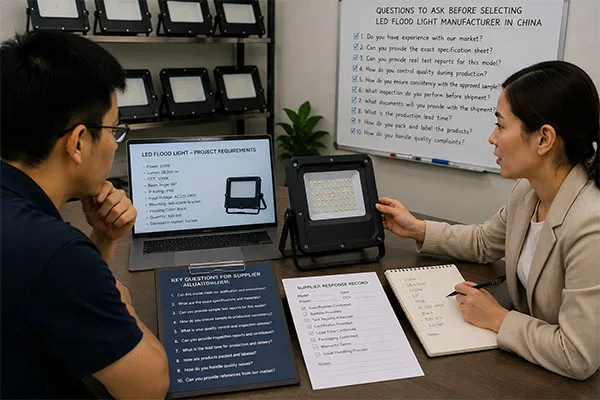
A Practical Pre-Order Question Set
We suggest using the following questions when comparing suppliers:
- Which floodlight configuration do you recommend for our mounting height and target area, and why?
- Which beam angles are available for this exact model?
- Can you provide a datasheet for the quoted version?
- Which components are fixed, and which can be customized?
- Can you provide an approved sample before mass production?
- How will the approved sample specifications be transferred to the production order?
- What aging, electrical, appearance, and outgoing checks do you perform for this order?
- Can you provide product photos, packing photos, or inspection records before shipment?
- What certificates or declarations apply to this exact model and destination market?
- What is the realistic production lead time after final confirmation?
- How will you document any change to color temperature, driver, cable, lens, label, or packaging?
- What is your process if goods arrive with a verified problem?
Compare Supplier Responses Side by Side
Buyers can create a simple comparison table rather than choosing based on price alone.
| Evaluation area | Supplier A | Supplier B | Supplier C |
|---|---|---|---|
| Application questions asked | |||
| Configuration clarity | |||
| Sample availability | |||
| Specification documentation | |||
| Quality-control explanation | |||
| Relevant compliance documents | |||
| Lead-time realism | |||
| Change-control process | |||
| Communication responsiveness | |||
| Total landed-cost clarity |
This process does not need to be complicated. It simply helps buyers make the sourcing decision based on evidence. In our view, the strongest supplier relationship starts when both parties agree on the product definition, commercial terms, inspection expectations, and communication process before production begins.
Frequently Asked Questions
What is the most important factor when choosing an LED flood light supplier?
The most important factor is whether the supplier can match the floodlight configuration to the real application and document that configuration for mass production. Price, certificates, and samples matter, but buyers should also verify quality controls, delivery commitments, and communication practices.
Should I always choose the lowest-priced LED flood light quote?
No. A low-priced quote may be appropriate if the product configuration, quality-control process, packaging, shipping terms, and lead time meet your requirements. Buyers should compare like-for-like specifications and ask what components or services account for major price differences.
How long should LED flood lights be aged before shipment?
There is no single aging period that proves suitability for every product or application. At our factory, products typically undergo 100% aging for 4 to 8 hours before shipment. Buyers should ask each supplier what their aging process covers and how results are checked.
Are CE and RoHS certificates enough to verify a floodlight supplier?
CE and RoHS documents can be important, but they are not enough by themselves.10 Buyers should verify that documents apply to the exact model, configuration, and destination market. They should also assess production consistency, inspection records, and supplier execution capability.
Should I arrange third-party inspection for LED flood light orders?
Third-party inspection can be useful for larger, customized, or project-critical orders. It provides an additional review against agreed requirements. Buyers should define the inspection criteria in advance, because an inspection is only as useful as the product specification and checklist behind it.11
Conclusion
A reliable LED flood light manufacturer in China should offer more than an attractive quotation or polished catalog. Buyers should confirm application fit, evaluate the exact product configuration, turn sample approval into a production reference, and request practical evidence of aging, inspection, and order controls. We also believe clear communication is part of reliability because documented changes and realistic delivery commitments reduce avoidable risk. If you are sourcing customized indoor or outdoor LED lighting for a project, distribution program, or private-label range, we welcome a detailed inquiry and can help review the relevant product requirements.
"Model Specification for LED Roadway Luminaires", https://energy.gov/eere/ssl/downloads/model-specification-led-roadway-luminaires-v20. IEC 60529 defines IP-code classifications for enclosures according to protection against access, solid foreign objects, and water ingress, which is relevant when specifying equipment for exposed environments. Evidence role: definition; source type: institution. Supports: The IEC IP Code framework defining protection against solid objects and water ingress, relevant to equipment enclosure selection.. Scope note: An IP classification addresses ingress protection only; it does not by itself establish corrosion resistance, thermal suitability, optical performance, or service life. ↩
"Coll Lighting Management Plan", https://darksky.org/app/uploads/2018/03/CollLMP.pdf. Outdoor-lighting guidance describes how luminaire distribution and mounting geometry can affect glare, light trespass, and the proportion of emitted light reaching the intended task area. Evidence role: mechanism; source type: research. Supports: Research or professional guidance showing how beam spread, mounting geometry, and aiming influence spill light, glare, and useful illuminance.. Scope note: The effect for a particular floodlight depends on its photometric file, aiming angle, shielding, mounting height, and surrounding site geometry. ↩
"2015 U.S. Lighting Market Characterization", https://www.energy.gov/sites/prod/files/2017/12/f46/lmc2015_nov17.pdf. Lighting standards and professional guidance use application-specific criteria for areas such as parking facilities, sports spaces, industrial sites, and pedestrian environments, reflecting differences in visual tasks, safety needs, and operating conditions. Evidence role: general_support; source type: institution. Supports: Lighting guidance establishing different recommended performance considerations, such as illuminance, uniformity, glare control, and safety, for different application types.. Scope note: Applicable criteria vary by jurisdiction, activity, user group, and local regulations; category-level guidance does not determine a final design for a specific site. ↩
"[PDF] LED Outdoor Area Lighting Fact Sheet - Department of Energy", https://www.energy.gov/sites/prod/files/2014/05/f16/outdoor_area_lighting.pdf. Professional lighting guidance treats photometric calculation and evaluation of site conditions as core elements of designing outdoor lighting installations to meet illuminance, uniformity, glare, and safety objectives. Evidence role: expert_consensus; source type: institution. Supports: Professional lighting guidance indicating that lighting installations should be designed or assessed using site-specific photometric calculations and relevant performance criteria.. Scope note: The required level of professional review depends on the application, jurisdiction, risk profile, and applicable local codes. ↩
"CE marking – obtaining the certificate, EU requirements - Your Europe", https://europa.eu/youreurope/business/product-rules-compliance/general-product-compliance/ce-marking/indexamp_en.htm. European Union conformity-assessment guidance requires manufacturers to assess the conformity of products placed on the market and to maintain technical documentation supporting the applicable requirements. Evidence role: general_support; source type: government. Supports: EU conformity guidance explaining that manufacturers must assess conformity and maintain technical documentation for the product placed on the market, including relevant changes or variants.. Scope note: Whether a particular wattage, component, or housing variation is covered by an existing assessment depends on the applicable legislation, test scope, and technical changes involved. ↩
"6.2.7. What is Skip Lot Sampling?", https://www.itl.nist.gov/div898/handbook/pmc/section2/pmc27.htm. Acceptance-sampling methods use a defined sample to make a decision about a production lot; they do not directly verify every unit, component choice, label, or packaging condition in mass production. Evidence role: mechanism; source type: government. Supports: Acceptance-sampling guidance explaining that inspection of a sample provides information about a lot under a defined sampling plan rather than direct verification of every production unit or process input.. Scope note: The confidence provided by sampling depends on the sampling plan, lot definition, acceptance criteria, and the stability of the production process. ↩
"Documents, Change Control and Records", https://www.fda.gov/media/118202/download. Quality-management standards emphasize controlled planning of changes and maintenance of documented information so that production requirements and conformity obligations remain consistently implemented. Evidence role: expert_consensus; source type: institution. Supports: Quality-management guidance requiring planned, controlled changes and retention of documented information needed for production and conformity.. Scope note: The appropriate formality and records for change control vary with product risk, regulatory obligations, contract terms, and organizational quality systems. ↩
"Trade Guide: WTO PSI", https://www.trade.gov/trade-guide-wto-psi. Pre-shipment inspection is a quality-control activity performed before dispatch to assess whether goods conform to agreed specifications, quantities, packaging, or defined sampling criteria. Evidence role: general_support; source type: government. Supports: Trade or quality-control guidance describing pre-shipment inspection as a verification step conducted before dispatch against defined specifications or sampling criteria.. Scope note: Inspection provides evidence only for the items and criteria examined; it cannot guarantee future performance or identify every latent defect. ↩
"Know Your Incoterms", https://www.trade.gov/know-your-incoterms. Incoterms rules define standardized trade terms that allocate specified delivery obligations, costs, and transfer-of-risk points between buyers and sellers in international sales contracts. Evidence role: definition; source type: institution. Supports: International trade guidance defining Incoterms and the differing allocation of delivery obligations, costs, and risks under EXW, FOB, and CIF.. Scope note: The exact obligations remain dependent on the named place or port, the contract wording, transport mode, insurance arrangements, and the applicable Incoterms edition. ↩
"CE marking – obtaining the certificate, EU requirements", https://europa.eu/youreurope/business/product-rules-compliance/general-product-compliance/ce-marking/index_en.htm. European Commission guidance states that CE marking signifies a manufacturer's declaration that a product meets applicable EU requirements; it is not a general certification of product quality or supplier performance. Evidence role: definition; source type: government. Supports: Official CE-marking guidance clarifying that CE marking indicates conformity with applicable EU requirements rather than a general quality certification or assessment of a supplier's operational capability.. Scope note: Separate evidence, such as process records, inspections, and contractual controls, is needed to assess batch consistency and order execution. ↩
"6.2.1. What is Acceptance Sampling?", https://www.itl.nist.gov/div898/handbook/pmc/section2/pmc21.htm. Quality-control practice requires defined product characteristics, inspection methods, and acceptance criteria in order to make consistent conformity decisions from inspection results. Evidence role: mechanism; source type: research. Supports: Quality-control guidance showing that inspection decisions require defined characteristics, sampling methods, and acceptance criteria.. Scope note: Well-defined criteria improve inspection consistency but do not eliminate measurement error, sampling risk, or defects outside the agreed checklist. ↩